Every time you roll out of the driveway, the road is running a live experiment on your skills. Camber shifts, wind bursts, random potholes, oil patches at intersections—none of it cares how good your last ride felt. What separates a merely “experienced” rider from a deeply capable one is not bravado or pace, but how precisely they can read the environment and adapt in real time.
This isn’t about riding “safer” in the vague sense. It’s about riding smarter and faster in the real world by understanding the physics, the feedback, and the subtle cues that most riders never consciously process. Let’s break down five technical riding concepts that—once you start applying them—change how you interpret every corner, every surface, and every input.
1. Surface Analysis: Reading Grip Before It Betrays You
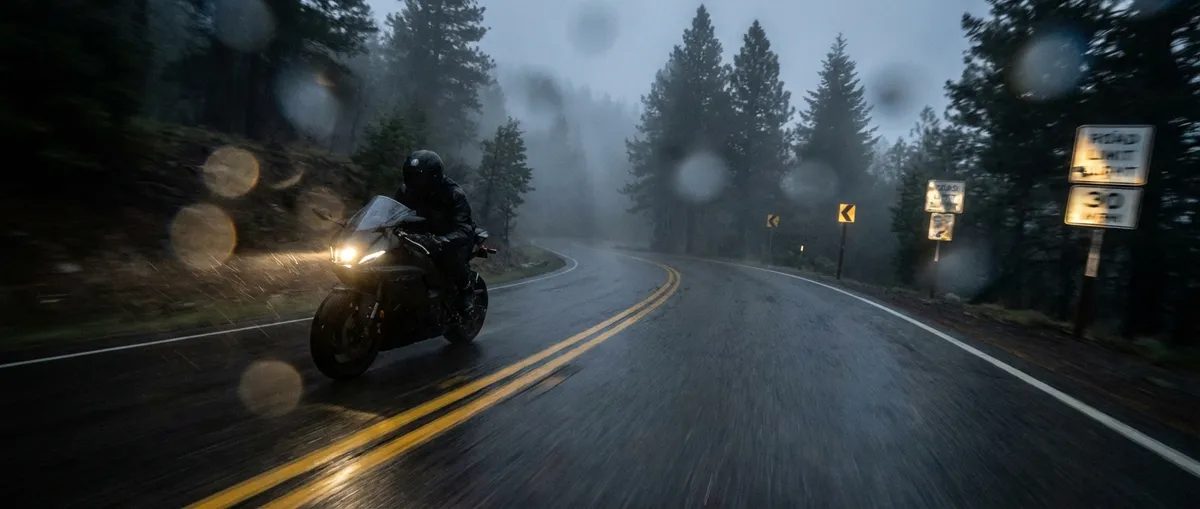
Grip is not binary. It’s a constantly shifting envelope defined by surface type, temperature, contamination, and tire condition. Advanced riders are constantly running a mental model of probable traction—not assumed traction.
Visually, you’re scanning 4–6 seconds ahead for:
- Texture contrast: Polished asphalt (shiny, dark) usually offers less mechanical keying than coarse aggregate. Fresh chip seal grips well but can have loose marble-like stones at the edges.
- Color anomalies: Rainbow sheens = oil/fuel. Dark, irregular patches = repaired asphalt with often less consistent grip. Light gray or dusty = reduced friction, especially in dry climates.
- Micro-elevation changes: Sunken manholes, overbanding (tar snakes), patch edges, and bridge joints can cause transient grip loss or lateral deflection mid-corner.
- If the tire feels “wooden” with little fork dive and no hint of chirp or ABS pulse, you likely have good grip and can increase brake load.
- If ABS flutters or you feel early skittering at modest decel, that’s the road telling you the µ (friction coefficient) is low—back off lean and reduce aggressive inputs for the next few corners.
- Green zone: Clean, warm, consistent asphalt—normal pace and angles.
- Yellow zone: Mixed surfaces, patches, tree shade, or unknown roads—deliberately smoother inputs, slightly more margin.
- Red zone: Gravel, construction, wet manhole covers, painted lines in rain—treat like you’re on 50–60% of your normal traction, with emphasis on upright braking and delayed lean.
Tactilely, your early-braking phase is your probe. Use initial brake pressure as a diagnostic:
Combine this with mental “surface zoning”:
Over time, you’re not just riding on the road—you’re riding the probability distribution of grip.
2. Camber and Grade: Using Road Geometry as Free Grip
The road is a 3D surface, not a flat drawing in your head. Camber (side-to-side tilt) and grade (uphill/downhill) heavily influence how much lateral load your tires can accept at any given moment.
Camber
- Positive camber (inside of the corner is lower than the outside) effectively “cups” the bike into the turn. This allows:
- Slightly more lean angle for the same risk level.
- Higher corner speed at equivalent tire load.
- More forgiving behavior if you momentarily over-brake or over-lean.
- Negative camber (inside of the corner is higher, like a reverse bank) reduces your tire’s lateral load capacity:
- Expect earlier onset of slide at a given lean angle.
- Reduce entry speed more than you normally would.
- Stay smoother with both throttle and steering—no abrupt gains in lean.
Grade
- Downhill corners:
- Increase stopping distance due to gravity assisting your motion.
- Multiply any mid-corner corrections—too hot on entry is punished more.
- Require earlier, firmer upright braking, and a smoother trail off as you lean.
- Uphill corners:
- Shorter stopping distances—gravity is your ally.
- Better load transfer onto the rear under throttle—more drive grip mid-corner exit.
- You can often carry slightly more corner speed for the same perceived risk, but beware reduced sightlines over crests.
A strong technique is to verbally annotate your ride (in your helmet):
“Decreasing radius, off-camber, downhill right.”
That one sentence forces your brain to plan for less grip and more conservative inputs—before you commit.
3. Load Management: Controlling the Contact Patch with Precision
Your tires don’t care how fast you feel like going. They only care about the vector sum of forces you’re asking them to handle: braking, accelerating, and cornering. This is often visualized as the “traction circle”—a 2D simplification of the tire’s workload.
The practical riding takeaway: your job is to shape how load builds and releases on the contact patch.
Key principles:
- One major job at a time when near the limit
At high lean, ask the tire mainly to corner, not brake or accelerate hard. As lean angle decreases, you can trade cornering force for throttle or braking force.
- Rate of change matters as much as absolute value
A tire can handle impressive loads if you build them smoothly. Abrupt on/off throttle, snap braking, or sudden steering inputs spike the load too quickly, breaking micro-adhesion.
- Front vs. rear tire specialization
- Front: Most braking + much of the direction change. It prefers progressive, smooth build of load (trail braking done well is about controlling this).
- Rear: Most drive + stabilizing role. It’s more tolerant of small slip but will punish abrupt chops or ham-fisted roll-ons, especially in low grip.
- On a familiar, clean corner, consciously make your brake release last longer, even if you start with slightly lighter pressure. Feel the fork extend slowly as you add lean—this smooths the load transfer and gives more front grip and feedback.
- On exits, focus on a linear throttle roll from neutral to positive. No “dead zones” or steps—one continuous, predictable increase as you pick the bike up.
Drills to improve load management:
Advanced riding is less about “how hard” and more about “how cleanly” you move the load footprint across your tires.
4. Visual Strategy: Turning Your Eyes into a Stability System
Your visual system is your primary stability control. Where and how you look defines when you react and how you steer.
Move past the basic “look where you want to go” with a more technical visual protocol:
- Vision horizon: Keep your main focal point 3–7 seconds ahead at typical road speeds. This creates time for:
- Path planning
- Surface assessment
- Hazard prediction (cars at intersections, turning vehicles, pedestrians)
- Scanning layers:
- Far field (primary): Exit of the corner, vanishing point, traffic flow.
- Mid field: Surface irregularities, patch changes, lane position opportunities.
- Near field (peripheral): Immediate surroundings, your lane edges, your reference lines.
You’re not “staring” at a single spot—you’re cycling through layers, with priority on the far field and using your peripheral vision for near inputs.
- Vanishing point method:
- If it’s moving toward you quickly: the corner tightens (decreasing radius)—you likely need to control speed more.
- If it moves away: the corner opens—you can plan an earlier, smoother drive.
- Head vs. eyes:
In a corner, the point where the two road edges visually meet is the vanishing point.
Move your head, not just your eyes. Rotating your head into the corner aligns your visual axis with your intended path, reducing the temptation to target-fixate on threats like guardrails or gravel. Let your eyes do fine adjustment; your head sets the macro direction.
An elite-level rider looks like they’re “ahead of the bike.” In reality, their vision is ahead, giving their brain enough lead time that the bike simply follows a pre-computed solution.
5. Environmental Inputs: Wind, Temperature, and Traffic as Data Streams
The road environment is constantly sending dynamic data. Treat it like telemetry instead of noise.
Wind
- Headwinds:
- Increase aerodynamic drag—expect reduced acceleration and slightly more front-end load.
- Can actually stabilize the bike at speed but may require more throttle to maintain pace.
- Crosswinds:
- Feel for consistent vs. gusty. A steady crosswind is predictable; gusts demand extra margin.
- Use slight counter-steer and body position as tools: shift a bit into the wind to reduce the amount of bar input needed.
- Avoid being fully upright on exposed bridges or open plains in extreme gusts; a modest lean creates a more stable configuration.
Temperature
- Tire warm-up:
- Street tires are functional when cold but gain significant grip as they warm into their intended temperature range.
- The first 5–10 minutes of riding, especially after overnight parking, should be treated as reduced-grip time—softer lean angles, smoother throttle.
- Cold surfaces:
- Asphalt below ~10°C (50°F) offers noticeably less grip, especially when combined with cold tires.
- Shaded sections that never see sun (tree tunnels, canyon walls) can stay colder than the rest of the road—even in warm weather.
Traffic and human factors
- Intersections and turning vehicles:
- Drivers often misjudge motorcycle speed. If you see a vehicle waiting to turn across your path, slightly cover the brakes, adjust your lane to maximize visibility, and build an “escape corridor” in your mind.
- Look at the front wheel of cars, not just their body—any twitch is an early sign of movement.
- Lane positioning as communication:
- Stay where you are most visible in mirrors and windows, not just “the middle” of the lane.
- On two-lane roads, consider a position that gives maximum sightline past the vehicle ahead while retaining a buffer from oncoming lanes.
Environmental awareness turns you from a rider who reacts to one who predicts and pre-loads decisions before they’re forced.
Conclusion
The best riders don’t look fast because they force the bike; they look fast because the bike never seems surprised. Predictable, controlled inputs matched to the real-time physics of the road create a ride that’s both thrilling and repeatable.
When you start reading surfaces instead of just seeing them, feeling load transfer instead of just grabbing controls, and using vision and environment as data rather than distractions, every ride becomes less of a gamble and more of a calculated performance.
Take these concepts—surface analysis, road geometry, load management, visual strategy, and environmental awareness—and apply them on your next ride at moderate speeds. The goal isn’t instant pace; it’s instant clarity. The speed will come on its own.
Sources
- [Motorcycle Safety Foundation – Riding Tips](https://www.msf-usa.org/ridercourses.html) - Offers foundational riding techniques and safety concepts that complement advanced street strategies.
- [U.S. National Highway Traffic Safety Administration (NHTSA) – Motorcycle Safety](https://www.nhtsa.gov/road-safety/motorcycles) - Provides data-driven insights on motorcycle crashes, risk factors, and safety recommendations.
- [UK Government – Motorcycle Riding Skills (GOV.UK)](https://www.gov.uk/motorcycle-practical-test/riding-skills) - Details assessed riding skills, including observation, positioning, and control that align with technical roadcraft concepts.
- [Institute of Advanced Motorists – Advanced Riding Guidance](https://www.iamroadsmart.com/courses/advanced-riding) - Describes systematic approaches to road reading, positioning, and hazard perception for advanced riders.
- [Dunlop Motorcycle Tires – Tire Technology & Performance](https://www.dunlopmotorcycletires.com/about/technology/) - Explains tire behavior, grip, and load characteristics that underpin traction and load management on the road.
Key Takeaway
The most important thing to remember from this article is that following these steps can lead to great results.