Modern motorcycles are drowning in electronics—ride modes, lean-sensitive ABS, traction control, IMUs, and dashboards brighter than your laptop. Useful? Absolutely. But if your core riding habits aren’t technically sharp, all that tech becomes a crutch instead of a force multiplier. This is about riding like the electronics might fail at any moment—because one day, they will—and developing analog precision that makes every sensor on the bike work with you, not for you.
Below are five deeply technical riding points aimed at riders who already go beyond “just commuting” and want to feel mechanically connected to their machine at speed.
1. Throttle as a Load Tool, Not a Speed Pedal
Most riders still treat the throttle like a volume knob for speed. On a modern bike, the throttle is primarily a load controller for the chassis and tires. Speed is just a side effect.
On entry, your goal isn’t “slow down, then add gas later.” Your goal is to control the longitudinal load migration along the wheelbase so the bike stays within a stable window of grip, geometry, and tire temperature.
Key behaviors:
- Initial roll-off defines fork attitude. An abrupt chop spikes fork compression, steepens head angle, and sharpens steering—great for turn-in, terrible for mid-corner stability if overdone. A controlled roll-off allows you to “tune” how much weight you move to the front without shocking the fork.
- Maintenance throttle isn’t a myth; it’s a band. Between fully closed and meaningful drive, there’s a low-load range where engine torque just offsets drag (rolling resistance, aero drag, driveline friction). For many bikes, this is a tiny rotation—often 1–3° of grip movement. Finding this range in each gear by feel is crucial. It keeps the fork from pogoing and the chassis neutral while leaned.
- Drive phase: build torque, don’t spike it. Even with traction control, abrupt roll-on mid-lean can “blow up” tire shape—squashing the rear, extending the front, lengthening the wheelbase, and slowing steering right when you want to finish your arc. A progressive roll that matches your increase in available grip (as you reduce lean) gives the electronics an easy job and keeps the bike composed.
- Electronics are grip managers, not miracle makers. If your traction control is constantly flashing on corner exits, that’s your riding telling the ECU, “I’m dumping load faster than the tire can translate it.” Work toward exits where TC rarely intervenes; when it does, it should feel like a faint correction, not a full-on engine stutter.
To train this, ride a familiar, flowing road in one mode (preferably with softer throttle mapping if available) and focus on feeling fork travel and rear squat through your palms, feet, and seat as you modulate throttle. Imagine you’re sculpting torque into the tire rather than “adding speed.”
2. Brake Pressure as a Geometry Dial, Not Just Deceleration
Brakes aren’t just for slowing down; they are your most precise tool for shaping the motorcycle’s geometry on demand. How you apply and release brake pressure determines fork travel, rake, trail, and how quickly the tire reaches its optimal slip angle.
Advanced riders think in pressure ramps, not in “on/off” inputs:
- Initial bite sets attitude. That very first 10–20% of lever pressure defines whether the fork dives smoothly or knifes downward. Squeeze the lever too fast, you collapse the fork, risk bottoming, and push the front tire into a sudden high-load situation. Squeeze too lazily and you waste distance with sluggish weight transfer, potentially pushing deeper into the corner than intended.
- Trail braking is a geometry strategy. Carrying some brake pressure into the corner isn’t just for “going fast.” It keeps load on the front contact patch, compresses the fork, steepering geometry and helping the bike hold a tighter line. Think of remaining brake pressure as a “geometry knob” you unwind as lean angle increases and as you approach your desired apex.
- Release rate is more critical than max pressure. Most front-end slides under braking happen not at max pressure, but during release—when the load shed is too fast, the fork rebounds, and the tire momentarily “skips” across the asphalt. You want a smooth decay of pressure that roughly matches your lean-in rate: deeper lean, less brake, but never a sudden “let go.”
- Rear brake: micro-attitude controller. Light rear brake use can calm chassis pitch, trim speed without dumping weight on the front, or help tighten the line slightly on some bikes. You’re not trying to lock or heavily load the rear; you’re using it as a fine-tuning tool, especially useful in downhill or off-camber turns.
Practice on a straight, empty road: pick a reference marker, then do repeated stops where your only focus is how linearly you ramp in and ramp out pressure. Aim for zero ABS activation, zero fork bottoming, and a perfectly smooth pitch forward, then back to neutral.
3. Vision as a Data Pipeline, Not Just “Look Where You Want to Go”
“Look where you want to go” is kindergarten-level advice. At real pace, your vision needs to be a high-bandwidth sensor array feeding constant updates into your brain’s predictive model of what the bike needs next.
Elevating your visual game:
- Horizon scanning vs. micro-tracking. Your main focus should be far ahead—vanishing points, road texture changes, traffic flow, surface color shifts—while your peripheral vision handles lane lines, shoulder boundaries, and near-field threats. Train yourself to avoid “fixating” on the piece of tarmac right in front of your wheel unless something has gone wrong.
- Vanishing point as corner speed gauge. On a closed or consistent road, the rate at which the vanishing point moves closer or farther away gives you continuous data on whether the corner is tightening, opening, or constant radius. As it pulls toward you quickly, the corner is tightening—prepare for additional lean or less throttle. As it stabilizes or starts to move away, you can begin thinking about drive.
- Surface decoding at a glance. You want your brain to instantly classify: uniform asphalt, patchwork repairs, tar snakes, polished aggregate, paint, gravel, damp patches, shadows that might hide irregularities. At pace, you don’t have time to consciously “think” about each; you train to recognize and pre-assign risk and grip levels subconsciously.
- Traffic as dynamic obstacles, not scenery. Every vehicle is a vector: speed, direction, likelihood of lane change or turn, driver attention level (head movements, wheel position within lane). Your eyes should briefly “ping” mirrors, head position, and wheel angle, then integrate this into your mental map of possible collision paths.
Drill this by riding at moderate speed on a known loop and narrating, in your head, what your eyes are collecting: “Patch change left, dark spot mid-lane, SUV drifting to the line, vanishing point steady, oncoming car with left blinker, pedestrian near curb.” It feels unnatural at first, but it forces your brain to treat vision as continuous data, not occasional snapshots.
4. Body Position as a Force Vector, Not a Style Choice
Hanging off, staying neutral, or simply relaxing the upper body isn’t about “looking fast”; it’s about controlling where combined bike + rider mass acts through the tire contact patches. You’re manipulating force vectors, not posing for photos.
Break it down technically:
- Mass placement vs. lean angle. Moving your torso and head to the inside reduces the lean angle required for a given cornering force, which slightly increases ground clearance and tire grip margin. The key isn’t extreme hang-off; it’s consistent, repeatable mass placement that the bike can “trust” every corner.
- Hip pivot, not shoulder twist. Effective body position starts at the hips. Rotate your hips toward the corner, slide your butt a half to one cheek off the seat, then let your torso follow naturally. Twisting from the shoulders alone disconnects your core from the tank and bars, making inputs vague and forcing you to compensate with your arms.
- Lower body locks, upper body floats. Use your outside thigh and knee to lock into the tank, your core to stabilize, and leave your arms as relaxed as possible. If your forearms are loaded, you’re feeding steering inputs every time the bike hits a bump or the front tire talks back.
- Head as the final stabilizer. Where your eyes go, your balance system goes. Aim to keep your head level with the horizon and slightly forward & inside. This gives your inner ear a more consistent reference and helps your brain interpret lean, grip, and acceleration forces more accurately.
- Don’t fight self-steering. A well-set-up bike wants to lean and steer along its natural arc. Your job with body position is to invite that behavior, not force it via bar pressure. Done right, you can initiate most turns with a decisive but brief countersteer, then “hold” the line largely through subtle weight placement rather than constant bar tension.
Try a cornering drill: on a safe, open curve at moderate speed, exaggerate an upright body position for one pass, then a smooth, inside-oriented body position the next. Pay attention to required steering effort, lean angle, and how “eager” the bike is to finish the turn. You’ll feel the geometry and weight transfer responding.
5. Interfacing With Rider Aids Instead of Fighting Them
Modern rider aids aren’t just safety nets—they’re dynamic systems that assume a certain style of input. If you don’t understand how they think, you’ll constantly butt heads with ABS, traction control, or cornering ABS and blame the bike, not your technique.
Key technical points:
- ABS is tuned for panic, not finesse. Most road ABS systems are designed to prevent wheel lock in low-grip, high-stress conditions. At high grip, their threshold is fairly high; if you trigger ABS regularly on dry pavement, your brake ramp is either too abrupt, your fork setup is poor, or you’re riding on weak tires. Aim to brake just below ABS activation—the system should be a backup, not part of your routine.
- Cornering ABS and attitude. Lean-sensitive ABS tracks yaw, lean, and pitch to manage pressure differently mid-corner. If you stab the brake mid-lean, the system will aggressively protect grip at the cost of line stability, sometimes standing the bike up. A smoother, earlier application with delicate trail braking works with the algorithm instead of forcing last-second intervention.
- Traction control sensitivity vs. throttle discipline. Many bikes have multiple TC levels. Learn how your bike behaves at each: which levels feel intrusive, where it starts cutting power, and in what gears. Use higher levels in wet/unknown conditions, but use that feedback: if it’s constantly intervening, your wrist is outrunning available grip. On dry, predictable roads, a slightly lower TC level can teach you to feel early slip without letting it escalate.
- Engine braking strategies. Modern ECUs often modulate engine braking by mode. Heavy engine braking can destabilize the rear on downshifts or entries, especially on low-grip surfaces. Lighter engine braking lets you separate deceleration more clearly into brake and throttle phases. Experiment with options—on some bikes, reducing engine braking and relying more on the front brake can smooth the chassis dramatically.
- Mode discipline. Don’t just pick “Sport” and forget it. Use modes intentionally:
- Full power + low aids when grip is high and predictable and you’re focused.
- Softer maps + higher aids for rain, fatigue, cold tires, or unknown roads.
The point isn’t bravado; it’s consistent, predictable behavior from the bike that matches your current risk envelope.
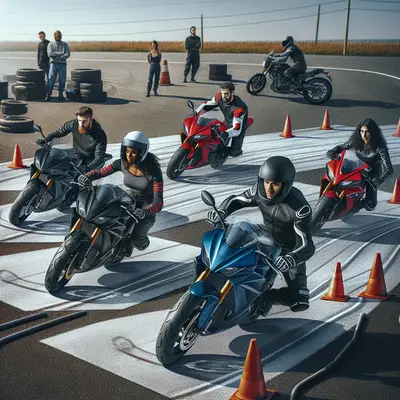
If you can, find an empty parking lot and do controlled tests: hard straight-line braking to just shy of ABS, gentle corner braking with cornering ABS, and progressive throttle roll-ons in different TC modes. Learn the “language” of your rider aids so their interventions tell you something about your inputs.
Conclusion
Riding fast isn’t what separates a casual motorcyclist from a serious one; technical precision does. Throttle as a load tool, brakes as geometry controls, vision as a live data stream, body position as a force vector, and electronics as cooperative partners—these are the habits that make a modern rider truly “moto ready.”
The more mechanically and dynamically you understand what your bike is doing beneath you, the less you’ll be surprised by it—and the more the ride starts to feel like one continuous, intentional act of engineering in motion.
Sources
- [Motorcycle Safety Foundation – Advanced Tips](https://www.msf-usa.org/rider-tips.aspx) – Training-based insights on braking, vision, and cornering fundamentals that underpin advanced technique.
- [BMW Motorrad – Riding Dynamics and Rider Aids](https://www.bmw-motorrad.com/en/experience/stories/know-how/safety-assistance-systems.html) – Technical explanations of ABS, traction control, and riding modes on modern motorcycles.
- [Kawasaki – KIBS and KTRC Technical Overview](https://www.kawasaki.eu/en/technology-detail/KIBS/100871) – Detailed look at how advanced ABS and traction systems manage braking and grip.
- [Yamaha – Lean-Sensitive Rider Aids Overview](https://global.yamaha-motor.com/business/mc/innovation/technology/imccs/) – Explanation of IMU-based control systems for braking and traction.
- [U.S. Department of Transportation (NHTSA) – Motorcycle Safety](https://www.nhtsa.gov/road-safety/motorcycles) – Data and guidance on motorcycle dynamics, braking distances, and safety considerations on public roads.
Key Takeaway
The most important thing to remember from this article is that this information can change how you think about Riding Tips.