Every fast, precise ride is built on something invisible: a maintenance baseline. Not a random checklist, not “I’ll do it when I remember,” but a repeatable, measurable routine that makes your bike predictable at speed. When your throttle input, brake pressure, and chassis feedback are consistent, it’s because the underlying system is consistent. This article is about engineering that consistency—using five technical maintenance points that turn your garage time into performance, safety, and longevity on every ride.
Engineering a Maintenance Baseline (Why Random Won’t Cut It)
A proper maintenance routine is less like “chores” and more like a calibration protocol. You’re not just changing oil; you’re controlling variables.
A baseline means:
- You service the same systems at known intervals.
- You measure and record, not just eyeball.
- You can detect drift—subtle changes in how the bike feels—because everything else is stable.
- Date and odometer reading
- Work performed (e.g., “engine oil + filter, 10W-40 JASO MA2, 2.9 L”)
- Parts/fluids used (brand, spec, part numbers)
- Torque values for critical fasteners (fork pinch bolts, axle nuts, brake caliper bolts, etc.)
- Subjective notes (e.g., “front brake initial bite softer after pad change,” “chain noise reduced after adjustment”)
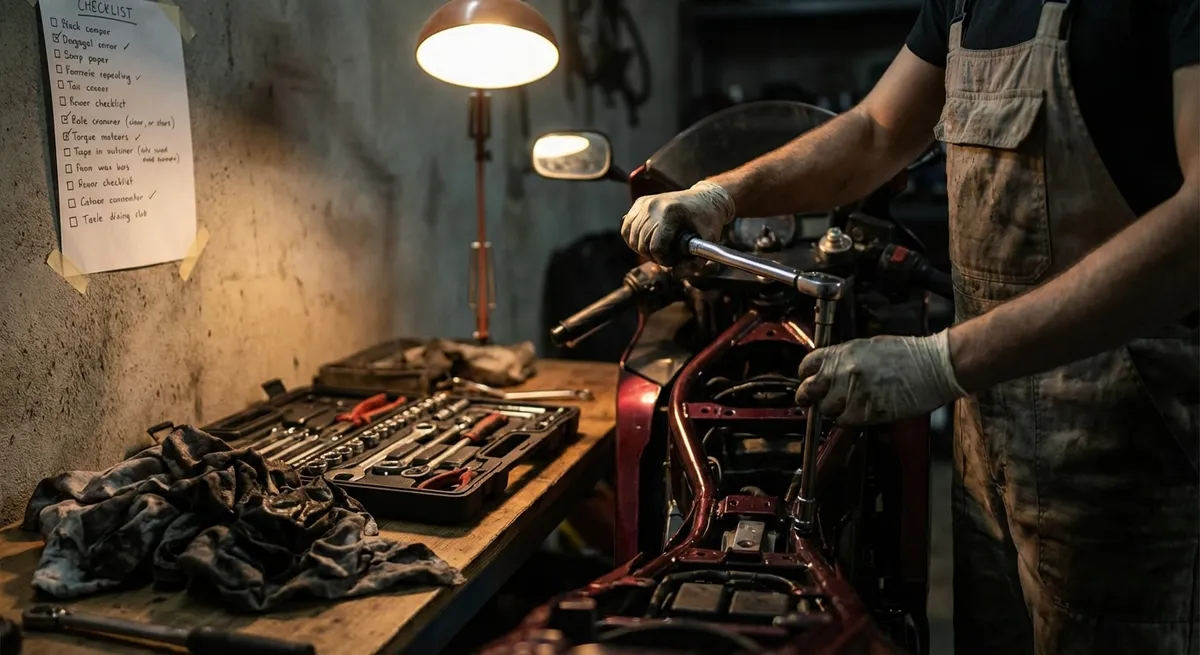
Start by building a simple maintenance log. It can be an app, a spreadsheet, or a notebook, but it must capture:
This log becomes your engineering history. It tells you if new pads wear faster than the old compound, if one oil shears down more quickly than another, or if a new chain stretches faster than spec. It also exposes cause and effect: change tire type, feel a different turn-in; re-gear the final drive, see higher RPM at cruise; switch brake fluid, note firmer lever.
Without this baseline, you’re guessing. With it, you’re tuning.
Technical Point 1: Oil as a Wear Report, Not Just a Lubricant
Engine oil is the most abused, most critical working fluid in your bike—and it’s also full of data.
Instead of only following time/mileage, think in terms of:
- Operating profile: Frequent short trips that never reach full operating temperature? Oil ages faster from fuel dilution and moisture. High-RPM track days? Higher shear stress and heat loading.
- Viscosity stability: The “40” in 10W-40 is a high-temp viscosity rating. Hard use can shear multigrade oils down toward a thinner viscosity, altering film strength under load.
- Additive package life: Detergents/dispersants suspend combustion byproducts. When they’re depleted, sludge and varnish start forming, especially in hot-running engines.
- Wear metals (iron, aluminum, copper) indicating where the engine is wearing
- Contaminants (fuel, coolant, dirt/silica) showing issues like rich running, head gasket problems, or poor air filtration
- Viscosity shift and additive levels revealing if your interval or oil choice is appropriate
- Always use oil that meets the manufacturer’s viscosity and spec, such as JASO MA or MA2 for wet clutches. Automotive “energy conserving” oils can cause clutch slip.
- Don’t stretch intervals blindly because “it still looks clean.” Modern oils hide contaminants well.
- Pay attention to how the bike feels after a fresh oil change: idle quality, shifting feel, temperature behavior in traffic. Those become your reference conditions.
If you want to go deeper, consider occasional used oil analysis (UOA) through a lab. You send an oil sample, and they send back:
From a practical standpoint:
You’re not just changing oil; you’re tuning an internal environment that directly affects throttle response, longevity, and heat management.
Technical Point 2: Chain and Sprockets as a Precision Drivetrain System
A chain drive isn’t “just a chain.” It’s an exposed, high-speed mechanical system that directly affects throttle precision, corner exit stability, and rear suspension behavior.
The core parameters to control:
1. Chain Slack Under Real Conditions
Spec is usually given with the bike on its wheels, no load, at the midpoint between front and rear sprockets. But the true critical moment is when the front sprocket, swingarm pivot, and rear axle are in a straight line—that’s peak chain tension.
Practical approach:
- Set slack to factory spec (e.g., 30–40 mm) as a starting point.
- With the rear wheel off the ground, compress the suspension (with a strap or helper) to approximate that straight-line condition and ensure the chain is not going completely taut.
- Always check slack in multiple wheel positions; tight spots indicate uneven wear or stiff links.
2. Sprocket Condition as a Wear Amplifier
Hooks, sharp teeth, or “leaning” teeth don’t just mean replacement time; they also accelerate new chain wear. Replacing a chain on worn sprockets is like putting new tires on bent wheels—technically possible, mechanically dumb.
Check:
- Tooth profile symmetry (no directionally-leaning hooks).
- Side wear (from misalignment or improper chain line).
- Surface pitting or abnormal polishing.
3. Alignment and Load Distribution
Modern chain adjusters can be deceiving. Don’t trust only the marks; use:
- A straightedge aligned from rear to front sprocket, or
- A quality laser alignment tool for repeatable precision.
- Reduces rolling resistance.
- Lessens vibration at constant throttle.
- Increases chain and sprocket life dramatically.
- Clean with a chain-specific cleaner or mild degreaser, never harsh solvents that can damage O-rings/X-rings.
- Lube after rides while the chain is warm; the warmed metal helps penetration.
- Target the inside of the lower chain run so centrifugal force works in your favor.
A properly aligned chain:
Lubrication and cleaning complete the system:
You’re not just avoiding noise and fling; you’re maintaining a stable, efficient torque transfer system.
Technical Point 3: Brake System as a Thermal and Hydraulic Network
Good brakes are more than pad material. They’re a thermally and hydraulically stable system that has to convert speed into heat, lap after lap, stop after stop, without surprising you.
Key technical elements:
1. Brake Fluid as a Time-Limited Component
Brake fluid is hygroscopic—it absorbs moisture from the air. Over time:
- Boiling point drops, increasing risk of vapor lock and fade under hard braking.
- Corrosion risk rises in calipers, lines, and master cylinders.
- Minimum dry boiling point (fresh fluid).
- Minimum wet boiling point (aged/contaminated fluid).
- Firm, with minimal “sponginess.”
- Consistent in stroke between hot and cold stops.
DOT ratings (e.g., DOT 4, DOT 5.1) define:
On a street bike ridden aggressively, an annual flush is realistic. On a track bike, consider every few events. The lever should feel:
2. Pad and Rotor Interface Management
Brake performance is built at the pad-rotor interface, especially during bedding-in:
- Proper bedding transfers an even layer of friction material to the rotor.
- Uneven transfer or overheating can lead to “hot spots,” pulsing, or glazing.
- Measured thickness vs. minimum spec (stamped or in the service manual).
- Runout (warping) checked with a dial gauge.
- Surface condition—no deep grooves or blue overheated patches.
- Organic: Good feel, less noise, more dust, moderate fade resistance.
- Sintered: Higher friction, better high-temp performance, more rotor wear.
- Track compounds: High temp stability but may perform poorly when cold on the street.
Rotor inspection should include:
Pad selection is an engineering decision:
3. Hardware and Torque Fidelity
Caliper bolts, rotor bolts, and master cylinder mounting hardware all influence brake feel and safety:
- Always use specified torque values and thread treatments (e.g., threadlocker where required).
- Ensure calipers are centered and sliding pins (where applicable) move freely.
- Replace tired rubber lines with quality braided stainless lines for more consistent feel and less expansion under high pressure.
Think of your brakes as a tuned energy management system. If lever travel, bite point, or fade behavior starts to change, that’s your early warning.
Technical Point 4: Suspension Health as a Dynamic Control System
Suspension isn’t just about comfort; it’s your tire’s only tool for staying in meaningful contact with the road. Maintenance here is about preserving damping control, geometry consistency, and predictable response.
1. Fork and Shock Oil Degradation
Suspension oil lives a hard life:
- It shears through tight orifices and shim stacks.
- It’s constantly aerated and de-aerated.
- It’s heated and cooled on every ride.
- Brake dive increases.
- Rebound becomes inconsistent (bouncy, wallowy behavior).
- Mid-corner stability declines, especially over bumps.
- Fresh oil restores more consistent damping.
- Internal bushing and seal inspection prevents future leaks and stiction.
- High-end or aftermarket shocks usually are rebuildable and should be serviced based on time/use.
- A worn shock kills rear tire life, grip, and confidence on corner exit.
Over time, viscosity breaks down, air content changes, and damping curves drift. The practical effect:
A factory interval might not even list fork oil replacement, but a 20,000–30,000 km (or every 2–3 years for active riders) fork service is a significant performance and safety upgrade:
Rear shock service is often neglected because many are non-rebuildable by design. But:
2. Static Sag and Rider Sag as Baseline Geometry
Sag is how much your suspension compresses under its own weight (static) and with you on it (rider sag). It defines:
- Ride height.
- Steering geometry.
- Weight distribution.
- Front rider sag: roughly 25–35% of total travel.
- Rear rider sag: roughly 25–35% of total travel.
- Too little sag (too stiff/spring too hard): poor traction, harsh ride, front pushing wide.
- Too much sag (too soft/spring too light): excessive dive/squat, lazy steering, instability.
Within typical ranges:
If you’re out of range:
Preload is not a comfort dial—it’s the tool to get sag into the correct window. Once that’s set, then you refine compression and rebound.
3. Mechanical Inspection: Bushings, Bearings, and Stiction
Suspension performance isn’t only about oil and springs. Linkage and pivot points matter:
- Check rear suspension linkage bearings for play, corrosion, or binding.
- Verify steering head bearings for notchiness or free-play; either condition can cause vague or self-centering steering.
- Inspect fork stanchions for pitting and seal area for weeping—micro-damage there quickly becomes an oil leak and loss of damping.
Proper suspension maintenance turns your adjustments into actual changes instead of random guesses against worn hardware.
Technical Point 5: Electrical and Charging System Reliability as Ride Insurance
Modern motorcycles are increasingly dependent on stable electrical systems: fuel injection, ABS, ride modes, traction control, quickshifters—all of it lives or dies on clean, consistent power.
Core elements to manage:
1. Battery Health Beyond “It Cranks, So It’s Fine”
Lead-acid and AGM batteries degrade over time from:
- Sulfation due to partial state-of-charge storage.
- Deep discharge events (leaving the ignition or accessories on).
- Heat and vibration.
- Resting voltage: A healthy fully charged 12 V lead-acid battery should read around 12.6–12.8 V after resting.
- Cranking voltage: If it drops below ~9.6 V during crank, it’s suspect.
- Age: Past 4–5 years, even if it seems “okay,” you should be suspicious.
Practical checks:
A smart charger/maintainer during off-season reduces sulfation and extends life. For bikes parked often, a lithium upgrade (where appropriate and compatible) can offer better cranking, lower weight, and less self-discharge—but must be matched to a compatible charging system.
2. Charging System Performance (Stator, Regulator/Rectifier)
Your charging system has one job: keep that battery within a healthy voltage band across RPM.
Using a multimeter:
- At idle: Expect roughly 13.0–13.5 V.
- Around 3–5,000 rpm: Typically 13.5–14.5 V, depending on manufacturer spec.
- Battery never fully charges, leading to sulfation and starting issues.
- Risk of overcharging and damaging both the battery and sensitive electronics.
- Stator output (AC voltage across phases, resistance between phases and to ground).
- Regulator/rectifier operation as per service manual.
Too low:
Too high:
If you see abnormal behavior, test:
3. Harness Integrity and Grounding
Electrical gremlins are often mechanical:
- Chafed wires where the harness passes sharp edges or tight bends.
- Corroded connectors exposed to weather (handlebar switches, under tail, near headstock).
- Weak or corroded ground points increasing resistance and causing intermittent issues.
- Periodically unplug, visually inspect, and re-seat key connectors (ECU, main relay, charging system, sensor clusters).
- Use dielectric grease where appropriate to resist moisture and oxidation.
- Confirm main grounds are clean, tight, and corrosion-free.
Preventive maintenance:
Stable power and clean signal paths are as critical as stable fuel delivery. When everything electrical is predictable, ride modes, ABS, ignition timing, and fueling all behave the way the engineers intended.
Conclusion
Maintenance is not a separate activity from riding; it’s upstream riding technique. A stable, predictable machine lets you push your skills without second-guessing what the bike will do mid-corner, under hard braking, or at the top of the rev range.
By treating:
- Oil as a wear and environment report,
- Chain and sprockets as a tuned drivetrain system,
- Brakes as a thermal-hydraulic network,
- Suspension as a dynamic control system, and
- Electricals as critical ride infrastructure,
you stop “keeping the bike running” and start actively engineering your motorcycle’s behavior. That’s where confidence comes from: a baseline you created, measured, and can trust at speed.
Sources
- [Motorcycle Safety Foundation – Motorcycle Maintenance Tips](https://www.msf-usa.org/downloads/Maintenance_Tips-Final.pdf) - Overview of foundational maintenance practices and inspection routines from a major safety organization
- [U.S. National Highway Traffic Safety Administration (NHTSA) – Motorcycle Safety](https://www.nhtsa.gov/road-safety/motorcycles) - Data and guidance on critical safety systems like brakes, tires, and visibility
- [Yamaha Motors – Owner’s Manuals and Maintenance Information](https://www.yamaha-motor.eu/gb/en/service-maintenance/owner-s-manuals/) - Factory-recommended maintenance intervals and specifications for real-world reference
- [Kawasaki Motors – Service & Maintenance](https://www.kawasaki.eu/en/service) - Official service and maintenance guidance illustrating manufacturer expectations for key systems
- [Penn State University – Fundamentals of Hydraulic Braking Systems](https://www.me.psu.edu/cimbala/me415/brakes/brakes.htm) - Technical explanation of brake system physics, including hydraulics and heat, applicable to motorcycle braking behavior
Key Takeaway
The most important thing to remember from this article is that this information can change how you think about Maintenance.