Most riders chase “smooth.” That’s a start—but smooth alone doesn’t keep you upright when the road goes sideways, traction changes fast, or your brain is overloaded. The real unlock is riding with mechanical feel: understanding what the bike is physically doing under you and deliberately shaping that behavior with your inputs.
This isn’t mystical “feel” that only racers have. It’s applied physics you can train into your hands, feet, and vision—so the bike starts talking to you in real-time, and you have the language to answer back.
Below are five technical riding points tuned for riders who want to go past “I feel okay” and into “I know exactly what the chassis is doing right now.”
1. Throttle as a Suspension Tool, Not Just a Speed Pedal
Most riders think throttle = speed. The chassis doesn’t care about your speed; it cares about load shift. That’s where control lives.
When you roll on the throttle, you aren’t just going faster—you’re unloading the front and loading the rear. Close the throttle, and the opposite happens: weight transfers forward, compressing the fork and lightening the rear. Think of throttle as a vertical control axis, not just a horizontal one.
This is why “maintenance throttle” mid-corner matters. A tiny, steady opening stabilizes the bike by gently shifting load rearward, keeping the suspension in the middle of its travel instead of topped or bottomed out. Chopping the throttle mid-corner spikes load onto the front tire, tightens your line abruptly, and can overwhelm available front grip—especially if you’re already leaned over.
Practical drill:
On a familiar, low-traffic road, pick a medium-speed corner. Enter at a calm pace, roll off to your planned entry speed before turn-in, then:
- As you lean, add a small amount of throttle and hold it steady.
- Track how the bike feels: does it settle, widen slightly, and feel calmer on the bars?
- Next pass, intentionally chop the throttle mid-corner—once, safely, at lower lean—and feel how the bike tries to tighten and pitch forward.
You’re building a library of cause-and-effect: “This throttle change = this chassis reaction.” That’s the foundation of real cornering control.
2. Brake Pressure Curves: Shaping Traction, Not Just Killing Speed
Braking isn’t on/off; it’s a pressure curve you draw with your fingers.
When you first touch the brake lever, the tire needs a moment to deform and build a contact patch. If you grab a handful instantly, you spike force before the contact patch is ready, and ABS or a front washout becomes a real possibility. This is why advanced riders talk about a “progressive squeeze”: you’re synchronizing lever force with the tire’s ability to generate grip.
Think of ideal front braking as three phases:
- Initial load-in – Light, quick take-up to close pad-to-disc gap and begin loading the front.
- Ramp to peak – Smooth, increasing pressure as the fork compresses and the contact patch grows.
- Trail off – Gradual release of pressure as speed drops and you add lean angle, trading braking force for cornering force.
That last phase—trail braking—is often misunderstood as “braking deep because fast.” Technically, what you’re doing is controlling how fast load leaves the front tire as you turn. Abruptly letting go of the brakes at turn-in causes the fork to rebound and unload the front, which can make the bike stand up or feel vague right when you need precision.
Practical drill (straight-line only at first):
- At a moderate speed in a straight line, pick a marker.
- At the marker, apply the brake slowly but firmly over about 0.5–1 second, then release just as progressively.
- Focus on making both the squeeze and the release perfectly smooth, no steps or grabs.
- As you improve, shorten the ramp time but keep the shape of the curve.
You’re teaching your fingers to modulate force so the tire never gets surprised by what you ask it to do.
3. Steering Torque and the “Pre-Load” Turn-In
Countersteering isn’t just “push left, go left.” It’s about how you shape the bike’s lean-in profile.
The bar doesn’t care which way you think you’re turning—it cares about torque. A sudden, sharp shove into the bar creates a fast roll rate: the bike snaps to lean. That can be useful in emergencies but costly in grip, because you ask the tires for a lot of lateral acceleration very quickly.
A more controlled method is to pre-load your turn-in:
- Just before turn-in, firm up your body position: outside leg locked to the tank, spine neutral, head toward the inside of the future turn.
- Apply a progressive countersteer torque over a fraction of a second—start light, then build, then taper as you reach your planned lean angle.
- Let the bike “fall” into the lean in a controlled arc, not a sudden drop.
Mechanically, you’re controlling the roll acceleration of the chassis. The tire feels that as a gradual increase in lateral load, instead of a spike.
Practical drill:
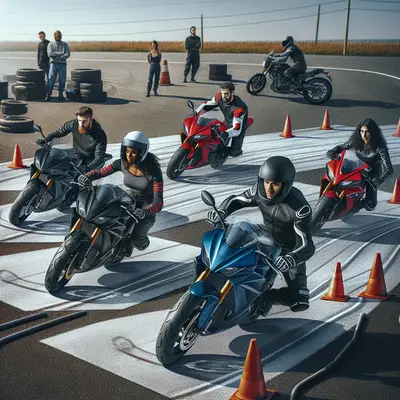
- On a large empty parking lot, ride a smooth arc around a reference point (cone or imaginary marker).
- First, use a quick, jabby push on the bar to initiate the turn. Feel how abrupt the transition is.
- Next, ride the same arc but apply the steering pressure over about half a second, smoothly increasing and then tapering.
- Note how much more predictable and planted the bike feels, and how easier it is to hold your line.
This “pre-loaded” turn-in is key to repeatable corner entries, especially when the surface isn’t perfect.
4. Reading the Contact Patch: Micro-Signals Through the Chassis
The tires are talking constantly; most riders just have the volume turned down with tension, noise, and overload.
Grip loss almost never arrives as a total surprise. Before a slide, the bike often whispers through:
- A slight “smear” sensation: feedback becomes less sharp, slightly delayed.
- Micro-wiggles or gentle oscillations in the bars or seat.
- A sense that the bike needs more steering input to hold the same line at the same speed.
- Under heavy drive, a faint “squirm” from the rear as the tire deforms.
These are early warnings that you’re at a higher percentage of available traction. To hear them, your job is to lower the noise floor:
- Relaxed grip: Fingers wrap the bar, but your forearms aren’t braced like a push-up. Tension filters out detail.
- Neutral core: Support your upper body with your core and legs, not your palms. If you’re hanging on the bars, all feedback gets blended with your own weight shifts.
- Clean line choice: The more chaotic your line, the more random inputs you interpret, making it harder to recognize consistent tire behavior.
Practical awareness drill:
On a familiar corner, ride at a reduced pace and focus exclusively on what you feel:
- Entry: Can you feel the fork compress and the front tire load up?
- Mid-corner: Is the bar firm and precise, or vague and “rubbery”?
- Exit: Does the rear feel locked on rails, or does it gently walk or squirm?
By deliberately noticing these micro-signals at lower stress, you’ll recognize them instantly when you’re riding harder or conditions deteriorate (cold tires, rain, gravel).
5. Vision as a Stability System: How You Aim the Bike’s Future
Where you look is not just a safety cliché—it’s a stabilizing input into the control loop of you and the bike.
Your hands subconsciously steer toward your visual focus. If your eyes are bouncing between the front wheel, the pavement cracks, and oncoming traffic, your micro-steering corrections will mirror that noise. The result is a bike that never quite settles, always dancing slightly under you.
Technically, your vision sets the prediction horizon for your brain: how far ahead you’re planning your control inputs.
- Short horizon (staring near the front wheel) = frequent, late corrections, choppy lines, and emergency reactions.
- Long horizon (looking far through the corner) = smoother, earlier inputs that demand less grip at any given instant.
A strong technique is the two-plane visual model:
- Far plane (primary): The exit of the corner or the next “task” point (vanishing point of the road, your next braking marker, or your planned turn-in).
- Near plane (secondary, quick checks): The surface directly ahead of your front tire, checked briefly for potholes, gravel, or oil, then eyes back up.
You’re constantly scanning but living in the far plane. That increases your time budget per decision, which directly reduces how hard you must load the tires to make the bike go where you want.
Practical drill:
- On a simple curve, deliberately lock your eyes to a point just ahead of your front wheel for one easy, safe pass. Feel how wobbly, late, and imprecise your inputs become.
- Next pass, pick the farthest visible point on your line through the corner and glue your eyes there, using only micro-glances downward for hazards.
- Notice how your whole body calms down, the bike tracks more cleanly, and you naturally smooth out throttle and steering.
Vision is your first stability system; everything else just refines what your eyes choose.
Conclusion
Riding at a high level isn’t about bravery or secret tricks; it’s about understanding how your inputs mechanically reshape what the bike is doing under you—second by second, meter by meter.
When you treat the throttle as a suspension control, brakes as a shaped pressure curve, steering as controlled roll torque, contact patches as live sensors, and vision as your prediction engine, you stop guessing and start engineering every ride in real time.
That doesn’t just make you faster. It makes you more precise, calmer when things go wrong, and more connected to the machine you’re trusting with your life.
The next time you ride, don’t try to do everything at once. Pick one of these technical points, isolate it, and listen to what the bike tells you back. That feedback loop is where real progress lives.
Sources
- Motorcycle Safety Foundation – Basic RiderCourse Rider Handbook – Official curriculum and materials explaining foundational throttle, braking, and vision techniques.
- UK Government – Advanced motorcycling: a guide for riders (GOV.UK) – Government-endorsed guidance on advanced roadcraft, vision, and machine control.
- Yamaha Champions Riding School – “Brake or Coast? Why Trail Braking Works” – Detailed explanation of trail braking and load management from a professional riding school.
- BMW Motorrad – Riding Tips and Safety Advice – OEM perspective on safe, controlled road riding with emphasis on vision and braking.
- Iowa State University – Friction and Tire-Road Interaction – Technical background on tire friction and contact behavior relevant to understanding grip.
Key Takeaway
The most important thing to remember from this article is that this information can change how you think about Riding Tips.