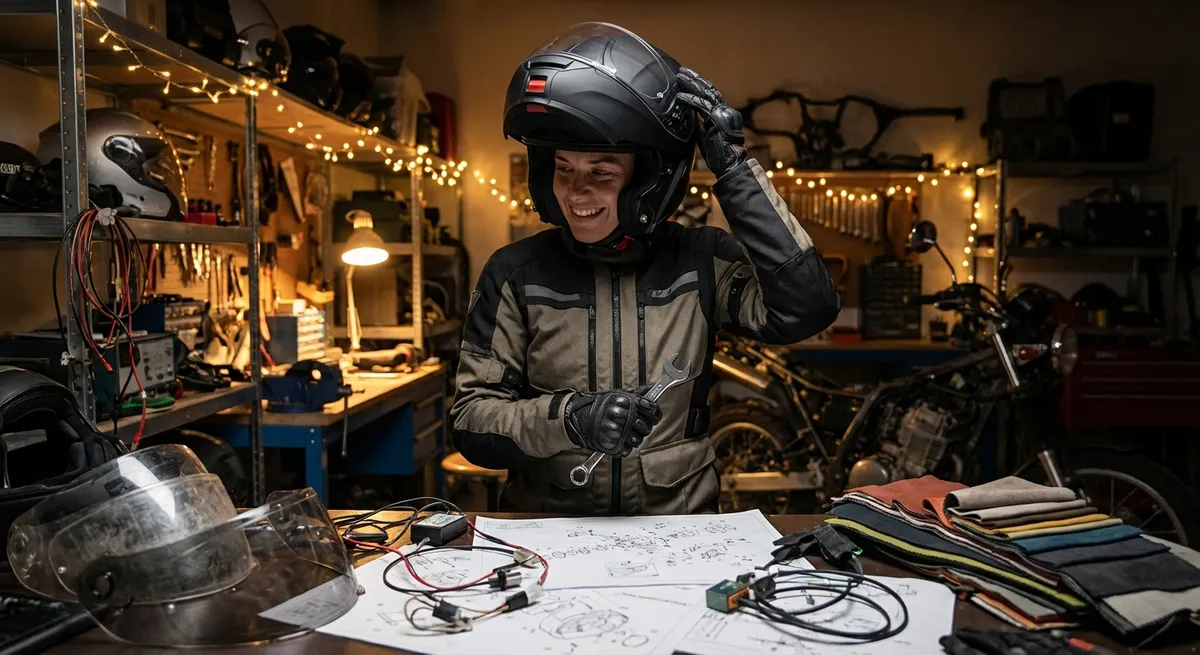
Most riders buy gear by size, color, and price. Serious riders treat gear like a performance system—just as tunable and technical as suspension or tires. When you start looking at helmets, jackets, and gloves through an engineering lens—materials science, impact attenuation, friction coefficients—you stop “buying gear” and start specifying components.
This is about building a protective system, not just a matching outfit.
Understanding Impact: How Your Gear Actually Manages Energy
Every crash is an energy management problem: kinetic energy has to go somewhere. Your gear’s job is to absorb, disperse, and delay that energy long enough to keep your body below injury thresholds.
Modern motorcycle equipment approaches this in three main ways:
Energy absorption (foam and liners)
- Helmets use EPS (expanded polystyrene) or multi-density foams tuned for specific impact velocities. - Higher-density foam manages higher-energy hits but transmits more force in low-speed knocks; multi-density liners blend layers to widen the protection window. - In gear, CE-rated armor (e.g., viscoelastic materials like D3O, SAS-TEC) deforms under load, turning impact energy into heat and plastic deformation instead of bone fractures.
Energy distribution (shells and armor shapes)
- Hard shells on helmets and armor spread point loads across larger areas of foam or fabric. - A properly curved shoulder or knee protector pushes force sideways and across the pad, instead of straight into the joint. - Flat armor or pads that “float” loosely in pockets often fail to stay located during real-world impacts, concentrating load on small areas.
Energy time-shifting (slowing deceleration)
- Injury severity is strongly related to peak deceleration. - Longer crush distance and controlled deformation (foam compression, sliding surfaces) lower peak G forces. - That’s why a slim leather fashion jacket with thin foam pads is not in the same universe as a CE-certified motorcycle jacket with Level 2 armor and a back protector that has documented impact transmission values.
Technical point #1: When comparing armor, look for its CE impact force transmission numbers, not just “Level 1/Level 2.” Two Level 2 pads can both meet ≤9 kN average transmission, but one might average 5 kN and the other 8.5 kN. That difference is huge when you’re the one hitting the ground.
Helmet Engineering: Beyond Shape, Graphics, and Snell Stickers
Helmets are the most over-simplified and under-understood component in a rider’s kit. Protection isn’t binary—good or bad—it’s tuned.
Key technical elements that actually matter:
Shell construction and behavior
- Polycarbonate/thermoplastic shells are generally thicker and rely more on deformation; they can be heavier but cost-effective. - Fiberglass composite shells combine glass fiber with resin for better strength-to-weight and controlled flex. - Multi-composite / carbon shells (fiberglass, Kevlar/aramid, carbon fiber mixes) allow very high stiffness in some zones and engineered flex in others, improving impact distribution while reducing weight. - A stiffer shell is not automatically “safer”; it must be matched to a liner that can crush appropriately. Overly stiff shells can spike transmitted forces if the foam can’t manage the load.
Impact standards and what they really imply
- DOT (FMVSS 218) sets a baseline for impact testing and penetration, but with self-certification. - ECE 22.06 (replacing 22.05) uses oblique impact tests and a broader range of impact points and energies, closer to real-world conditions. - Snell adds very high-energy hit tests; beneficial for track scenarios but can bias designs toward harder shells and higher-density liners. - SHARP (UK) does comparative testing with a star rating and multiple impact intensities.
None of these guarantee “the safest helmet” in all scenarios; they indicate how the helmet behaves under specific test conditions.
Rotational impact mitigation
- Real crashes rarely involve pure linear impacts. Your head often strikes at an angle, creating rotational acceleration—highly correlated with brain injuries like diffuse axonal injury. - Systems like MIPS, Slip Plane liners, or proprietary rotational management designs create a low-friction interface allowing the helmet to rotate slightly around the head during an oblique impact, off-loading rotational forces. - This doesn’t replace good foam; it complements it, targeting a different injury mechanism.
Technical point #2: Evaluate helmets by systems: liner density design, shell material, rotational tech, and certification type together. A helmet with ECE 22.06, a multi-density EPS liner, and a rotational management system is generally more advanced in addressing diverse real-world crash vectors than a helmet just boasting a single high-energy standard.
Textile vs Leather: Friction, Abrasion, and Real-World Slide Dynamics
The purpose of your outer layer is not just to “not tear.” It must control how you decelerate while sliding.
Coefficient of friction (CoF)
- Too little friction and you slide forever—risking secondary impacts and sliding into hazards. - Too much friction and you may “grab” the surface, promoting tumbling or abrupt limb loading (think rotational injuries and snapped joints). - High-quality motorcycle-grade leather and engineered textiles sit in an optimal band—enough friction to slow you predictably, but not so much that you instantly hook.
Abrasion resistance and layer strategy
- Cowhide or kangaroo leather in the 1.2–1.4 mm range, when properly tanned and stitched, offers excellent abrasion resistance and controlled slide behavior. - Advanced textiles (Cordura, high-denier nylons, aramids like Kevlar/Twaron) use weave density + fiber type + coatings to approach or exceed leather’s slide time in some tests. - Critical zones (shoulders, elbows, hips, seat, knees) should have multi-layer reinforcement: outer shell + abrasion layer + armor beneath. One thin textile layer is not a crash solution, it’s a windbreaker.
Seam design and failure modes
- Low-quality gear often fails at seams before the fabric wears through. - You want double or triple stitching and preferably safety seams (hidden rows of stitching protected from abrasion). - High-stress areas should have bar tacks or specific reinforcement patterns, just like load-bearing climbing gear.
Technical point #3: When choosing a jacket or pants, ask: What’s the tested abrasion performance of this material system (not just fabric brand name), and how are the seam constructions in the high-impact zones? CE garment certification to EN 17092 (Class A/AA/AAA) gives you a data-backed baseline instead of marketing adjectives.
Impact Zones, Armor Placement, and Fit: The Geometry of Staying Protected
Armor is only useful if it’s still in the right place when you hit the ground. This is where fit stops being a comfort question and becomes a safety variable.
Primary impact zones
- Statistically, the highest-frequency impact points are: shoulders, elbows, knees, hips, and back, followed by chest and ribs. - Hands and wrists absorb a huge amount of impact as riders instinctively reach out; this is why glove armor is not optional for serious riding.
- CE armor coverage vs. real coverage
- CE approval means the pad itself meets impact criteria in a standardized test rig—not that your body is perfectly covered in a crash.
- A Level 2 elbow pad that only covers a narrow section of the joint may technically pass the lab test while leaving actual bony structures exposed when you move, lean, and twist on the bike.
Fit tension and positional stability
- Armor must be pre-tensioned against the body in riding position, not just when standing. - Loose, fashion-cut jackets allow armor to rotate away from critical points during a slide. - Touring and track-oriented gear tends to use pre-curved sleeves and legs, accordion stretch, and cinch systems to keep pads locked in over joints when you’re actually on the controls.
Coverage continuity
- Look for overlap: jacket to pants, gloves over cuffs, boots under pants or over with good sealing. Skin gaps at wrists, waist, and ankles are common real-world failure points. - A properly designed suit system works like tiles on a roof—overlapping layers that preserve coverage as you move.
Technical point #4: When you try on gear, get in a full riding crouch—on a bike if possible. Check if shoulder, elbow, knee, and hip armor stay centered; if they drift significantly, the garment is incorrectly cut for your body, regardless of size label.
Technical Gloves: Micro-Control, Macro Protection
Gloves are a brutally hard design problem: you need tactile feedback and fine motor control, but also serious protection for some of the most fragile, injury-prone bones in a crash.
Palm slide and scaphoid protection
- In an unprotected glove (or bare hands), your palm grabs the surface, loading the wrist and scaphoid bone with huge forces. - High-end gloves use palm sliders (hard TPU, composite, or palm sliders with low-friction inserts) to let your hand glide instead of catch, off-loading wrist hyperextension. - This is not a gimmick—it directly addresses common hand and wrist fracture modes documented in crash research.
Knuckle and finger armor as a structural cage
- Hard knuckle protectors distribute impact across the back of the hand and into surrounding materials. - Finger bridge designs (especially between ring and pinky) help prevent finger splay and tearing during a slide. - Good gloves integrate padding and armor into the seams and panels, rather than just sewing a hard cap on top.
Material and seam layout
- Full-grain cow or goat leather remains a top-tier choice due to its tensile strength and flexibility. - High-stress areas receive extra panels and double or external seams; track-style gloves typically use externally stitched fingers to reduce pressure points while still reinforcing the structure. - Stretch panels (accordion leather or textile) are placed to preserve grip and lever feel without creating weak points in high-abrasion zones.
- Control feedback vs. insulation
- Thicker, heavily insulated gloves are safer thermally but can dangerously reduce feel, increasing over-braking, delayed input, or fatigue.
- For performance riding, prioritize precise lever control and complement it with heated grips or hand guards to manage cold, rather than relying solely on thick insulation.
Technical point #5: Treat gloves as precision control interfaces that also manage crash loads. When testing gloves, focus on three things: (1) can you modulate front brake with two fingers precisely, (2) do palm sliders and wrist construction prevent excessive flex when you simulate a fall onto your hands, and (3) does the glove maintain full coverage when you fully close and open your hand?
Conclusion
Your gear is not just “good” or “bad.” It’s a tunable system with measurable performance characteristics: impact force transmission, slide behavior, friction profiles, structural stability, and ergonomic control.
When you start reading spec sheets like a race engineer—looking at liner density, shell construction, CE levels with actual kN ratings, seam structures, impact zones, and friction behavior—you stop guessing and start specifying.
Build your helmet, jacket, and glove system the way you’d spec a suspension package: intentionally, with a clear understanding of what each component contributes. The difference in a worst-day scenario isn’t theoretical—it’s measured in millimeters of foam crush, fractions of a second of deceleration, and whether your kit stays in place when the asphalt comes rushing up.
Sources
- NHTSA Motorcycle Helmet Safety Information - Overview of U.S. helmet standards (FMVSS 218) and motorcycle safety data
- ECE 22.06 Motorcycle Helmet Regulation (UNECE) - Official documentation on updated ECE helmet testing, including oblique impact considerations
- Snell Memorial Foundation – Helmet Standards - Technical details on Snell helmet testing protocols and impact criteria
- Cambridge University – Motorcycle Protective Clothing Research - Study on motorcycle garment performance and injury reduction (PDF)
- FEMA: Motorcycle Protective Equipment Guide - European riders’ federation overview of PPE standards, CE ratings, and practical implications
Key Takeaway
The most important thing to remember from this article is that this information can change how you think about Gear & Equipment.