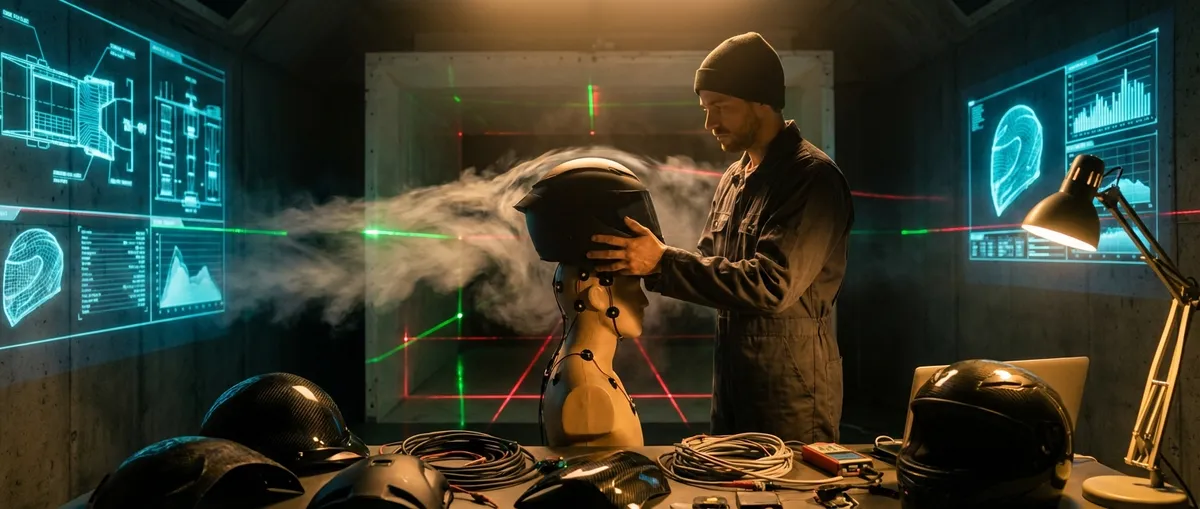
Most riders shop for helmets like they shop for phone cases—style first, safety somewhere around third. That’s a problem. A helmet isn’t just “protection”; it’s a system of impact control, aerodynamics, acoustics, optics, and thermal management wrapped around your brain at highway speeds. When you understand the engineering behind it, you stop chasing graphics and start chasing performance.
This is a deep dive into how to evaluate a helmet like an engineer, not a catalog model. We’ll break down five critical technical dimensions that actually change how your head, neck, and brain experience a crash—and a long day in the saddle.
1. Impact Energy Management: Beyond “It’s DOT Certified”
Most riders stop at “DOT” or “ECE” and assume every approved helmet is functionally similar. It’s not.
Modern helmet engineering is about time and distance—how far and how long your head can decelerate in a crash. The shell’s job is to spread the initial hit; the EPS (expanded polystyrene) liner’s job is to crush in a controlled way and convert kinetic energy into plastic deformation.
Key technical points to understand:
Single-density vs multi-density EPS
- Single-density EPS uses one foam hardness throughout. It’s simple and cheaper, but can be a compromise: too soft for big hits or too hard for small ones. - Multi-density EPS (common in higher-end helmets) layers different foam densities in zones. Softer foam manages low-speed impacts (common in real-world lowsides); harder foam handles higher energy, more violent impacts.
*Shell material is about behavior, not bragging rights
- Polycarbonate: good energy absorption, more flex, slightly heavier, cheaper. Tends to rely more on foam for energy management. - Fiberglass composite: lighter, stronger, can be tuned to flex and crack in a controlled way to spread the load. - Carbon fiber: stiffer and very lightweight, but needs careful layup and resin systems so it doesn’t transmit too sharp a pulse to the liner. Pure stiffness without tuned flex can be counterproductive.
Linear vs rotational acceleration
Standards like DOT, ECE 22.05/22.06, and Snell primarily focused on linear impacts for years, but rotational acceleration (head twisting) is strongly linked to brain injury. This has driven systems like: - MIPS, LDL, or other slip-plane technologies that allow a few millimeters of shear movement between your head and the helmet. - Shell and liner designs tuned to manage oblique impacts, not just straight vertical drops onto anvils.
Certification hierarchy is not absolute, but it matters
- DOT is a self-certification in the U.S.; compliance is spot-checked by NHTSA. - ECE 22.06 and FIM standards (for racing) have tightened performance requirements, especially for oblique and rotational impacts. - A helmet meeting modern ECE 22.06 or FIM is generally showing up-to-date impact management thinking, not just minimal legal compliance.
Fit is a performance variable, not a comfort preference
Even the best helmet fails if it’s loose. Excess interior volume allows your head to accelerate inside the helmet before the liner engages. That’s wasted distance and energy management. A performance fit is: - Firm, even pressure around the crown. - No hot spots in the first 10–15 minutes; if there are, they only get worse. - Cheek pads that compress with resistance, not instantly collapse. - Minimal rotation when you grab the chin bar and twist.
2. Aerodynamics and Neck Load: Stability at Speed Is Safety
Helmet aerodynamics isn’t just about noise and fuel economy; it’s a neck and fatigue problem. At 70–90 mph, your helmet is a bluff body in turbulent air, and your neck is the control linkage.
The engineering goal: stable pressure distribution and predictable flow separation so the helmet doesn’t yank your head around when you look over your shoulder, pass a truck, or change lanes.
Technical factors that matter:
Shell profile matched to riding posture
- Upright/naked/ADV riding: helmets optimized for more vertical head orientation, higher frontal area, and turbulent flow from a shorter screen or no screen. - Sport/track riding: shells tuned for a tucked or semi-tucked position. The spoiler, rear contour, and chin bar are shaped for lower airflow angle, reducing lift and buffeting over 100 mph.
Using a track-focused helmet on a tall ADV bike with a big screen can create lift and instability because the pressure zones are wrong for your posture and bike’s wake.
Lift and drag balance
- Drag (straight-line air resistance) primarily contributes to fatigue over long distances. - Lift (upward force) can unload your neck and cause subtle instability. Good helmets try to “center” aerodynamic forces around your neck pivot line to minimize torque.
Wind tunnel testing and CFD are used to refine shell shapes and rear spoilers so that the net aerodynamic moment around your neck is close to zero at target speeds.
Yaw and crosswind behavior
Side forces in crosswinds or when you pass large trucks can generate yawing torque on the helmet. Look for: - Strong, centered stabilizers or spoilers at the rear. - Shell shapes with smooth lateral transitions, avoiding abrupt side ridges that can catch gusts. - Road testing feedback from riders about stability when checking blind spots.
Weight vs polar moment of inertia
Everyone chases lighter weight, but where the weight is located matters. A slightly heavier helmet with mass concentrated closer to your head (compact shell, efficient liner) can feel less fatiguing than a lighter helmet with a large, bulbous shell. What your neck feels is not just mass, but the moment of inertia when you turn or when a gust hits.
Visor position and turbulence coupling
On faired bikes, the interaction between your windscreen’s vortex shedding and the helmet’s lower edge/shell profile can create intense buffeting at specific speeds. Micro-adjustable screens or small clip-on deflectors can shift this turbulence band away from your normal cruising speed.
3. Acoustic Engineering: Controlling Noise Without Killing Ventilation
Helmet noise isn’t just an annoyance; prolonged exposure to 90–100+ dB at highway speeds can cause permanent hearing damage. Since you should be wearing earplugs, the helmet’s job is to shape the acoustic environment—for reduced fatigue and better signal-to-noise for critical sounds (sirens, horns, your own engine).
Here’s where the engineering gets interesting:
Primary noise sources
- Turbulent flow around the neck roll and bottom edge. - Vortex shedding around the visor edge and side pods. - Whistling from poorly sealed vents or gaps. - Interaction between the bike’s screen and the helmet (pressure fluctuations hitting the chin bar and crown).
Neck roll and base sealing
A well-engineered neck roll with carefully shaped padding and flexible skirt material acts as both: - An aerodynamic fairing for your jaw/neck transition. - An acoustic baffle, reducing high-frequency turbulence-generated noise.
A helmet that’s “quiet” in isolation can become loud if the neck roll fit is loose on your specific jawline and neck structure.
Visor seal precision
Look for: - A continuous, well-defined gasket around the eye port. - A hinge mechanism that pulls the visor in and down at the last few millimeters of travel. - Rigid visor construction that doesn’t flutter at speed.
Even minor visor flex can modulate the air gap and create pulsating wind noise at specific frequencies that are more fatiguing than constant broadband noise.
Internal liner materials and acoustic damping
Multi-layer comfort liners can be designed to absorb specific frequency ranges. Denser foams and certain fabric constructions help damp higher-frequency hiss, while cavity geometry and padding thickness influence mid-frequency resonance (the “droning” riders complain about).
Tradeoff with ventilation
You can easily make a quiet helmet: seal every vent and add a huge neck skirt. You’d just cook the rider. Real engineering is about: - Channeling airflow in laminar, predictable paths through intake and exhaust ports. - Smoothing internal airflow so you get mass flow (cooling) without internal turbulence (noise) right around your ears. - Designing vents that open into low-pressure zones to encourage flow without creating whistling edges.
4. Optics and Visual Performance: The Engineering in Front of Your Eyes
Your visor is essentially a curved, transparent structural element that has to maintain clarity, accurate optics, and stable mechanics at highway speed in UV exposure, rain, dust, and possibly track-level debris impacts.
Key technical considerations:
Optical class and distortion
High-quality visors are often “optically correct” (or specified as Class 1 under certain standards). That means: - Minimal distortion across your primary field of view, especially when scanning apexes or mirrors. - Curvature and thickness are tuned so your brain doesn’t have to constantly re-calibrate depth perception.
Cheaper visors can cause subtle distortion at the periphery, leading to eye strain and reduced confidence in high-speed cornering.
Mechanical stiffness and sealing
A visor acts like a small wing at speed. If it flexes: - The seal to the gasket breaks intermittently, causing pulsing noise and potential water ingress. - The optical surface can vibrate, giving a slight “shimmer” that’s distracting at night.
High-end helmets often use thicker visors (2–3 mm) with robust pivot hardware and metal detents for consistent sealing force.
Anti-fog systems: coatings vs physical barriers
- Simple anti-fog sprays or coatings are short-lived and less reliable in cold, humid conditions. - Pinlock-style internal inserts create a double-pane system: a sealed air gap with a hydrophilic inner surface that resists condensation. - The quality of the pin bosses, insert fit, and seal uniformity determines whether you get edge fogging or optical distortion.
Field of view and helmet cut geometry
Vertical FOV matters for sport and track riding—can you see up the road while tucked? Horizontal FOV affects situational awareness in traffic. Helmets with: - Wider eye ports and carefully designed cheek pad profiles maximize peripheral vision without compromising structural integrity. - Thinner but stronger reinforcement around the eye-port cut maintain rigidity even under frontal impacts.
Photochromic and tinted solutions
- Integrated drop-down sun visors add convenience but often increase shell complexity and can create additional noise paths or slightly weaken the shell structure. - Photochromic outer visors eliminate internal moving parts but can have limitations: activation/deactivation speed in tunnels or at night, and long-term UV-induced changes to performance.
From a pure engineering standpoint, a high-quality clear visor plus separate, well-fitting sunglasses (or a dedicated tinted visor for track) is often the cleanest solution—but convenience is a valid real-world design parameter.
5. Thermal and Moisture Management: Your Head as a Heat Engine
Your brain is extremely sensitive to heat. Cognitive performance, reaction time, and decision quality all degrade as core and skin temperatures rise. That means helmet ventilation and moisture management aren’t “comfort features”; they’re performance variables.
What matters under the shell:
Vent architecture vs vent count
It’s easy to drill holes and call it a ventilation system. Real engineering means: - Matching intake vent area to internal channel cross-section, so flow doesn’t choke immediately behind the shell. - Positioning intakes in high-pressure zones (usually frontal crown, chin area) and exhausts in low-pressure zones (rear top, back of the head) to create a pressure-driven flow path. - Using smooth internal EPS channels that guide air from front to rear across heat-generating zones (forehead, crown, occipital region).
Two well-placed, well-channeled vents will outperform six random holes in the shell.
Boundary layer and scalp contact
The comfort liner creates micro-channels between your skin and the EPS. Good designs: - Use 3D mesh or sculpted foam to keep minimal but consistent contact, letting air move over* the scalp rather than compressing a hot pad against it. - Balance pad density so sweat can be wicked away into the fabric rather than pooling and then evaporating directly into your eyes.
Moisture wicking and evaporation
Technical helmet liners use multi-layer fabric systems: - A hydrophilic inner layer to pull sweat off the skin. - A more open, fast-drying outer layer that spreads moisture for efficient evaporation.
If the inner layer saturates and cannot move moisture outward, you get swampy hotspots and more fogging.
Chin bar flow and breathing comfort
The chin vent is critical for: - Reducing CO₂ buildup and stuffiness. - Managing fog on the lower part of the visor. - Cooling the face without blasting your eyes.
Internal deflectors should steer air upward toward the visor and cheeks without sending a high-velocity jet directly into your eyes, which can cause tearing and vision issues at speed.
Modular/flip-up complexity
Flip-up helmets add joints, seals, and potential leak paths. High-quality modulars: - Use robust locking mechanisms that keep the chin bar in stable alignment—critical both for safety and consistent vent performance. - Engineer additional seal surfaces to maintain weather and noise control when closed. - Carefully integrate extra hardware and channels so they don’t compromise impact performance around the critical jaw and temple zones.
Conclusion
Treat your helmet like a system, not a fashion accessory. The best helmet for you isn’t the lightest, or the most expensive, or the one your favorite racer wears—it’s the one whose engineering matches your riding: your bike, your speeds, your posture, your climate, and your risk envelope.
When you look past marketing and into impact management, aerodynamics, acoustics, optics, and thermal control, you start evaluating helmets the way an engineer would evaluate a critical component in a performance machine. And that’s exactly what it is: the most important component you’ll ever bolt to the motorcycle’s control system—your brain.
Sources
- [NHTSA Motorcycle Helmet Safety](https://www.nhtsa.gov/road-safety/motorcycle-safety) - U.S. government overview of helmet safety, standards, and effectiveness data
- [UNECE Regulation No. 22.06](https://unece.org/transport/documents/2020/06/standards/uniform-provisions-approval-protective-helmets-and-their-visors) - Official documentation for ECE 22.06 helmet regulation, including test methods
- [Snell Memorial Foundation: Helmet Standards](https://smf.org/standards) - Technical details on Snell helmet testing and performance criteria
- [CDC: Hearing Loss Prevention - Noise and Hearing Loss](https://www.cdc.gov/nceh/hearing_loss/what_noises_cause_hearing_loss.html) - Information on noise exposure levels and long-term hearing risks
- [NIH: Effects of Heat Stress on Cognitive Performance](https://www.ncbi.nlm.nih.gov/pmc/articles/PMC4473167/) - Research discussion of how elevated temperatures impact mental performance and reaction time
Key Takeaway
The most important thing to remember from this article is that this information can change how you think about Gear & Equipment.