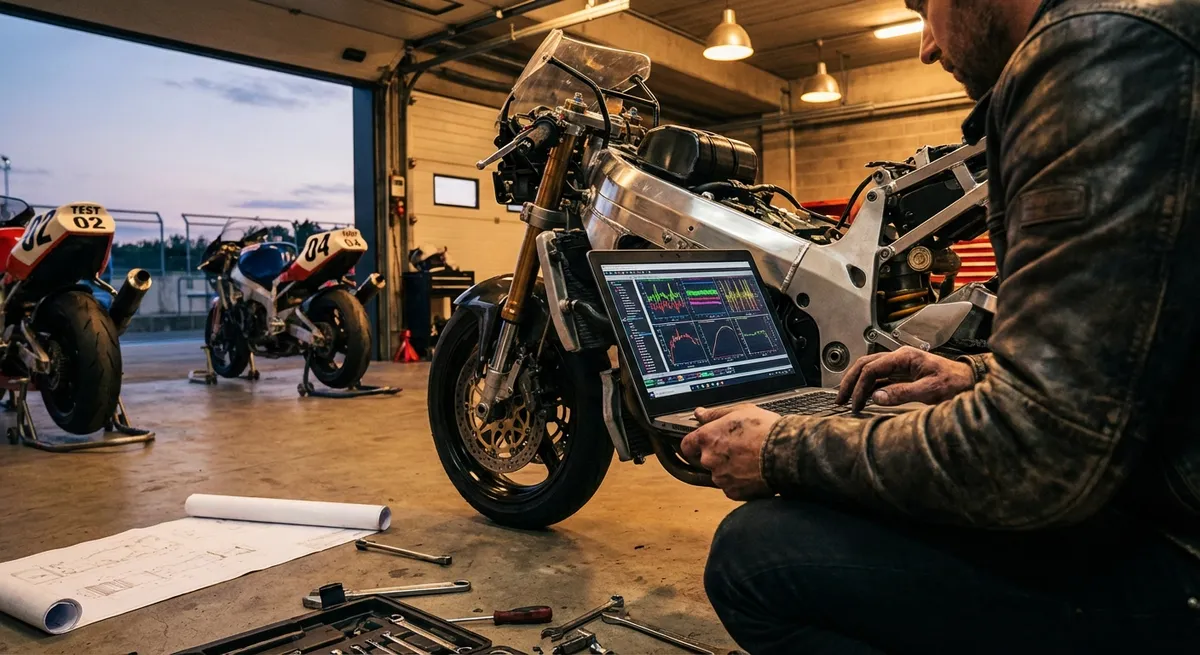
Motorcycle reviews are flooded with buzzwords: “punchy midrange,” “flickable chassis,” “confidence-inspiring brakes.” They sound good—but they rarely tell you what the bike is actually doing underneath you. At Moto Ready, we care less about adjectives and more about mechanisms. If you understand how a bike makes grip, stability, and feedback, you can choose a machine that matches your real riding, not just your ego or the marketing copy.
This guide breaks down how to read—or write—motorcycle reviews with an engineering lens. We’ll focus on five technical pillars that separate a hype-driven impression from a genuinely useful evaluation.
1. Chassis Geometry in the Real World: Stability vs. Agility, Not Just Numbers
Every spec sheet lists rake, trail, and wheelbase, but those numbers don’t mean anything until you connect them to real riding behavior.
- Rake (head angle): A steeper rake (smaller angle) generally sharpens steering response and makes direction changes easier, but can reduce straight-line stability. A lazier rake (larger angle) calms the bike down at speed but can slow transitions.
- Trail: More trail typically adds stability and self-centering behavior at the bars, while less trail gives quicker, lighter steering—sometimes at the cost of mid-corner composure on imperfect pavement.
- Wheelbase: Longer wheelbases resist pitch (less dramatic weight transfer during braking/accel) and add high-speed stability. Shorter wheelbases snap into corners more aggressively, but can feel nervous if suspension and damping aren’t dialed.
A technical review should connect these to road behavior like this:
- Does the bike stand up under brakes mid-corner, forcing line corrections?
- Does it weave or shimmy in fast sweepers, or does it track like it’s on rails?
- How does it respond to quick transitions in linked bends—does it flow, or does it require conscious muscling?
The key is dynamic geometry: how the bike’s geometry changes as the suspension moves. A well-written review will mention how the bike behaves on brake, at neutral throttle, and on drive, not just “it handles great.”
2. Engine Character: Power Delivery, Not Peak Horsepower
Peak horsepower sells bikes, but torque curve shape and throttle response are what you actually ride. A technical review needs to go beyond “plenty of power” and address:
- Low-end and midrange vs. top-end bias:
- Is the engine tuned for strong torque between 3,000–7,000 rpm (street-friendly, short-shift riding), or does it wake up only above 8,000 rpm (more track-biased)?
- Does it feel “flat” until a certain rpm, or is it linear and predictable?
- Throttle mapping and fueling:
- Is there on/off snatch when transitioning from closed to slightly open throttle in lower gears? This hugely affects corner exits and urban riding.
- In different ride modes, does the throttle become too soft (laggy) or too sharp (twitchy)?
- Engine braking behavior:
- Strong engine braking can help slow the bike entering corners but can induce rear-wheel hop or instability if not well-managed.
- Light engine braking feels smoother but may require more rear brake usage.
When you evaluate or read a review, look for language that ties engine behavior to real scenarios:
- “In tight corners, the bike tolerates sloppy gear selection thanks to a thick midrange.”
- “Below 4,000 rpm, the engine chugs and surges, making slow-speed traffic work annoying.”
- “Sport mode offers instant response but is too sharp over bumps, upsetting mid-corner stability on rough roads.”
Technical riders don’t just care if it’s fast; they care where and how that power shows up.
3. Suspension Damping and Support: Feel, Not Just “Comfort”
Suspension is the translator between asphalt and your brain. A good review doesn’t stop at “it’s comfortable” or “it’s firm.” It should break down how the fork and shock behave under load.
Key concepts to look for:
- Initial compliance vs. mid-stroke support:
- Initial compliance = how well the suspension absorbs small, sharp bumps (cracks, joints, gravel).
- Mid-stroke support = how much the bike dives, squats, or wallows when braking, accelerating, or cornering hard.
A well-sorted suspension feels supple over chatter but holds its shape under aggressive inputs.
- Damping quality (compression and rebound):
- Too little rebound damping and the bike can feel bouncy or vague, especially in a series of bumps.
- Too much rebound and the suspension “packs down,” losing travel and making the bike harsh and choppy.
- Too little compression and the bike blows through its stroke (excessive dive/squat). Too much and it feels harsh and skittery over imperfections.
- Adjustability that actually works:
- A technical review should note if small clicker changes produce noticeable, predictable differences, or if the adjusters are more cosmetic than functional.
- For electronic suspension, pay attention to whether modes simply feel “soft/medium/hard” or if they adapt meaningfully to braking and lean inputs.
Instead of “the suspension is good,” an engineering-smart review sounds like:
- “On the brakes from 70–0 mph, the fork uses about 80% of travel without harsh bottoming, maintaining good feedback.”
- “Over linked bumps in fast corners, the rear shock recovers quickly without kicking, indicating sufficient rebound control.”
- “Rider + luggage puts the rear close to its limit; pre-load range is adequate for solo touring but marginal for two-up with full luggage.”
That’s the level of specificity that lets serious riders understand if a bike fits their weight, speed, and roads.
4. Braking Systems and Thermal Performance: More Than Just Initial Bite
Brakes aren’t just about “strong” or “weak.” They’re a thermomechanical system, and a solid review respects that.
Critical braking elements to look for:
- Initial bite vs. controllability:
- Strong initial bite feels impressive but can make low-speed braking jerky.
- Progressive systems may feel softer at first but are easier to modulate at deep lean or in low-traction conditions.
- Fade resistance and consistency:
- On a mountain descent or track session, do the brakes maintain a consistent lever feel, or does the lever travel increase as heat builds?
- A review that mentions repeated high-speed stops or extended downhill riding is telling you about thermal capacity and pad/disc pairing.
- ABS calibration and cornering behavior:
- Standard ABS is now common, but cornering ABS (IMU-based) is what matters if you ride aggressively or in poor conditions.
- Does ABS intervene early and bluntly (pulsing and lengthened stopping distances), or does it quietly correct only when traction is truly compromised?
- Lever ergonomics and feedback:
- Can you comfortably operate the brake with two fingers while maintaining a solid grip, or does the lever positioning force awkward hand angles?
- Is there a clear sense of when the pads are contacting the disc?
A good review connects all of this:
- “After a series of 100–30 km/h stops, lever feel remained stable with no perceptible fade.”
- “ABS activation at the rear is gentle, but front ABS cuts in early on poor surfaces, lengthening panic-stop distances.”
- “Initial bite is mild, but from there the braking force is beautifully linear, ideal for precise trail braking.”
That’s the kind of detail you need for real confidence at speed.
5. Electronics, Rider Aids, and Data: Systems That Work With You
Modern motorcycles are rolling control systems: ride-by-wire, traction control, wheelie control, cornering ABS, engine-brake management, electronic suspension, and multiple power modes. A technical review should judge these as integrated systems, not separate gadgets.
Important dimensions:
- Traction control behavior:
- Does TC intervene smoothly and early, or abruptly and late?
- On imperfect pavement exiting corners, does it allow a controlled smear of the rear tire or shut power aggressively?
- Ride modes that change more than labels:
- Do modes actually change throttle maps, ABS/TC levels, suspension damping, and engine braking—or just display a different word on the dash?
- Is there a mode that maps cleanly to your reality (e.g., wet-city, fast-twisties, loaded-touring), or do you need to build a custom profile?
- User interface and setup:
- How many steps does it take to change TC or ABS levels from the bar controls?
- Can you adjust settings on the move, or is everything locked when rolling?
- Data visibility:
- Useful reviews note the quality of the dash, gear indicator, shift lights, and fuel range accuracy.
- Does the dash show live fuel consumption, lean angle, or brake pressure in a way that’s actionable, or is it gimmicky?
Strong, rider-centric electronics comments sound like:
- “In sporty riding, the intermediate TC setting allows slight slip and rotation without cutting power, aligning well with experienced street riding.”
- “Rain mode delivers a gentle initial throttle response and earlier ABS/TC intervention, making slick commutes less mentally taxing.”
- “The UI requires deep menu dives to adjust engine braking; not ideal when conditions change mid-ride.”
The core question: does the bike’s electronic strategy amplify your skill—or blunt it?
Conclusion
Motorcycle reviews are only useful if they tell you how the bike behaves as a dynamic system, not just how it looks on a press launch. For performance-minded riders, the real gold is in how chassis geometry, engine character, suspension behavior, braking performance, and electronics integrate into a coherent ride.
When you read your next review—or write one—look for clear, specific connections between technical fundamentals and real-road behavior:
- Does the geometry description explain why the bike is calm or twitchy?
- Does the engine analysis talk about torque curve, not just peak power?
- Does suspension coverage distinguish comfort from control?
- Do brake comments cover fade and modulation, not just stopping distance?
- Are electronics treated as a serious control layer, not an extra bullet point?
That’s the standard we aim for at Moto Ready: reviews that help you choose a machine you can push hard, trust deeply, and grow with over time.
Sources
- Yamaha Motor – Motorcycle Chassis and Handling Basics – Technical discussion of chassis geometry, stability, and handling characteristics
- Kawasaki – Motorcycle Engine Performance and Torque Characteristics – Explains torque curves, power delivery, and how they affect real-world riding
- Öhlins – Suspension Fundamentals – Detailed information on damping, spring rates, and how suspension adjustments affect behavior
- Brembo – Motorcycle Braking Systems – Overview of braking components, performance, and thermal considerations
- Bosch Mobility – Motorcycle Safety Systems – Technical breakdown of ABS, cornering ABS, and traction control for modern motorcycles
Key Takeaway
The most important thing to remember from this article is that this information can change how you think about Motorcycle Reviews.