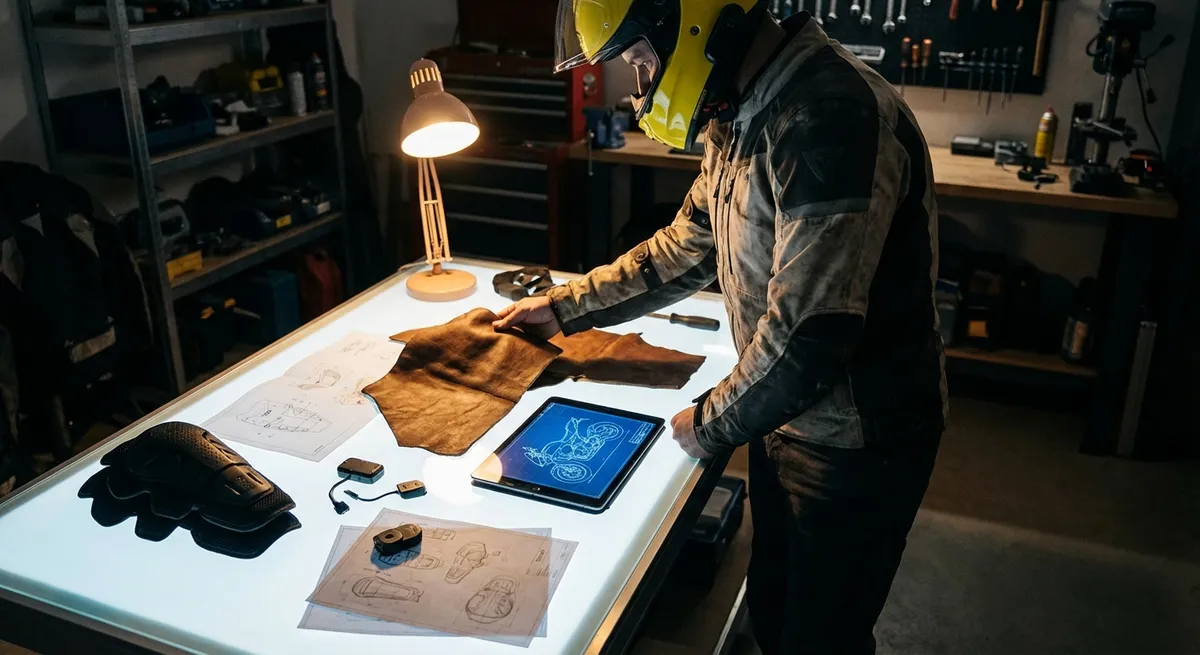
Motorcycle gear isn’t “accessories.” It’s a distributed safety system wrapped around a very fragile human body, operating in a violently dynamic environment. Most riders know they should wear gear—but very few understand what’s actually happening at a material, mechanical, and biomechanical level when that gear is called on to save skin, joints, or your brain. This guide goes past marketing terms and colorways into the physics, standards, and engineering details that actually matter when you’re choosing what to wear.
Impact Energy: How Your Gear Actually Buys You Time
When you hit the ground, the enemy isn’t just force—it’s time. Injury severity is heavily tied to how quickly your body is decelerated. Good gear doesn’t eliminate impact energy; it stretches the impact out over a longer time window, reducing peak loads on your bones and soft tissue.
A CE-rated protector (shoulder, elbow, knee, back, chest) is tested by dropping a mass onto it and measuring how much energy passes through to a sensor underneath. For example, under EN 1621‑1 (limb protectors), Level 1 armor must transmit an average of ≤35 kN of force in the lab test; Level 2 must transmit ≤20 kN. That reduction isn’t abstract—less transmitted force directly correlates with lower fracture risk.
Viscoelastic materials like D3O, SAS-TEC, and similar compounds behave as rate-dependent dampers. Under slow movement, they’re flexible; under rapid impact, their internal structure resists deformation, converting more kinetic energy into heat and internal work rather than letting it spike into your bones. This is why “soft” armor can still provide serious protection when properly certified.
Real-world takeaway: don’t judge armor just by feel, thickness, or brand name—look for CE level ratings and the relevant standard number stamped on the protector (e.g., “EN 1621‑1:2012 Level 2”). That stamp means the piece has survived controlled, repeatable abuse in a lab so you don’t have to do that testing with your own body.
Abrasion and Burst Strength: The Physics of Sliding vs. Shredding
At street speeds, you’re more likely to slide than tumble endlessly like a MotoGP crash. That slide is where textile vs. leather vs. single-layer denim stops being fashion and becomes applied materials science.
CE garment standard EN 17092 classifies gear from AAA (highest) down to C (basic impact coverage only). To earn those letters, the garment has to survive:
- Abrasion tests using a rotating drum (like the Darmstadt or Cambridge methods), measuring how long the fabric lasts before it holes through.
- Seam burst tests, where panels are pulled apart until the stitching or material fails, indicating whether your jacket will stay together or unzip itself on the asphalt.
Leather—especially 1.2–1.4 mm cowhide or kangaroo—still sets the benchmark for high-speed abrasion resistance, which is why racing suits are leather and not Cordura. But modern multi-layer textiles with aramid (Kevlar), UHMWPE (Dyneema, Spectra), or high-tenacity nylon can approach or, in specific test scenarios, rival leather in sliding time when properly constructed and reinforced in critical zones.
What matters technically:
- Zone mapping: EN 17092 defines high-risk zones (butt, hips, outer arms, knees, shoulders) that must meet tougher abrasion requirements. If a garment only reinforces “style zones” (like random panels), it’s not optimized for real crashes.
- Seam construction: Look for multiple rows of lockstitch or safety stitching with protected thread lines. Single-row decorative stitching with exposed thread is for looks, not survival.
- Multi-layer strategy: An outer shell, impact foam, and internal abrasion liner together create a stack-up that spreads point loads and delays penetration much more effectively than a single layer of “motorcycle denim.”
The technical bottom line: pick gear with documented EN 17092 ratings, pay attention to the letter (A, AA, AAA), and remember that construction details around seams and panels can matter as much as fabric brand names.
Helmet Performance: Vent Channels, Shell Geometry, and Brain Physics
Every full-face helmet on the shelf promises safety, but the details behind that promise are where the engineering gets interesting—and where you can make a smarter choice.
At minimum, look for certification labels like DOT (FMVSS 218), ECE 22.06, or SNELL, depending on your region and riding style. But once you’re past “legal,” dig deeper:
- Multi-density EPS: The EPS (expanded polystyrene) liner should have multiple densities tuned to different zones. Harder EPS manages high-energy impacts; softer EPS handles lower-energy hits and reduces peak acceleration to the skull. This layered behavior is similar to having multiple suspension stages on a race bike.
- Rotational impact systems (MIPS, PFS, proprietary slip liners): Real crashes aren’t perfect straight-line hits. The brain is especially vulnerable to rotational acceleration, which can cause diffuse axonal injury even when linear G‑forces aren’t lethal. Slip-plane systems allow the shell and liner to move slightly relative to your head, reducing rotational energy transfer.
- Shell shape and venting as airfoils: A well-designed helmet uses vent channels, spoilers, and shell geometry to manage both aerodynamic lift and pressure zones. This matters at highway speeds: less buffeting equals less neck fatigue, which equals more attention and smoother control inputs.
- Weight distribution: A light helmet is great, but so is balanced mass. A slightly heavier but better-balanced helmet may cause less neck strain than a lighter helmet with a forward-heavy design.
The structural goal is simple: delay and distribute energy so that your brain’s internal motion stays inside survivable thresholds. Don’t select a helmet solely on graphics or integrated gadgets; prioritize modern standards (ECE 22.06 over 22.05), multi-density EPS, and some form of rotational mitigation if available in your budget.
Thermal and Moisture Management: Regulating the Rider’s Operating System
Your body is an engine with thermal limits. When you ride, your brain is making thousands of micro-decisions per hour—vision processing, balance corrections, throttle/brake modulation. Overheating or getting chilled degrades that system just like cooking or freezing electronics.
Technical riding gear that manages heat and moisture flow lets you operate closer to your mental and physical optimum:
- Base layers: Synthetic or merino base layers use capillary action to pull sweat off your skin, reducing clammy microclimates that trigger evaporative overcooling at speed. Cotton, by contrast, absorbs and holds moisture, becoming a cold, wet sponge once airflow hits it.
- Membranes (Gore‑Tex, eVent, proprietary): Proper waterproof-breathable membranes function as selective vapor barriers. They block liquid water while allowing water vapor to escape under a pressure gradient. Cheap “waterproof” liners that don’t breathe trap sweat, leading to internal dampness and rapid chilling when conditions change.
- Venting architecture: Look for intake and exhaust vents that align with your riding posture, not just your standing posture in a showroom. On a sportbike tuck, chest vents might be out of the airflow while shoulder vents are perfectly placed. That’s a design choice that either works for you or doesn’t, depending on your bike.
- Layering strategy: A modular system (base + insulating mid-layer + outer shell) gives you the tuning range of adjustable suspension versus a fixed “one-temp” jacket. The right combination lets you maintain a tight thermal window where reaction time and focus stay sharp.
Well-engineered climate control in your gear isn’t just about comfort—it’s cognitive performance engineering. A stable, dry, thermally regulated rider makes better decisions, reacts faster, and rides smoother.
Fit, Kinematics, and Armor Placement: Making Protection Work in Motion
Gear that fits like a trash bag or a tourniquet is a mechanical liability. Protection is only effective if it stays exactly where it needs to be through complex, violent motion.
From a kinematics perspective, think about how your body moves under:
- Full lock steering
- Deep braking and acceleration
- Aggressive countersteering and body shifts
- A sudden low-side or high-side event
Key technical factors in fit and function:
- Armor coverage envelope: CE tests measure energy transmission at specific impact points. That’s only relevant if those pieces line up with your shoulders, elbows, knees, hips, and spine in real riding positions. When you try gear on, sit in a mock riding stance: bars up, knees bent, head rotated. If armor shifts off joints, the protection envelope is misaligned.
- Pre-curved patterning: Good jackets, pants, and gloves are cut to a pre-curved shape that matches riding posture, not standing posture. This puts fabric under mild tension where needed, reducing bunching that can cause pressure points, numbness, and control interference.
- Strap and adjuster mechanics: Calf straps, biceps adjusters, and waist cinches are not cosmetic. They’re tuning points that let you lock armor to your limbs like a properly set sag and preload on suspension. Loose pads can rotate out of the way in a crash; snug, well-adjusted armor is more likely to stay engaged.
- Articulation zones: Stretch panels, accordion leather, and high-mobility fabrics at joints reduce resistance to motion. That means your muscles waste less energy fighting your own gear and more bandwidth goes to precise control inputs.
If you think of your gear as an external exoskeleton, fit becomes a mechanical interface design problem—you’re optimizing how your body and the protective shell move as a unit under both normal and crash conditions.
Five Technical Upgrades That Actually Change Your Risk Profile
For riders who already own “basic” gear, these five targeted improvements deliver outsized returns in real-world safety and control:
Upgrade to Level 2 Armor Where It Matters Most
Swap stock Level 1 pads in shoulders, elbows, knees, and hips with certified Level 2 units and add a full-length Level 2 back protector (EN 1621‑2) instead of a thin foam insert. If available, add a chest protector. You’re directly reducing peak transmitted forces in the zones most likely to hit first.
Move to a Modern Standard Helmet with Rotational Protection
If your helmet is certified only to older standards (like ECE 22.05) and lacks any rotational impact system, prioritize upgrading to an ECE 22.06 or SNELL-rated lid with multi-density EPS and some form of slip-plane or rotational mitigation. Head protection is the single biggest risk-leverage point in your whole kit.
Add a Dedicated Abrasion Layer at the Lower Body
Lower-body injuries are common and often underprotected. Instead of casual jeans, switch to pants or underlays with CE-rated abrasion protection (EN 17092 AA or AAA) and integrated or upgradeable knee/hip armor. Your slide time on real asphalt will increase dramatically compared with fashion denim.
Build a True Layering System for Climate Control
Assemble a package: moisture-wicking base layers, an insulating mid-layer, and a properly vented, possibly laminated outer shell. This enables year-round cognitive performance rather than “comfortable until weather changes.” You’re engineering for consistent alertness, not just crash outcomes.
Dial-In Fit Using a “Ride-Position” Test Protocol
When buying or adjusting gear, always mimic your bike’s real ergonomics in-store or at home. Sit, crouch, reach as you do when riding. Confirm armor stays locked, seams don’t pull, glove fingers don’t bind on levers, and helmets don’t interfere with shoulder checks. This is a basic yet overlooked functional test that turns generic gear into a bike- and body-specific system.
Conclusion
Gear isn’t a fashion decision or a guilt purchase. It’s a tunable, engineered safety system that works as a network: helmet, armor, abrasion shell, thermal layers, and precise fit all interacting with the physics of impact, sliding, and human performance. When you choose based on standards, materials, fit dynamics, and how those pieces function in your actual riding stance and climate, you’re not just “geared up”—you’ve built a personal crash-management and performance platform.
Specs, labels, and marketing copy tell part of the story. Understanding the underlying engineering lets you tell the rest—and that’s where Moto Ready riders separate themselves: by treating their gear with the same seriousness they bring to suspension setup, braking feel, and tire choice. Every time you throw a leg over the bike, that system is either working for you, or against you. Make it intentional.
Sources
- European Commission – Protective Equipment for Motorcyclists – Overview of motorcycle PPE, standards, and effectiveness data in crashes
- Snell Memorial Foundation – Motorcycle Helmet Standards – Technical details on helmet impact testing, criteria, and certification procedures
- Gore‑Tex – How Waterproof Breathable Fabrics Work – Explanation of membrane behavior, moisture vapor transfer, and real-world implications for garment design
- NIH / NCBI – Biomechanics of Head Injury and Helmet Protection – Research-level discussion of brain injury mechanisms, linear vs. rotational acceleration, and helmet performance
- Transport Research Laboratory (TRL) – Development of a Test Method for Motorcycle Protective Clothing – Background on abrasion, seam burst, and impact testing that underpins modern EN motorcycle clothing standards
Key Takeaway
The most important thing to remember from this article is that this information can change how you think about Gear & Equipment.