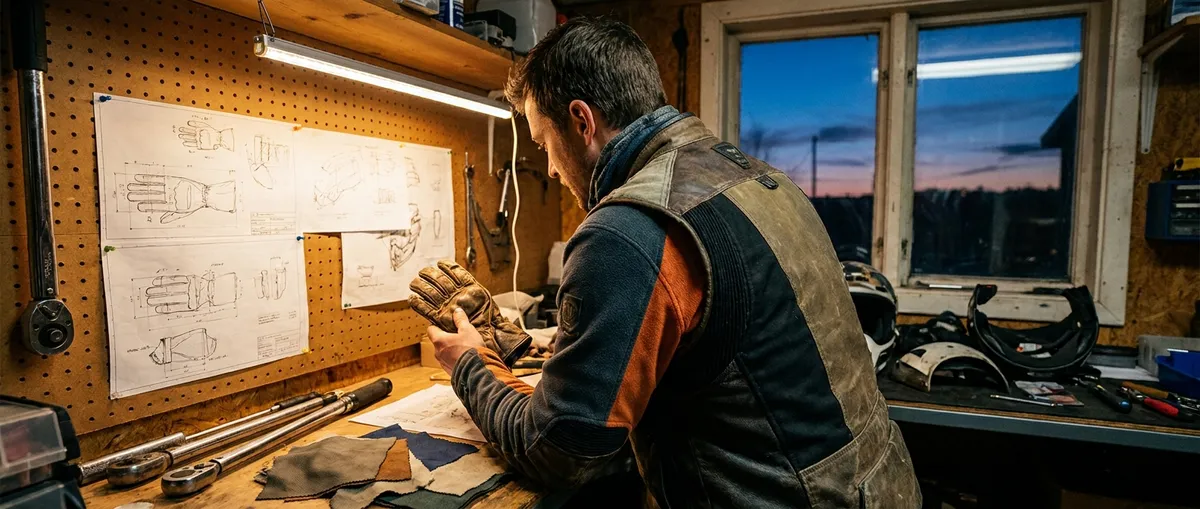
The gear you wear is not a costume; it’s a mobile engineering system wrapped around your body. Every zipper, seam, vent, layer, and buckle translates directly into heat management, impact control, and cognitive load on the bike. When you stop treating gear as “stuff you buy” and start treating it as an integrated system, your riding changes. This isn’t about brand hype; it’s about understanding the physics, materials, and ergonomics that actually keep you functional when things go right—and survivable when they don’t.
System Thinking: Building a Gear Stack, Not a Gear Pile
Most riders accumulate gear reactively: a jacket here, gloves there, boots when the old pair dies. That’s a pile, not a system. A gear system starts with use-case and operating envelope: temperatures, speeds, distances, and surfaces you actually ride.
Think in layers that map to engineering functions, not just clothing categories. Your base layer is a moisture transport system; its job is to move sweat away from skin so evaporative cooling can work and so your insulation can stay dry and effective. The mid layer is your thermal resistance element—typically a compressible material that traps air (the real insulator). The shell layer is a structural and environmental barrier: abrasion resistance, impact coverage, wind and water management.
When you align all three, you reduce noise in the system: less overheating, fewer cold spots, more predictable grip from your hands and feet, and a clearer brain thanks to stable core temperature. That stability directly affects reaction time, fine motor control on the levers, and decision-making under stress.
Technical Point 1: Abrasion Physics and Why Fabric Ratings Actually Matter
Abrasion resistance isn’t magic; it’s energy management. When you slide, kinetic energy is dissipated as heat and fiber destruction. The two key variables are surface type (coarse chip seal vs smooth asphalt) and impact speed. That’s why laboratory abrasion tests exist: to approximate how long a material can delay failure under load.
You’ll see references to EN 17092 classes (A, AA, AAA) or older EN 13595 in some high-end race gear. These aren’t marketing stickers; they’re minimum performance bands in standardized tests. AAA-rated road gear is tested for higher impact and abrasion performance than A or AA, particularly at the zones most likely to contact the ground first—shoulders, elbows, hips, knees, and seat.
Material choice and construction are equally important. High-denier nylons (e.g., 600D+), advanced polyamides, Cordura blends, and leather all behave differently under heat and shear. Leather typically fails by thinning and eventually tearing; synthetics often fail catastrophically when they melt through once the temperature spikes. That’s why many serious touring or track outfits use layered structures: outer abrasion shell, sometimes a secondary reinforcement layer, then armor, then your base layers. The more controlled the failure sequence, the longer your skin stays out of the equation.
Technical Point 2: Impact Energy Management and Proper Armor Tuning
Impact protection is not just “does it have armor?” but “how does that armor manage energy and fit in the load path between ground and bone?” CE EN 1621-1 (for limbs) and EN 1621-2 (for back) define impact attenuation thresholds (e.g., Level 1 vs Level 2) by how much force passes through to your body.
A Level 2 protector allows significantly less transmitted force than Level 1, but that gain means nothing if the armor is floating, misaligned, or rotates away in a crash. The joint between garment ergonomics and armor geometry is critical. Shoulder and elbow pieces should cup and wrap, not skate on top of the joint. Knee armor needs to stay put through a full range of motion: seated, standing on the pegs, off the bike walking. If it only aligns when you’re standing in front of a mirror, it’s wrong.
Modern viscoelastic armors (e.g., D3O-type materials) are engineered to remain flexible under low-speed movement and stiffen rapidly under impact, spreading and slowing the load. Hard shell over soft armor can help with puncture resistance and point impacts but may increase bulk or reduce comfort. Smart tuning involves choosing armor that matches your riding context (e.g., more extensive chest and back coverage for higher-speed work, extended tailbone and hip protection for urban and ADV drops) while ensuring the garment’s sleeve and leg patterns are cut to keep that armor locked into your personal biomechanics.
Technical Point 3: Thermal Regulation as a Performance Variable, Not Just Comfort
Your core temperature directly influences your brain’s processing speed and your muscle control. Prolonged hyperthermia degrades reaction time, increases fatigue, and can produce genuinely dangerous decision errors. Effective motorcycle gear is a thermal management system with configurable resistance and flow.
In hot conditions, you’re balancing airflow against dehydration and sun load. Textile shells with strategically placed, controllable vents (chest, biceps, back exhaust, thigh, and calf) create a pressure gradient that pulls air through—intake low and forward, exhaust high and rearward. Perforated leather suits rely on ram-air through perforations plus localized stretch panels; they’re tuned for apparent wind at speed, not stop-and-go heat soak.
Underneath, a technical base layer with low water retention and high wicking (polyester blends, merino engineered for warm conditions) builds an evaporative engine against your skin. In cold conditions, that same wicking layer prevents sweat from freezing you once you slow down, while lofted mid layers and wind-blocking shells control convective loss. Static insulation R-values matter much less than how well the system works under riding-specific conditions—tucked posture, exposed neck, wind-driven rain, and repetitive acceleration/deceleration.
The goal is predictable thermoregulation: gear that can shift modes with venting, removable liners, or modular layers so you stay within a narrow temperature band where your brain and muscles operate optimally for hours.
Technical Point 4: Glove and Boot Engineering for Control Fidelity
The contact between rider and machine is not conceptual; it happens through specific interfaces: grips, levers, pegs, and controls. Gloves and boots act as both protective shells and signal filters. Too much cushioning or stiffness and you lose feel; too little and you risk catastrophic injury.
For gloves, think in three layers of function: outer abrasion shell (leather, advanced synthetics), impact and slide management (knuckle armor, palm sliders, scaphoid protection), and tactile interface (finger tips, palm thickness, seam placement). The scaphoid (small wrist bone) is particularly vulnerable in typical “hand out” falls; dedicated scaphoid sliders are engineered to encourage the hand to slide rather than dig in and twist. Double-stitched external seams on high-risk areas reduce bursting; pre-curved finger construction lowers grip force over long distances.
Boots must connect you securely to the pegs while protecting against crushing, torsion, and hyperextension. Look for defined shank constructions (often reinforced midsole) that distribute peg pressure and support standing riding. Ankle bracing systems, hinge designs, and hard toe/heel cups create a protective exoskeleton tuned to flex primarily in the sagittal plane (forward/back movement needed for shifting and braking) while resisting lateral twisting. Outsole compound and tread design determine how confidently you can dab or paddle on gravel, wet paint, or oil without losing balance. Your boots should feel like a mechanical extension of the bike’s controls, not like soft sneakers or ski boots.
Technical Point 5: Aerodynamics, Noise, and Cognitive Load in Helmet Selection
Helmets are life-support systems, not fashion accessories. Beyond impact attenuation (governed by standards such as DOT FMVSS 218, ECE 22.05/22.06, Snell), their shape and venting define how much fatigue they will impose through aerodynamic drag, buffeting, and noise.
At speed, turbulent airflow around the shell can induce lift, yaw, and oscillations that your neck muscles must constantly counter. A well-designed helmet uses shell shaping, rear spoilers, and controlled vent channels to stabilize the lid in your main riding posture. What feels fine at 30 mph might become a neck workout at 80 mph if the aero is wrong for your bike’s screen height and your torso angle.
Noise is not just annoyance; prolonged exposure to wind noise at highway speeds can cause permanent hearing damage and elevate stress hormones, degrading concentration. Helmet shell shape, seal quality around the visor, neck roll design, and vent architecture strongly affect acoustic performance. Even with earplugs (which you should use for anything beyond short, slow rides), a quieter baseline helmet reduces cognitive load and fatigue. Good vent design pulls moist, warm air out while minimizing whistling and roar, using pressure differentials created at the intakes and exhaust ports.
Inside, the EPS liner density is tuned in zones to manage different impact profiles—so cutting or heavily modifying padding beyond fit tuning is a direct compromise to the engineered energy path. Fit must be snug but not painful, with even pressure around the crown and cheeks; hotspots, pressure points, or ‘float’ zones are red flags that the helmet’s internal shape doesn’t match your head form.
Conclusion
Gear is a riding system, not a shopping list. When you understand the engineering behind abrasion, impact energy, thermal regulation, control fidelity, and aerodynamic noise, you can build a kit that amplifies your capability instead of quietly eroding it. The right gear doesn’t just save you in a crash; it sharpens your perception, preserves your focus, and extends the envelope where you can ride hard and stay mentally clear.
Treat your next gear decision like a chassis setup change: define your target conditions, understand the physics involved, and choose components that work together as an integrated system wrapped around you. That’s how you stop being a passenger in your own equipment and start riding inside a tool that’s been engineered—by you—for the way you actually ride.
Sources
- European Commission – Motorcycle Protective Clothing and EN 17092 - Overview of motorcycle PPE standards, including abrasion and impact requirements under EN 17092
- Snell Memorial Foundation – Helmet Standards - Detailed technical information on motorcycle helmet impact testing and performance criteria
- U.S. Centers for Disease Control and Prevention – Occupational Noise and Hearing Loss - Data on noise exposure, hearing damage thresholds, and relevance to high-noise environments like motorcycling
- Harvard T.H. Chan School of Public Health – Heat Stress and Performance - Explanation of how elevated core temperature affects cognition, fatigue, and physical performance
- University of Wisconsin-Madison – Fundamentals of Heat and Mass Transfer (Course Resources) - Background on convective and evaporative heat transfer concepts relevant to thermal management in clothing systems
Key Takeaway
The most important thing to remember from this article is that this information can change how you think about Gear & Equipment.