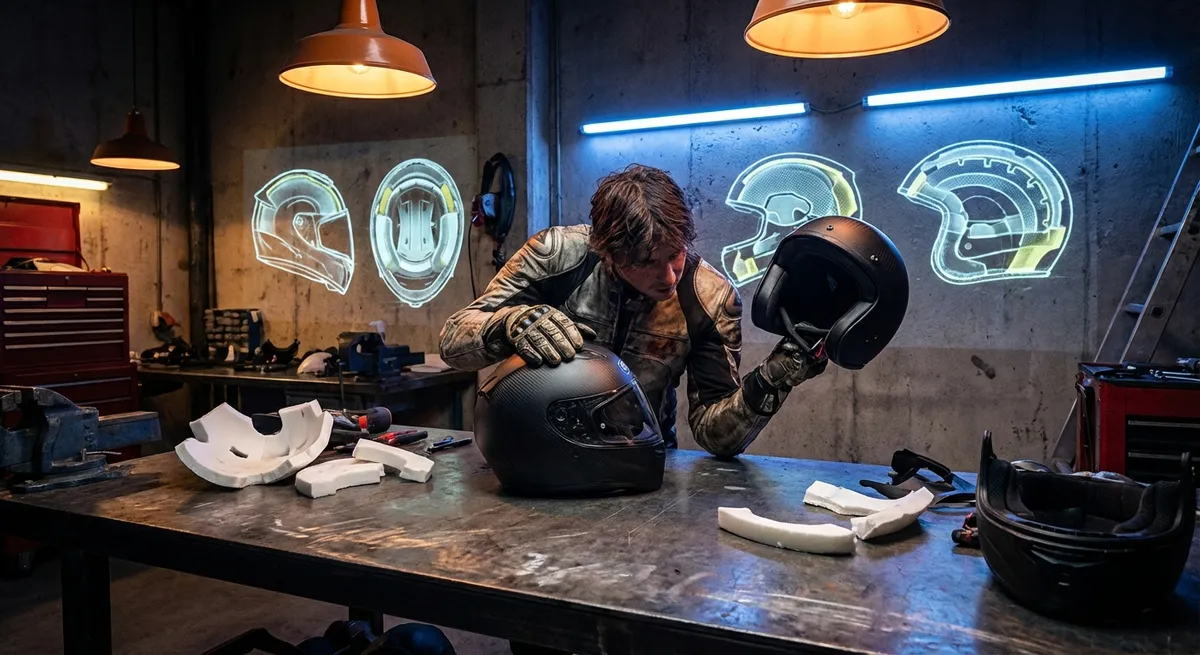
Your helmet is the one piece of gear that has to be “on the limit” every single ride. It’s an aerodynamic fairing for your head, an impact energy management system, an acoustic shell, and a life-support interface for vision and communication—all at once. Yet most riders still choose one based on paint, brand loyalty, and whether it fogs up on a cold morning.
This isn’t a style decision, it’s an engineering problem you wear at 80 mph. Let’s tear into the tech that actually matters so you can pick (or upgrade) a helmet like a test rider, not a casual shopper.
1. Impact Energy Management: Beyond “It Has a Safety Sticker”
Helmet safety isn’t binary—“safe” or “unsafe”—it’s about how the shell and liner manage impact energy across different crash scenarios. Traditional EPS (expanded polystyrene) liners are tuned for a specific deceleration range: they crush once, in a controlled way, to keep peak g‑loads on your brain below a survivable threshold. But real crashes aren’t lab-perfect: your head might hit at an oblique angle, at a lower speed than the test, or with multiple impacts.
Modern designs use multi-density EPS or segmented EPS “zones” to address that variability. Softer foam layers handle low-to-medium energy hits (the kind that can still cause concussions), while denser zones are placed where high-energy impacts are most likely—usually at the crown, forehead, and sides. Some helmets integrate slip-plane systems (like MIPS or proprietary rotational liners) that allow the liner to shear a few millimeters relative to the shell, bleeding off rotational acceleration before it reaches your brain.
When evaluating your next helmet, dig for more than “meets ECE/DOT/SNELL.” Look for:
- Multi-density or multi-layer EPS called out explicitly in the tech specs.
- Any rotational management tech and whether it’s been third‑party tested.
- How the internal structure is laid out: some brands publish cutaway diagrams—study them like a chassis cross‑section.
If a manufacturer only talks graphics and vents, but won’t show you the “inside story” of their energy management, treat it like a bike review that never mentions the suspension.
2. Shell Construction: Composite Layups, Flex Profiles, and Real-World Tradeoffs
The outer shell isn’t just there to look pretty and pass penetration tests—it controls how impact loads are spread across the EPS liner and how the helmet behaves at speed. Polycarbonate shells are generally heavier and rely more on the EPS to manage the energy, while composite or carbon shells can be engineered with variable stiffness and flex profiles.
Think in chassis terms: a shell that’s too stiff can spike loads into the EPS and your skull, while a shell that’s tuned with strategic flex can increase the “crumple zone” and extend the time over which deceleration happens. High-end helmets use fiber orientations and layered weaves (fiberglass, aramid, carbon) to build in different flex behaviors at different regions—stiffer around the base for structural integrity, more compliant at the crown and sides for controlled deformation.
When you’re comparing gear:
- Pay attention to shell materials—“fiberglass composite” is usually a step up from polycarbonate, and multi-composite (fiberglass + carbon + aramid) gives more tuning opportunities.
- Check how many shell sizes are offered. A helmet with only two shell sizes for a full size range forces some heads into thicker or thinner EPS, affecting both fit and impact performance.
- Look for wind tunnel development or CFD-backed aero design; a well-shaped shell reduces buffeting, which means less micro-strain on your neck and better stability during emergency inputs.
You feel the difference on a long, fast ride: a properly tuned shell doesn’t just pass tests—it disappears around you like well-set-up suspension.
3. Aerodynamics and Stability: Why Your Helmet Is Part of the Chassis
At highway speeds, your helmet is a moving aero surface bolted to the top of your steering column: your neck. Any lift, drag, or turbulence at the shell translates into rider fatigue and reduced precision at the controls. If your helmet starts to tug when you shoulder-check or dance in crosswinds, you’re essentially fighting a dirty fairing with human muscles.
Look for spoilers and stabilizers that aren’t just cosmetic. Rear diffusers, side stabilizers, and carefully sculpted chin bars manage laminar flow and pressure zones around the helmet. The goal: reduce lift at speed, minimize yaw instability in turbulent air (like riding behind SUVs), and control where the wake detaches so you’re not getting randomly yanked by the wind.
What matters in real use:
- Stability at your actual riding speeds: a “sport-touring” helmet may be more stable in semi-upright positions at 70–90 mph than a pure race helmet tuned for full tuck at 150+.
- How the helmet behaves when you turn your head quickly—do you feel resistance building like a sail, or a controlled, predictable drag?
- Integration with your bike’s screen and ergonomics. A helmet that’s magic on a naked bike might get hammered by turbulence behind a tall touring screen.
If you can, test-ride helmets back-to-back in the same conditions. Note neck fatigue, how much you subconsciously “brace” your head at speed, and whether emergency head checks feel frictionless or like breaking through a pressure wall. That’s aero design—or lack of it—talking.
4. Ventilation and Acoustic Tuning: Managing Heat and Noise, Not Just Airflow
Ventilation isn’t about how many vents you can count—it’s about how air moves from high-pressure to low-pressure zones through your helmet’s internal channels. A well-engineered system uses the airflow over the shell to actively pull hot, moist air out of the liner, not just dump cool air on your forehead and call it a day.
Internal EPS channeling is critical: intake vents must connect to sculpted tunnels that run above your head and exit cleanly, usually out the back or sides. The more defined those paths, the more predictable the cooling. In hot conditions, this is the difference between a helmet you can lock into for a full tank and one you subconsciously crack open every five minutes.
But airflow has a cost: noise. Pure airflow often means more turbulence and sound pressure inside the lid. High-end helmets tackle this with:
- Neck rolls and cheek pads that seal effectively without crushing your jaw.
- Carefully shaped visor seals and side pods that don’t generate whistling eddies.
- Acoustic liner materials that absorb high-frequency noise rather than just block it.
You’re aiming for a helmet that keeps your head cool enough and your ears quiet enough that you don’t get cognitively drained on a long ride. Chronic noise fatigue blunts reaction time and situational awareness as surely as heat exhaustion. When you read reviews, pay particular attention to riders who talk about days-long comfort, not just “feels airy in the parking lot.”
5. Optics, Sealing, and Interface: The Visor System as a Performance Component
Your visor is effectively your HUD window. If the optics are distorted, the seal is weak, or the mechanism is sloppy, your riding suffers in ways that are hard to quantify but very real at the limit. Poor optical clarity can make you misjudge gaps, apexes, and peripheral movement; a badly sealed visor can fog at the exact moment you need the most visual data.
Look for visors made from optically correct polycarbonate or similar materials, preferably stamped or injection-molded with minimal distortion. Some brands explicitly state “class 1 optics” or compliant distortion standards—this matters if you’re sensitive to visual warping at the edges.
Key technical features that pay dividends:
- Positive, precise detents: the visor should lock, half-lock, and crack-open with repeatable positions you can find with gloves on, without flexing the shield or the side plates.
- Robust sealing: a continuous gasket around the eyeport with even pressure across the entire perimeter reduces water ingress, noise, and fogging.
- Pinlock or integrated anti-fog systems: not just included, but properly sized and positioned so you don’t get a double image or halo effects at night.
Also consider how the visor system integrates with your lighting conditions and riding style. Quick-change mechanisms matter if you regularly swap from clear to dark or photochromic shields. Internal sun visors are convenient, but they add complexity and sometimes compromise shell thickness in the forehead region—understand the tradeoff for your use case.
When you treat the visor as a true performance interface, not a clear piece of plastic, your next helmet choice gets a lot more focused—and your riding vision gets a lot more precise.
Conclusion
The right helmet isn’t just “comfortable and cool-looking”—it’s a tuned, composite system that manages impact energy, airflow, vision, and stability around the most important component on your bike: you.
Approach your next upgrade like you’re speccing a race chassis. Ask what the shell is made from and why, how the EPS is structured, how the aerodynamics were developed, how the ventilation paths are designed, and what level of optical and sealing engineering went into the visor system.
When you start thinking in those terms, your helmet stops being a passive requirement and becomes an active performance tool. And once you feel that difference at speed—in stability, clarity, and zero-distraction focus—you won’t go back to choosing lids by paint scheme ever again.
Key Takeaway
The most important thing to remember from this article is that this information can change how you think about Gear & Equipment.