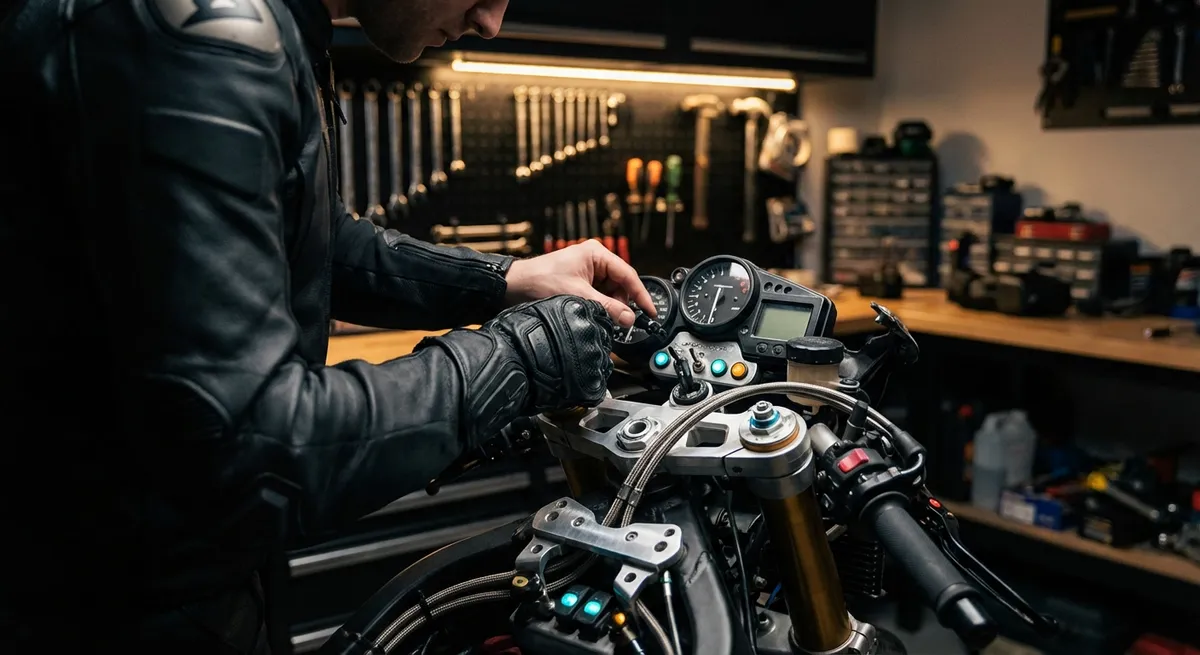
The fastest upgrade most riders never make is not more horsepower or stickier tires—it’s turning the cockpit into a high‑bandwidth, low‑friction interface between brain, body, and machine. The way your controls, levers, display, luggage, and protection are configured decides how much of your attention goes to riding and how much is wasted managing discomfort, glare, or awkward reach. This is where gear and equipment stop being accessories and start becoming mechanical extensions of your nervous system.
This is not a style exercise. It’s an engineering project you sit inside every single ride.
Control Geometry: Lever, Pedal, and Bar Setup as a Human-Machine Interface
Control placement isn’t “comfort fluff”—it’s applied biomechanics. You’re optimizing the kinematic chain from shoulder to fingertip and hip to toe so your inputs are fast, repeatable, and low effort.
On the bars, your wrist angle under braking is the red flag. In a proper setup, when you’re in a standing attack or sport riding crouch with elbows slightly bent, your forearm should form a nearly straight line through your wrist into the lever blade. If your levers are rotated too high, your wrist cocks upward under braking, loading small extensors and limiting fine modulation. Too low, and you’ll overflex, sacrificing strength and control. Rotating the master cylinder clamps in 3–5° increments and testing under real braking loads is the correct approach—not guessing in the garage.
Lever reach adjusters aren’t just for small hands. You’re tuning mechanical advantage versus throw. Bringing the lever in typically reduces effort but increases travel; pushing it out increases effort but shortens the stroke. Ideally, you should be able to fully load the brake to the threshold of ABS using only two fingers without the lever touching the remaining fingers on the bar. If it does, you’re forced into inefficient four‑finger braking that compromises bar control.
Foot controls follow the same logic. Set the shift lever so that, in your normal riding boot, you can preload the lever with the ball of your foot without lifting your heel off the peg. For rear brake, your ankle should be neutral—neither flexed nor extended—when you first contact the pedal. This reduces accidental brake dragging and improves repeatability in trail braking.
Finally, bar width and sweep matter. Excessive sweep (bars pulled too far back) rotates your elbows inboard, which reduces your ability to absorb inputs and steer precisely. Experiment with small bar rotations, or even different bar bends, to achieve a neutral wrist angle with elbows slightly out and shoulders relaxed. Control geometry isn’t an aesthetic decision; it is the front line of your human-machine interface.
Visual Systems: Helmet, Visor, and Display as an Optical Stack
At speed, your eyes are running a continuous closed‑loop control system: detect, predict, correct. Any delay or noise in that system—fogging, glare, distorted optics—adds latency you’ll pay for in corner entries and hazard avoidance.
Your helmet visor is effectively a curved, transparent lens. Better lids use optically correct visors with minimal distortion across the field of view. You can test this quickly: look at a straight vertical line (doorframe or pole) through different parts of the visor. Significant “bending” of the line indicates distortion that can subtly fatigue your eyes and slow saccades over longer rides.
Anti-fog technology is not just convenience, it’s system uptime. Hydrophilic inner coatings and Pinlock-style inserts work by absorbing or separating condensation before droplets become scattering points. The key technical point: their performance is contingent on a clean, sealed interface. Tiny gaps around the edge of an insert create micro temperature differentials that reintroduce fog. Install the insert evenly, and replace it when the seal loses tension.
On the bike, your dash brightness and contrast should be tuned for peripheral readability, not just raw brightness. If your display forces central fixation to decode speed or gear, you’re stealing attention from the vanishing point and mirrors. High-brightness TFTs with auto-dim sensors help, but you still need to calibrate. In dark conditions, excessive dash brightness destroys night vision; it constricts your pupils and reduces sensitivity to unlit hazards. The ideal setting is just bright enough to be legible with a soft glance but dim enough that your eyes can re-acquire the road instantly.
Photochromic or interchangeable visors and glasses act as adaptive filters in this system. The priority isn’t looking cool—it’s maintaining a consistent visual “gain” from dense shade to full sun. If you ride through variable light (trees, canyons, city), a rapid-transition visor or carrying a secondary clear visor can be the difference between smooth visual processing and constantly over/under‑exposed vision.
Treat your optical stack—helmet visor, any eyewear, and dash—as one integrated system. The goal is simple: zero fog, minimal distortion, and instant information acquisition without dragging your gaze off the road.
Load Path Engineering: Luggage, Racks, and Weight Distribution
Most riders treat luggage like storage. In reality, it’s structural engineering strapped to a dynamic system. Where and how you carry mass radically alters chassis behavior, steering effort, and suspension performance.
Start with the concept of a load path. Every rack or luggage system transmits load into the bike at specific points—subframe, passenger peg brackets, or dedicated mounting bosses. Lightweight aluminum subframes on many modern bikes are designed with finite fatigue limits; overloading them with top-heavy boxes creates a cantilevered bending moment that the original engineering never assumed. Hard top cases mounted far behind the rear axle are the worst offenders, acting as a lever arm that lightens the front end and amplifies weave at speed.
Technically, you want your heaviest static loads as low and as close to the bike’s longitudinal center of mass as possible. This is why well-engineered pannier systems hug the sides and sit forward, often just above or slightly behind the rider’s calves. Soft luggage with compression straps allows you to cinch the mass tight, reducing oscillations. Any ability of the luggage to swing or flap turns it into a moving, time-varying load that the suspension constantly has to correct for.
Pay attention to mounting hardware. High-quality racks distribute load across multiple attachment points, often triangulated, creating stable load paths that resist torsion. Single-point or poorly triangulated mounts can flex, fatigue, and eventually crack, especially on rough roads. If you’re riding off‑road with luggage, check fasteners regularly and consider using threadlocker and safety wire where appropriate.
Finally, interact this with suspension. Additional luggage weight should not be “absorbed” by your sag alone. Increasing rear preload to bring your rider+gear sag back into spec (typically around 30–35% of total travel for mixed use) maintains steering geometry and stability. If your bike gains 20–30 kg of travel gear and passengers, you’re outside the OEM calibration envelope; uprated springs may be less glamorous than new aluminum cases, but they’re the upgrade that keeps the system honest.
Engineer your luggage as part of the chassis—not an afterthought hanging off it.
Impact and Abrasion Systems: Armor That Actually Works Under Load
Protective gear isn’t just “CE rated” or “not.” Those labels hide a lot of physics about energy management, friction, and fit. To turn your kit into a true safety system, you have to understand what’s happening at the material and interface level.
CE impact ratings (EN 1621) quantify how much force gets transmitted through armor to your body after a standard impact. Level 1 allows up to 18 kN average transmitted force; Level 2 cuts that to 9 kN. In practical terms, Level 2 spreads and slows the impact more effectively, especially for high‑energy crashes. But the material construction matters: viscoelastic foams stiffen on impact, while multi-layer composites and 3D-printed structures use geometry plus material properties to control load paths.
Abrasion resistance standards like EN 17092 (for garments) test how long a material survives sliding against a specific abrasive surface before failure. Here, textiles with high denier, advanced weaves, or blends (e.g., aramid, UHMWPE) can approach or exceed leather performance in key zones. The most important detail: zoned construction. Shoulders, elbows, hips, and knees should use higher-spec materials and multiple layers, while less critical areas can use lighter fabrics without compromising core protection.
However, the most technical failure mode of armor isn’t in the lab—it’s in fit. Armor that shifts even 2–3 cm under impact or slide can leave joints partially unprotected. In engineering terms, your body and armor must remain mechanically coupled throughout a chaotic, high-G event. This is why properly placed adjustment straps on the arms, waist, and legs are not cosmetic. They are part of the retention system that keeps armor aligned with your skeletal structure.
Don’t ignore fastening systems either. Zippers, snaps, and stitching must withstand peel forces when garments catch on surfaces during a slide or tumble. Double or triple-stitching, bar-tacking at stress points, and robust connection zips between jacket and pants reduce the likelihood of catastrophic garment failure, where skin suddenly becomes the abrasion layer.
When evaluating gear, think like an engineer: How is impact energy absorbed and spread? How is abrasion delayed? And, crucially, how is all of this reliably kept in the correct place on your body when everything is going wrong?
Thermal and Moisture Management: Building a Stable Rider Microclimate
Your body is part of the bike’s performance envelope. If your core temperature or hydration drifts outside a narrow band, your reaction time, vision processing, and decision-making degrade—often before you consciously feel “off.” The gear you wear is a microclimate control system, and getting it right is a technical exercise, not guesswork.
Moisture-wicking base layers are non-negotiable. Cotton traps sweat; synthetic or merino blends transport moisture away from the skin via capillary action, allowing evaporation to occur at the garment surface instead of against your body. This evaporation is the heat sink that keeps your core in check. A proper base layer also reduces friction hot spots, which matter during long rides when micro-movements can lead to chafing and altered posture.
Waterproof membranes like Gore‑Tex and comparable technologies operate on differential vapor pressure: water vapor passes through microscopic pores, while liquid water is blocked. But their performance is load- and condition-dependent. High humidity and low temperature gradients reduce the driving force for moisture to escape, so vent management becomes critical. Opening intake vents without providing exhaust pathways creates localized cooling but can trap moisture deeper in your layers. Always think in terms of flow: air must enter and exit to carry heat and moisture away.
In hot climates, vented gear and mesh panels work by maximizing convective heat transfer. Direct airflow over a wet base layer can produce significant cooling—almost too much if you’re not careful. At highway speeds, fully open vents can overcool joints and muscles, leading to stiffness and reduced fine control. Partial vent closure or using wind-blocking layers over high-flow mesh during long, high-speed stints can balance cooling with muscular performance.
In cold conditions, mid-layer selection becomes about trapped air volume and stability. Lofted insulation (down or synthetic) works by trapping air; compression under tight jackets or at elbow creases reduces effective insulation dramatically. That’s why purpose-built moto mid-layers use mapped insulation, keeping bulk where it can survive compression and thinning it where articulation matters.
Treat your apparel system as a tunable thermal circuit. Your goal is a stable core temperature and dry skin across changing external conditions, so your brain can spend its processing budget on lines, traffic, and traction—not on trying to keep you alive.
Conclusion
Your motorcycle doesn’t stop at the frame. The cockpit, controls, luggage, armor, and clothing are all part of one integrated dynamic system: you plus machine. When you configure gear with the same technical intent you’d apply to suspension or fueling, everything sharpens. Inputs become cleaner. Vision becomes clearer. Protection becomes more reliable. Fatigue recedes into the background.
This is what a frictionless interface feels like: nothing calling attention to itself, every component quietly doing its job so you can do yours—riding hard, precisely, and for a very long time.
Sources
- [Gore-Tex: How It Works](https://www.gore-tex.com/technology/how-it-works) - Technical overview of waterproof/breathable membrane function and moisture vapor transmission
- [EN 1621-1:2012 Motorcycle Protective Clothing – Limb Joint Impact Protectors](https://standards.cencenelec.eu/dyn/www/f?p=204:32:0::::FSP_ORG_ID:6151) - CEN listing for the standard governing impact protectors used in motorcycle armor
- [MotoCAP Technical Information](https://motocap.com.au/technical-information) - Independent test data and explanations on impact and abrasion performance of motorcycle protective gear
- [NHTSA Motorcycle Safety Facts](https://www.nhtsa.gov/road-safety/motorcycles) - U.S. government data and guidance on motorcycle safety and protective equipment
- [CDC – Heat Stress](https://www.cdc.gov/niosh/topics/heatstress/default.html) - Research-based information on heat stress, thermoregulation, and performance impacts relevant to rider microclimate management
Key Takeaway
The most important thing to remember from this article is that this information can change how you think about Gear & Equipment.