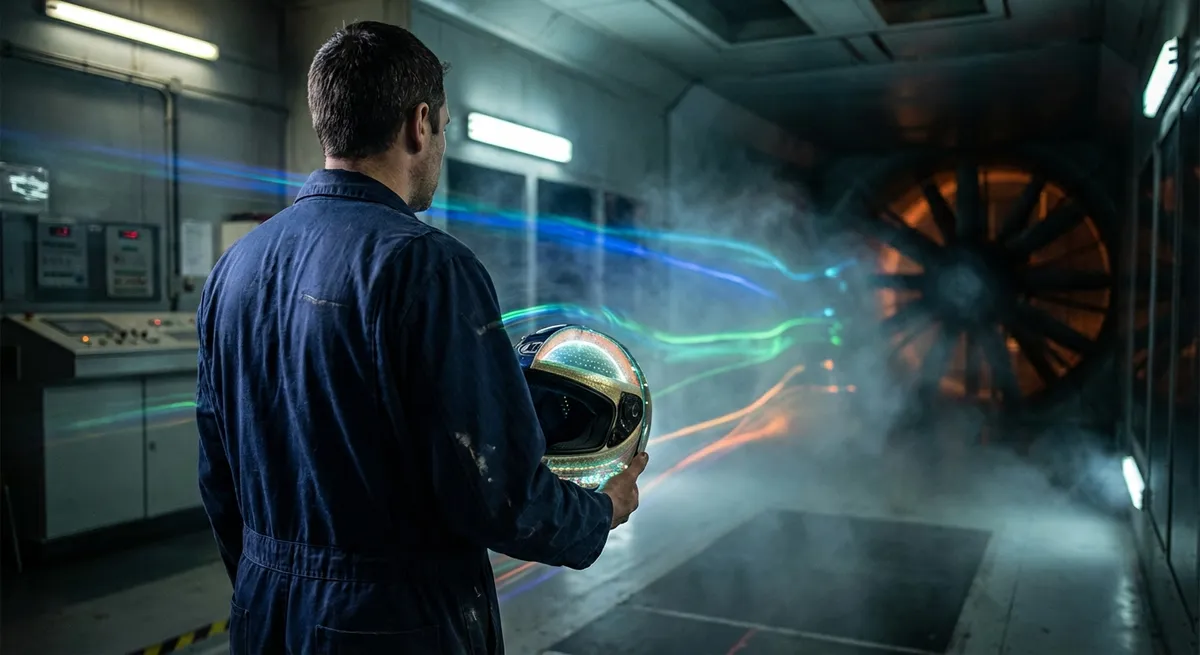
Your helmet is not “a piece of gear.” It is a structural system managing energy, airflow, data, and human perception at highway speeds. Treat it like a system and you move from “I have a helmet” to “I have a tuned head-protection platform built around my riding.”
This is where most riders leave performance on the table. They obsess over horsepower and slip-ons, then wear a 6-year-old helmet with fogged visor, crushed EPS, and random comms double-taped to the side.
Let’s engineer it properly.
Shell, EPS, and Energy Pathways: How Your Helmet Actually Manages Impact
The outer shell and inner EPS (expanded polystyrene) liner are not “hard layer + foam.” They are a paired structure designed to control how impact energy moves and dissipates.
From a technical standpoint:
- Shell stiffness vs. flex
- Polycarbonate / thermoplastic shells tend to flex more, distributing load over a wider area before transferring it to the EPS.
- Fiberglass / composite / carbon shells are stiffer and can be engineered with multi-axial weaves and different resin systems to control where they flex and where they hold.
The goal is controlled deformation, not maximum hardness.
- Single-density vs. multi-density EPS
- Low-density EPS crushes more easily to manage lower-speed impacts.
- High-density EPS resists crush to manage higher-energy hits.
A multi-density EPS liner zones these densities—thicker in areas statistically likely to strike first (forehead, temporal regions).
Impact direction matters
Most real-world helmet strikes are oblique, not perfectly perpendicular. Modern shells and liners are modeled (via finite element analysis, in many cases) to avoid local “spikes” in deceleration by spreading energy across the structure.
Standards tell you priorities, not perfection
- DOT FMVSS 218: US minimum; focuses on linear impact and penetration in fixed, standardized tests. - ECE 22.06: More modern; includes more impact locations and higher test complexity. - Snell: Focuses on high-energy linear impacts and penetration; known for more severe testing. None of these fully represents a real crash, but a helmet tested to multiple standards has usually been engineered with more complex scenarios in mind.
Aging and degradation
EPS can harden or turn brittle through heat, sweat, and contamination from chemicals (cleaners, fuels, hair products). A 7-year-old helmet, even if pretty, is not the same structure it was when new. For high-mileage riders or high-heat environments, 5 years of real use is a more realistic service life than a generic “five to seven.”
Technical takeaway: Look beyond “carbon = best.” Look for multi-density EPS, robust modern certification (ECE 22.06 or Snell + DOT), and a manufacturer that publishes real test/engineering detail—not just graphic options.
Aerodynamics, Stability, and the Hidden Physics of Neck Fatigue
Aerodynamics isn’t about looks; it’s about load paths through your neck and shoulders. Above 100 km/h (60 mph), a poorly designed helmet can be adding continuous torque to your cervical spine—every second of the ride.
Consider these factors:
Drag and lift vectors
Your helmet is a bluff body in turbulent flow. - Drag acts rearward, constantly pulling your head back. - Lift (often upward) can create an unsettling “floating” feeling at speed. A well-designed shell uses pressure management (not just shape) to minimize both. Subtle tail spoilers, surface curvature, and rear exhaust design are all about stabilizing the pressure distribution.
- Buffeting vs. pure wind noise
- Buffeting is pressure fluctuation—your head physically oscillates because the flow field around the helmet is unstable.
- It’s often a system problem involving bike fairing, windscreen angle, rider height, and helmet shape.
A helmet wind-tunnel-tuned for an aggressive sportbike position won’t behave the same on an ADV with a tall screen.
Neck torque and rider position
The moment arm from your spine to the helmet center of pressure changes with riding posture: - Sport / tucked: Flow hits at a downward angle; a good helmet in this space keeps stability in that angle. - Upright / ADV / touring: Flow is more horizontal; different shell profiles and spoilers are optimized for this.
Weight is not the only variable
A 1.2 kg helmet with poor stability can feel worse after 300 km than a 1.5 kg helmet that sits rock-solid in the airstream. The effective fatigue load is a combination of mass + aerodynamic stability + center of gravity height and fore–aft balance.
Real-world testing over spec sheet reading
To properly tune your setup: - Test at your typical cruising speed (not just around town). - Try turning your head 15–20° left/right at speed to check for excessive torque. - Experiment with windscreen height and angle; small changes can drastically alter buffeting.
Technical takeaway: When evaluating helmets, search for wind-tunnel development, position-specific design (sport vs. touring vs. ADV), and rider feedback about buffeting on bikes similar to yours, not just general “quiet” comments.
Shield Systems, Optics, and Your Visual Processing Speed
Your visor is an optical instrument moving through dirty air at closing speeds that routinely exceed 200 km/h when you and oncoming traffic are both in motion. You’re asking your eyes and brain to process high-resolution, high-speed visual data through that layer.
Five technical optics points that matter:
Optical class and distortion
Look for optically correct / class 1 visors (common in high-end helmets and race-spec shields). This reduces warping at the edges and visual distortion when you scan with your eyes instead of turning your head. Distorted optics increase eye strain and slow reaction times.
- Anti-fog architecture (Pinlock vs. coatings)
- Hydrophilic coatings (cheap “anti-fog”) degrade quickly and often fail as a system.
- A Pinlock-style inner lens creates a dual-pane structure with trapped air, functioning like double-glazing on a window to raise the dew point.
For real-world commuting or wet/cold rides, a Pinlock-ready visor with a well-installed insert is practically non-negotiable.
Light management and contrast
- Photochromic visors: React to UV; great for variable conditions, but can be slow to darken/clear and often don’t reach the darkness of a full dark smoke. - Internal sun visors: Convenient but add thickness, complexity, and (sometimes) turbulence and noise. - High-contrast tints (amber/yellow): Increase contrast in low light / fog at the cost of color accuracy; beneficial for seeing surface imperfections.
Seal integrity and pressure control
A high-quality visor seal: - Prevents high-frequency whistling (which is both annoying and fatiguing). - Stabilizes internal pressure during crosswinds, making micro-opening the shield at speed more predictable. The hinge system (eccentric cams, multi-stage ratchets) and gasket design define how stable that seal remains after thousands of open/close cycles.
Field of view and head movement load
A wide horizontal and vertical field of view means: - Less head rotation to check blind spots. - Better peripheral detection of motion (critical for spotting cross-traffic and wildlife). Helmet shells with tall eyeports (common in ADV and some sport-touring models) can dramatically reduce how much you have to crane your neck.
Technical takeaway: Don’t treat the visor as an afterthought. Prioritize optical class, real anti-fog architecture, high-quality sealing, and a field of view appropriate to your riding environment and body position.
Ventilation, Thermal Management, and Cognitive Performance
Riding is cognitive work. Heat buildup inside your helmet degrades that performance long before you feel “overheated.”
Helmets manage thermal load and moisture via a controlled airflow path and material science:
- Convective vs. evaporative cooling
- Convective cooling: Moving air pulls heat from your skin and liner surfaces.
- Evaporative cooling: Your sweat evaporates, carrying heat away.
The helmet’s job is to maintain enough airflow and wicking to keep sweat in the “evaporate, don’t drip” zone.
Vent channel design inside the EPS
When you remove the comfort liner, you should see shaped air channels in the EPS—not just random foam. These channels must connect intake vents to exhaust vents in a coherent path. For high-output riders (spirited canyon riding, track days), effective top and brow venting can be the difference between consistent focus and mental fog.
Chin bar intake and breath management
Chin vents and internal airflow guides: - Reduce visor fogging by directing air up the inner surface. - Control how much cold air hits your mouth and nose directly, which is crucial for winter riding comfort. Advanced systems may use shutters or internal diffusers to fine-tune flow.
- Noise vs. airflow trade-offs
More vents generally equal more openings in the shell, which can increase noise and change local airflow.
High-end lids focus heavily on aerodynamic shaping around vent ports so they pull air efficiently without becoming turbulent noise sources.
Liners as active components
- Moisture-wicking fabrics move sweat off your skin to where airflow can evaporate it. - Multi-density comfort foams help keep the liner in stable contact with your head, preventing hot spots and localized overheating. Removable, washable liners are not just about hygiene; keeping the wicking layer functioning properly is a performance issue.
Technical takeaway: Evaluate helmets for internal vent channel architecture, not just the number of switches on the outside. For hot climates or high-output riding, prioritize effective EPS channeling and quality liner materials over gimmicky vent “count.”
Integration: Comms, Cameras, and the Smart-Helmet Trap
Adding electronics to your helmet can either create a coherent, low-drag information system—or a noisy, draggy mess that compromises safety and comfort.
Five technical points to build a clean, integrated setup:
Acoustic environment and mic placement
Helmet comms performance is largely determined by: - Mic placement (ideally in the quietest local air, often behind a breath guard or in a chin curtain zone). - Interior acoustic profile of the shell and liner. A noisy helmet plus poor mic placement forces aggressive noise-cancelling, degrading voice quality and sometimes situational awareness.
- Embedded vs. clamp-on systems
- Helmet-specific integrated systems use dedicated cutouts for speakers, battery, and wiring. They minimize aerodynamic disruption and weight distribution issues.
- Universal clamp-ons are more flexible but can create drag, local turbulence, and stress on the outer shell if installed poorly.
If you go universal, keep the unit as low-profile as possible and mount it in laminar flow regions.
Speaker positioning and ear health
The difference between “muddy” audio and clear sound is often 2–3 mm of offset. - Speakers should be centered over the ear canal openings, not “in the general ear area.” - Thicker pads or stick-on spacers can bring speakers into the correct plane, allowing lower volume levels—and less long-term hearing fatigue.
Weight and center of gravity with accessories
- Action cameras, lights, and comms all add weight far from the neck pivot, multiplying their perceived load. - Top-mounted cameras (common for POV) raise the center of gravity and increase leverage in buffeting and sudden head movements. Side-mounted units alter yaw dynamics and can increase neck torque in crosswinds.
When possible, choose small, aerodynamic cameras, mount them as close to the shell surface and as low as practical, and avoid heavy accessory stacking.
- Smart helmet features vs. failure modes
HUDs, integrated brake lights, and radar connections look futuristic—but every subsystem is a potential failure mode:
- Extra wiring channels can compromise liner integrity or create hard points.
- Batteries can change heat distribution inside the helmet.
- Bright internal displays can become distracting in low light.
Any “smart” feature must pass this test: Does this materially improve my situational awareness or safety without adding failure risk or distraction? If not, skip it.
Technical takeaway: Treat electronics as part of the helmet’s aerodynamic, acoustic, and structural system. Prioritize clean integration, correct speaker/mic placement, and minimal drag over stacking features for the sake of tech.
Conclusion
A helmet is not just a legal requirement or a fashion choice; it’s a highly engineered, multi-domain system. When you understand how shell construction, EPS zoning, aerodynamics, optics, ventilation, and electronics integration all interact, you stop shopping by graphics and brand hype—and start building a helmet system tuned to your riding style, machine, and environment.
The result is tangible: lower neck fatigue, sharper vision, better focus, clearer comms, and a real edge when things go sideways faster than you can think.
Don’t just buy a helmet. Engineer your headspace.
Sources
- [Snell Memorial Foundation – Helmet Standards and Testing](https://smf.org/standards) – Technical details on impact testing, penetration tests, and performance criteria for Snell-certified helmets
- [NHTSA – FMVSS No. 218 Motorcycle Helmets](https://www.nhtsa.gov/fmvss/motorcycle-helmets) – Official U.S. DOT safety standard outlining test procedures and minimum performance requirements
- [UNECE – Regulation No. 22 (Protective Helmets and Their Visors)](https://unece.org/transport/standards/transport/vehicle-regulations-wp29/un-regulation-no-22) – Full text of the ECE helmet regulation, including the updated 22.06 requirements
- [Shoei Technical Information – Helmet Structure & Aerodynamics](https://www.shoei-helmets.com/info/technology/) – Manufacturer’s overview of shell construction, EPS liners, ventilation, and aerodynamic development
- [Arai Helmet Technology – Ventilation and Shell Design](https://www.araihelmet.eu/en/technology) – Detailed discussion of shell design, EPS configuration, and airflow management from a major premium helmet manufacturer
Key Takeaway
The most important thing to remember from this article is that this information can change how you think about Gear & Equipment.