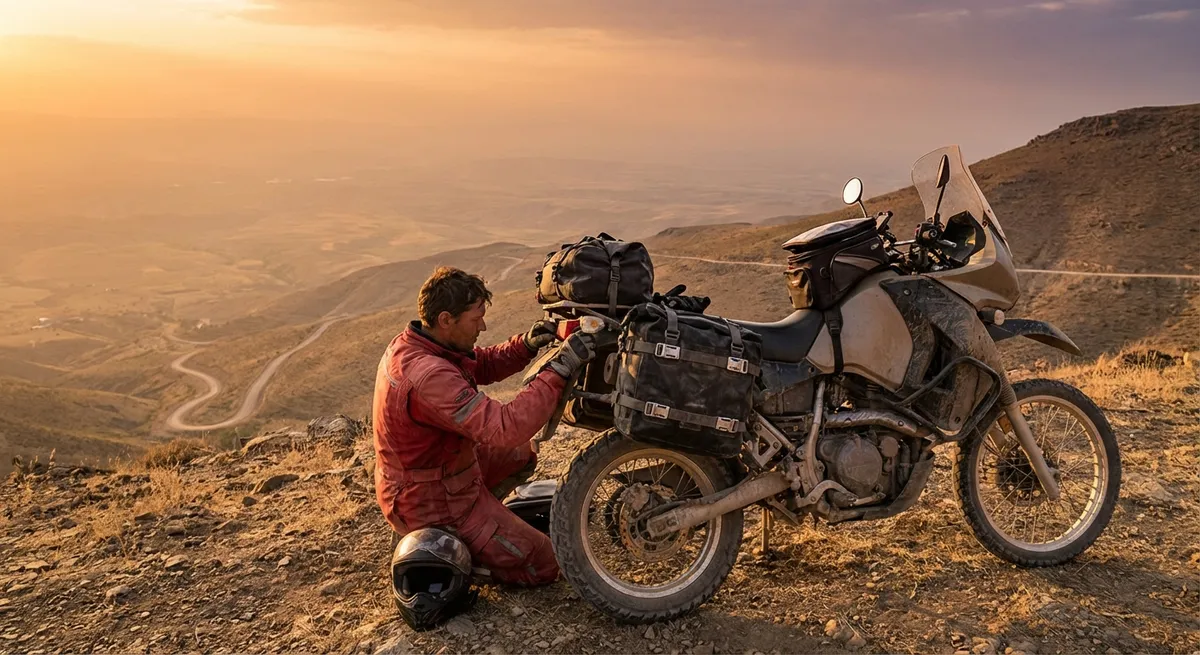
Modern touring isn’t about bolting random bags to a bike and hoping for the best. It’s about engineering a complete load-carrying system that respects geometry, weight distribution, aerodynamics, and the reality of long days in the saddle. When your luggage setup is dialed, the bike feels planted, your body stays fresher, and your gear survives abuse that would shred cheaper solutions.
This is where technical gear choice stops being “accessory shopping” and starts to look a lot more like chassis tuning. Let’s build a serious touring system piece by piece—and make it ride like it belongs on the bike.
Start With the Subframe: Structural Limits and Mounting Logic
Before dreaming about panniers and top boxes, you need to know exactly what your motorcycle’s rear structure can handle.
Most manufacturers publish a maximum “payload” or “rear carrier” limit in the owner’s manual or service data. This isn’t a suggestion; it accounts for:
- Subframe material (aluminum vs steel vs hybrid castings)
- Fastener diameter and grade
- Welded vs bolted joints and their fatigue life
- Bending moments from cantilevered loads (top boxes especially)
A 40 L top case stuffed with dense gear (tools, water, chain, laptop) can easily exceed 10–12 kg. Mounted far aft, that weight exerts a much higher leverage on the subframe than its raw mass suggests. You’re not just adding weight—you’re adding a bending moment and dynamic loads from bumps, pitch under braking, and chassis flex.
Technical points to consider:
- Subframe rating vs system rating: If the manual calls for a 10 kg limit on the rear rack and your top box is rated for 12 kg, the limiting factor is the bike, not the box. Treat the lower number as absolute.
- Rack triangulation: Better luggage racks use triangulated supports tied into multiple frame points—often the passenger peg brackets and a cross-brace. This converts flex-prone cantilever loading into more stable load paths. When shopping for side racks or a rear carrier, look for gussets, braces, and multi-point tie-ins.
- Avoid single-bolt stress risers: Some cheap racks concentrate load through a small number of undersized bolts. Those turn into stress risers in the frame or subframe. Quality kits use larger-diameter fasteners, wide spacers, and load-spreading brackets to keep local stress below fatigue limits.
- Check fastener spec and torque: Use the manufacturer’s torque values, apply medium-strength threadlocker where specified, and re-torque after the first 500–1000 km of loaded use. That’s when components “bed in” and small clearances close up.
- System planning: Decide early if you’ll run side cases, soft bags, or a hybrid setup. Side racks may support a tail rack and vice versa—buying a modular “system” from one brand often yields better structural coherence than mixing parts.
In short: treat the rear of the bike like a structural engineering problem, not a cargo shelf. If your mounting points and subframe are sound, everything else becomes more predictable and safer.
Soft vs Hard Luggage: Materials, Friction, and Crash Behavior
Choosing between hard cases and soft luggage is more than a style decision—it’s a physics and materials problem.
Hard cases (aluminum or plastic)
- Load path: Hard cases transfer impacts and vibration directly into mounting hardware and racks. In a tip-over, they act like long levers, applying torsion to racks and subframes.
- Energy absorption: High-quality plastic cases (like ABS or reinforced polymers) can deform and absorb energy; aluminum tends to dent and crease, sometimes permanently.
- Friction and sliding: Hard, smooth surfaces reduce friction in a slide, which can help the bike slide instead of snagging. But on rough terrain, edges can catch and induce violent rotation.
- Sealing: Hard cases typically offer very good water and dust resistance via molded seals or gaskets and compression latches.
Soft luggage (textiles and laminates)
- Energy dissipation: High-denier nylon (e.g., 1000D Cordura), ballistic nylon, or UHMWPE blends (Dyneema/Spectra) deform and absorb energy in tip-overs and low-speed offs, reducing peak loads into racks.
- Tear resistance: Look at denier rating, weave, and reinforcement zones. Double-layered panels and Hypalon (synthetic rubber) reinforcements in high-abrasion zones dramatically extend lifespan.
- Crash behavior: Soft bags can deform around obstacles instead of turning into rigid hooks that flip the bike. On dirt and mixed surfaces, this is a major advantage.
- Waterproofing architecture: The best systems decouple structure and waterproofing—an abrasion-resistant outer shell plus removable welded-seam dry bags. This spreads wear over a sacrificial layer while keeping the waterproof core intact.
Technical point #2: Know your materials
Look for precise fabric and construction specs, not just marketing claims:
- Cordura 500D vs 1000D (500D is lighter and more flexible; 1000D is more abrasion-resistant)
- Coated vs laminated fabrics (laminates tend to offer better long-term waterproofing)
- RF (radio-frequency) welded seams vs stitched + taped (RF welded is the gold standard for waterproof bags)
If your riding includes dirt, off-road, and frequent drops, structurally-supported soft luggage with proper racks usually offers the best balance between durability, weight, and crash behavior.
Tank Bags and Weight Distribution: Steering Feel and Human Factors
Tank bags seem simple until you feel your front end go vague on a fast sweeper—or your phone dies because you cooked it in a greenhouse.
A tank bag changes two critical interfaces: bike-to-rider and bike-to-road.
Steering and mass distribution
- Mass placement: Keeping weight centered and low is ideal. A compact, low-profile tank bag close to the steering stem adds little to the moment of inertia around the steering axis.
- Steering input: Overloaded, tall tank bags can interfere with bar lock and restrict body movement, especially when standing on the pegs or hanging off in twisties.
- Fuel tank shape: On steeply sloped tanks, load sits higher and further rearward, magnifying its effect on center of mass and braking pitch.
Technical point #3: Target a functional load envelope
For most street and mixed-use riders:
- Aim to keep tank bag load under ~3–4 kg total (including bag)
- Pack dense items (tools, batteries, heavy electronics) lower and closer to the steering head
- Use side pockets for light, bulky items only
Magnetic, strap, or ring mount?
- Magnetic: Fast and convenient on steel tanks, but can shift under hard braking or off-road hits, and magnets can trap metallic debris that scratches paint.
- Strap: Universally compatible and stable, but slower for fuel stops, and poor routing can chafe paint or wiring.
- Tank-ring systems: Mechanically elegant—fixed ring on the filler, bag clips on/off. They isolate the bag from paint and make refueling fast, but capacity is usually lower.
Electronics and thermal management
Tank bags with clear map/electronics windows can trap solar load. Your phone, GPS, or power bank can easily exceed safe operating temps.
- Use ventilated mounts or mesh pockets for devices generating heat
- Avoid sealed, clear-top compartments for active phones on hot, sunny days
- If you must use them, prop the flap slightly open or use a light-colored cover to reduce radiant heating
The tank bag is not just storage; it’s part of your cockpit ergonomics and steering feel. Treat it as such.
Load Balance: Tail Racks, Panniers, and the Physics of a Packed Bike
Riders often obsess over total weight but ignore where that weight lives on the bike. The “how it’s packed” often matters more than “how much it weighs.”
Center of gravity and polar moment
- Weight high and far from the bike’s roll axis (e.g., a tall top box or overloaded tail bag) increases the polar moment of inertia, making the bike feel slow to tip in and sluggish in quick transitions.
- Weight placed low and near the vertical midline (like low-mounted panniers) keeps the CG close to the roll axis, preserving agility.
Technical point #4: Plan your load vertically and laterally
- Vertical: Put the densest items as low as possible—tool rolls at the bottom of panniers or over the passenger pegs, not at the top of a tail bag.
- Lateral: Balance left/right: fuel bottles, tools, and heavier spares should be mirrored or offset to achieve near-symmetry. A consistent 1–2 kg imbalance is very noticeable in fast, linked corners.
- Fore-aft: Avoid pushing CG too far rearward. If you’re running both a top case and panniers, keep the top case lightly loaded (clothes, sleeping bag, soft goods) and reserve panniers for heavier gear.
Tail racks and cantilevered loads
- Choose racks that keep the mounting platform as close as possible to the subframe’s support. Long overhangs exaggerate leverage forces over bumps and potholes.
- Many manufacturers explicitly warn against mounting heavy top cases; if your manual does that, interpret it literally. Excess leverage can crack the subframe or shear mounting bolts over time.
Dynamic testing
Once packed:
- Ride a familiar, twisty route at moderate pace and pay close attention to:
- Turn-in effort and mid-corner corrections
- Rear suspension response over bumps
- Straight-line stability in crosswinds
- If the bike feels vague, wallowy, or heavy to initiate lean:
- Lower and centralize dense items
- Reduce or relocate weight from the top box
- Consider increasing rear preload and slightly increasing rebound damping (within the manufacturer’s suspension adjustment range)
You’re not just carrying stuff—you’re tuning the bike’s mass properties for real-world dynamics.
Attachment Systems and Redundancy: Straps, Hooks, and Failure Modes
Most “luggage failures” aren’t freak accidents; they’re predictable consequences of poor attachment design or user error. The goal is to engineer your attachment system like a safety-critical component.
Straps and hardware
- Webbing: Look for UV-resistant, low-stretch webbing in appropriate width (usually 20–25 mm for small bags, 25–38 mm for primary load straps).
- Buckles: High-quality acetal or metal buckles with positive locking features; avoid cheap snap buckles for main load-bearing points.
- Cam vs ratchet: Cam buckles provide reliable, non-creeping tension with less risk of overtightening. Ratchets can crush soft luggage or plastic racks if used aggressively.
Technical point #5: Use intentional load paths and redundancy
- Primary and secondary retention: Your main straps should secure the bag; secondary (backup) tethers should prevent catastrophic loss if a primary point fails. A simple lanyard with a carabiner from bag to rack can save you from losing everything.
- Closed systems: Pass straps through closed loops or around frame sections whenever possible. Avoid relying solely on open hooks that can unseat with vibration.
- Avoid sharp edges: Any contact point between strap and metal should be rounded or padded. Sharp or stamped edges become cutting tools after a few thousand kilometers of vibration.
- Periodic inspection: Every fuel stop or two, visually confirm:
- Strap tension and position
- Abrasion spots on webbing
- Any movement or rotation of bag relative to the bike
- No bungees for primary load: Elastic cords should never be the main attachment for heavy or critical items. They stretch, creep, and have no defined tension under dynamic load.
Plan for failure modes: assume a buckle can crack, a strap can chafe, and a pannier latch can half-engage. Redundant, properly-routed attachments turn those into inconveniences instead of disasters.
Conclusion
A serious touring setup isn’t about how many liters of storage you can stack on a bike—it’s about how intelligently you integrate that system into the motorcycle’s structure, geometry, and real-world dynamic behavior.
Understand your subframe’s limits and use racks that respect engineering, not just aesthetics. Choose luggage materials that match your use case and crash reality. Treat tank bags as part of your steering and cockpit ergonomics. Pack with deliberate control over CG and load symmetry. And design your attachment system with redundancy and failure modes in mind.
When you approach gear and luggage like this, your motorcycle stops being “a bike with bags” and becomes a fully engineered travel platform—stable, predictable, and ready to carry you and your kit across whatever map edge you’ve been staring at.
Sources
- BMW Motorrad – Luggage & Accessories Technical Information – Official owner’s manuals and accessory guidelines, including load limits and luggage recommendations for various BMW models.
- Givi – Fitting Instructions and Load Limits – Manufacturer documentation for racks, panniers, and top cases, including maximum load ratings and mounting diagrams.
- SW-Motech – Engineering and Product Details – Technical information on tank rings, soft and hard luggage systems, and mounting hardware design.
- U.S. Federal Highway Administration – Motorcycle Safety & Stability Factors – Background on motorcycle dynamics and loading considerations in the context of safety.
- Cordura – Technical Fabric Specifications – Material data on abrasion-resistant textiles commonly used in motorcycle luggage and gear.
Key Takeaway
The most important thing to remember from this article is that this information can change how you think about Gear & Equipment.