Every smooth corner exit, every clean downshift, every “how is this thing still this tight at 40,000 miles?” moment starts in the garage—not on the road. Maintenance isn’t just about preventing breakdowns; it’s about engineering a consistent, predictable machine you can trust at 130 km/h in a bumpy sweeper. When you stop treating maintenance like a chore and start treating it like system engineering, your bike transforms from “something you ride” into “a platform you’ve dialed in.”
This isn’t a checklist for basic upkeep. This is a deep dive into why specific maintenance decisions matter mechanically, and how to build a repeatable, data-backed routine that makes your motorcycle feel like a precision instrument, ride after ride.
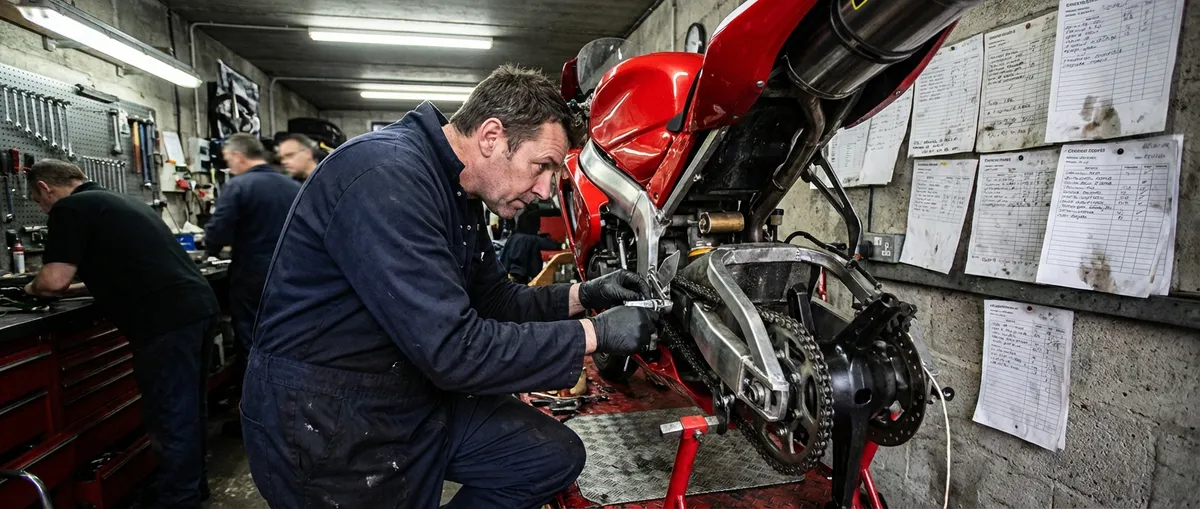
1. Chain and Sprocket Dynamics: Tuning a Power Transmission System, Not Just “Lubing a Chain”
A chain drive is a flexible power transmission system that has to handle shock loads, misalignment, contamination, and temperature swings—without a housing like a car’s final drive. Treat it like a proper mechanical system, not an exposed bicycle chain.
Key technical points:
Measuring slack under real loading conditions
The manual gives a slack spec (e.g., 30–40 mm), but that’s with the bike unladen. The true critical condition is when the swingarm, countershaft, and rear axle are in a near-straight line—the chain is at its tightest. - Use a ratchet strap or rear stand + jack to compress the suspension to that geometry at least once. - Confirm that, at maximum compression, the chain still has a hint of free play. - Once verified, you can safely adjust by the book with the bike unladen, knowing it’s correct in the loaded state.
Alignment by measurement, not eyeballing the swingarm marks
Swingarm marks are often rough indicators, not precision references. - Use a chain alignment tool, straightedge against the rear sprocket, or measure from swingarm pivot to axle on each side with a caliper or steel tape. - Misalignment accelerates sprocket wear and causes uneven chain loading that can feel like a surge or vibration at steady throttle.
Lubricant selection based on use-case physics
- O/X-ring chains are internally lubricated; your main goal is sealing protection and roller lubrication, not “soaking the thing.” - Wet climates or all-weather commuting: use a tackier lube or chain wax that resists fling-off and water wash. - Dry, dusty conditions: favor a lighter, less sticky lube to avoid building an abrasive paste of dust + oil. - Track-heavy use: some riders prefer thinner lubes for lower drag, applied more frequently.
Sprocket wear as a diagnostic
- Hooked teeth (leaning forward in direction of rotation) indicate accelerated wear—often from a stretched chain or poor lubrication. - Alternating worn and less-worn teeth can signal tight spots in the chain or alignment issues. - Replace chain and sprockets as a set; mixing old/new components just teaches the new part bad habits.
Deflection as an input to performance feel
Chain lash (too much slack) shows up as on/off throttle harshness and jerky low-speed behavior. - Within the safe spec, tighten toward the lower side if you want crisper response—especially on big twins with strong engine braking. - Stay conservative for off-road use where full suspension compression and debris can spike load on the chain.
You’re not “just lubing a chain”—you’re tuning a mechanical link between crankshaft torque and rear tire shear force.
2. Braking System Integrity: Hydraulic Behavior You Can Actually Feel at the Lever
Your brakes are a hydraulic system converting lever input into clamping force at high temperatures and pressures. The more you understand its behavior, the easier it is to keep it precise and fade-resistant.
Key technical points:
- Pad material vs. thermal environment
- Organic pads: good initial bite, quieter, gentle on rotors; can fade faster under heavy repeated braking.
- Sintered pads: better high-temp performance, stronger bite when hot; can be harsher on rotors and noisier.
- Track-focused compounds: require heat to work properly; on the street they may feel wooden until warmed up.
Choose based on how often you’re hammering from 200–60 km/h, not just brand loyalty.
Fluid boiling point and moisture absorption
Brake fluid is hygroscopic—it absorbs water over time, which lowers its boiling point and can cause vapor lock under hard braking. - DOT 4 is common; high-performance DOT 4 (or DOT 5.1) has a higher dry and wet boiling point. - The “wet” boiling point (after moisture absorption) is what matters on a two-year-old street bike. - If you ever feel the lever pulling closer to the bar on long descents, you’re likely flirting with fluid boil or pad fade.
Line flex and pressure consistency
- Rubber hoses flex more under pressure, especially as they age, giving a softer, less consistent lever feel. - Braided stainless lines reduce expansion, stabilizing lever travel and improving modulation. - On ABS-equipped bikes, ensure any line upgrades are compatible with the system routing and fittings.
Rotor condition as a feedback surface
- Blueing or heavy discoloration can indicate high, repeated thermal stress. - Lateral runout (rotor wobble) can cause pulsing at the lever; check with a dial indicator against the manufacturer’s spec. - Uneven pad deposits (often miscalled “warped rotors”) show as patchy friction zones—these can sometimes be corrected by carefully bedding in new pads on a clean rotor surface.
Bleeding with intent, not just “until no bubbles”
- Start at the calipers, finish at the master cylinder (if it has a bleed), and on ABS bikes follow the manufacturer’s procedure to ensure fluid is renewed through the ABS modulator. - Use a clear hose and observe for microbubbles; tap calipers and lines lightly to dislodge trapped air. - Document your change interval (e.g., every 12–24 months) and fluid type—this becomes a system log, not a guess.
Solid, predictable brakes aren’t an upgrade—they’re the baseline for riding at your actual potential.
3. Engine Health as a Data Stream: Compression, Valve Train, and Thermal Control
A modern motorcycle engine is a controlled explosion machine running thousands of cycles per minute. Staying ahead of wear means monitoring the system behavior, not just changing oil on time.
Key technical points:
- Oil viscosity vs. bearing and clearance reality
- The viscosity spec (e.g., 10W-40) is tied to your engine’s bearing clearances, operating temperatures, and pump design.
- Running significantly thicker oil “for protection” can starve tight, high-RPM clearances at cold start.
- Running too thin at high temperatures can reduce film strength and accelerate wear on cams and crank journals.
Stick to the manual viscosity for your climate range unless you have data (oil analysis, logged temps) to justify a change.
Oil analysis as a real diagnostic tool
Send used oil to a lab and track: - Wear metals (iron, aluminum, copper) for cylinder/piston/bearing health. - Contaminants (fuel dilution, coolant) for leaks or ring sealing issues. - Viscosity retention and additive depletion for confirming change intervals. One or two reports are interesting; a trend over time is powerful.
Valve clearance as a long-term reliability lever
- Tightening clearances (especially on exhaust valves) can lead to valves not fully seating, losing compression and overheating the valve face. - On bucket-and-shim systems, watch for patterns: if the same valve keeps tightening, note mileage and adjust more proactively next interval. - Slightly noisy but within spec clearances are preferable to silently tight valves.
Compression and leak-down testing for deeper insight
- A compression test gives a quick look at overall cylinder sealing, but is influenced by cranking speed and procedure. - A leak-down test pinpoints where losses occur: intake, exhaust, rings, or head gasket. - Testing before a big trip or after a season of hard use gives you a baseline that’s far more informative than “it still feels strong.”
Cooling system as a stabilizer of everything else
- Coolant isn’t just anti-freeze; it raises boiling point and provides corrosion protection inside the head, water pump, and radiator. - Inspect for fin damage, blocked radiator cores, and thermostat function if the bike runs hotter than usual. - Mixing incompatible coolant types can reduce corrosion protection—stick to the spec and flush at recommended intervals.
A healthy engine isn’t just one that starts—it’s one that behaves predictably under load, in heat, and at the edge of its rev range.
4. Suspension and Bearings: Keeping the Chassis “On the Same Page” as the Engine
If the engine is the heart, the chassis is the nervous system and skeleton. Worn suspension and bearings don’t just feel sloppy—they corrupt the feedback loop that lets you ride with precision.
Key technical points:
Sag as a structural setting, not a comfort tweak
- Rider sag (typically 25–35% of total travel for sporty road use, 30–40% off-road) sets your suspension’s operating point. - Too much sag: lazy steering, vague front-end feel, easier to bottom. - Too little sag: harsh ride, poor traction over bumps, tendency to “top out” or skip. Adjust preload with a tape measure, not by guesswork.
Damping adjustment with a method, not just “clicking around”
- Compression damping controls how fast the suspension compresses on bumps and load transfer. - Rebound damping controls how fast it extends back. - Make changes one circuit at a time (front or rear, compression or rebound) and in small increments, documenting each setting and your impressions on a familiar test loop. This is data-driven tuning, not superstition.
Steering head and wheel bearings as stability anchors
- Notchiness in the steering (bike wants to self-center) usually means pitted steering head bearings—often from impact or long-term overtightening. - Front-end wobble, vague tracking, or “hunting” in fast sweepers can be linked to bearing preload being too loose or too tight. - Wheel bearings with play or roughness change the effective wheel alignment under load—subtle, but absolutely noticeable at lean.
Swingarm and linkage bearings in real motion
- With the rear wheel off and shock disconnected, move the swingarm through its travel. It should be smooth, with no binding or lateral play. - Linkage bearings (on link-equipped bikes) are load multipliers; small roughness here becomes big inconsistency in rear wheel behavior. - Regular greasing (where serviceable) or scheduled replacement on sealed units is critical for bikes that see rain or off-road abuse.
Tires as part of the suspension system
- Sidewall stiffness and construction dramatically affect feel; two “sport-touring” tires can behave very differently at the same pressure. - Check cold/hot pressure delta: a 10–15% increase from cold to hot is a good starting target on the street. Much more can indicate overworking the tire; much less can indicate under-loading it. - Cupping, stepped wear, or unusual patterns are telling you about your damping and pressure, not just the tire compound.
When chassis components are dialed, the bike talks to you clearly. Slop and stiction are just signal noise.
5. Electrical Reliability: System-Level Thinking Beyond “Check the Battery”
Modern bikes are electronic systems with an engine attached. Reliability here isn’t about avoiding mods; it’s about understanding load, grounding, and connector health.
Key technical points:
*Battery health by voltage and behavior
- Static voltage (bike off) is one data point; cranking voltage (while starting) is the real test—if it drops below ~9.6 V, you’re nearing the edge. - Measure charging voltage at idle and at 3–4k rpm; most systems should sit around 13.5–14.5 V. - Log these values seasonally—trends are more useful than single snapshots.
Ground paths as part of every diagnostic
- High resistance in ground circuits can mimic component failure. - When diagnosing intermittent issues, check voltage drop between the battery negative and frame/engine under load. - Cleaning and properly tightening main grounds (and adding a dedicated ground for accessories) prevents a lot of “ghost” problems.
Connector care and environmental sealing
- Waterproof doesn’t mean immune; repeated heat cycles and vibration can still cause oxidation. - Use dielectric grease on high-risk connectors (exposed, near the headstock, or under the tail where spray collects). - Pay special attention to connectors related to the charging system and critical sensors (crank, TPS, wheel speed on ABS bikes).
- Accessory load vs. charging capacity
- Heated grips, jacket, lights, and GPS might collectively exceed what your alternator can safely supply at idle or low RPM.
- Look up your bike’s alternator output and subtract baseline bike load; what’s left is your true accessory budget.
- If your voltage sags below charging levels at cruise with everything on, you’re running a slow-motion brownout.
Fuses and relays as intentional safeguards, not annoyances
- If a fuse keeps blowing, find the cause—up-fusing is a great way to melt a harness. - Carry spares and know where every major fuse and relay is located on your* bike. - For any custom wiring, fuse as close to the battery as possible, and size based on wire gauge and device draw, not just “whatever came in the kit.”
Treat the electrical system like any other: measured, logged, and designed with margins, not hope.
Conclusion
A truly dialed motorcycle doesn’t happen by accident or by blindly following a service schedule—it comes from understanding the mechanical and electrical systems well enough to maintain them with intention. Chain slack becomes torque delivery tuning. Brake fluid changes become thermal management. Valve checks become long-term reliability engineering. Suspension tweaks become data-driven chassis control. Electrical checks become systems validation.
When your maintenance has this level of purpose, the bike stops feeling like a collection of parts and starts feeling like a coherent machine that does exactly what you ask, every time you roll onto the throttle or trail the brakes into a corner.
That’s the difference between owning a motorcycle and running a motorcycle you’ve truly engineered for your riding.
Sources
- [Motorcycle Safety Foundation – Maintenance Tips](https://www.msf-usa.org/downloads/Maintenance_Tips.pdf) - Practical guidance on basic motorcycle maintenance and inspection routines
- [Honda Powersports: Owner’s Manuals and Maintenance Info](https://powersports.honda.com/owners/manuals) - Official service intervals, fluid specs, and technical details for common Honda motorcycles
- [Yamaha Motors – Technical Communication: Brake Fluid and Maintenance](https://global.yamaha-motor.com/business/ymgnavi/technical_review/) - Engineering-focused articles and technical reviews, including braking systems and fluids
- [Engineering Explained: Understanding Brake Fade and Boiling Points](https://www.youtube.com/watch?v=phcUo5HhZ0A) - Technical breakdown of brake fluid behavior, boiling points, and fade under real-world conditions
- [U.S. Department of Transportation – FMVSS No. 116 (Motor Vehicle Brake Fluids)](https://www.ecfr.gov/current/title-49/subtitle-B/chapter-V/part-571/subpart-B/section-571.116) - Regulatory definitions and performance standards for DOT brake fluids, including dry and wet boiling points
Key Takeaway
The most important thing to remember from this article is that this information can change how you think about Maintenance.