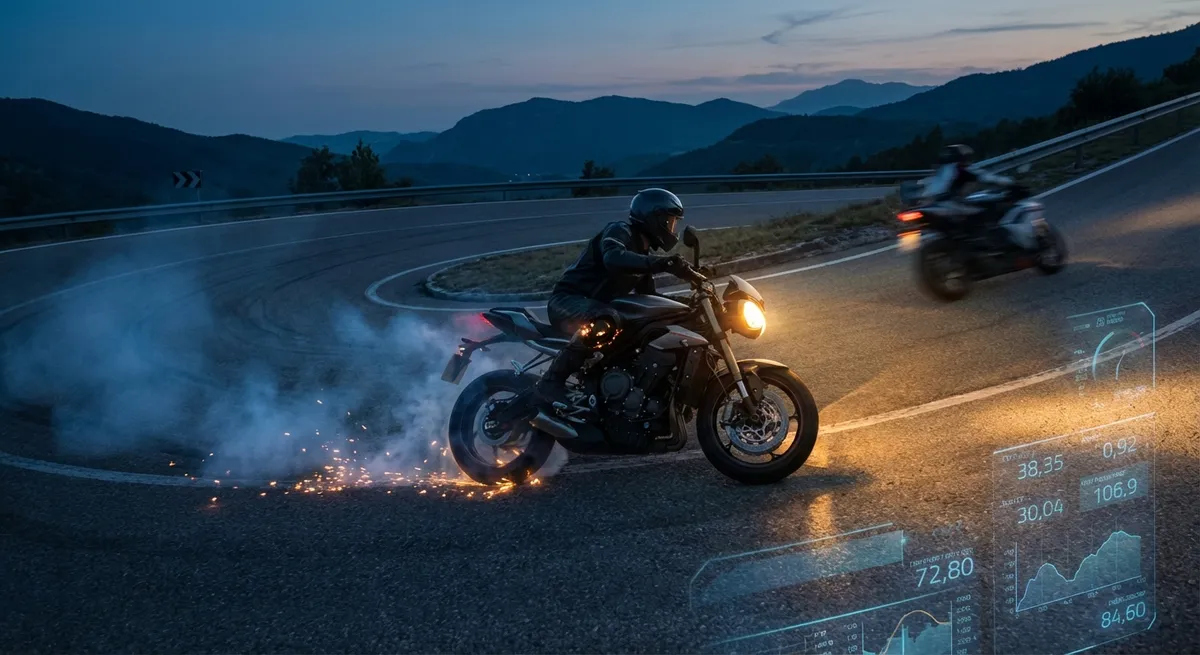
Most motorcycle reviews talk about horsepower, paint, and “character.” That’s brochure language. What actually matters is what the bike does at corner exit, under hard braking on a bumpy road, in a 20-minute heat cycle, and in the last 5% of your attention span when you’re tired and still 40 miles from home.
This is where a review should live: at the interface between rider inputs and chassis response. If a bike can’t hold a precise line, tolerate bad pavement, communicate grip, and stay coherent when everything heats up, it doesn’t matter what the spec sheet says.
This article breaks down five technical points that should anchor any serious motorcycle review—and how to interpret them as a rider who actually cares about pace, feedback, and durability, not just “first ride impressions.”
1. Corner Exit Drive: Throttle, Geometry, and Real Traction
When you read or watch a review, “cornering” talk is usually about lean angle and confidence. That’s incomplete. The real test is corner exit drive: how the bike accepts throttle while loaded, and how it turns that into forward acceleration without asking you to babysit it.
A serious review should dissect how the bike behaves at the point where you begin to pick it up from max lean and feed in throttle. This is where front-end geometry, anti-squat behavior, and throttle mapping all intersect.
Key questions an enthusiast should look for in a review:
- Does the bike run wide at exit when you add throttle, or does it hold (or even tighten) its line?
- Does the rear suspension extend cleanly under drive, or does it pump, chatter, or squat and stay there?
- Is the throttle mapping predictable enough to add 2–3% opening mid-corner without drama?
- Does the traction control intervene with a smooth, torque-shaped reduction, or is it a harsh cut you can feel through the chassis?
On a well-sorted bike, increasing throttle at exit adds a clear, linear drive sensation. The rear tire deforms but stays repeatable; the bars stay neutral, and the bike doesn’t demand mid-corner line corrections. On a compromised machine, you’ll see reviewers describing “pushing wide,” “needing more steering input,” or “slightly vague exits.” Translate that as geometry, shock, or electronics not working together under load.
When you evaluate a review, look for data points: the tester referencing the ability to choose a line at entry and reliably hit the same exit marker lap after lap, or over a full mountain run. Repeatability is the real metric—not one perfect corner that looked good for the camera.
2. Brake Stability: Load Paths, ABS Logic, and Real Stopping Confidence
Brakes aren’t just about rotor size and caliper branding. The real test is how the chassis handles aggressive deceleration while the surface is imperfect and the rider is imperfect. Any review that doesn’t discuss high-effort braking on real roads is incomplete.
Front-end stability under braking comes from more than fork stiffness—it’s about how load transfers through the headstock, triple clamps, fork internals, tire carcass, and electronics. A nuanced review will cover:
- Initial bite: Is the first 5 mm of lever travel progressive or grabby?
- Mid-pressure behavior: Does the chassis pitch excessively, or does it compress into a stable “platform”?
- ABS strategy: Does ABS intervene late and smoothly, or early and abruptly?
- Surface tolerance: How does the bike handle braking over ripples, tar snakes, or patchy grip?
Under hard braking, a properly sorted motorcycle feels like it’s digging into the surface, not just slowing down. The fork compresses but doesn’t pogo; the rear stays in contact enough to remain useful for stability and even a bit of braking work. A reviewer might describe this as “confidence-inspiring” or “planted”—but you should look for specifics: mention of trail braking into corners, controllable ABS, and consistent lever feel even when hot.
Advanced reviews may reference brake fade, especially on track or long descents. That’s where thermal mass of rotors, pad formulation, and fluid quality intersect. If a tester talks about the lever coming back to the bar or the feel going “mushy” after repeated stops, that’s a major red flag for hard riders—even if the peak stopping distance tested once in a lab looks great.
3. Mid-Corner Feedback: Chassis Flex and Tire Communication
The best way to understand a motorcycle is at mid-corner, when lean angle stabilizes, throttle is neutral or slightly positive, and the tire is loaded but not yet asked to accelerate hard. This is where the chassis either talks to you—or goes quiet and forces you to rely on faith instead of data.
Chassis flex is not automatically bad. Overly rigid frames can be skittish on rough roads, while controlled flex allows the bike to “breathe” over imperfections without breaking grip. The question is how that flex is distributed and what it tells the rider.
Technical markers of good mid-corner feedback that reviewers should address:
- Can the rider feel small grip changes as a texture, not as a sudden slide?
- Do small line changes mid-corner (slight handlebar input or weight shift) happen smoothly, or does the bike resist then suddenly flop?
- Is there a clear difference in feel between upright, partial lean, and maximum lean?
- Does the bike tolerate mid-corner bumps without snapping the line wide or running a violent correction through the bars?
Reviews that simply say “stable in corners” are skipping important detail. Look for language about “reading the surface,” “feeling the tire working,” or “knowing exactly how much grip is left.” Strong tests will also mention tire type and pressure, because carcass stiffness and profile radically affect feedback.
A cornering-focused review should always separate “confidence from electronics” (traction control, cornering ABS, IMU assistance) from “confidence from mechanical communication” (chassis stiffness, tire feedback, ergonomic triangle stability). Electronics can save a mistake; mechanical transparency prevents it in the first place.
4. Heat Cycle Behavior: Power, Electronics, and Rider Interface Over Time
One of the most under-reported aspects of motorcycle reviews is heat-cycle behavior: what the bike becomes after 20–40 minutes of hard use, not just in the first 5. Power, electronics, and even ergonomics change character as temperatures rise. Riders who push their bikes need to know this.
A serious review should differentiate between:
- Cold/first-ride performance vs. hot performance after repeated accelerations and braking
- How intake air temps and coolant temps affect throttle response and power delivery
- Whether electronic systems become more intrusive or change feel as temps go up
- Human factors: how heat soak from engine, exhaust, and radiator affects rider focus and comfort
Modern engines are heavily managed by ECUs, and thermal thresholds can trigger subtle changes: softer throttle maps, lower rev limits, or more conservative ignition timing. A thoughtful reviewer might note that the bike “felt slightly dulled” or “less responsive” late in a session compared to the start, even if peak dyno numbers look great. That’s heat management in the real world.
For electronics, IMU-based systems may adjust behavior with temperature and wheel speed sensor signal quality. Under extended use, if a tester reports traction control “getting more intrusive” or ABS pulsing more aggressively, that indicates that heat and possibly tire degradation are altering signal quality and grip, and the system’s algorithms are reacting.
Finally, consider rider heat load. Reviews should report whether hot air is ducted away from the rider, how much radiant heat reaches the legs and core, and whether the cockpit becomes a heat trap in slow traffic or technical sections. Pace is not just about horsepower and brakes; it’s about whether the rider can still think clearly after 40 minutes of effort.
5. Control Bandwidth: How Demanding the Bike Is to Ride at Pace
A fast motorcycle isn’t necessarily a good one. The real measure is how much bandwidth it consumes to ride at your desired pace. Some bikes feel “busy” even at medium speed, constantly asking for corrections and attention. Others remain calm and predictable, letting you use more of your mental capacity for reading the road, planning lines, and staying safe.
Reviews almost never use the phrase “control bandwidth,” but you can infer it from how testers describe:
- Fatigue: Did they feel mentally or physically drained after a spirited ride?
- Correction load: Were they “constantly making small corrections” or did the bike “hold a line effortlessly”?
- Mode sensitivity: Did they have to toggle electronics or adjust settings frequently to keep the bike predictable?
- Ergonomic stability: Could they lock in with their lower body and keep their arms light, or were they hanging on with the bars?
A truly sorted bike lets you run a brisk pace with what feels like 70–80% of your attention committed. Inputs are small, predictable, and reversible; the bike doesn’t punish minor errors. When a review says the motorcycle is “forgiving” or “easy to ride fast,” this is what they’re talking about—low control bandwidth for high performance.
This is arguably the most important metric for real riders. Lap times and top-speed numbers are interesting, but what matters is how much of your cognitive load the bike consumes over hours of riding. If a machine demands perfection just to stay stable, it’s not a weapon—it’s a liability on real roads. When you compare reviews, prioritize descriptions of effort and focus, not just excitement.
Conclusion
Motorcycle reviews that obsess over peak horsepower, 0–60, or cosmetic details miss the core reality of riding: your connection to the bike is defined by what happens in those loaded, imperfect, high-consequence moments.
If you want to extract the truth from any review, filter it through these five technical lenses:
- Corner exit drive under real throttle.
- Brake stability on imperfect surfaces with ABS active.
- Mid-corner feedback and usable chassis flex.
- Heat-cycle behavior of engine, electronics, and ergonomics.
- Control bandwidth required to ride at your pace.
The next time you scan a test, ignore the glamour shots and the generic “confidence-inspiring” language. Look for evidence that the reviewer actually pushed the bike into its meaningful operating envelope—and told you how it behaved when it mattered. That’s the difference between a spec-sheet story and a Moto Ready standard of evaluation: not how the bike looks parked, but how honestly it tells the truth at the edge of traction and attention.
Sources
- [Motorcycle Dynamics by Vittore Cossalter – Official Summary (Lulu)](https://www.lulu.com/shop/vittore-cossalter/motorcycle-dynamics-3rd-edition/hardcover/product-20589171.html) - Foundational reference on motorcycle chassis behavior, load transfer, and cornering dynamics
- [Kawasaki Technical Explanation: KIBS & ABS Systems](https://www.kawasaki-cp.khi.co.jp/technology/chassis/kibs_e/index.html) - Detailed look at modern motorcycle ABS design and behavior under hard braking
- [Bosch MSC (Motorcycle Stability Control) Overview](https://www.bosch-mobility.com/en/solutions/motorcycle-systems/motorcycle-stability-control/) - Explains how IMU-based stability systems manage traction, braking, and lean angle
- [Pirelli Motorcycle Tire Technical Insights](https://www.pirelli.com/tires/en-us/motorcycle/all-about-tires) - Deep dive into tire carcass construction, profiles, and how they affect feedback and grip
- [NHTSA Motorcycle Safety Research](https://www.nhtsa.gov/road-safety/motorcycles) - Government data and studies on braking performance, control, and rider safety under real-world conditions
Key Takeaway
The most important thing to remember from this article is that this information can change how you think about Motorcycle Reviews.