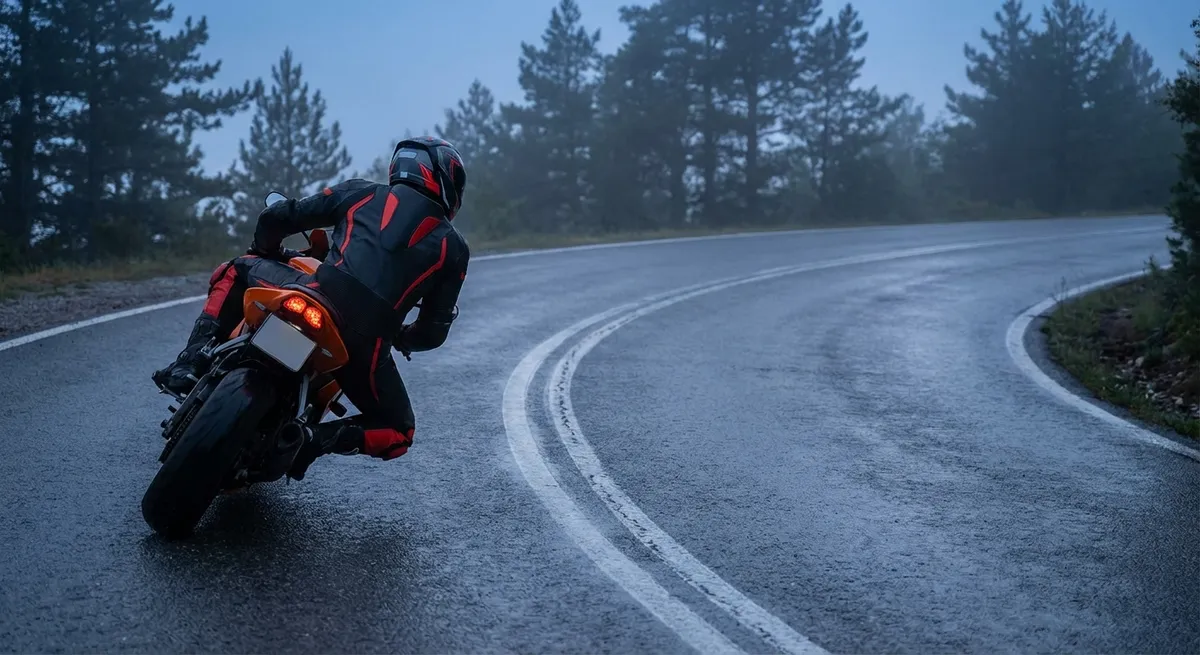
Road riding isn’t about dragging knee in perfect hairpins under track lights—it’s about threading a 500 lb machine through imperfect lines, blind crests, broken pavement, and traffic that doesn’t care you exist. The riders who feel “planted” in every corner aren’t just brave; they’re running a precise, repeatable cornering system that doesn’t fall apart the moment conditions stop being ideal.
This is a deep dive into five technical cornering habits that change how your bike feels under load—especially when things get messy. No fluff, no fantasy race lines. Just real-world precision for riders who want their cornering to be predictable, repeatable, and fast enough without gambling.
1. Build a Two-Stage Visual System: Information, Then Execution
Most riders “look ahead” in a vague way, but they never structure their eyes the way racers and high-level road riders do. You need two distinct visual layers running at all times:
Information Scan (far field)
This is your data stream: vanishing point, surface changes, traffic, intersecting roads, runoff area, and possible escape routes. It lives roughly 2–5 seconds ahead of the bike depending on speed.
Execution Scan (near field)
This is where your front tire will be in the next 0.5–1.5 seconds: entry marker, turn-in point, apex zone, exit alignment. This is where lines become real, not theoretical.
Technically, what you’re doing is separating strategic vision (deciding if the corner is safe and what general line you’ll take) from tactical vision (the exact inputs you’re about to make). When those two collapse into one—when you’re only looking “kinda ahead”—you get late decisions, mid-corner corrections, and that vague feeling of chasing the bike instead of leading it.
Practical drill on a familiar route:
- On approach, lock in the vanishing point first: where the road visually disappears.
- Ask: Is that point coming toward me (tightening) or moving away (opening)?
- Once you’ve read the corner, drop your attention down to your entry marker (a crack, post, or shadow) where you’ll begin your turn.
- As you commit, your eyes should snap to apex zone, not a single paint chip—an area of road where your bike will be at maximum lean.
- Exiting, your eyes must beat the bike to the exit—you should see the area your bike will occupy 1–2 seconds ahead.
This two-layer system lets you adjust early to hazards while still riding clean lines. It feels like “extra time” suddenly appears in every corner.
2. Engineer a Stable Chassis: Throttle, Load, and Geometry
The front end will tell you exactly how honest your riding is. If your inputs are sloppy, the fork and contact patch get punished for it. Corner stability is less about bravery and more about how consistently you manage weight transfer and geometry.
Key technical concepts:
- Neutral vs. off-throttle:
- Off-throttle (closed or sharply reduced) moves weight onto the front, shortens the fork, steepens geometry, and shrinks the margin for error.
- Neutral or gently positive throttle maintains or adds slight rearward bias, keeps the chassis stable, and maximizes tire footprint where you need it.
- Chassis pitch:
Any sudden change in throttle mid-corner (chop → coast → re-apply) creates pitch oscillation—fork dives then extends while the rear does the opposite. That oscillation shows up at the tire as grip instability.
- Suspension working window:
Your fork and shock have a range where damping works properly. Tiptoe into a corner off-throttle and then whack the gas mid-lean and you’re bouncing in and out of that range.
Practical riding rule:
- Set your corner speed before you lean using brakes (front and/or rear, as appropriate).
- Once leaned, aim for a very light, progressive throttle roll—enough to hold or slightly build speed without abrupt changes.
- Any mid-corner speed adjustment should be subtle: think micro-changes in grip, not on/off switches.
Want to feel this directly? On a safe, clear, open-radius corner:
- Ride it once with a closed throttle from turn-in to mid-corner, then gas out.
- Ride again with speed correctly set pre-turn, then a smooth, shallow roll-on from turn-in.
- The second pass should feel calmer, more planted, and the bike will stand up and drive out with less drama.
You’re not just “going faster”; you’re engineering a stable, predictable platform for the tires to work with.
3. Rethink Lines: Vision-Limited, Not Racetrack-Perfect
Track lines assume perfect visibility, predictable surfaces, and consistent behavior from everyone around you. The street gives you none of that.
On the road, your primary line constraint is not speed; it’s what you can see and stop for. That changes the whole geometry of how you use the lane.
Technical priorities for real-world lines:
Maximize sight distance, not just radius
- In right-handers (in right-hand traffic countries), a mid/outside approach often improves sightlines around oncoming vehicles, but riding too close to the centerline exposes you to oncoming drift. - In left-handers, staying slightly to the outside improves your look “through” the bend, giving you more time to read gravel, parked vehicles, or tightening radius.
Think in segments, not a single arc
- A long corner is rarely one perfect curve. Break it into visual segments: entry segment (worst-case plan), mid-corner (updated plan), exit (commit/accelerate). - Each segment gets its own micro-line adjustment based on what your far-field vision reveals.
Guard your exit space
- Never commit to a line that uses every inch of your lane on exit. You need lateral reserve to dodge debris or a vehicle cutting in. - Imagine a narrow “buffer stripe” at lane edges you refuse to cross at max lean unless it’s an emergency.
Drill for line discipline:
- On a familiar twisty section, ride slightly slower than usual and explicitly name out loud (inside your helmet):
- “Entry position”
- “Turn-in”
- “Apex zone”
- “Exit lane position”
- Force yourself to justify your lane choice in terms of sightline, margin, and escape, not just radius.
You’re not drawing pretty arcs—you’re solving a visibility and risk puzzle at 60+ mph.
4. Calibrate Your Braking System: Predictable Decel Under Real Load
Fast, smooth cornering isn’t just about lean; it’s about how surgically you can remove speed when things go sideways. If you don’t know what 60% vs. 90% brake pressure feels like at the lever or pedal, you are guessing at the most critical control you have.
Key technical elements:
- Initial bite:
The very beginning of lever pull sets how the front tire is loaded. A smooth, deliberate squeeze that builds pressure over 0.5–1.0 seconds lets the contact patch “accept” the load without slipping.
- Linear vs. spiky pressure:
Good braking feels almost hydraulic in your brain: the more you squeeze, the more decel you get, predictably. If your pull is jerky, your brain never gets a consistent map of “lever distance = braking force.”
- Trail braking on the street (with discipline):
You don’t need race-style deep trail braking, but you absolutely benefit from carrying mild brake pressure past turn-in when visibility or radius is uncertain.
That retained front load keeps the tire “awake” and lets you tighten your line if the corner closes.
Safe practice framework:
- In a straight-line, empty road:
- Pick a reference speed (e.g., 40 mph / 60 km/h).
- Perform repeated stops to a target point using only the front brake, then only the rear, then both.
- Focus on smooth ramp-up, maintaining straightness, and noticing fork dive and weight shift.
- Add a mild curve later:
- Approach at moderate speed.
- Begin braking in a straight line, then carry just a tiny amount of pressure (5–15%) into the initial part of the turn.
- Release gently as lean increases and you’re sure of the radius.
You’re teaching your nervous system to associate lever feel, chassis attitude, and decel rate—so when a decreasing-radius corner appears, you already know exactly how much brake you can safely use while leaned.
5. Make Grip Predictable: Reading and Using the Contact Patch
Grip isn’t binary; it’s a bandwidth. The riders who seem “lucky” in sketchy surfaces are actually reading and managing that bandwidth better than everyone else.
Technical grip factors you can actually work with:
- Surface reading at speed
- Texture changes (smooth vs. coarse asphalt)
- Color changes (tar snakes, patches, diesel, wet leaves)
- Shadow regions where hidden moisture or gravel often lives
Train yourself to distinguish:
This should live in your far-field vision, not as last-second surprises.
- Vertical load and lean angle
Tire grip is strongest when it’s carrying consistent vertical load. Hard braking + big lean = asking a single contact patch to solve two big physics problems at once.
Your riding plan should aim to have:
- More braking / less lean early in the corner
- More lean / stable or gently increasing throttle mid-corner and exit
- Micro-adjustments instead of panic reactions
When you hit an unexpected low-grip patch (gravel, wet, paint), your survival reaction is to snap off the throttle or grab brake—both instantly destabilize the tire.
A better technical response:
- Freeze or slightly soften your current input (don’t add lean, don’t add brake abruptly).
- Let the bike float a fraction wider if there’s room.
- Once past, then gently reintroduce throttle or line adjustments.
Practical drill:
- In a safe environment, at modest lean angles:
- Feel how the bike responds to very small throttle changes mid-corner—just a 2–3% twist.
- Notice how even that little roll can make the bike stand up slightly or widen a hair.
- Then try the opposite: a very shallow roll-off and note how the bike tightens.
You’re building a language with the contact patch. The better you speak it, the less surprising “slippery” feels.
Conclusion
Precise road riding isn’t about bolting courage onto chaos. It’s about running a structured system under real-world constraints: a disciplined visual strategy, a stable chassis, lines built around visibility, calibrated brakes, and a working relationship with the contact patch instead of faith.
None of these skills are glamorous in isolation. But when they stack, the bike stops feeling like a nervous animal and starts feeling like a scalpel that does exactly what you ask—even when the road doesn’t cooperate.
Practice them on purpose. Slow down enough to feel the difference in your vision, your chassis, your line, your braking, and your grip. Speed comes later, almost as a side-effect. Control comes first—and that’s where real pace begins.
Sources
- [MSF – Cornering and Curves](https://www.msf-usa.org/library.aspx) – Rider education materials from the Motorcycle Safety Foundation, including visual strategies and cornering basics.
- [UK Government – Motorcycle Riding Skills (DVSA)](https://www.gov.uk/motorcycle-practical-test/what-happens-during-the-test) – Official guidance on the advanced skills examiners look for, including positioning, braking, and observation.
- [California Superbike School – Technology of Speed: Throttle Control](https://superbikeschool.com/article/the-first-rule-of-throttle-control) – In-depth explanation of how throttle affects chassis stability and cornering.
- [Motorcycle Consumer News Archive – Braking Techniques](https://web.archive.org/web/20160617195906/http://www.mcnews.com/mcn/features/Apr2013Braking.pdf) – Technical discussion of front/rear braking, weight transfer, and stopping performance.
- [NHTSA – Motorcycle Safety](https://www.nhtsa.gov/road-safety/motorcycles) – Data and safety analysis on motorcycle crashes, highlighting the importance of cornering, braking, and visibility.
Key Takeaway
The most important thing to remember from this article is that this information can change how you think about Riding Tips.