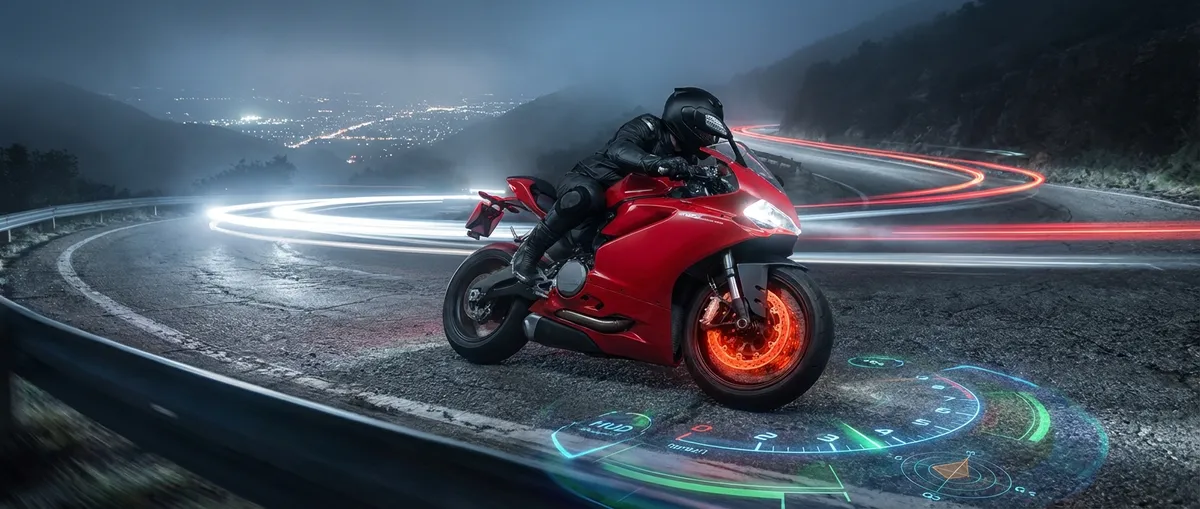
Every spec sheet looks fast on paper. Out on the road, most don’t live up to their own marketing. The difference between a forgettable demo ride and a meaningful motorcycle review is knowing what to measure, not just what to feel. When you understand how chassis dynamics, fueling, ergonomics, electronics, and brakes interact, you stop asking, “Is this bike good?” and start asking, “Is this bike engineered for my kind of riding?” This article is your blueprint for interpreting motorcycle reviews like a test engineer instead of a dazzled shopper.
1. Chassis Dynamics: Reading Stability, Agility, and Feedback
Every review that mentions “flickable,” “stable,” or “planted” is really talking about the chassis. Underneath those adjectives are measurable variables: rake, trail, wheelbase, weight distribution, and structural stiffness.
Longer wheelbase and lazier rake (bigger angle) typically produce high-speed stability but slower turn-in; shorter wheelbase and steeper rake sharpen response but can feel twitchy at speed. Trail is the quiet hero here: more trail = more self-centering and stability, less trail = quicker steering but potentially nervous behavior on rough surfaces or at triple-digit speeds.
When you read a review, look for how the bike behaves in three regimes:
- Initial turn-in: Does it require a firm countersteer input, or does it “fall” into corners? Reviewers might call this “eager,” “neutral,” or “reluctant.” That reflects the combination of rake, trail, tire profile, and bar leverage.
- Mid-corner support: On constant throttle in a long sweeper, does the bike hold a line or require constant correction? “Laser-precise” often means a torsionally stiff frame and compliant, well-damped suspension working together.
- Corner exit stability: On throttle, does the bike squat and track, or does it weave, pump, or run wide? That points to rear shock quality, swingarm geometry, and weight transfer characteristics.
Technical reviewers will sometimes reference torsional rigidity of the frame or swingarm. Too much rigidity with poor suspension tuning can make a bike feel harsh and skittish; too little, and it flexes, smearing feedback and precision. When a review says “great road feel without being punishing,” that usually means a well-balanced combination of frame stiffness, subframe design, and correctly valved suspension rather than just “soft vs. hard” springs.
2. Engine Character: Beyond Horsepower and Torque Peaks
Most riders obsess over peak horsepower and torque numbers, but what actually shapes your riding experience is torque curve shape, throttle mapping, and rotating mass.
A technically useful review will talk about:
- Low-end tractability: Does the bike pull cleanly from low rpm in tall gears, or does it lug and complain? This is crucial for commuting, touring, and riding in traffic. Look for phrases like “usable torque from 3,000 rpm” or “comes alive only above 7,000.”
- Midrange drive: For real roads, the 4,000–8,000 rpm band (varies by engine type) is where most riders live. A strong, flat midrange lets you carry a gear taller through a series of corners without constant shifting.
- Top-end rush: Inline-fours are often tuned to build power as revs rise, while many twins deliver a punch earlier, then taper. When a reviewer says “explosive top end but sleepy bottom,” that tells you the bike wants to be ridden aggressively, kept in the upper rev band.
- Throttle response and fueling: This is where electronic ride-by-wire mapping matters. Look for comments on “snatchy,” “buttery,” or “linear” response. On/off transitions at low throttle openings (e.g., in city riding or mid-corner roll-on) are a strong indicator of mapping quality and ECU calibration.
Crankshaft and flywheel inertia also influence character. High-inertia engines feel smoother and more forgiving, with less tendency to stall; low-inertia engines spin up fast and feel “racey” but can be less forgiving of sloppy clutch and throttle work. When a review mentions “hyper-responsive” or “spins up instantly,” that’s shorthand for low rotational inertia—great for track aggression, potentially tiring for relaxed road use.
3. Suspension and Damping: Translating Adjusters into Real-World Feel
Suspension is where many reviews become vague—“a bit soft,” “sporty but comfortable.” What you want is a translation of those impressions into damping behavior and spring support.
Key technical signals to listen for in a review:
- Compression vs. rebound control:
- If the bike dives heavily under braking or collapses over bumps, you’re looking at soft springs and/or insufficient compression damping.
- If it feels like it “pogo sticks” or takes multiple oscillations to settle after a bump, that’s inadequate rebound damping.
- Support under load: In aggressive cornering, does the front end feel vague, or does it load predictably when trail braking into the apex? Phrases like “front feels vague on initial turn-in” often point to insufficient front-end support (springs too soft, oil height too low, or compression too light).
- High-speed vs. low-speed damping:
- High-speed damping deals with sharp hits (potholes, expansion joints). Harshness over these suggests too much high-speed compression.
- Low-speed damping governs chassis motions like brake dive, squat, and gradual weight transfer. If the bike wallows or stands up mid-corner, low-speed control is lacking.
A useful review will also reference whether the suspension is fully adjustable, partially adjustable, or non-adjustable:
- Fully adjustable (preload, rebound, compression front and rear) means you can tune the bike to your weight, luggage, and riding style.
- Limited or no adjustability means the factory baseline must be very well chosen, or lighter/heavier riders will struggle.
When a review mentions that suspension works well “across mixed surfaces” or “remains composed on imperfect pavement,” you’re looking at good internal valving design: the shim stacks and orifice sizes in the fork and shock are letting oil flow in a controlled way, rather than simply relying on stiff springs to mask poor damping.
4. Braking System: Consistency, Modulation, and Thermal Performance
Brakes are rarely just “good” or “bad.” Technically informed reviews dissect initial bite, modulation, fade resistance, and ABS behavior.
Translate reviewer language like this:
- Initial bite: Sharp initial bite can feel powerful but may be intimidating to less experienced riders or on wet roads. Softer initial bite with strong progression is ideal for precise control. Phrases like “one-finger powerful” with “excellent modulation” are green flags for a well-matched master cylinder, caliper piston area, and pad compound.
- Modulation: This is your ability to fine-tune braking force within the available range. Good modulation means you can trail brake deep into a corner without the brake feeling like an on/off switch.
- Brake fade and thermal stability: On long descents or repeated hard stops, low-spec systems can fade—lever travel increases, or power drops as components heat up. When a review notes “no fade after repeated high-speed stops,” that points to adequately sized rotors, quality pads, and decent caliper design and fluid.
ABS and cornering ABS (IMU-based) are now central to modern reviews:
- Conventional ABS: Monitors wheel speed and releases pressure when it detects lockup. Some systems intervene abruptly, lengthening stopping distances on loose surfaces.
- Cornering ABS: Uses lean angle and pitch data from an IMU to optimize brake pressure while leaned over, significantly increasing safety on imperfect surfaces and in emergency mid-corner situations.
Technical reviewers may describe lever feel—spongy vs. firm. Sponginess often means rubber hoses, air in the system, or pad knockback from flexible rotors or wheel bearings. A firm lever with predictable build-up of pressure is what you want for spirited riding.
5. Electronics and Rider Aids: Evaluating the Logic Behind the Software
Modern motorcycles are rolling control systems. A good review should go beyond “it has traction control and ride modes” and talk about how intelligently those systems respond.
Critical aspects to look for:
- Traction control strategy:
- Crude systems cut power abruptly, upsetting the chassis mid-corner.
- Sophisticated systems meter torque reduction smoothly via ignition, fueling, and throttle plate control. Look for reviewers describing “transparent intervention” or noting that the light flickers but the bike stays composed.
- Ride modes and throttle maps:
- Are the modes genuinely distinct, or just marketing labels?
- Does “Rain” mode actually soften throttle response and limit torque, or just dull everything to the point of frustration? Technical reviews often compare the same corner in different modes to see how torque delivery and engine braking change.
- Engine braking control: On aggressive downshifts, too much engine braking can destabilize the rear tire. Some bikes offer adjustable engine braking maps; a good review will note whether “low engine braking” improves corner entry stability or makes the bike feel disconnected.
- Quickshifter and auto-blipper behavior:
- Up-only vs. up/down.
- Smoothness at low rpm vs. high rpm.
- Whether the system cuts ignition cleanly without lurches or driveline shock.
- IMU-enabled systems: Beyond cornering ABS and traction control, IMUs feed data into wheelie control, launch control, and cornering lights. Instead of just counting features, focus on calibration: you want reviewers saying systems are “permissive but protective,” allowing spirited riding without constantly chopping power.
Electronics that are technically advanced but poorly tuned can make a bike feel artificial and disconnected. The best motorcycle reviews—especially from test outlets with access to multiple models back-to-back—will explicitly compare intervention smoothness and customizability. That’s where you see the real engineering difference between a marketing bullet point and a genuinely supportive rider aid.
Conclusion
Every motorcycle review is an attempt to translate physics and engineering into human language. When you learn how to decode that language—chassis feedback, torque curve character, damping behavior, braking dynamics, and software logic—you stop chasing hype and start evaluating machines the way test riders and engineers do. The next time you read or watch a review, don’t just listen for “fun,” “comfortable,” or “fast.” Listen for the clues that reveal how the bike handles weight transfer, manages torque, communicates grip, and integrates electronics into the riding experience. That’s where a motorcycle’s true DNA lives, and that’s how you choose a machine that won’t just look good in the garage, but will feel right every time you roll out onto the road.
Sources
- Motorcycle Chassis Design – Fundamentals and Geometry (Cycle World) - Explains rake, trail, and wheelbase and how they affect handling characteristics
- Motorcycle Engine Characteristics and Torque Curves (Honda Powersports Tech Article) - Overview of how different engine configurations deliver power and torque
- Motorcycle Suspension Basics (Öhlins USA) - Technical education on damping, springs, and adjusters for real-world tuning
- Anti-lock Braking Systems and Motorcycle Safety (NHTSA) - Government-backed information on ABS benefits and performance
- Cornering ABS and IMU-Based Rider Aids (Bosch Mobility) - Technical descriptions of modern motorcycle safety and control systems
Key Takeaway
The most important thing to remember from this article is that following these steps can lead to great results.