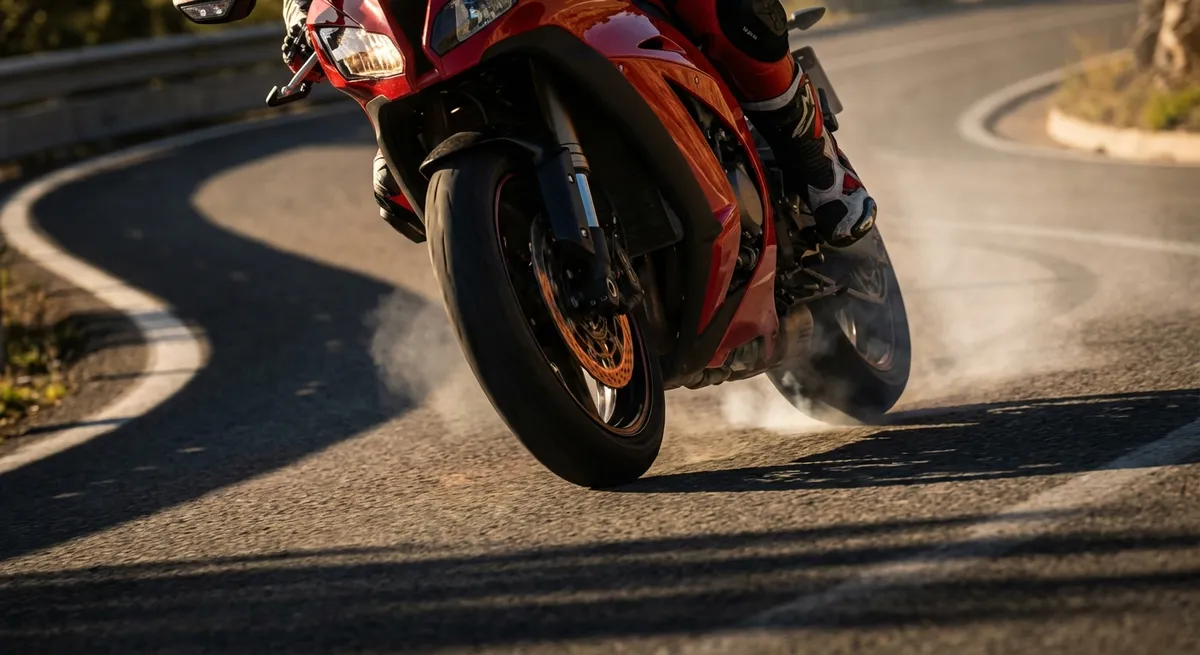
Braking is where skill, physics, and survival intersect. You don’t “get away with it” at the brake lever—your inputs are either mechanically sound or they’re not. Riders obsess over horsepower and lean angle, but the most high-performance system on your bike is the one that quietly trades kinetic energy for heat every time you reach for the lever. When you treat braking as a precision maneuver instead of a panic reaction, every stop, every corner entry, and every emergency becomes more survivable and more satisfying. This is where technical riding starts to feel engineered, not improvised.
Building a Progressive Front Brake Application
The front brake is your primary deceleration tool, but the difference between stability and a front-end washout is hidden in the first half-second of lever input. A technically sound front brake application is progressive: light initial contact, rapid but controlled ramp-up, then modulation. You’re not grabbing; you’re loading the contact patch.
When you first touch the lever, the fork is still extended and the front tire’s contact patch is relatively small. You need a brief “set” phase: 0–10% lever pressure to start compressing the fork. As the fork compresses, rake and trail reduce slightly, the contact patch grows, and the tire can accept more longitudinal load. Now you can ramp up to 70–90% of your available braking force. That ramp is where expert riders live—feeling for micro-lock, ABS hint, or slight tire protest and backing off a hair while staying near the limit.
Your right hand shouldn’t think in on/off. Think in gradients. Try practicing on a straight, empty road: pick a marker, roll at 30–40 mph, and apply the front brake in three stages across roughly one second—touch, load, then strong squeeze. Feel when the fork stops diving and “settles”—that’s the point where your grip should be firm and steady, not still increasing wildly. The goal: a smooth, predictable weight transfer that never shocks the tire.
Rear Brake as a Stability Tool, Not Just a Stopper
Too many riders treat the rear brake as decorative hardware or, worse, a skid switch. Used technically, it’s a powerful stability and attitude-control tool. While the front brake handles most of the deceleration, the rear brake helps manage chassis pitch, wheelbase behavior, and low-speed precision.
Under strong braking, weight shifts forward, unloading the rear tire. If you stomp the rear pedal at that moment, it will lock easily, and ABS (if equipped) will constantly intervene, heating the system and lengthening stopping distance. Instead, think of the rear brake as low-intensity but high-value—5–30% input to control the bike’s attitude. In corner entries, a light rear brake can help keep the chassis balanced, reducing pogoing from abrupt throttle-off transitions. In tight U-turns or slow maneuvers, combining a bit of rear brake with steady throttle “loads” the drivetrain, smoothing throttle response and giving you a more planted feel.
Technically minded riders should practice separating roles: front brake = primary deceleration; rear brake = attitude, line correction, and low-speed control. At low speed, drag the rear lightly with a positive, steady throttle to feel how the bike becomes more controllable and less twitchy. At medium speed, experiment with very light rear brake on entry to a familiar corner while off the throttle—note how the bike feels more settled and “pulled down” versus simply coasting in.
Reading Traction: Braking Feedback Through the Contact Patch
Traction isn’t theoretical when you’re on the brakes—it’s a live data stream. The trick is to read it before it becomes a problem. Your front tire tells you a lot, but you have to listen in three channels: bar feel, suspension motion, and acoustic feedback.
At the bars, a front tire near its grip limit under braking feels slightly “light” and a bit vague, not heavy and planted. Tiny twitches, micro-wiggles, or faint ABS pulsing are early warnings that you’re flirting with the edge. At the suspension, excessive fork dive that never settles tells you you’re asking too much, too fast—your front geometry is steep, and your tire is being overloaded. A smooth dive followed by a calm, loaded feel indicates you’re within a sane window.
Acoustically, a front tire starting to slide may emit a faint chirp or change in tone; ABS activation is usually audible as a buzz or pulse. On uneven or dirty surfaces, ABS will often trigger earlier than you expect. The engineering perspective here: you’re managing μ (friction coefficient) as a finite resource. Lean angle, braking, and surface quality all draw from the same pool. On low-μ surfaces (wet paint, gravel, cold tires), reduce both lean and brake demand. On high-μ surfaces (warm, clean asphalt with warm tires), you can use more of the friction budget for deceleration—but only if your inputs are progressive.
Practice “traction scanning”: each time you brake, note bar feedback, fork motion, and sound. On a known dry, grippy road, gently increase your braking effort across repeated stops to learn what “near the limit” actually feels like in a controlled way instead of discovering it during an emergency.
Integrating ABS and Cornering ABS into Your Technique
Modern motorcycles increasingly ship with ABS and, on higher-end models, IMU-based cornering ABS. These aren’t excuses to stop learning braking technique—they’re multipliers for good technique and lifelines when you get it wrong. The key is understanding their behavior so you don’t fight the system.
Conventional ABS monitors wheel speed and releases pressure when it detects imminent lock. This can slightly extend stopping distance versus a perfectly executed non-ABS stop on ideal pavement, but will almost always significantly shorten it in real-world conditions with dust, patchy grip, or rider panic. Cornering ABS adds lean-angle and pitch data, modulating brake force to avoid overwhelming a laterally loaded tire. It aims to preserve a controllable line rather than letting you stand the bike up abruptly or tuck the front.
Technically, you should still aim to brake so that ABS barely or rarely intervenes in normal riding; its ideal role is as a safety margin for unexpected variables. That said, you should intentionally feel your ABS work in a safe environment. Find an empty, straight, clean road or parking lot, accelerate to 25–30 mph, and execute a firm, straight-line stop using both brakes until you feel ABS pulsing. Note how the lever, pedal, and chassis behave. If you have cornering ABS, consult your manual and manufacturer docs, then experiment with mild braking at small lean angles in a very conservative, familiar corner—just enough to feel the system, not to test its absolute limits.
The end goal: treat ABS as part of your braking system’s architecture—a layer integrated into your technique—not a mysterious box that only wakes up when you’ve already lost control.
Structuring Braking Practice Like a Technical Drill, Not Guesswork
If you want your braking to be engineered instead of improvised, you need structure. Random hard stops once a year won’t encode the muscle memory you need under pressure. Build a repeatable drill protocol and treat it like gym training for your brain, hands, and tires.
Pick a consistent practice location: flat, low-traffic, with good sightlines and clean pavement. Define fixed entry speeds: for example, 20 mph, 30 mph, 40 mph. At each speed, run a series of stops focusing on a single variable per set: one set emphasizing progressive front-only braking, one with integrated front+light rear, one practicing emergency-style maximum effort with ABS engagement. Use visual markers or measured distances if possible—a cone, a crack in the pavement, or a painted line—to start braking at the same point and observe where you stop relative to a reference.
If you’re data-minded, record approximate stopping distances or at least reference points and conditions: tire type, tire age, tire temperature, road temperature, and load (solo vs. passenger/luggage). Over time, you’ll build an intuitive “map” of what your bike can do in various states. That map is invaluable when you have to decide, in one second, whether you can stop before that car’s bumper or whether your escape line is the better option.
Mentally, treat these drills as building a braking algorithm: see hazard → roll off → initial set → ramp → hold → release. The more you run that algorithm under low stress, the more likely it will execute cleanly under high stress instead of being replaced by “grab and hope.”
Conclusion
Riders love talking about speed, lean angle, and lines, but the real separator between casual and technical is braking. Braking is where your understanding of physics, your feel for the contact patch, and your discipline at the controls converge into real-world safety and performance. When you build progressive front-brake technique, use the rear intelligently for stability, learn to read traction, understand your ABS systems, and structure your practice like a test program, your stops stop being reactions and start being maneuvers.
Every ride gives you dozens of chances to refine this. Treat each approach to a light, each corner entry, and each low-speed maneuver as a live lab. You’re not just slowing down—you’re calibrating a high-performance system that happens to be your lifeline when everything goes wrong.
Sources
- [Motorcycle Safety Foundation – Braking and Cornering Basics](https://msf-usa.org/wp-content/uploads/2019/09/Basics-Brochure-MSF.pdf) - Official MSF material explaining fundamental braking concepts and safe techniques
- [NHTSA – Motorcycle Safety](https://www.nhtsa.gov/road-safety/motorcycles) - U.S. government overview of motorcycle crashes and the role of proper braking and control
- [BMW Motorrad – ABS Pro and Cornering ABS Explanation](https://www.bmw-motorrad.com/en/experience/stories/innovation/abs-pro.html) - Technical description of how advanced ABS and cornering ABS systems function
- [Kawasaki – KIBS and K-ACT Braking Systems](https://www.kawasaki.com/en-us/racing/stories/kibs) - Manufacturer insight into sport- and touring-oriented ABS/brake control designs
- [Harley-Davidson – How ABS Works on Motorcycles](https://serviceinfo.harley-davidson.com/sip/content/document/view?id=1193328571038754886) - Practical overview of motorcycle ABS operation and rider considerations
Key Takeaway
The most important thing to remember from this article is that this information can change how you think about Riding Tips.