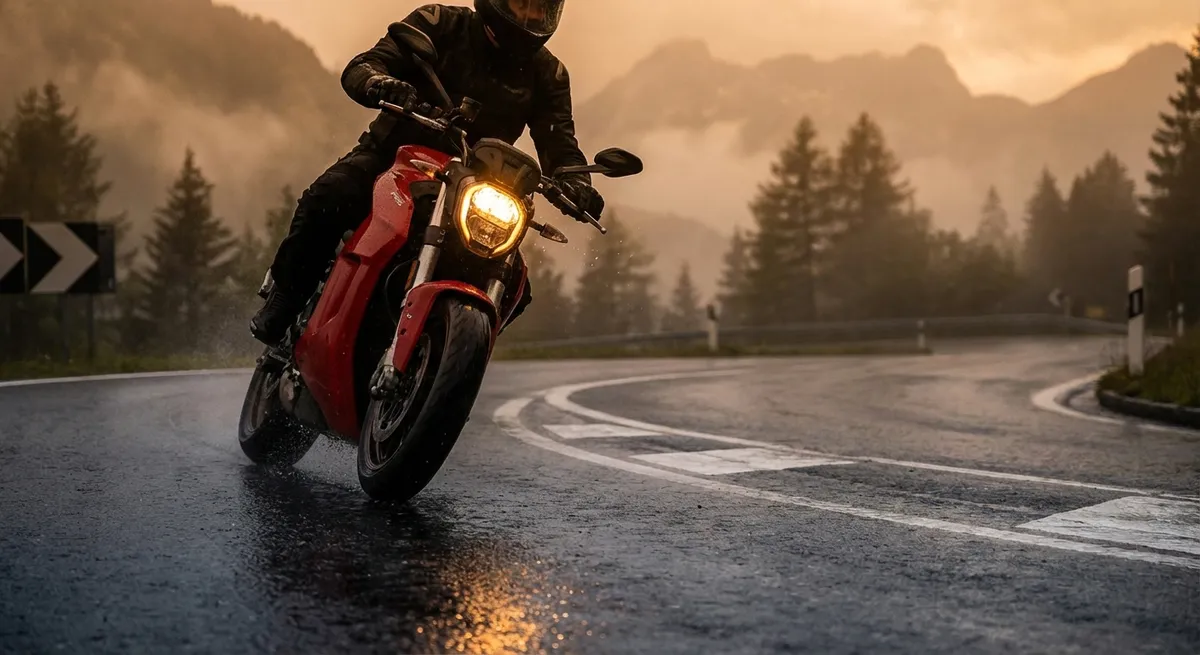
Traction isn’t magic—it’s math, materials science, and rider inputs colliding with asphalt in real time. Every time you roll on the throttle, trail the brake, or lean into a corner, you’re negotiating a complex friction problem with only two postcard-sized tire contact patches to solve it. The difference between a sketchy slide and a controlled carve usually isn’t luck; it’s how precisely you manage load, grip, and timing.
This guide dives into five technical riding concepts that directly affect how much usable grip you have and how confidently you can ride at your personal limit—without wasting traction on sloppy inputs.
1. Contact Patch Management: Where Real Grip Actually Lives
Most riders talk about “tire grip” as if it’s a fixed property, but what you really ride on is the tire–road system. The contact patch is not a static oval; it is a dynamic, deforming zone of rubber that responds to load, temperature, and surface texture.
Key technical points:
- Contact patch size is load-dependent: As vertical load on the tire increases (from weight transfer under braking, acceleration, or lean), the contact patch grows slightly. However, grip does not increase linearly with load—this is where you see diminishing returns. Adding 20% more load doesn’t give 20% more grip.
- Tire pressure is a tuning tool, not a guess: Too high a pressure and the contact patch shrinks, reducing mechanical keying into the asphalt and causing harsh, nervous feedback. Too low and the carcass flexes excessively, overheating the tire and destabilizing the bike under heavy inputs. Always start with manufacturer-recommended cold pressures and only deviate in small, measured steps.
- Rubber compound depends heavily on temperature: Sport-touring tires are designed to reach operating grip at lower temperatures and over a wider range. Hypersport or track-oriented compounds give brutal grip once warm but can feel vague or slippery when cold or in wet conditions. Understand your tire type and don’t ride like a superbike hero on cold hypersport rubber in 45°F ambient temps.
- Feedback is your early warning signal: A “greasy” feel, delayed response to steering, or a vague sensation on lean usually means the contact patch is either overloaded, too cold, overheated, or running on a contaminated surface (dust, paint, gravel). Treat vague feedback as a data point, not “just the road.”
Practical habit: At the start of each ride, spend the first 5–10 minutes warming the tires with progressive lean and moderate acceleration/braking, not aggressive throttle blips in a straight line. You’re warming the tire bulk and contact patch, not showing off.
2. Friction Circle Awareness: Using Grip in Two Axes, Not One
Every tire has a friction circle (or more accurately, friction ellipse): a maximum combined capacity for braking/acceleration (longitudinal) and cornering (lateral) forces. If you use more of one, you have less available of the other. Exceed that combined limit and the tire slides.
Key technical points:
- Straight-line braking = mostly longitudinal load: When upright, you can use nearly all available friction for braking. This is why emergency stops are done with the bike vertical and maximum braking force applied progressively.
- Mid-corner = mostly lateral load: At peak lean, a large portion of friction is used just to sustain the cornering radius. That means you have less margin for hard braking or abrupt acceleration.
- Trail braking done right respects the friction circle: You start with high brake force (upright, mostly longitudinal), then as you lean in and lateral load grows, you smoothly taper off brake pressure. You’re sliding your usage around the friction circle’s edge instead of punching straight through it.
- Throttle application must be vector-aware: Cracking the throttle at big lean angles should be gentle and linear. You’re transferring some friction budget from lateral (cornering) to longitudinal (drive) without exceeding the combined limit.
Practical habit: In a safe, empty lot, practice progressive braking into a curve at low speed: start braking upright, enter a gentle curve while easing off the brake, and feel how the bike responds. The goal is to make your transitions so smooth that the suspension doesn’t “bounce” when you lift or apply the brakes.
3. Load Transfer and Suspension Timing: Controlling the Chassis, Not Just the Throttle
Grip is heavily influenced by how and when you load each tire. The bike doesn’t just sit statically between the wheels; every throttle, brake, or steering input shifts weight front to rear and side to side. Your job is to shape these transfers so the tires are loaded predictably and the suspension stays in its optimal stroke range.
Key technical points:
- Braking = forward pitch and front tire loading: As you brake, inertia shifts load forward, compressing the fork. This increases front contact patch size and available grip—up to a point. Overly abrupt braking can spike fork compression, making the tire skip over bumps and reducing actual grip despite higher load.
- Acceleration = rearward pitch and rear tire loading: Rolling on the throttle transfers load to the rear. Smooth roll-on allows the rear tire to “dig in.” Abrupt throttle at low grip (cold tires, wet surface, dust) can instantly overwhelm rear traction before the suspension has time to settle.
- Suspension has a working range: Think of your fork and shock as having a “sweet zone” where they can still react to bumps. If you’re constantly topping out (fully extended) under braking or squatting excessively under acceleration, you’re reducing the suspension’s ability to absorb irregularities, which destabilizes the tire–road interface.
- Input timing matters as much as magnitude: The difference between a stable weight transfer and a sketchy one is often rate of change. A gradual 0–60% brake application over half a second loads the front predictably. A stabby 0–60% in a tenth of a second spikes weight transfer and unsettles the chassis.
Practical habit: Pay attention to how your bike feels mid-corner over bumps. If the chassis feels harsh, skittish, or bouncy, you may be entering the corner with poor weight distribution or inappropriate suspension settings (too much rebound, too little compression, etc.). Make one change at a time and test deliberately.
4. Line Choice as a Stability Tool: Engineering a Margin, Not Just a Path
Your line isn’t just “inside, apex, exit.” It’s a control strategy that dictates your lean angle, braking zone, throttle timing, and exposure to hazards. On real roads—with blind corners, driveways, gravel, and variable surface quality—your line should be engineered for maximum information and maximum margin, not minimum corner time.
Key technical points:
- Vision is the start of every line: Your practical corner entry speed is determined by how far ahead you can see the exit or at least a safe stopping zone. If you outrun your vision, you’re effectively “borrowing” from luck.
- Delayed, wide apex lines create buffer: By staying wider for longer and turning in later, you reduce required lean angle for a given speed and typically open your sightline earlier. This means more grip margin and a safer adjustment window if a hazard appears mid-corner.
- Surface scanning is continuous, not one-and-done: You should be evaluating patches of tar snakes, painted lines, ripples, and debris as you approach and adjust your intended line a meter or two at a time. A line that avoids a manhole cover at lean is often objectively better than a textbook geometric apex.
- Entry speed is the primary safety factor: Too hot in and no line can save you. When in doubt, enter slightly slower and prioritize smoothness on the brakes and throttle. This keeps you within your friction and suspension envelope and allows for correction mid-corner.
Practical habit: On your next ride, consciously choose a late apex in a familiar corner and focus on being smooth on the brakes, clean on turn-in, and decisive but gentle on the throttle. Notice how much more time and visibility you have compared to an early, tight entry.
5. Fine Control Inputs: Signal Quality Between Rider and Machine
At real riding speeds, the “bandwidth” between you and the bike is defined by how cleanly you control your interfaces: bars, pegs, seat, and controls. Sloppy or noisy inputs waste grip, confuse the chassis, and mask valuable feedback. Technical riding is as much about what you don’t do as what you do.
Key technical points:
- Bar input should be specific and minimal: You steer mostly with a brief, decisive countersteer to initiate lean, then very subtle pressure adjustments to hold or change your line. Constant micro-wiggling on the bars loads the front irregularly and introduces unnecessary instability.
- Lower body does the anchoring: Grip the tank lightly with your knees and use your core to stabilize your torso so your arms can stay relaxed. If your upper body is hanging off your wrists, every bump turns into bar input.
- Brake and throttle are analog signals, not on/off switches: Good riders treat them like dimmers, not light switches. The first and last 10% of every braking and throttle event are the most critical; that’s where you decide whether the transfer of load will be calm or violent.
- Clutch control improves low-speed stability: At parking-lot speeds, a slightly slipping clutch with gentle throttle and firm rear brake gives you a stable “loaded” drivetrain and smoother micro-movements. This reduces tip-over risk and builds fine-motor control that transfers to higher speeds.
Practical habit: Next ride, pick one control per session to focus on: one ride for ultra-smooth initial brake application, another for perfectly linear throttle roll-ons, another for relaxed, minimal bar input. Isolate, refine, then integrate.
Conclusion
Motorcycle control is not about memorizing tricks; it’s about understanding how physics, materials, and mechanical systems intersect beneath you—and then shaping your inputs to work with that, not against it. When you manage the contact patch intelligently, respect the friction circle, control load transfer, engineer safer lines, and clean up your control signals, you stop riding in reaction mode and start riding by design.
The payoff isn’t just speed. It’s a calmer mind, more readable feedback from your machine, and a bigger safety margin when the real world throws you a decreasing-radius corner with gravel at the exit. That’s where technical riding stops being theory—and starts being the reason you make it home smiling instead of shaken.
Sources
- [Motorcycle Safety Foundation – Basic RiderCourse and Safety Tips](https://www.msf-usa.org/) - Foundational guidance on motorcycle control, vision, and safe riding practices used in certified training programs.
- [Dunlop Motorcycle Tires – Understanding Motorcycle Tires](https://www.dunlopmotorcycletires.com/about/understanding-motorcycle-tires/) - Technical explanations of tire construction, pressure, temperature, and how they affect traction.
- [Bridgestone Motorcycle Tires – Tire Technology](https://www.bridgestone.com/products/motorcycle_tires/technology/) - Detailed look at tire compounds, carcass design, and performance characteristics relevant to grip and contact patches.
- [NHTSA Motorcycle Safety](https://www.nhtsa.gov/road-safety/motorcycles) - U.S. government information on motorcycle safety, braking, and crash factors that highlight the importance of proper technique.
- [Idaho State University – Friction and the Friction Circle (Automotive Dynamics Notes)](https://cs.isu.edu/~hackmart/FrictCircle.html) - Technical overview of the friction circle concept applied to vehicle dynamics and combined tire forces.
Key Takeaway
The most important thing to remember from this article is that this information can change how you think about Riding Tips.