Riding fast isn’t magic, and it isn’t bravado—it’s repeatable physics on demand. When you understand what the bike is actually doing under you, “feel” stops being mysterious and starts being something you can engineer. This isn’t about “ride smoother” or “look further ahead.” This is about five concrete, technical habits that change how your tires load, how your suspension works, and how confidently you can carry speed through real corners on real roads.
1. Load the Front Tire Like an Engineer, Not a Gambler
Most riders talk about “trusting the front,” but the front tire doesn’t need your trust—it needs your weight, delivered at the right time, at the right rate.
When you roll off the throttle or brake, you’re manipulating weight transfer, not just speed. Under deceleration, inertia throws load forward, increasing front tire contact patch and available grip—until you overdo it. The key isn’t how much you brake, but how you arrive at your maximum braking force.
Think in terms of brake ramp: smoothly increase pressure over the first 0.3–0.7 seconds as the fork compresses, the geometry steepens, and the tire flattens into the pavement. That ramp lets the carcass deform and “settle” instead of shocking it into a slide. Once the fork is in its working stroke (typically 25–35 mm into travel on a sporty setup), that’s your high-grip window. That’s when the front is loaded, predictable, and ready to turn.
A practical drill: on a familiar straight, pick a marker and repeatedly brake from, say, 60 mph to 20 mph. Focus on three things:
- Increasing pressure progressively (not grabbing).
- Feeling when the fork stops diving rapidly and holds a firm but compressed position.
- Releasing the brake with the same smoothness you used to apply it.
You’re training your hands to shape the load curve into the front, not just your speed. That load curve is what lets the tire talk to you instead of yelling.
2. Turn-In as a Vector Change, Not a Steering Gesture
Most riders steer with their arms; fast riders steer with forces. You’re not pointing the bars—you’re changing the lean and yaw vectors of the bike.
At turn-in, the bike wants to keep going straight due to momentum. To change direction, you apply a countersteer input: push on the inside bar (or pull on the outside) to create lean. The technical detail that matters is how short and decisive that input is. A vague, drawn-out steering input loads and unloads the chassis inconsistently; a deliberate, controlled push causes a quick, predictable roll into lean.
Think of it like this:
- Your countersteer is a pulse of torque into the bars.
- That pulse is timed while the front is still lightly loaded from your deceleration.
- Your goal is to place the bike at a specific lean angle at a specific point on the track/road, not “start turning and see what happens.”
- A turn-in point on the ground.
- A target lean angle in your mind (linked to your speed).
- An apex reference you commit to before you initiate the turn.
Pair that with vision and reference points. Choose:
Then execute: brake → load front → short, clean countersteer pulse → immediate, stable lean angle. You’re no longer “going into the corner”; you’re solving a geometry problem with deliberate inputs.
3. Throttle as a Suspension Tool, Not Just a Speed Control
Once leaned over, your throttle hand isn’t just deciding “faster or slower.” It’s deciding how much rear grip you have and how your chassis sits.
On a typical motorcycle under cornering:
- Closing the throttle shifts weight forward, increases front load, reduces rear load, steepens geometry.
- Opening the throttle shifts weight rearward, increases rear load, slightly extends the fork, and stabilizes the bike.
- Stop the bike from continuing to decelerate.
- Keep the suspension sitting in a balanced, mid-stroke position.
- Let the chassis hold a consistent attitude so your contact patches stay predictable.
You’re chasing a state called maintenance throttle—just enough drive to:
The technical skill is in the rate of your roll-on. Imagine the first 10–15 degrees of twist as “suspension mode” and anything beyond that as “acceleration mode.” In suspension mode, your roll-on is super delicate: you’re shaping how the rear shock loads the tire, not trying to add big speed.
Try this drill:
- Enter a medium-speed corner at a conservative pace.
- Roll off, brake lightly, set lean.
- Once at lean, gently crack the throttle just off idle and hold it there.
- Feel how the bike becomes calmer and more supported compared to coasting closed.
You’re teaching your right hand to stabilize the platform before you ask for real drive on exit. Once you feel that stability, then you can build more throttle while staying within the tire’s grip envelope.
4. Use Your Body to Tune Geometry in Real Time
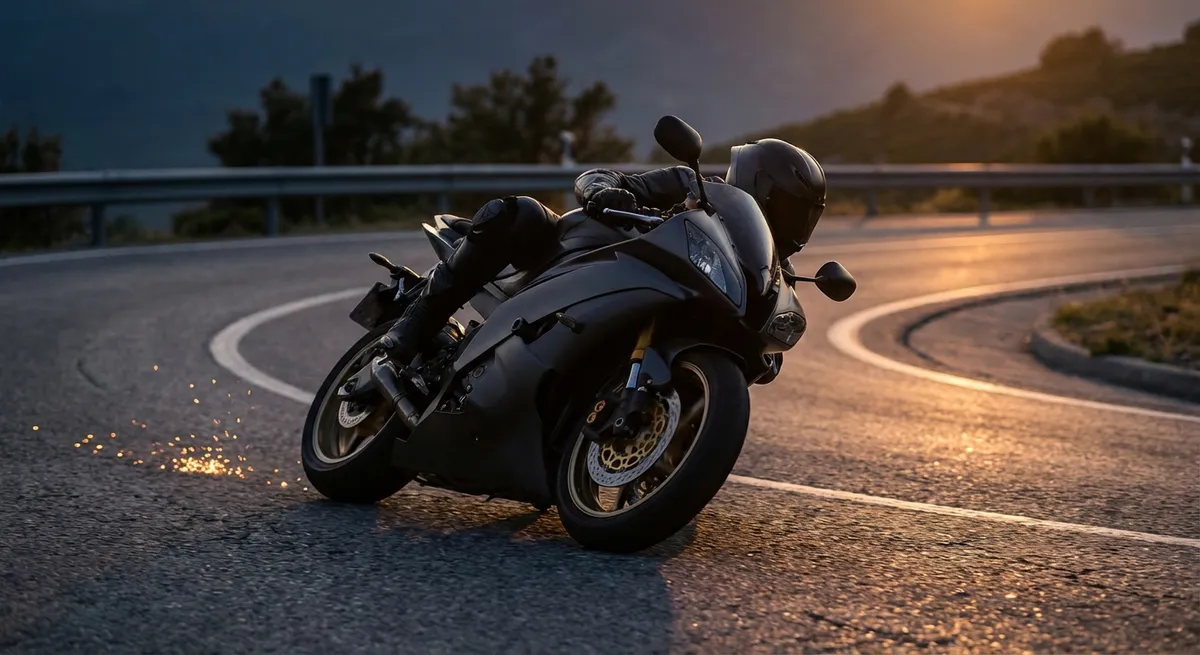
Body position isn’t just about “hanging off because racers do it.” You’re shifting the combined center of mass of you + bike, which changes how much lean angle the bike itself needs for a given cornering load.
There are two key technical goals:
- Reduce bike lean angle for a given corner speed.
- Keep the chassis as upright and un-twisted as possible so the suspension can work in its designed range.
When you move your torso and hips to the inside:
- You move the system’s center of mass inwards.
- The bike can stay a few degrees more upright for the same corner speed.
- Your tires keep a more favorable contact patch shape and temperature profile.
- Inside foot: ball of the foot on the peg, heel lightly touching the frame.
- Hips: rotated slightly into the corner, not just your head leaning.
- Outside knee: braced into the tank to anchor your torso.
- Arms: loose, allowing the bars to self-correct and the fork to operate freely.
But it only works if you’re connected correctly:
The technical detail most people miss: if your arms are supporting your upper body because your legs and core aren’t doing their job, every bump, brake input, or throttle change is contaminated by unintentional bar input. That corrupts your steering feel and makes grip feel inconsistent.
So the habit to engineer: use your lower body and core to hold position, and let your upper body be a sensor, not a brace. The more “floating” your hands feel on the bars, the more cleanly the bike can tell you what the tires are doing.
5. Build a Personal Friction Map of Every Corner
Grip is not a constant; it’s a field of probabilities spread across every meter of pavement. Fast riders don’t just ride the road—they ride a mental friction map of that road.
Technically, you’re always estimating:
- Macro grip: general condition of the surface (temperature, age, texture).
- Micro grip zones: painted lines, patches, tar snakes, manhole covers, seams, gravel, polished car tracks.
- Environmental modifiers: shade vs. sun, damp patches, oil drips at intersections, debris on the outside of bends.
- Where did the suspension react more?
- Where did the bars feel lighter or heavier?
- Where did the tire “speak up” a bit more (a slight squirm, a change in noise)?
Every pass through a corner should update your internal model:
You’re not riding one corner—you’re riding version 1, 2, 3, 4… of the same corner, each with more data. With experience, your brain starts pre-loading your inputs: a tiny earlier brake, a slightly later apex, a fraction more caution near that patch that looked dusty last time.
To make this deliberate:
- On a familiar loop, consciously label 3–5 “reference corners.”
- Each ride, pick one corner and treat it like a lab test.
- Mentally note exact grip changes at: entry, mid, exit, and over any visible defect.
- Adjust your line, lean, or throttle use on the next lap based on those observations.
You’re training a predictive model of grip, not just reacting. That’s what turns “confidence” from emotion into data-backed certainty.
Conclusion
Speed that survives years of riding isn’t built on courage; it’s built on controlled physics. Load the front tire with intention, change direction with decisive vector control, use throttle to stabilize instead of only accelerate, tune geometry with your body instead of fighting the bars, and constantly update your mental friction map.
These five habits give you something better than blind faith in your bike: they give you repeatable, testable control. When you treat riding like a dynamic engineering problem—and your inputs like tools, not guesses—corner speed stops feeling risky and starts feeling inevitable.
Sources
- [Motorcycle Safety Foundation – Advanced Riding Tips](https://www.msf-usa.org/ridercourses.aspx) - Offers formal guidance on braking, cornering, and advanced control techniques.
- [Yamaha Champions Riding School – Blog & Tech Articles](https://ridelikeachampion.com/blog/) - In-depth technical breakdowns of load, brake usage, and cornering dynamics from professional instructors.
- [BMW Motorrad – Riding Tips: Correct Braking and Cornering](https://www.bmw-motorrad.com/en/experience/stories/road/riding-tips.html) - Manufacturer-backed explanations of braking behavior, weight transfer, and corner technique.
- [U.S. National Highway Traffic Safety Administration (NHTSA) – Motorcycle Safety](https://www.nhtsa.gov/road-safety/motorcycle-safety) - Data and safety context that underscore the importance of precise control and technique.
- [California Superbike School – Technical Articles](https://superbikeschool.com/articles/) - Detailed riding theory on throttle control, body position, and chassis behavior in real-world and track scenarios.
Key Takeaway
The most important thing to remember from this article is that this information can change how you think about Riding Tips.