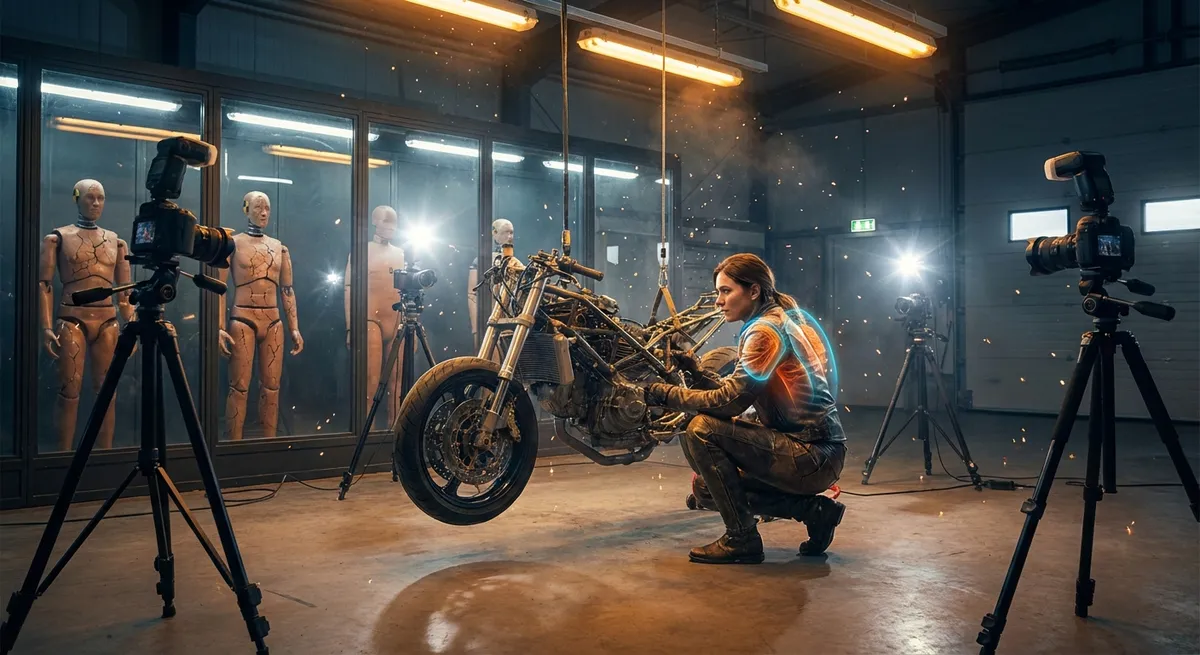
Motorcycle gear isn’t fashion with armor glued on—it’s a load-management system for your body. When things go wrong, your gear decides how impact, abrasion, and heat are distributed across milliseconds that determine whether you walk away or get carried away. This isn’t about “wear gear because it’s safer”; it’s about understanding how that gear behaves mechanically so you can choose equipment that performs the way you ride.
Below are five technical concepts that separate casual “biker gear” from rider-critical equipment—and how to evaluate it like you’re spec’ing components for a track bike, not shopping for a jacket.
1. Impact Energy Management: What CE Levels Actually Mean for Your Bones
Most riders know “CE Level 1 vs. Level 2,” but few understand what those labels really measure. CE impact protection testing (per EN 1621 standards) doesn’t rate materials—it rates how much force actually gets through to your body during a controlled impact.
In the lab, armor is placed over a standardized anvil, then hit with a known energy (usually 50 Joules for limb protectors). Sensors underneath measure transmitted force:
- CE Level 1: Average transmitted force must be ≤35 kN, with any single strike ≤50 kN
- CE Level 2: Average transmitted force must be ≤20 kN, with any single strike ≤30 kN
What this means in rider language: a Level 2 protector can cut peak force to your bones and ligaments by 30–40% compared to Level 1 under test conditions. That’s the difference between “deep bruise and limping” vs. “plate and screws” in marginal crashes.
Technical points to look for:
- Coverage geometry: A Level 2 badge doesn’t help if the armor is 3 cm too short and your elbow finds the tarmac. Check how much bony structure is actually covered in riding position, not on a hanger.
- Energy dispersion vs. localization: Rigid shells spread impact over a wider area but can create edges that become new stress concentrators. Viscoelastic “memory” foams (e.g., D3O-type materials) absorb and convert more energy into heat but depend on thickness to work properly.
- Multiple-hit performance: Real-world crashes often involve sliding, then tumbling. CE tests use multiple impacts on the same sample; gear that permanently compresses or cracks after one hit isn’t what you want when you start rolling.
- Cold and heat behavior: Some foams harden in cold temps and soften too much in extreme heat. If you ride in big temperature ranges, check if the armor is certified to EN 1621-1:2012 with temperature markers (T+ / T−).
Bottom line: treat armor like brake pads. “It has pads” isn’t enough—you want the right compound, right coverage, and right spec for how and where you ride.
2. Abrasion & Tear Resistance: Why Fabrics Fail When Sliding Sideways at 60 mph
Leather vs. textile isn’t a style war—it’s a materials science problem. When you hit the ground, two things try to destroy your gear: abrasion (surface grinding and melting) and tearing (sudden load spikes, often at seams and edges).
Standards like EN 17092 (for motorcycle garments) use a machine called a Darmstadt or Cambridge abrasion tester to simulate a slide. Sample material is dropped onto a rotating abrasive surface, and test time until failure is recorded. Higher classes (AAA, AA, A) withstand longer exposure before the surface wears through.
Key technical considerations:
- Leather thickness & type
- ~1.2–1.4 mm cowhide or kangaroo in impact/slide zones is typical for serious street/track gear.
- Thinner fashion-grade leather (0.8–1.0 mm) often fails quickly under high-speed abrasion.
- Kangaroo has higher tensile strength per thickness but demands high-quality tanning and construction.
- Textile construction
- Look for high-denier (500D+) nylon, Cordura, or specialized high-tenacity fibers.
- UHMWPE (Ultra-High-Molecular-Weight Polyethylene, like Dyneema) and aramids (Kevlar, Twaron) offer excellent abrasion resistance—but only in correct weaves and weights. A “Kevlar-lined” tag means nothing without density and placement.
- Heat generation
- Synthetic fibers can melt under friction heat, bonding into your skin. That’s why premium gear uses layered systems: abrasion shell outside, heat-resistant inner layer, and liners that don’t fuse to the body.
- Tear strength & seam integrity
- The best fabric is useless if the seams unzip on impact. Look for triple-stitched main seams, lockstitch or safety stitch patterns, and bar-tacked stress points.
- EN 17092 includes tear and seam burst tests—look for AA or AAA ratings if you ride aggressively or at highway speeds regularly.
Think of your outer layer like a tire carcass: it doesn’t just need grip (abrasion resistance), it needs structural integrity (tear and seam strength) so it doesn’t explode under load.
3. Biomechanics of Fit: Why Armor Placement Is a Dynamic, Not Static, Problem
Buying a jacket that “fits” standing in a shop is like setting sag with the bike on a center stand. Your body in motion is a different system. Impact zones move when you ride, brake, and twist.
Ergonomic and biomechanical considerations that matter:
- Riding-position bias
- Check if elbow armor tracks the olecranon (the bony point) with arms bent.
- Ensure knee armor stays centered over the patella with feet on pegs—not walking around.
- Armor pocket architecture
- Multi-position pockets (Velcro or multiple stitch points) let you tune armor height like adjusting rearsets.
- Excess pocket volume lets armor “float,” which can allow it to rotate off target during impact.
- Articulation zones
- Accordion panels, stretch zones, and pre-curved sleeves are more than comfort—they reduce tension loads on seams when you move, which helps the garment maintain correct armor position during a crash.
- Poor articulation means fabric is already stressed in your normal stance; add crash loads, and you get early seam failure.
- Load spreading vs. concentration on the body
- Overly stiff armor edges can dig into surrounding soft tissue under tangential (sliding) loads.
- Ideally, armor cups and wraps, increasing contact area and reducing stress concentrators—like a well-designed helmet EPS managing rotational and linear forces together.
- Retention systems
- Knee/shin armor in pants should be stabilized not just by pockets, but by tapered legs, cinch straps, or snug boots that keep everything locked in.
- Chest and back protectors should be held by the jacket and sometimes by dedicated straps or harnesses if you ride hard.
Put the gear on, get into your actual riding stance (not a showroom crouch).
Treat gear fit like chassis setup: position under dynamic load is what counts, not how it looks parked.
4. Thermal & Moisture Management: Building a Microclimate You Can Actually Ride Hard In
If your gear cooks you at 90°F or soaks you in sweat in cool weather, your brain and reaction time will degrade long before your tires do. Thermoregulation is performance gear’s quiet superpower.
The body dumps heat in three primary ways: convection (airflow), conduction (contact), and evaporation (sweat turning to vapor). Technical gear uses layered systems to help all three without compromising protection.
Critical technical elements:
- Base layer as a functional component
- Synthetic or merino base layers move sweat away from skin, enabling evaporation and reducing chill when temps drop.
- Cotton traps moisture, increasing evaporative cooling when you don’t want it and sticking to the skin, which can hinder armor movement and comfort.
- Ventilation vs. structural integrity
- Perforated leather and mesh panels must be carefully placed away from major slide zones.
- Look for solid, high-abrasion material over shoulders, elbows, hips, and outer thighs, with venting in non-primary impact areas (inner arms, torso sides, upper chest).
- Membrane behavior (waterproof/breathable)
- Laminated membranes (e.g., Gore-Tex Pro) bond directly to the outer shell, reducing water absorption and drying time—critical for long days in variable weather.
- Drop-liner systems put a membrane behind the shell; cheaper, but the outer fabric can saturate and become cold/heavy, even if you technically stay “dry.”
- Moisture vapor transmission rate (MVTR)
- Specifications like “X g/m²/24h” tell you how much sweat vapor can move through a membrane. Higher MVTR means better ability to ride hard without turning into a steam room.
- Thermal liners as tuning tools
- Removable liners allow you to tune your gear like changing tire compounds for different track temps.
- A good system lets the outer shell handle protection while liners adjust insulation, not the other way around.
Think of your gear’s microclimate as rider electronics: if it’s set up wrong, your “software” (brain and muscles) go into limp mode long before the bike does.
5. Integration & System Thinking: Making Your Gear Work as One Protective Package
Helmet, jacket, pants, gloves, boots, back protector, chest piece, airbag—each is a subsystem. The question is not, “Is each part good?” but “Do they work together without creating blind spots or conflicts?”
System-level details that matter:
- Overlap and gap control
- Sit on your bike in full kit. Reach for the bars, tuck, hang off a bit.
- Look for lumbar gaps between jacket and pants, wrist exposure between gloves and sleeves, and shin gaps between pants and boots.
- Zipper connection between jacket and pants isn’t just to keep drafts out; it helps keep the jacket from riding up and rotating during a slide.
- Boot and pant interface
- Internal shin armor should sit inside the boot’s protection zone without stacking hard edges that can transfer load into the tibia.
- Race boots with external bracing systems should work with slim, well-tapered pant legs instead of bunching fabric that can catch and twist.
- Back, chest, and airbag interplay
- If you run a standalone airbag vest, ensure it doesn’t compromise the lay of your back and chest protectors—or that it replaces them by design. Doubling up incorrectly can move impact points away from intended zones.
- Check manufacturer guidance: some airbag systems are tested and certified only in combination with specific layers or without additional armor.
- Glove and sleeve interface
- Long gauntlet gloves should sit securely over or under the sleeve (depending on design) without exposing the ulna or wrist bones when you reach fully forward.
- Hard knuckle and scaphoid sliders should not be positioned where sleeve seams or zippers can become pressure risers in a crash.
- Weight and fatigue
- Heavier, overbuilt gear can be safer in isolation but may induce rider fatigue, slower head checks, or reduced fine control over several hours.
- The safest setup is the one you can wear, move in, and mentally forget about for an entire day of real-world riding.
Think of your gear like a complete chassis package: suspension, tires, geometry, and electronics all have to work together. One “hero component” can’t save a poorly integrated system.
Conclusion
Protective gear isn’t a checklist; it’s applied engineering wrapped around your skeleton. Impact ratings, abrasion resistance, biomechanical fit, thermal management, and system integration are the real levers that decide whether your kit is just “motorcycle-themed clothing” or a genuine crash management system.
When you evaluate gear with the same mechanical curiosity you apply to brake compounds, tire carcasses, or suspension valving, your equipment choices stop being guesses and start being setups. And when the day comes that you truly need that system, you’ll know—before you ever hit the ground—that every layer is there for a reason.
Sources
- [European Commission – Protective Equipment for Motorcyclists](https://single-market-economy.ec.europa.eu/sectors/mechanical-engineering/personal-protective-equipment-ppe/protective-clothing-and-equipment-motorcyclists_en) – Overview of PPE standards and requirements for motorcycle gear in the EU
- [Gore-Tex Professional – How Waterproof, Windproof, and Breathable Membranes Work](https://www.gore-tex.com/learn/science-and-benefits) – Technical explanation of membrane construction, breathability, and performance characteristics
- [D3O – Impact Protection Testing and CE Standards](https://www.d3o.com/resources/impact-protection-standards/) – Detailed breakdown of EN 1621 impact protection standards and test methods
- [NIH / National Library of Medicine – Motorcyclist Injury Patterns](https://www.ncbi.nlm.nih.gov/pmc/articles/PMC6389026/) – Research article analyzing common injury locations and mechanisms in motorcycle crashes
- [Harley-Davidson University / MSF Rider Course Handbook (via NHTSA)](https://www.nhtsa.gov/sites/nhtsa.gov/files/documents/811990.pdf) – Includes sections on protective gear selection and its role in rider safety and injury reduction
Key Takeaway
The most important thing to remember from this article is that this information can change how you think about Gear & Equipment.