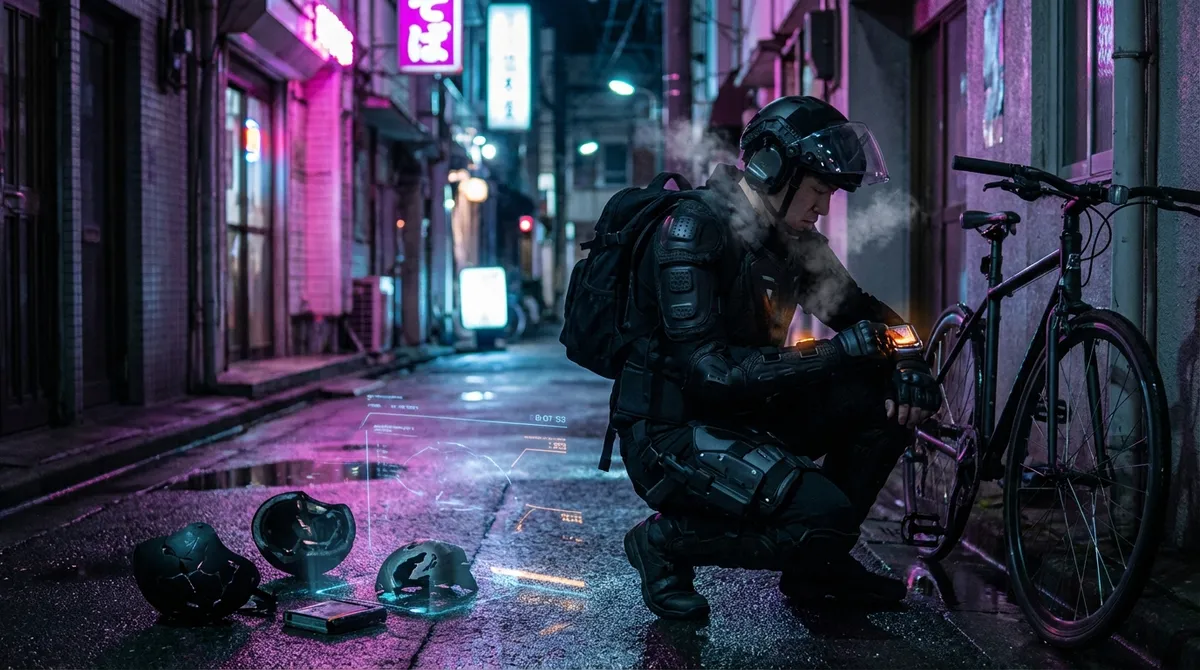
A modern street bike can brake harder, corner deeper, and accelerate faster than most riders will ever fully use—but only if your gear is engineered to survive the same loads you’re asking the chassis to endure. Gear isn’t just “armor and fabric”; it’s a stacked series of impact, abrasion, thermal, and data systems all trying to manage energy around your body while you ride at speed. If you treat gear like a technical platform instead of a fashion choice, you can build a street kit that actually tracks with how aggressively you ride, not how aggressively the catalog is written.
This is about that kind of gear: load-capable, heat-aware, and smart enough to talk back.
Impact Energy Management: Reading CE Ratings Like a Data Sheet
Most riders know “CE Level 1 vs Level 2,” but the way you interpret those numbers should be closer to how you’d read a brake pad spec than a marketing bullet.
Modern limb and back protectors are tested under EN 1621 standards by dropping a 5 kg impactor from a specified height into the armor and measuring transmitted force in kilonewtons (kN) on the other side. The key numbers:
- EN 1621-1 (limbs)
- Level 1: average transmitted force ≤ 35 kN
- Level 2: average transmitted force ≤ 20 kN
- EN 1621-2 (back)
- Level 1: average transmitted force ≤ 18 kN
- Level 2: average transmitted force ≤ 9 kN
From a rider’s perspective, that’s effectively an “impact bandwidth” spec. Level 2 is not “a bit better”; it’s roughly half the transmitted energy at the same test impact. When you’re evaluating gear:
Demand the rating, not the marketing word
“CE-approved armor” is meaningless without the specific norm and level: EN 1621-1:2012 Level 2, EN 1621-2:2014 Level 2, etc.
Look at coverage radius, not just level
Some chest and back protectors qualify on a small area but leave edges thin. If the protector doesn’t span from shoulder-blade to shoulder-blade and from roughly C7 (base of neck) down toward the sacrum, you’re trading kN performance for surface coverage.
Check flex behavior at low temperature
Energy-absorbing foams (e.g., viscoelastic “memory” types) can stiffen in cold conditions. Try bending the armor after it’s been in a cold garage. If it feels like a rigid plate, your real-world crash performance may drift from the lab number.
Pair armor choice with your riding environment
High-speed commuter or fast B-road rider? Level 2 across limbs and spine is justified. Slow urban use with frequent dismounts and walking? Lighter, more vented Level 1 may be the better system because you’ll actually wear it.
Impact performance is a system design decision, not a checkbox. Read armor labels the way you’d read torque curves: numbers first, story second.
Abrasion and Burst Resistance: Thinking in Sliding Distance, Not Just Fabric Names
“Leather vs textile” is the wrong question. The better question is: “How many meters of sliding does this garment realistically survive before exposing skin?”
Under EN 17092 (the current motorcycle garment standard in Europe), zones of the garment are tested on a rotating concrete drum to simulate sliding. Ratings range from AAA (highest) down to A:
- AAA: Highest abrasion, tear, and seam strength
- AA: Balanced touring/street protection
- A: Basic urban / low-speed orientation
But the rating by itself doesn’t tell the whole story. Five technical points that matter for abrasion and structural integrity:
Zone mapping, not just global rating
Garments are divided into risk zones (Zone 1: high-risk impact/abrasion areas; Zone 2: medium; Zone 3: low). A good jacket or suit uses different materials per zone—for example, leather or high-denier textile in Zone 1 (shoulders, elbows, hips, knees), and lighter fabric in Zone 3. Ask for a zone diagram or check the brand’s tech drawings; if they can’t show it, be suspicious.
Material stack, not single-layer hype
High-denier nylon (e.g., 500D–1000D), UHMWPE fibers (Dyneema, Spectra), aramids (Kevlar), and leather all have strong sliding performance—but stacking them in high-risk zones (outer shell + reinforcement panel + lining) dramatically increases time-to-failure on abrasion. Single-layer jeans with blended UHMWPE can be impressive, but multi-layer designs frequently beat them in real-world durability.
Seam architecture: lockstitch vs safety stitch
Many failures in real crashes are from burst seams, not fabric holes. Look for triple or safety-stitched seams (a structural stitch with a cover stitch), especially on arms, shoulders, seat, and outside leg. If you see single, decorative top-stitches doing “structural” work, that’s an engineering red flag.
Leather: thickness and finish over romance
Full-grain cowhide in the 1.2–1.4 mm range (or comparable kangaroo) with minimal weak perforation lines in high-risk zones will still outperform almost all textiles in raw abrasion. However, perforation layout matters: perforated leather across the elbow or outer knee can create tear lines where you least want them.
Textile: denier and weave density as core specs
Decide on a minimum denier for your own riding. For serious street use, many technical riders consider 500D Cordura-type nylon a practical lower bound for primary impact zones, with 600D+ preferred. Higher weave density and ripstop patterns help control tear propagation once abrasion begins.
When you evaluate abrasion, imagine the crash as a “low, dirty highside”: impact, slide, roll, slide. Your jacket and pants are managing a long, asymmetric energy event, not just a single “fall.”
Thermal and Weather Management: Treating Heat as a Safety-Critical Load
Overheating doesn’t feel dramatic like a crash, but it can quietly destroy your reaction time, vision, and decision-making. A 2–3 second delay in a braking decision because you’re cooked inside a black jacket can be just as catastrophic as weak armor. Thermal performance is safety performance.
Think about your gear as a temperature-control system with tunable layers:
Ventilation channels as airflow circuits
Direct front-to-back vents (chest → back, thigh → calf) are more effective than random “breather” holes. You’re trying to create pressure-driven airflow: high-pressure zone at the chest, lower pressure behind the shoulders and back. Look for large, lockable intake vents on the chest and arms with matched exhaust vents out back, not just chest zippers and no exit paths.
Base layers: moisture transport engines
Cotton base layers hold sweat, increasing conductive heat load and chafing. Technical synthetics or merino blends that rapidly move moisture away from the skin reduce perceived temperature and delay fatigue. Treat base layers as sensors and transport layers, not afterthoughts—they define how effectively your outer jacket can work.
Modular liners vs single heavy shell
Instead of a single heavyweight, insulated jacket, a modular shell + mid-layer (e.g., thin insulated jacket or heated layer) gives you thermal range without compromising crash protection. The outer shell should be your abrasion and armor platform; everything else can be swapped based on ambient temperature and ride intensity.
Waterproofing: membrane behavior under hysteresis
Laminated membranes (e.g., Gore-Tex Pro and equivalents) bond the waterproof layer directly to the outer shell, which greatly reduces water soak and weight gain vs drop-in liners. But laminated shells can feel hotter at low speeds. For high-rain, high-speed commuting, lamination is worth it. For mixed-speed summer riding, highly vented shells with packable rain shells may be more realistic.
Color and solar load
Dark gear absorbs more solar radiation, which matters in slow traffic or urban heat islands. If you’re stuck with black for style or availability, prioritize aggressive venting and high-performance base layers. Otherwise, light or neutral colors are a passive thermal upgrade baked into every ride.
When you’re speccing gear, ask: “What’s my worst-case heat day, and will I actually wear this setup in that scenario?” A safe jacket on the hanger is zero protection.
Fit, Kinematics, and Retention: How Gear Moves When You Don’t
Many high-spec jackets and pants fail in real crashes because they shift, rotate, or balloon away from the body just when impact loads arrive. Fit is not comfort alone; it’s impact positioning control.
To treat fit like a technical parameter, focus on:
Armor lock: zero-play in the impact direction
Bend your elbow fully and then extend it, simulate a slide position, and see if the elbow armor leaves the point of your joint. If you can rotate the jacket and move armor 2–3 cm off target, that’s a retention failure. You want adjusters at the biceps and forearm, plus cuff closure that can comfortably cinch over or under gloves without slack.
Pre-curved patterning vs straight fashion cuts
Motorcycle gear should be cut for the riding position, not for standing in a showroom. Pre-curved sleeves, rotated knees, and articulated hips reduce tension in the crash position, which reduces the likelihood of seams being pre-loaded before impact. Less tension means more remaining energy margin for the fabric and seams.
Waist and hem anchor points
A jacket designed to integrate with pants via a full-circumference zipper or robust connection loops massively reduces the chance of the jacket riding up during a slide. Short fashion cut + no connection = exposed lumbar at exactly the worst time.
Boot and glove overlap strategy
Decide consciously: glove over cuff or under? Pants over boot or tucked? In a high-energy slide, any exposed wrist or ankle skin is usually the result of a gap, not thin armor. Design your system so there’s at least a few centimeters of overlap in your true riding position, not just standing straight.
Inflatable systems and expansion volume
If you’re using an airbag vest or jacket, consider how much the outer layers can expand under deployment. Too-tight outer shells can restrict full airbag inflation; too-loose shells may let the bag shift. Brands that engineer combos (their airbag + their jacket) often do the pattern work to maintain correct expansion volume. Mixing and matching is possible, but test how they interact when zipped and cinched.
Fit is the difference between “I own armor” and “that armor was actually on the impact site when I hit the deck.”
Data-Driven Gear: Airbags, Sensors, and the Feedback Loop
The most aggressive frontier in rider safety gear is not a new fabric; it’s algorithms and sensors tucked into vests, suits, and sometimes even helmets. What matters for a technically minded rider is how that data flow changes real-world survivability and decision-making.
Key technical aspects to understand:
Trigger logic: algorithm vs tether
- Tethered airbags (mechanically triggered, usually attaching to the bike) deploy when a cord is pulled hard enough. Simple, reliable, but can fail in some lowside scenarios where you don’t separate cleanly from the bike until late. - Inertial measurement unit (IMU)-based airbags constantly read acceleration, roll, pitch, and yaw, sometimes wheel speed and GPS. They can fire in pre-separation events (for example, a violent lowside where you slam the ground while still momentarily entangled with the bike).
Update cadence and ride modes
Top-tier electronic systems run algorithms that are updated over time by the manufacturer, and some have discrete “Street / Track / Adventure” modes with different sensitivity profiles. For street use, a “Street” or “Urban” algorithm is tuned for varied surfaces, slower speeds, and weird hazards (cars, potholes, curbs) rather than smooth, predictable track crashes. Keeping firmware updated is not marketing fluff; it’s an evolving safety envelope.
Coverage map: chest, back, neck, collarbone
Modern airbag systems can stabilize the neck, protect the collarbones, and add additional volume over the spine and chest. Compare actual deployment diagrams: does it stabilize your helmet from extreme lateral flex? Does it wrap the ribs or primarily cover spine and sternum? In chest-impact-heavy crashes (e.g., hitting a car), rib and thoracic protection can be crucial.
Integration with traditional armor
Some airbag systems are designed to replace back/chest protectors; others are meant to be layered with them. Doubling up back protection without understanding the stack’s ergonomics can create pressure points or reduce the airbag’s effective volume. Follow the manufacturer’s recommendation on “with vs without back protector” instead of blindly stacking armor plates.
Post-crash data and rider learning
A few systems allow access to crash logs or at least basic info (speed, g-loading). Treated properly, that’s not “trophy data”; it’s feedback. You can correlate where things went wrong with what your gear sensed, which in turn can shape how you pick routes, brake markers, or even tires in the future.
Smart gear isn’t about replacing skill; it’s about giving you a second envelope of protection built on data you can’t see or feel in real time.
Conclusion
Your motorcycle is an engineered system: frame stiffness, tire carcass flex, brake feel, and suspension valving all tuned to manage energy and information at speed. Your gear needs to be held to the same standard—impact numbers that mean something, abrasion capacities tied to sliding reality, thermal behavior that keeps your brain online, kinematics that lock armor in place, and sensor systems that can act faster than you can even recognize a crash.
Treat every piece of gear as a component in an integrated protection architecture. Read the labels like spec sheets. Check the stitching like you’d check safety wire on a caliper bolt. Tune venting like you’d tune sag. When your gear is engineered to ride at the same level as your motorcycle, you stop dressing like “a rider” and start operating as a complete system.
Sources
- European Commission – Motorcycle Protective Clothing and Standards - Overview of protective clothing, CE standards, and test methods for impact and abrasion
- Gore-Tex Professional – Technology for Motorcycle Garments - Technical explanation of laminated membranes, waterproofing behavior, and breathability in riding gear
- Alpinestars Tech-Air Airbag Systems - Details on airbag algorithms, coverage zones, and integration with jackets and suits
- Dainese D-air Smart Jacket Technical Info - Information on sensor-based deployment, impact protection, and coverage areas for street airbag systems
- NIOSH / CDC – Preventing Heat Stress and Heat-Related Illness - Research-backed guidance on heat stress, cognitive impact, and mitigation strategies relevant to riders in hot conditions
Key Takeaway
The most important thing to remember from this article is that this information can change how you think about Gear & Equipment.