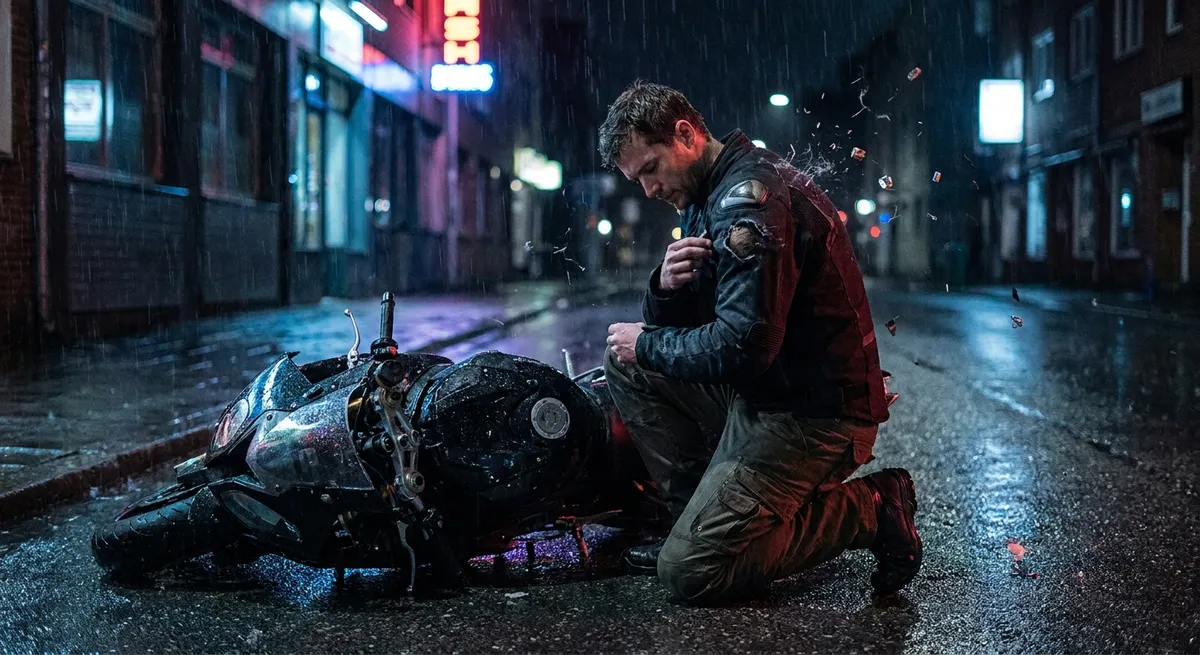
Motorcycle gear is not a costume; it’s a wearable impact-management system. Every seam, stitch, and vent is either working for you at 120 km/h—or against you. If you care about braking distances, tire compounds, and suspension sag, your gear deserves the same engineering-level obsession. This is about building a kit that doesn’t just look “protective,” but actually performs under load, slide, heat, and fatigue in the real world.
Impact, Slide, Heat, Fatigue, Weather: The Five Technical Demands on Gear
Your motorcycle doesn’t experience “crashes” in a single dimension, and neither does your gear. It must simultaneously manage five engineering problems:
- Impact – Short-duration, high-G deceleration when you hit something (or the ground).
- Slide – Long-duration friction as you scrub off speed on asphalt or aggregate.
- Heat – Thermal load from friction, sun, and your own body.
- Fatigue – Rider fatigue from weight, restriction, pressure points, and poor ergonomics.
- Weather – Water and wind penetration, plus evaporative cooling control.
High-performance gear is a compromise optimizer. Leather gives superb slide resistance but can cook you in traffic. Textile can be lighter and more versatile, but not all fabrics survive a long slide. Hard armor disperses point loads well, but if it doesn’t stay in place, your body takes the hit. Thinking about gear this way—like a multi-axis engineering problem—lets you choose pieces that complement each other instead of just stacking random “protective” labels.
Technical Point 1: CE Ratings Are Not Marketing – They’re Load Limits
Most riders have seen “CE Level 1” or “Level 2” on armor and “AA” or “AAA” on garments, but few know what those actually mean in terms of forces and failure thresholds.
Armor Ratings (EN 1621-1 and EN 1621-2)
- CE Level 1 limb armor:
- Average transmitted force ≤ 35 kN
- No single strike > 50 kN
- CE Level 2 limb armor:
- Average transmitted force ≤ 20 kN
- No single strike > 30 kN
In plain terms, Level 2 allows significantly less force to pass into your body. On the chest, back, shoulder, and knee, that difference is the gap between “survivable bruising” and “fracture risk under identical impact conditions.”
Back protectors (EN 1621-2) use similar logic, with Level 2 again meaning lower transmitted force. For any high-speed or spirited road riding, prioritizing Level 2 armor at back, shoulders, elbows, hips, and knees is one of the most meaningful, quantifiable upgrades you can make.
Garment Abrasion & Burst Ratings (EN 17092)
- AAA – Highest level; tested for higher-speed, longer-duration slides and seam strength.
- AA – Strong protection for typical road use.
- A – Urban, lower demand.
Key takeaway: AA or AAA jacket and pants with Level 2 armor is a significantly different safety system than casual “motorcycle-style” gear with unknown materials and no CE certification. When you see those labels, think “tested to specific impact and slide loads,” not “marketing badge.”
Technical Point 2: Material Science of Abrasion – Not All Fabrics Die the Same
Abrasion resistance is a combination of fiber type, weave, denier, and layer architecture. The goal is to manage surface friction, puncture, tear, and heat generation during a slide.
Leather vs. Textile
- 1.2–1.4 mm cowhide or kangaroo leather (quality, not fashion grade) has outstanding abrasion performance and predictable failure modes. It can often endure multiple seconds of real-world sliding before wearing through.
- High-denier nylon (e.g., 500D–1000D) or advanced blends like Cordura, Armacor, or SuperFabric leverage engineered fibers and coatings to approach leather-like abrasion performance at lower weight.
Critical detail: many “textile” jackets use low-denier polyester (e.g., 300D poly) with limited slide endurance. That’s fine for commuting at low speeds, but not for aggressive canyon riding. Look for:
- High-denier nylon or Cordura in impact zones (shoulders, elbows, hips, knees, seat).
- Reinforcement overlays (double layers, ripstop weaves, or ceramic/superfabric panels).
- Seam engineering – triple stitching and hidden safety seams where failure is most likely.
If the manufacturer doesn’t publish denier ratings or reinforcement details, treat it as a red flag. Good gear brands are proud of their material specs and will list them explicitly.
Technical Point 3: Impact Armor Design – Thickness, Coverage, and Mobility
Armor isn’t just about the CE level; it’s about how that armor behaves dynamically under your movement and in a crash.
Density and Thickness
- Level 2 armor is typically thicker and denser, using viscoelastic materials that stiffen under impact.
- More thickness allows more energy absorption distance—just like more suspension travel helps manage bumps.
But pure thickness is not the entire story. Good armor uses:
- Zoned density – softer toward the body for comfort, firmer toward the outside for load management.
- Ventilation channels – perforations and grooves to allow airflow without creating failure lines.
Coverage and Fit
You want armor that covers high-risk zones in the actual riding position, not just when you’re standing in a store:
- Shoulder armor should fully cradle the humeral head, not float on top of your deltoid.
- Elbow armor should cover the ulna/olecranon across the entire range of reach to the bars.
- Knee armor should remain centered when you’re in a crouched, pegs-down posture.
- Back armor should reach from just below C7 (base of neck) to just above the tailbone.
Test this: sit on your bike in your full kit. Move your arms through lock-to-lock steering, crouch onto the tank, hang off slightly. If the armor visibly shifts off-target or “floats,” the garment isn’t technically stable under load. That’s a fit or patterning problem, not just a comfort issue.
Technical Point 4: Thermal Management – Matching Ventilation to Workload
Riding is a heat-management game. You’re producing muscular heat, absorbing solar radiation, and dealing with engine and road heat. Protectiveness plummets if you’re overheating, because fatigue, dehydration, and cognitive load all spike.
Layering as a Thermal System
Think of your kit as a controllable thermal stack:
- Base layer:
- Synthetic or merino; wicks sweat away from skin.
- Avoid cotton—it saturates and kills evaporative cooling.
- Mid layer (optional):
- Insulating fleece or lightweight synthetic if you ride in cold conditions.
- Must not bind inside the jacket or distort fit of armor.
- Outer shell:
- Either true mesh (high airflow, lower slide endurance)
- Or laminated/zip-out systems that let you tune vents vs. weatherproofing.
Vent Design That Actually Works at Speed
Vent placement matters more than vent count. Technical details to look for:
- Intake and exhaust pairing – chest or bicep intakes plus rear shoulder or back exhaust vents create a pressure-driven flow path.
- Direct-to-body vents – openings that bypass liners and send air straight to the base layer.
- Sleeve vents that blow along the arms, where a lot of blood flow occurs and cooling is efficient.
For hot climates, a full mesh jacket can be the right answer—but recognize that many mesh jackets trade away slide duration. A hybrid solution (AA-rated chassis with heavy mesh panels in non-primary impact zones) can give you high flow without fully sacrificing abrasion performance.
Technical Point 5: Ergonomics Under Load – How Gear Changes Your Control Inputs
Control feel is a safety feature. Stiff gloves, bulky boots, or restrictive pants don’t just feel annoying; they curve your braking and shifting response and can subtly change how you load the bike.
Gloves: Tactile Feedback vs. Protection
Technical glove features that matter:
- Palm construction – single or dual layers of leather with minimal bulky seams across the grip area.
- Scaphoid sliders on the palm/heel – reduce the chance of the glove “grabbing” the tarmac and torquing your wrist on a fall.
- Finger articulation – pre-curved fingers, stretch panels over the knuckles, and floating knuckle armor that doesn’t bind when you reach for the brake.
Do a calibration test: with your gloves on, can you:
- Modulate the front brake from “brush” to “threshold” with clear feel?
- Feather the clutch at walking pace and in a U-turn?
- Operate turn signals, horn, and kill switch without visually checking?
If not, the glove is too bulky or poorly patterned for technical riding.
Boots: Ankle Stability vs. Peg Feel
High-performance boots are ankle braces disguised as footwear. Look for:
- Lateral bracing systems (internal bracing, ankle pivots, or reinforced cups) to prevent ankle roll.
- Torsional rigidity in the sole so the boot doesn’t twist on impact.
- Heel and toe cups with real reinforcement, not just cosmetic shaping.
Yet the sole must transmit good feedback from the pegs. A boot that’s too soft can fold on impact; a boot that’s too hard kills peg feel. Mid-stiffness soles with defined peg zones strike the best balance for road and spirited riding.
Pants and Jacket Ergonomics
- Pre-curved knees and articulated hips prevent the garment from “pulling” against you mid-corner.
- Stretch panels (accordion leather or stretch textile) in the crotch, lower back, and behind the shoulders reduce resistance to body positioning.
- A jacket-pant connection (zip or robust loop system) keeps the lower back covered in any slide, and stabilizes armor alignment.
If your gear restricts you from comfortably shifting body weight, hanging off, or quickly transitioning side to side, it is technically interfering with your ability to ride well.
Conclusion
Riders obsess over horsepower, lean angle, and brake rotor diameters, but your gear is the only hardware guaranteed to be between you and the road at the exact moment everything goes wrong. Treat it with the same engineering rigor you apply to your tire pressures or suspension setup.
Evaluate every jacket, pant, glove, and boot against measurable criteria: CE levels, material construction, abrasion zones, armor stability, thermal management, and ergonomic interference. Build a kit that answers the five real demands—impact, slide, heat, fatigue, and weather—and your protection system will finally match the performance of the machine you’re riding.
Your bike is already ready. Make sure your gear is, too.
Sources
- European Committee for Standardization – EN 17092 Protective Motorcycle Clothing – Official technical framework for modern motorcycle garment protection levels (A/AA/AAA)
- European Commission – Protective Clothing for Motorcyclists – Overview of motorcycle PPE standards and safety considerations
- Dainese Technical Safety – CE Certifications Explained – Brand-side explanation of CE armor and garment ratings with practical context
- Rev’It! – Guide to Motorcycle Apparel Safety Levels – Detailed breakdown of EN 17092 classes, materials, and protection philosophy
- NHTSA Motorcycle Safety – Gear and Protective Equipment – U.S. government guidance on motorcycle protective gear and its role in injury reduction
Key Takeaway
The most important thing to remember from this article is that this information can change how you think about Gear & Equipment.