If you only skim horsepower numbers and 0–60 times, you’re missing about 80% of what a motorcycle review is really telling you. Modern reviews are loaded with data—some good, some lazy, some outright misleading. But if you know what to look for, you can extract brutally honest, real-world performance info from almost any test, even when the reviewer doesn’t realize how much they’re revealing.
This isn’t about “feelings on the bike.” This is about reading between the lines: chassis behavior, throttle logic, braking stability, heat management, and how the electronics actually intervene when you’re riding at your personal limit—not a MotoGP rider’s.
Below are five technical lenses you can use to decode motorcycle reviews and turn them into real, rideable information.
1. Interpreting Dyno Curves vs. Brochure Horsepower
Peak power sells bikes, but the shape of the curve decides whether you actually enjoy riding them.
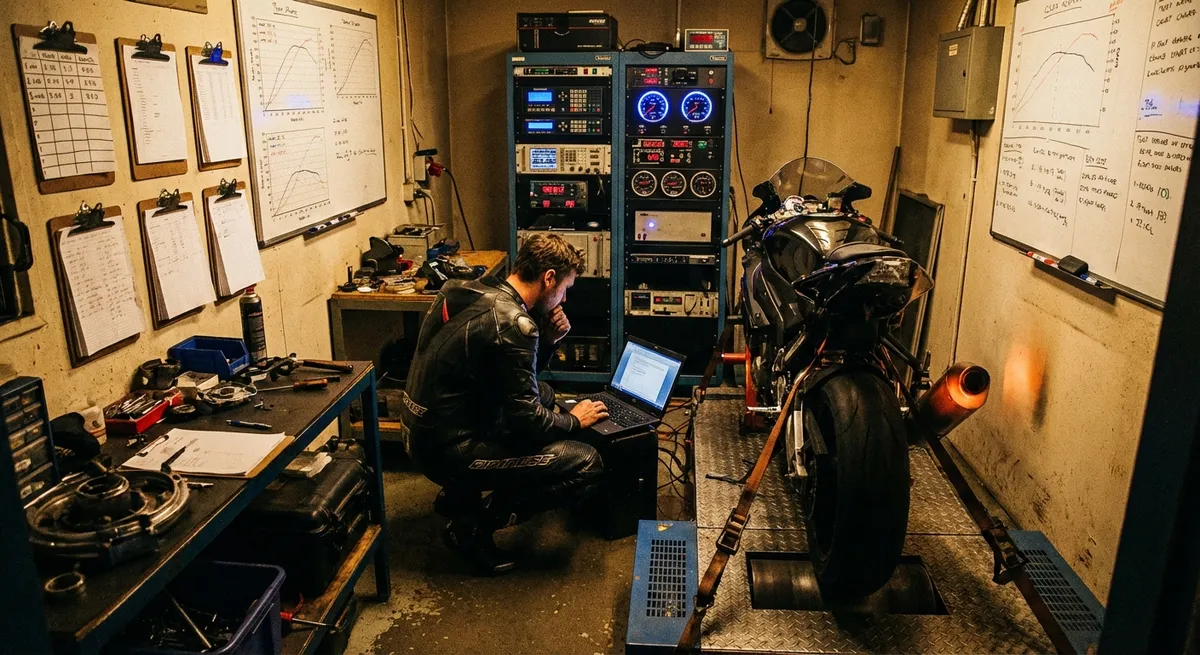
When a review includes a dyno chart, don’t just look at the number at the top. Pay attention to:
- Torque plateau vs. torque spike
A broad, flat torque curve from midrange to near redline usually translates to a bike that can pull cleanly in one gear through a series of corners. A sharp spike followed by a drop suggests a “heroic” rush that’s harder to manage at the edge of grip.
- Where torque actually wakes up
If peak torque sits at, say, 9,000 rpm on a street bike but the reviewer keeps mentioning “needing to downshift to pass,” that’s a mismatch between gearing, torque delivery, and usable road rpm. You want the most area under the curve in the rpm band you actually ride (often 4,000–8,000 on middleweights and liter bikes).
- Power taper near redline
A bike that holds power near redline usually rewards a high-rpm riding style. If the curve nosedives early, pushing to the limiter just generates more noise and heat, not more drive. When a tester says, “No reason to rev it out,” check if the dyno confirms that.
- Difference between manufacturer claims and measured output
Crank vs. wheel horsepower matters. If the factory claims 150 hp and the dyno shows 130 at the wheel, that’s normal. But if a competing bike with a similar claim makes 140 at the wheel on the same dyno in the same test, the gap is real.
Technical takeaway:
Use dyno curves in reviews to predict how you’ll actually use the engine—which gear you’ll live in, how often you’ll shift, and whether the bike’s powerband suits your riding style (short-shifting torque surfer vs. limiter-chasing animal).
2. Translating Suspension Talk into Real-World Behavior
Most reviews throw around words like “planted,” “harsh,” “compliant,” and “vague.” Those are emotional summaries of very physical behaviors. Reframe them in terms of suspension fundamentals:
- “Harsh over sharp bumps”
This usually means too much high-speed compression damping. It’s not about bike speed; it’s about how fast the suspension shaft moves. Potholes, expansion joints, and broken pavement trigger high-speed damping. If multiple reviewers complain about this, expect fatigue on rough roads unless you re-valve or significantly tweak settings.
- “Wallows mid-corner” or “moves around when pushed”
That’s often insufficient rebound damping or overly soft spring rates. The bike compresses under load and doesn’t recover fast or consistently enough, so it feels like it’s floating or drifting off line when you roll on throttle.
- “Stable but slow to turn”
Usually tied to conservative geometry (long wheelbase, relaxed rake, lots of trail) or a tall rear + low front preload combo. Great for highway confidence, but it may resist quick line changes.
- “Twitchy” or “nervous at high speed”
That’s a geometry and weight-distribution story: steep rake, short trail, lighter front-end loading, often combined with strong acceleration. If the review mentions needing a steering damper, that’s a warning flag for riders who value calm over razor agility.
- Pay attention to rider weight and settings
If a 150 lb tester says “stock suspension is perfect,” a 210 lb rider will likely bottom it out. Good reviews list clicker positions, preload changes, and shock adjustments. Use those as a starting map for your own tuning.
Technical takeaway:
When you see those subjective words, mentally translate them into spring rate, preload, compression, and rebound behavior—then decide whether the base setup matches your weight, roads, and aggression level.
3. Reading Brake Performance Beyond “Strong” or “Adequate”
Brakes are the difference between “fast” and “confidently fast.” A review that only says “plenty of stopping power” is basically telling you nothing. Look for these indicators:
- Initial bite vs. progression
- “On/off feeling,” “grabby,” or “too aggressive” = strong initial bite, less progression. Great on track, tricky in the wet or at low speed.
- “Needs a firm pull,” “more progressive than powerful” = softer initial bite, more linear ramp-up. Often better for street and mixed riding.
- Thermal performance and fade
Pay attention if the reviewer mentions repeated hard braking from triple-digit speeds. If they note “consistent lever feel all session,” that’s code for solid calipers, pads, fluid, and rotor design. If they say, “Lever came closer to the bar after several laps,” that’s a warning about fade and heat saturation.
- ABS tuning
- “Invasive ABS” or “cuts in early” often shows up on bumpy roads or downhill braking. That suggests the ABS logic is conservative; it starts releasing pressure as soon as it senses wheel speed fluctuation.
- “You barely notice ABS until you really overstep” = more performance-focused mapping.
- Rear brake usefulness
When a reviewer notes the rear brake is “weak” or “hardly noticeable,” that affects slow-speed control, trail-braking into tight corners, and stability mid-turn. A strong, controllable rear brake is critical for low-speed maneuvers and dirt or mixed-surface riding.
- Brake hardware context
Radial-mount calipers, steel-braided lines, and large dual discs sound impressive, but the review’s impressions of feel and consistency matter more than the parts list. If great hardware still gets so-so feedback, the weak links are often pads or master cylinder feel.
Technical takeaway:
Use brake comments to evaluate confidence under repeated hard use, not just raw stopping distance. The best setup for you is predictable, consistent, and controllable—not just “strong.”
4. Decoding Electronics: Traction, Modes, and the Hidden Logic Layer
Modern reviews are stuffed with acronyms: TC, IMU, ABS Pro, wheelie control, slide control, engine modes, and more. The important question is not “does it have it?” but “how does it intervene?”
Look for how reviewers describe behavior, not just the presence of systems:
- Traction control (TC)
- “Cuts power abruptly,” “kills the drive,” or “feels like hitting a wall” = crude, conservative TC strategy. Fine for commuting, frustrating when you start pushing.
- “Lets you feel a bit of spin” or “smooth, almost transparent intervention” = more performance-oriented mapping, good for fast road or track use.
- Wheelie control
When testers say, “Bike refuses to lift the front even at full throttle,” the wheelie control is tightly integrated with power delivery. If you like power wheelies, note whether it can be disabled independently from TC and ABS.
- Ride modes and throttle maps
- “Rain mode dulls response significantly” = good for low-grip safety.
- “Sport mode feels snatchy off closed throttle” = too-aggressive throttle mapping or insufficient fueling smoothness.
If they say “I left it in Road/Standard most of the time,” that’s usually the most balanced, real-world usable map.
- Cornering ABS (IMU-based)
If cornering ABS is present, see how it’s described in downhill hairpins or mid-corner braking. “Saved a few late braking moments without upright drama” is exactly what you want from IMU-based logic.
- User configurability
Reviews that praise “fully customizable modes” but then mention a clunky menu system are telling you something important: you may not bother changing setups if it’s a pain. Practical tuning matters more than theoretical flexibility.
Technical takeaway:
Treat electronics as another tunable chassis parameter. Good reviews tell you how the logic behaves when the tire is at the edge—not just that the features exist.
5. Extracting Real Ergonomics and Heat Management Data
Comfort, heat, and ergonomics are often the difference between “dream bike” and “sold it in six months.” This is where many riders get blindsided because brochure specs don’t show what your knees, wrists, and thighs will actually feel.
From a technical reading of reviews, focus on:
- Rider triangle (bar–seat–peg relationship)
- “Weight on wrists at highway speeds” = lower bars, forward lean; wind may not fully support your torso.
- “Knees tightly bent” or “cramped legroom for taller riders” = high rearsets, lower seat, or both. If you’re over 6 ft, this is crucial.
Terms like “sporty but not extreme,” “upright,” or “aggressive” are vague. Instead, look for:
Some reviewers include measured seat height and bar width; cross-reference those with your current bike if you can.
- Seat shape and long-distance support
“Firm but supportive over distance” usually beats “plush but sags after an hour.” Foam density and seat width at the front vs. rear change weight distribution on your sit bones. If multiple testers mention numbness after 90+ minutes, expect aftermarket seat shopping.
- Engine and exhaust heat
Take heat comments seriously. Phrases like “uncomfortable in stop-and-go,” “right leg cooks in traffic,” or “fine at speed, hot in town” are huge tells about underbody catalytic converters, exhaust routing, and radiator efficiency. High-compression, high-output engines often trade some around-town thermal comfort for performance.
- Wind protection and aero stability
- “Clean airflow but a lot of pressure on the chest” = little turbulence, but you’ll get tired at higher speeds.
- “Buffeting at helmet level” = badly shaped windscreen or turbulence at your height. Riders of different heights may report opposite experiences, so look for patterns across multiple reviews.
Comments about crosswind stability hint at fairing and chassis design: some broad-faired bikes act like sails.
- Tank shape and body support
If reviewers mention “great support under braking” or “easy to grip the tank with knees,” that directly affects fatigue and control. Tank width and knee cutouts are engineering decisions that change how you load your core vs. wrists under deceleration.
Technical takeaway:
The way testers describe fatigue, heat, and aero at specific speeds is pure gold. Use those details to predict whether a bike will be a 45-minute toy or a 5-hour weapon for you.
Conclusion
Motorcycle reviews are more than opinions—they’re noisy, imperfect data streams. Once you learn to translate the language of “planted,” “harsh,” “invasive,” and “effortless” into dyno behavior, damping logic, brake consistency, and electronic intervention, you stop shopping for spec sheets and start hunting for systems that match your riding reality.
Treat every review like a lab report with missing labels. Ask:
- What does the dyno curve say about how I’ll actually ride this engine?
- What does the suspension description say about my weight and road surface?
- What does the brake and ABS feedback say about repeated hard use?
- What does electronics behavior say about where the bike lets me explore the limit?
- What do ergonomics and heat notes say about my actual commute or weekend routes?
Do that, and you’ll stop buying on hype—and start choosing machines that feel like they were engineered specifically for you.
Sources
- [Motorcycle News – Dyno Explained: What Power and Torque Really Mean](https://www.motorcyclenews.com/new-rider/choosing-bike/2016/june/mcn-plus---dyno-explained-what-power-and-torque-really-mean/) – Solid primer on interpreting dyno charts and understanding power vs. torque in real riding.
- [Öhlins Motorcycle Suspension Technical Info](https://www.ohlins.com/support/owner-s-manuals/motorcycle/) – Official suspension documentation that explains compression, rebound, and setup principles referenced in the article.
- [Brembo – Motorcycle Braking Systems Overview](https://www.brembo.com/en/company/news/motorcycle-braking-system) – Technical breakdown of calipers, discs, and braking behavior relevant to evaluating brake performance in reviews.
- [NHTSA – Motorcycle ABS and Safety Research](https://www.nhtsa.gov/motorcycle-safety/abs-motorcycles) – Government-backed data on anti-lock braking systems and their effect on real-world safety.
- [SAE International – Motorcycle Rider Anthropometry and Ergonomics](https://www.sae.org/publications/technical-papers/content/2000-01-3395/) – Research-based look at rider geometry and ergonomics that underpins the discussion of rider triangle and comfort.
Key Takeaway
The most important thing to remember from this article is that this information can change how you think about Motorcycle Reviews.