Most riders throw gear into a backpack and call it “prepared.” Serious riders engineer a system. A properly built road kit isn’t random tools and gadgets—it’s a carefully curated ecosystem that matches your bike, your riding style, and the real failures that happen on the road. If you want gear that does more than look “ADV” on Instagram, you need to think like a race engineer and a field mechanic at the same time.
This isn’t about packing everything. It’s about packing the right things, configured the right way, so when things go wrong at 70 mph, your kit turns chaos into procedure.
Start with Failure Modes, Not With Shopping Lists
Before you buy a single tool roll or fancy multitool, you need to map your bike’s likely failure modes. Your road kit should be a response to real mechanical and electrical weak points, not a generic “starter pack.”
Five high-value technical points to lock in:
Platform-specific fasteners:
Audit your bike. Count how many fastener types you actually have: hex sizes, Torx, Phillips, JIS, external hex, axle nuts. Design your kit around the minimum effective set that touches at least 90% of your bike. A kit that can’t remove your front wheel or adjust your chain is a fashion accessory, not a tool.
On-bike electrical diagnostics:
Modern bikes are rolling networks—CAN bus, ECUs, sensor arrays. At minimum, your kit should allow: - Access to the battery and main fuses (correct tools to remove seat/bodywork quickly) - Basic continuity checks with a compact multimeter or test light - Direct battery access leads (SAE or similar) for jump packs and chargers If you can’t verify power and ground under stress, you’re diagnosing blind.
Load-rated tie-down and repair systems:
Bungees are not a load-securing system. Use ratchet or cam straps with known working load limits (WLL) and abrasion-resistant webbing. For emergencies, add: - At least one rated soft shackle or carabiner - A short length of quality paracord or accessory cord Engineered redundancy beats improvising with a shoelace on a windy highway shoulder.
Tire repair optimized for your wheel type:
Tube vs tubeless isn’t a small detail—it’s the entire game. - Tubeless: Quality plug kit (mushroom or rope), vulcanizing cement, compact compressor or reliable CO₂ setup, and a valve core tool. - Tube-type: Correct tube sizes (front can sometimes serve rear in a pinch), real tire irons, rim protectors if needed, and a compact pump. Your kit should be validated in your garage first; if you’ve never actually plugged or changed a tire with your setup, you’re testing in production.
Thermal and chemical resilience of components:
The roadside environment is hot, dirty, and sometimes soaked in fuel or chain lube. Choose gear with: - Fuel- and oil-resistant plastics or metals - Heat-tolerant gloves for working near headers - Tape that adheres in cold and heat (self-fusing silicone, high-temp electrical) Gear that fails when hot, wet, or oily is not “emergency equipment”—it’s trash.
When you design your kit around failure modes, you’re no longer “hoping you’re covered.” You know exactly why every piece is there.
Tools: From Random Assortment to Integrated System
A road kit should function like a modular, miniaturized pit-lane toolbox. Every tool should have a job, a location, and a reason it made the cut.
Build from the bike backward
Start with your service manual and work backward:
- Chain adjustment & wheels:
- Loosen axle nuts (often 24–36 mm on many bikes)
- Adjust chain slack (correct spanners or sockets)
- Remove front and rear wheels if needed
Confirm you can:
Many “travel toolkits” skip these high-torque fasteners. That’s a nonstarter. If your kit can’t loosen an axle, it’s incomplete.
- Controls & bodywork:
- Lever perch bolts
- Bar clamp bolts
- Fairing and panel fasteners
Your kit must handle:
That means correctly sized Allen/hex keys, Torx bits where applicable, and at least one JIS-compatible screwdriver for Japanese bikes (standard Phillips can cam-out and damage JIS screws).
- Engine and chassis basics:
- 1/4" or compact 3/8" drive with key sockets
- Bit driver with hex/Torx/Phillips/JIS bits
- Short and long extensions
- A small adjustable wrench for backup (not as primary for critical fasteners)
Include:
Precision vs. bulk
Overpacking tools makes you slower. Focus on:
- Multi-bit drivers instead of full screwdrivers
- Combination wrenches only in sizes your bike actually uses
- A single high-quality compact ratchet with carefully chosen sockets
- One compact but high-leverage solution for big nuts (collapsible or special-purpose wrench)
Test it. Time yourself removing a wheel, pulling a fairing panel, and adjusting the chain using only your kit. If you reach for a garage tool, your kit is lying to you.
Electrical Readiness: Power, Light, and Fault Isolation
Electronics are often blamed when riders simply don’t have the tools to verify anything. Build your electrical sub-kit so you can isolate faults logically, not guess.
Power access and protection
At minimum you should carry:
- Correct seat/bodywork tools for battery access
- Spare fuses for the main values your bike uses (especially main and ignition circuits)
- Small 12 V jump starter or a plan for using an SAE pigtail and another bike/battery safely
Install an SAE or similar quick-connect pigtail directly on the battery and route it to a reachable location. That single connection point supports:
- Battery tender
- Jump starter (if supported)
- Portable compressor
- Charging small devices (with correct adapter)
Diagnostic capability
A palm-sized multimeter is not overkill; it’s control. Learn to:
- Check battery voltage off and running (resting vs. charging system)
- Verify a suspect ground with continuity checks
- Confirm a blown vs. good fuse by measurement, not by guesswork
Pair that with:
- A compact, high-output headlamp (hands-free work)
- One small, magnetic work light to attach to frame or swingarm
In the dark, with traffic noise and stress, the combination of hands-free light and a known-good diagnostic process prevents you from dismantling the wrong thing.
Tire, Load, and Structure: Keeping the Rolling System Intact
A “tire kit” isn’t just about the puncture. It’s about structural and load integrity: how your bike behaves after the repair, and whether your cargo or components stay where they’re supposed to.
Tires: realism over optimism
For tubeless riders:
- Use rope plugs or mushroom plugs from a reputable kit
- Always carry vulcanizing cement, even if your kit claims “no glue needed”
- A compact compressor with a known fill time for your tires is far superior to random CO₂ cartridges whose capacity you haven’t tested
For tube bikes:
- Carry at least one spare tube sized for your front. In emergencies, a front tube can often be stretched into a rear long enough to get you moving again.
- Use two or three proper tire irons with enough length for leverage but short enough to pack
- Practice at home once. A “first-ever tube change” done in gravel and rain is an education in suffering.
Load management and field repairs
Cargo slop destroys handling faster than most riders think. Your kit should support:
- Proper cam or ratchet straps with known WLL and decent hooks or loops
- At least one soft tie to avoid scratching bars or frames
- Reinforcement materials like:
- Self-fusing silicone tape for coolant hoses and low-pressure sealing
- Quality duct tape (the real, fabric-reinforced stuff)
- A few zip ties in multiple lengths and tensile strengths
These let you secure a loose muffler shield, lash a broken fairing, or stabilize a cracked luggage mount long enough to limp out.
Human Factors: Access, Ergonomics, and Repeatability
Your road kit isn’t just a pile of objects—it’s a system you interact with under stress, in bad weather, often with gloves on and adrenaline up. Design it for actual humans, not flat lays on a workbench.
Location and access
- Low and central beats high and aft:
Keep heavy tools low and near the bike’s center of mass—under-seat, inside frame cavities, or in engine guards. A top-heavy tail bag full of tools destabilizes high-speed transitions and crosswind behavior.
- Segmentation by function:
- Tools (mechanical)
- Electrical (diagnostics/lighting/power)
- Tire & air
- Medical/trauma (even a small, smart kit is better than nothing)
Break your kit into sub-modules:
Each module should be accessible without unloading your entire bike.
Ergonomics and workflow
Design for gloved hands:
- Use pouches with large pull tabs and clear zippers
- Avoid micro-bits in loose bags; store bits in rigid or indexed holders
- Label or color-code critical items (e.g., red pouch for medical, yellow for electrical)
Finally, rehearse:
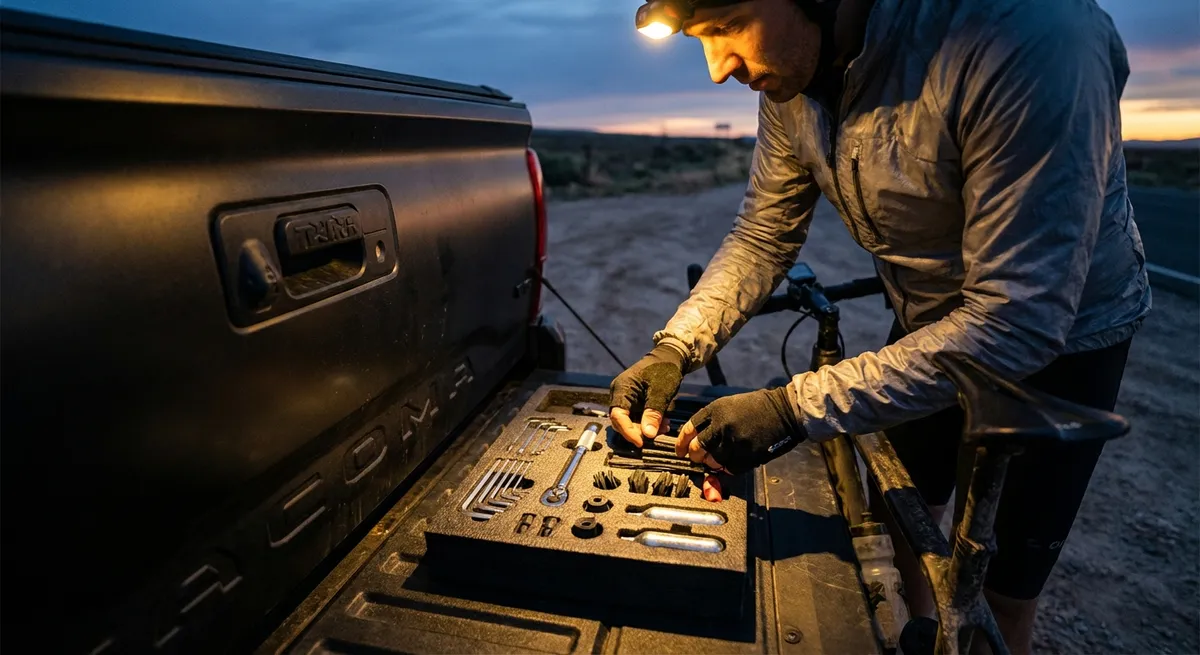
- In your garage, simulate a night roadside scenario: lights off, headlamp only, gloves on.
- Time how long it takes to access your tools, find your tire kit, or reach your fuses.
That practice compresses panic into a checklist. When something fails on the side of the road, you don’t “figure it out”—you execute a process you’ve already debugged at home.
Conclusion
A serious road kit isn’t defined by how much you carry, but by how precisely it matches your bike, your failures, and your riding reality. When your setup is engineered instead of improvised, your gear stops being dead weight and becomes something far more valuable: confidence.
You’re no longer hoping the ride goes smoothly. You’re prepared for when it doesn’t—and that’s the difference between a ruined day and a story you’ll tell for years, backed by a machine that got you home because you built the right system to support it.
Sources
- National Highway Traffic Safety Administration (NHTSA) Motorcycle Safety - Data and guidance on motorcycle safety, failure modes, and risk factors on the road
- Motorcycle Safety Foundation – RiderCourse Handbooks & Tips - Practical recommendations on preparedness, pre-ride checks, and basic roadside readiness
- RevZilla Technical Articles – Motorcycle Tools & Maintenance - In-depth guides on tools, tire repair kits, and on-the-road maintenance practices
- BMW Motorrad – Rider’s Manuals and Technical Information - Example factory procedures and specifications that inform what tools and gear are truly necessary for real-world interventions
- University of Wisconsin – Vehicle Electrical Systems Overview - Background on modern vehicle electrical architectures useful for understanding on-bike diagnostics and power management
Key Takeaway
The most important thing to remember from this article is that this information can change how you think about Gear & Equipment.