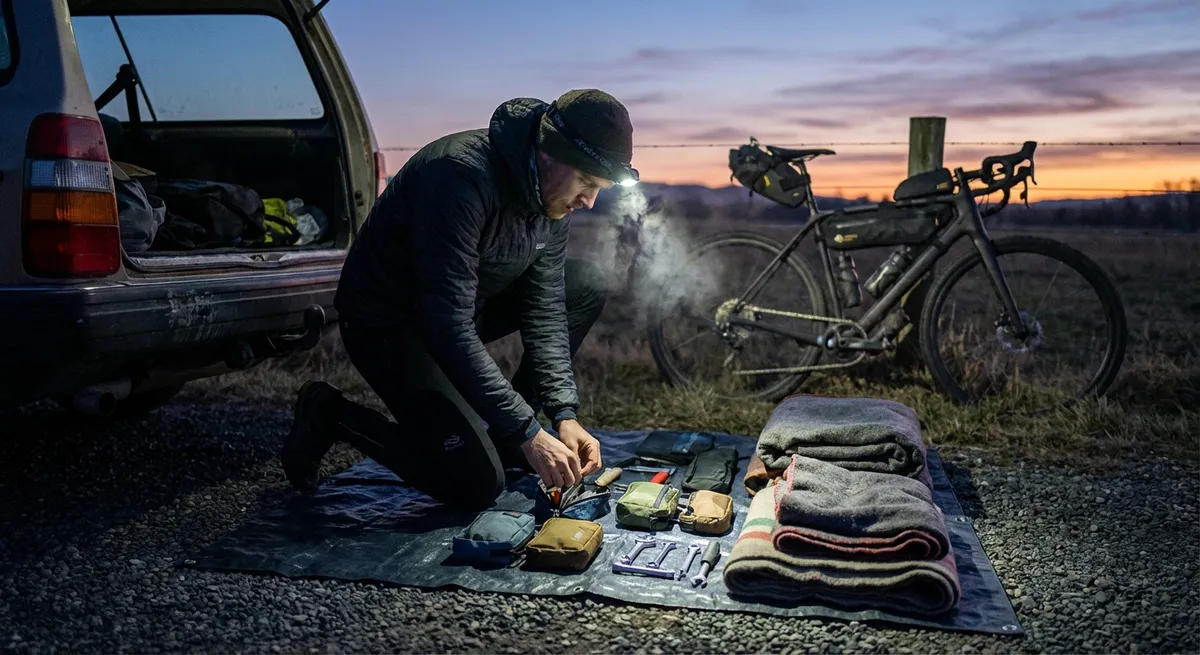
Most riders buy gear as separate pieces: helmet, jacket, gloves, boots, maybe pants if they’re disciplined. But the bike doesn’t see separate pieces—it sees a system: surfaces, friction, impact zones, aerodynamics, and heat transfer. Treat your gear like a system, and suddenly everything from fatigue resistance to crash survivability becomes something you can engineer instead of hope for.
This is about going past “good gear” and into “tuned gear.” Not just safer on paper—mechanically better for your riding, your bike, and your environment.
Designing a Rider-Centric Gear System, Not a Closet
A rack full of “good” gear can still add up to a bad system. The goal is functional integration: every piece doing a job that complements the others, not fighting them.
Think of your gear in four functional layers: impact, abrasion, environment, and control.
- Impact layer: This is your armor set—helmet EPS, back protector, chest, shoulder, elbow, hip, and knee protection. The question is not “Do I have armor?” but “What is its coverage, energy absorption rating, and fit stability at real crash angles?” CE Level 2 armor with poor positioning is functionally inferior to Level 1 that stays locked over joints.
- Abrasion layer: Outer shells. Leather vs textile is not a style choice; it’s a slide-duration engineering trade. Premium race-grade leather can reach 4+ seconds of slide resistance in standardized tests, while mid-grade textile might be 0.7–2 seconds depending on construction. What matters is reinforcement density (denier), weave type, and strategic double layers.
- Environment layer: This controls heat, moisture, and wind. A laminated Gore-Tex or equivalent membrane behaves very differently from a drop liner in terms of evaporation dynamics and heat transfer. Your thermal fatigue over a 400-mile day is often a result of poor evaporative and convective management—not just “it’s hot.”
- Control layer: Gloves, boots, and interface zones where your body talks to the bike. Tactile feedback, lever precision, and boot sole stiffness directly influence brake modulation and weight transfer.
When you buy or upgrade gear, evaluate it by these system roles. If you add a heavy-duty adventure jacket, does it overload your thermal envelope for summer? If you switch to ultra-tactile race gloves, does your cold tolerance collapse in shoulder seasons? The best systems are built intentionally around the riding you actually do: commute, canyon, track, or long-distance.
Technical Point 1: Impact Energy Management Isn’t Just “CE Rated”
Most riders know “CE Level 1 vs Level 2” and stop there. But impact protection is about energy management across the entire body, not just individual pads.
- Back and chest protection: A standalone CE Level 2 back protector often absorbs impact better than thin inserts shipped with jackets. Many stock pads barely pass Level 1. The difference can be the peak force transferred to your spine dropping by 30–50%. A properly shaped chest protector can significantly reduce blunt-force trauma from bars and controls in frontal impacts.
- Coverage vs thickness: A thicker pad at the wrong angle or too small a coverage area is a false comfort. Look at the geometry: does the shoulder armor wrap over the humeral head? Do elbow pads protect both tip and forearm? Does hip armor sit on the bony crest or float in space while you’re in a riding tuck?
- Armor stability under load: On impact, armor tries to move. Loose-fit textiles, oversized jackets, and poorly anchored pockets let pads rotate away from the strike zone. When trying on gear, sit on your bike (or mimic your riding posture) and deliberately rotate your shoulders, tuck, look over your shoulder, and bend your knees. If armor shifts more than 1–2 cm off target, that’s a failure mode.
- Multi-density and viscoelastic materials: D3O, SAS-TEC, and other non-Newtonian or viscoelastic compounds stiffen under fast impacts but remain flexible at rest. Their strength is not just peak force reduction, but the time curve—how quickly they decelerate your body. You want longer deceleration times, lower peak loads.
- Integration with your riding style: Track-focused riders benefit from larger armor coverage and internal race suits that keep everything tight and locked. Urban riders may need more emphasis on chest and rib protection due to car-door and bar-height impacts. Adventure riders should bias hip, knee, and shoulder coverage due to off-axis falls and low-speed, high-frequency impacts.
Treat your armor layout like an impact map. Think honestly about how and where you’re most likely to touch the ground, then tune coverage and level accordingly.
Technical Point 2: Abrasion Resistance Is a Material Science Problem
“All textiles are the same” is as wrong as “all tires are round, so they’re equal.” Abrasion resistance is a function of fiber type, thickness, weave, and construction.
Key variables that matter mechanically:
- Fiber type (base material):
- Leather (especially full-grain cowhide or kangaroo) offers excellent slide time due to fiber density and tear resistance. Track-grade suits are often tested to survive multiple seconds of sliding at ~100 km/h.
- Aramid fibers (like Kevlar) are highly cut- and heat-resistant but often need to be paired with other materials for full-liner or panel usage.
- Nylon / polyamide textiles generally outperform basic polyester in abrasion, especially in high-denier weaves (500D, 1000D, etc.).
- Weave and construction:
- High-denier, tightly woven textiles (ballistic nylon, Cordura) resist both tearing and abrasion better than loose weaves.
- Ripstop patterns add tear-stopping capability but don’t automatically grant slide time; it’s the blend of thread type, thickness, and coating that matters.
- Reinforcement zones: Real slide zones are shoulders, elbows, hips, and knees—plus side-of-leg and outer thigh. Jackets or pants that only reinforce front-facing panels (for “style”) ignore real-world crash dynamics, where you often land and slide on the side.
- Seam strength and failure modes: Many garments fail at the seams long before the fabric itself wears through. This is a stitching-engineering problem:
- Double or triple stitching in critical zones
- Hidden or safety seams where a backup stitch holds if the outer fails
- High-tensile threads designed to resist both heat and tension
- Certification clues (EN 17092): Europe’s EN 17092 standard classifies garments into AAA, AA, A, etc. It’s not perfect, but it’s a quantitative starting point. AAA generally corresponds to higher slide times and tear resistance suitable for higher-speed use. For aggressive road or track-leaning riders, AAA gear for outer layers is worth prioritizing.
If you ride regularly at highway speeds, think of your jacket and pants as your “skin substitute.” Can that shell endure a 2–3 second abrasive event at your cruising speed? That’s the real question.
Technical Point 3: Thermal and Moisture Management as Performance Gear
Fatigue kills focus. And the biggest invisible fatigue engine on long rides is uncontrolled thermal and moisture load. This is not just “comfort”—it’s a performance variable.
- Base layers vs cotton: Technical synthetic or merino wool base layers transport sweat away from the skin to outer layers where it can evaporate. Cotton traps moisture, collapses insulation when wet, and accelerates cooling when you stop—perfect for cold shivers at fuel stops.
- Perforation vs venting:
- Perforated leather flows air directly through micro-holes, which is ideal at speed, but can be too cold off-pace or at elevation.
- Zip vents (especially those with direct-to-body pathways) allow more control. The best systems have intake vents placed in high-pressure zones (chest, shoulders) and exhaust vents in low-pressure zones (upper back), creating a pressure-driven airflow path.
- Membranes: laminated vs drop liner:
- Laminated membranes (e.g., Gore-Tex Pro) are bonded directly to outer fabric, preventing it from soaking up water (“wet-out”). Result: jacket stays lighter and dries faster, but may flow less air when all vents are closed.
- Drop liners hang behind the outer shell; the shell can become saturated, adding weight and enhancing conductive cooling in long rain events.
- Thermal liners vs modular layers: Integrated thermal liners are convenient but often bulky and less adaptable. A better system approach is an independent mid-layer (e.g., synthetic insulated jacket) you can remove off-bike. That gives you heat away from the bike, plus better adjustability for changing temps.
- Altitude and speed interplay: Higher altitude = lower air density = different convective cooling behavior. At 70 mph in thin mountain air, a heavily vented mesh can actually overcool you faster than expected because evaporative and convective cooling combine. Seasoned riders tune venting not just to the thermometer, but to speed and altitude.
When your thermal and sweat management is right, you think more clearly, ride more smoothly, and extend your “sharp riding window” significantly. That’s engineering your endurance, not just your comfort.
Technical Point 4: Tactile Control – Gloves and Boots as Precision Interfaces
Your hands and feet aren’t just protected—they’re sensors and actuators. Poorly designed or poorly matched gear corrupts that signal.
- Glove construction and feel:
- Palm material: Thinner, high-quality leather (like kangaroo) gives superior lever feel while still offering strong abrasion resistance. Too-thick palms reduce modulation ability, especially in panic braking.
- Internal seams and finger curvatures: Pre-curved fingers reduce fatigue and pinch points when you’re on the bars for hours. Internal seams must avoid pressure on flex points to prevent numbness.
- Knuckle and scaphoid protection: Hard knuckle shells and palm sliders reduce direct impact and rotational injury. Palm sliders help your hand slide instead of “dig in,” which can help reduce wrist and scaphoid fractures.
- Boot stiffness vs control:
- Torsional and lateral stiffness (torsion bars, bracing, hinged ankle supports) protect ankles in twisting falls.
- A flat, too-soft sole might feel “comfortable,” but on a sport or ADV bike it transmits peg vibration and flexes excessively during aggressive braking and weight shifts.
- Track or ADV boots often incorporate controlled flex points: stiff against twist and hyperextension, flexible along the power axis you use to brake and shift.
- Interface with controls: Your gear must match lever and peg geometry:
- Glove finger length relative to lever reach—no bunching at the fingertips when you fully pull the lever.
- Boot toe-box thickness vs shifter clearance. If you have to deliberately lift your whole leg to upshift because your boot won’t fit under the lever, you’ve introduced a delay and fatigue source, especially off-road or in technical riding.
- Feedback and fine control: Ride with a glove that’s too thick in winter? You know the sensation: imprecise throttle, vague brake onset. Now imagine that all the time due to poor glove selection. Precisely tuned gear gives you a clear, linear sense of what the bike is doing—the difference between guessing and knowing whether your front brake is close to locking on marginal asphalt.
If you think like an engineer, gloves and boots are not “add-ons.” They’re your input devices. Protect them, yes—but protect without killing signal resolution.
Technical Point 5: Visibility, Signaling, and Dynamic Conspicuity
High-vis gear is not binary—on or off. It’s a dynamic system interacting with motion, environment, and other drivers’ perception.
- Retroreflective placement: Retroreflective panels are most effective when they outline human shape in motion—shoulders, arms, lower legs. This creates a biological “person” signature that car drivers’ brains process faster than random patches of reflection.
- Color vs environment:
- Fluorescent yellow/green works well in daylight and many overcast conditions, but can lose contrast against bright foliage backgrounds.
- White and light gray stand out at night when lit by other vehicles’ lights. On hot days, lighter colors also reduce solar heat gain compared to black shells.
- Motion contrast: Static brightness is less powerful than moving contrast. Reflective elements on moving joints (wrists, elbows, knees, ankles) amplify your presence when you shoulder-check, extend legs, or dangle a foot off-road. That motion draws attention far more effectively than a single large reflective logo on your back.
- Helmet as signaling platform:
- Bright or contrasting helmets increase your head’s visual signature—the part of you that moves most dynamically as you scan traffic.
- Studies have linked white or light-colored helmets with lower crash involvement compared to black or dark colors, likely because of detection advantages in mixed lighting.
- Powered visibility: Auxiliary brake lights on top cases, helmet-mounted brake lights, and high-mounted LEDs can significantly raise your detection plane. A car following too close may see a high-level stop signal earlier than your primary brake light if they’re close enough that their view is partially blocked.
Conspicuity is not about looking like a construction cone; it’s about understanding how human perception works in motion and using gear design to hack that system in your favor.
Conclusion
Your gear is not fashion. It’s a mechanical system living at the interface between human and machine, air and asphalt, impact and slide. When you treat it that way—tuning impact absorption, slide resistance, thermal regulation, tactile control, and conspicuity like an engineer—you stop being “geared up” and start being system-ready.
Audit your current setup with a technical eye:
- Where will this fail first if I crash?
- Where does this cost me focus or energy on a long day?
- Where is my feel for the bike being dulled by poor materials or fit?
- Where am I invisible when traffic makes its worst mistakes?
Answer those honestly, and you’ll know exactly where to upgrade next—not just to look more “pro,” but to ride longer, sharper, and walk away from more things that could have ended very differently.
Sources
- [European Commission – Protective Equipment for Motorcyclists](https://road-safety.transport.ec.europa.eu/staying-safe/think-about-road-users/motorcyclists/protective-equipment_en) - Overview of certified gear, standards, and protection principles for riders in the EU
- [Gore-Tex – How Waterproof Breathable Membranes Work](https://www.gore-tex.com/technology/original-gore-tex-products) - Technical explanation of laminated membranes, breathability, and weather protection relevant to motorcycle gear
- [REV’IT! – CE Rating and EN 17092 Explained](https://www.revitsport.com/en_en/blog/ce-certification-explained) - Detailed breakdown of motorcycle garment certification levels and what they mean for abrasion and impact performance
- [NHTSA – Motorcycle Safety Information](https://www.nhtsa.gov/road-safety/motorcycles) - U.S. government data on motorcycle safety, visibility, and protective equipment considerations
- [BMJ – Motorcycle Rider Conspicuity and Crash Risk](https://www.bmj.com/content/328/7444/857) - Research article analyzing the relationship between rider conspicuity (including helmet and clothing) and crash involvement
Key Takeaway
The most important thing to remember from this article is that this information can change how you think about Gear & Equipment.