Cornering on a motorcycle isn’t magic, and it isn’t “feel” alone—it’s applied physics, micro-decisions, and repeatable habits stacked together at speed. When you understand what the bike is actually doing under you, “riding by feel” stops being guesswork and starts becoming controlled experimentation. This is where flow-state riding comes from: you’re not just surviving corners; you’re engineering your line in real time.
Below are five technical, rider-controlled variables that dramatically change how your bike behaves mid-corner. Master these, and your riding stops being reactive and starts becoming intentional.
1. Vision as a Control Input, Not Just “Look Where You Want to Go”
Most riders are told to “look through the corner.” Useful, but incomplete. Vision isn’t just about where you look—it’s how early, how wide, and how steadily you take in visual data and convert it into control inputs.
Think of your eyes as the system that feeds your brain a corner “preview.” The earlier you collect that preview, the more time your brain and body have to smooth out steering, throttle, and lean-angle changes. Late vision creates rushed, binary inputs—grabby brakes, sudden bar turns, lazy throttle—while early vision allows gradual, analog corrections.
Technically, what you’re doing when you look early and wide is building a mental “trajectory model” of the corner: entry, apex, and exit. As you ride into it, you continuously compare real-time data (what you actually see) with that model and subtly update your line. This reduces the tendency to fixate on threats (like oncoming traffic or a guardrail) because your brain already has a prioritized path: the line you intend to ride.
Practical drill: on rides, consciously extend your visual horizon. Pick your turning point, apex, and exit early. Keep your head stable and rotate from the neck, not the shoulders, to reduce unintended steering inputs. Notice how much smoother you become when your hands only do what your eyes have already planned.
2. Steering Torque and Lean Rate: How Fast You Ask the Bike to Turn
Countersteering isn’t mysterious: push the right bar to go right, left bar to go left. But the speed and magnitude of that steering torque—how quickly and how hard you apply it—control your lean rate, and lean rate is a massive control variable in cornering.
At a given speed and radius, the bike needs a corresponding lean angle to balance the cornering forces. You can’t change that physics, but you can change how quickly you arrive at that lean angle. Slow steering inputs give you a lazy, delayed turn-in; decisive countersteer inputs “snap” the bike onto the desired lean angle earlier, which allows you to finish most of the steering work before mid-corner.
From a chassis perspective, a clean, decisive steering moment upsets the bike less than a long, wandering one. The tire loads rise to their cornering demand quickly and predictably instead of being constantly re-negotiated over several seconds. The fork compresses, the geometry steepens, and then stabilizes instead of wandering through a range of rake and trail values.
Practical drill: in a safe, open environment, experiment with deliberate but controlled bar inputs. Pick a speed and a marker, then practice turning in at that marker with a firmer, shorter steering input that sets lean angle quickly, then relax the bars. Pay attention to how much more stable the bike feels once you stop “holding” it into the corner and just maintain a light, neutral grip.
3. Throttle as Chassis Geometry Control, Not Just Speed Control
Throttle isn’t only for acceleration—it’s a tool for controlling weight distribution and therefore chassis geometry mid-corner. That geometry—front/rear ride height, rake, and trail—directly affects how willingly the bike turns and how stable it feels.
Off-throttle or light braking compresses the fork, steepening rake and shortening trail. The front becomes more agile but also more sensitive to inputs and surface changes. Rolling back into a neutral or slightly positive throttle transfers some load rearward, extending the fork, increasing rake and trail, and stabilizing the bike. This is why many experienced riders talk about a “maintenance throttle” through the apex: not because it’s a magic number, but because it holds a predictable geometry and tire load balance.
Chopping the throttle abruptly mid-corner can spike front-end load and effectively steepen the geometry when you least want that extra sensitivity. Conversely, whacking open the throttle too early can unload the front, flatten the geometry too fast, and run you wide as cornering grip is consumed by sudden drive.
Practical drill: on a familiar, low-risk road or track, focus one lap or one pass on what the chassis is doing when you smoothly roll from off-throttle into a gentle, steady throttle through mid-corner. Feel when the bike “settles” mid-lean—the moment where it stops feeling nervous and starts feeling on-rails. That’s your reference for a stable, supportive chassis balance.
4. Body Position as a Load-Tuning Tool, Not a Style Choice
Hanging off isn’t cosplay; it’s a way to reduce required lean angle and tune where the load goes through the tires and suspension. Even modest changes in body position can significantly improve grip margins and stability, especially on imperfect surfaces.
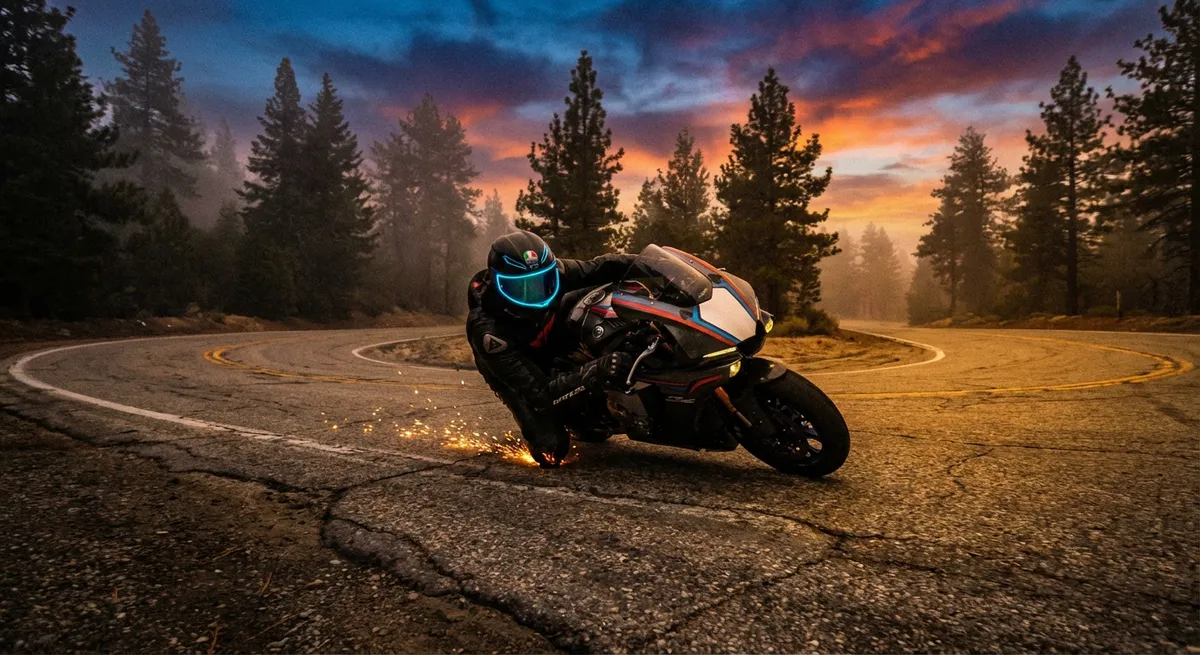
When you shift your upper body and hips to the inside of the turn, you move the combined center of mass inward. For the same corner speed and radius, the bike itself can stand a bit more upright. That means more tire contact patch in reserve for bumps, surface changes, or mid-corner corrections. It also reduces how much the suspension needs to compress at a given lateral load, which helps keep geometry within a more stable range.
You don’t need knee sliders on the street to gain the benefit. Even “quiet” technique—sliding your butt half a cheek to the inside, dropping your inside shoulder, keeping your head in line with or just inside the mirror—takes work away from the tires without being reckless or theatrical. The key is to move early, before turn-in, so you don’t destabilize the bike with last-second shifts.
Practical drill: on a known route, pick a series of medium-speed corners. On the first pass, stay centered and ride smoothly. On the second, add a subtle but deliberate inside shift: hips slightly to the inside, upper body following, outside knee anchored against the tank. Observe how the bike needs slightly less lean to hold the same line and how much calmer it feels over mid-corner bumps.
5. Corner Entry Speed as a Line-Editing Decision, Not Bravery
Most corner problems—running wide, mid-corner corrections, panic inputs—start at the moment you commit to entry speed. Once you’ve tipped in, your available tools are limited: your lean angle, your remaining traction, and how much room you have to adjust. If you treat entry speed as a test of courage rather than a technical decision, you’ve already limited your options.
Technically, the “right” entry speed is the one that leaves you with adjustability mid-corner. You want a safety margin that allows you to tighten or open your line slightly using steering and throttle without immediately hitting your maximum lean or traction. On the street, where sightlines can be short and surfaces variable, that margin needs to be generous.
From a dynamics standpoint, a slightly slower entry that allows earlier throttle application often results in a smoother, faster exit because the bike is settled and driving sooner. Trail braking (light, progressive braking into the early part of the corner) can be used to fine-tune entry speed and line while keeping the front tire loaded, but it must be done with respect for available grip and surface quality.
Practical drill: choose a sequence of corners where you frequently feel “rushed.” On a clear, low-traffic day, consciously reduce entry speed by 5–10 mph below your usual pace. Focus on being ultra-smooth with turn-in and rolling on the throttle earlier, but gently, from the apex out. Compare your line consistency, stress level, and exit drive to your “braver” runs. You’ll often discover that controlled, conservative entries give you more real-world speed and far more safety.
Conclusion
Flow-state cornering isn’t about talent you either have or don’t—it’s about understanding how your vision, steering torque, throttle, body position, and entry speed work together as one system. When you stop treating these as isolated skills and start using them as coordinated control variables, every corner becomes an experiment you can actually repeat and refine.
You’re not just leaning a motorcycle; you’re actively managing geometry, weight transfer, and traction in real time. That’s where real confidence comes from: not from ignoring the physics, but from knowing you’re riding them on purpose.
Sources
- [Motorcycle Safety Foundation – Cornering Tips](https://www.msf-usa.org/downloads/Motorcycle_Tips.pdf) - MSF’s official riding tips PDF covering cornering basics, visual strategies, and lane positioning
- [Australian Government – Transport and Main Roads: Cornering Safely](https://www.qld.gov.au/transport/safety/rules/motorcycle/ride/cornering) - Government guidance on motorcycle cornering techniques and common hazards
- [Yamaha Champions Riding School – Why Trail Brake?](https://ridelikeachampion.com/why-trail-brake/) - In-depth explanation of braking and throttle transitions from a professional riding school
- [Cornell University – Forces on a Banked Turn](https://courses.cit.cornell.edu/engri1101/L1-Forces_on_a_Banked_Turn.html) - Technical breakdown of the physics of turning and lean, applicable to motorcycle cornering
- [Cycle World – The Science of Motorcycle Handling](https://www.cycleworld.com/sport-rider/how-motorcycles-work-science-handling/) - Explores how geometry, weight transfer, and rider inputs affect motorcycle handling
Key Takeaway
The most important thing to remember from this article is that this information can change how you think about Riding Tips.