When a rider hits a perfect corner, it feels like time stretches and the bike moves on rails. That isn’t magic—it’s applied physics, biomechanics, and a little bit of data processing happening at 100+ km/h. This guide breaks down how to engineer that feeling on real roads, using five technical riding concepts you can apply on your next ride. No fluff, no clichés—just the mechanics of riding at a higher level.
Building a Predictive Vision System: Where and How You Look
Most riders know “look where you want to go,” but that’s a low-resolution version of what’s really happening. A high-level rider uses a predictive vision loop—constantly sampling, processing, and updating a mental model of the road ahead.
Instead of just staring at the apex, train your eyes to run a rolling “scan ladder”: far, mid, near, mirrors, instruments (briefly), then back out again. At corner entry, your primary vision should be 3–5 seconds ahead, not on the patch of asphalt right in front of your front tire. This extended visual horizon buys you time to plan steering, throttle, and body changes before you need them, rather than reacting after the fact.
Use peripheral vision to track lane position, road surface texture, and unexpected motion (cars, wildlife, pedestrians). Central vision should be locked on the vanishing point of the road—where the two sides of the lane appear to converge. As that vanishing point moves closer or further away, your brain is constantly recalculating corner radius and available grip. This is how experienced riders sense a tightening radius before it becomes a crisis.
You can train this off the bike: practice scanning ahead while walking or driving, checking how far down the road you can clearly read signs or detect surface changes. On the bike, discipline yourself to avoid tunnel vision—no target fixation on potholes, guardrails, or vehicles. You’re not just “looking”—you’re continuously modeling how the road will change in the next 1–3 seconds and adjusting your inputs accordingly.
Throttle as a Geometry Tool: Stabilizing the Chassis Through the Turn
Throttle isn’t just speed control; it’s a geometry control system tied directly to your suspension. In a corner, your right wrist is quietly managing rake, trail, and weight distribution every time you roll on or off the gas.
On most bikes, rolling off the throttle mid-corner shifts weight forward, compresses the front suspension, and steepens rake and trail. The bike becomes more willing to turn, but also more nervous and less stable. Rolling on gently transfers load rearward, slightly extending the forks and increasing rake and trail, stabilizing the chassis and often increasing ground clearance. This is why maintaining a light, progressive roll-on through the corner typically feels “on rails.”
Think of your ideal corner as three phases: entry (controlled deceleration), neutral (constant or very slight throttle), and exit (progressive acceleration). Abrupt roll-off mid-corner can upset the bike and overload front grip; a smooth, early but gentle roll-on helps you settle the suspension and keep tire loading predictable. You want the contact patches to feel like they’re pushing the bike through the arc, not hanging on for dear life.
On a safe, open road with good sight lines, experiment with how little throttle input it takes to feel the front end relax and the bike settle—often just 2–5% additional opening makes a noticeable difference. If your bike has ride modes or traction control, understand how they change throttle mapping; a snatchy “sport” map may demand more refined wrist control than a smoother “road” or “rain” map in technical sections.
Steering Torque and Lean: Actively Commanding the Contact Patch
The bike doesn’t lean “by itself”—you are constantly applying steering torque, even if you don’t consciously feel it. Countersteering is the headline term, but the real art is understanding how much and how long to apply that torque to control lean angle with precision.
At any speed above walking pace, to lean the bike right you apply a brief, firm input on the right handlebar (pushing forward), which steers the front wheel slightly left. The created lateral force tips the bike right. Once the desired lean angle is reached, you relax pressure and the front aligns with the direction of travel. This happens fast—often under half a second at real-world speeds.
Advanced riders treat steering torque like a scalpel, not a hammer. On corner entry, use one clean, deliberate input rather than a series of corrections. The more you “saw” at the bars, the more you disturb the chassis and consume grip with unnecessary direction changes. If you end up wide mid-corner, a small, precise increase in steering torque (not panicked bar-yanking) can tighten your line more effectively than chopping throttle.
Bar setup matters here: if your levers are too high or low, or your bars rotated awkwardly, you lose mechanical efficiency and fine control over steering torque. Adjust controls so your wrists are neutral when seated in your normal riding position. Then practice deliberate steering drills in a safe environment—feel how different levels of bar pressure change lean rate, and how the bike responds when you combine steering with throttle and body inputs.
Body Position as a Load-Balancing System
Body position isn’t about “looking fast” in photos; it’s a tool to manipulate where and how your tires are loaded. A well-managed body position can reduce lean angle for the same corner speed, increase ground clearance, and give you a wider grip envelope on marginal surfaces.
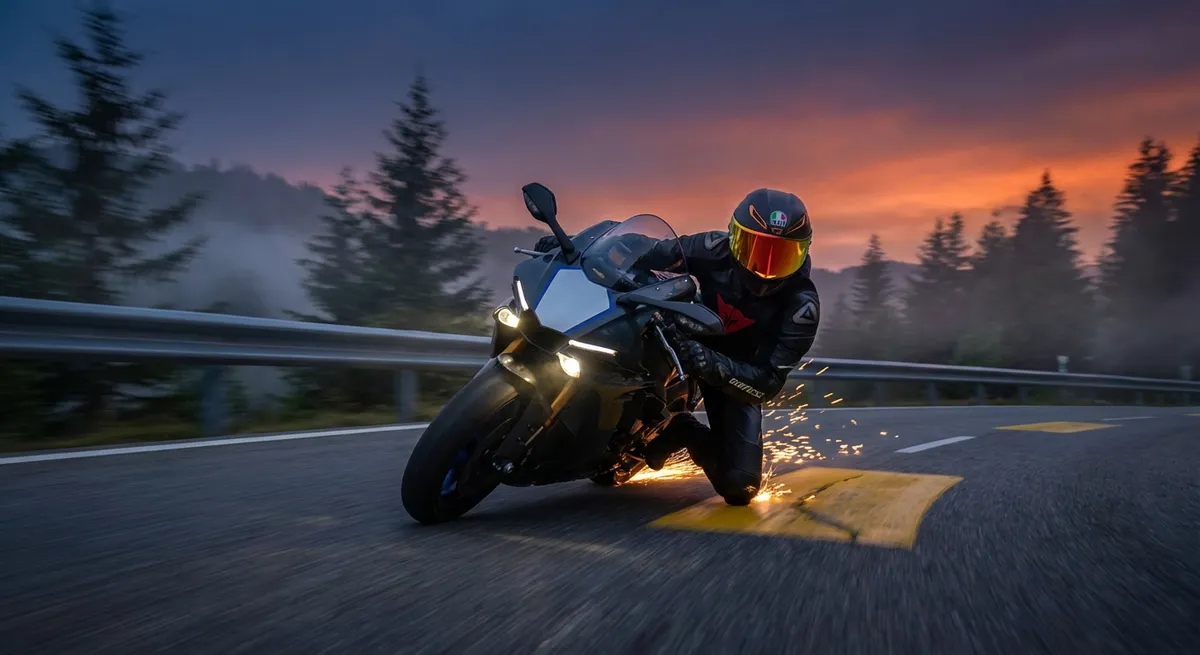
On the street, you rarely need full track-style hanging off, but even a small shift of your upper body toward the inside of the turn reduces bike lean slightly. Think about moving your head and chest toward the inside mirror while keeping your outside arm relaxed and your inside arm slightly bent. Your hips can stay mostly on the seat, but a half-cheek shift toward the inside helps align your torso naturally.
Crucially, keep your weight light on the bars. Your primary support should be through your core and legs, with your feet loading the pegs. Loaded bars reduce steering sensitivity and can induce wobble or weave over bumps mid-corner. On braking zones, grip the tank lightly with your knees so your hands don’t become your primary deceleration anchor.
Use your lower body to stabilize yourself so your upper body is free to fine-tune steering and throttle without fighting your own weight. On bumpy corners, a slightly “alive” stance—small bend in elbows and knees, not locked—lets the bike move beneath you while you keep your center of mass relatively smooth. The net effect is more stable tire loading and a more compliant feel over imperfect surfaces.
Traction Budgeting: Reading and Managing Grip in Real Time
Every corner is an ongoing negotiation with available friction. Your tires have a finite “grip budget” that must be shared between braking, accelerating, and turning forces. Exceed that vector sum and you’re sliding—hopefully in a controlled way, but often not.
As you lean, the tire’s usable traction envelope shrinks for acceleration and braking. This doesn’t mean “never brake in a corner,” but it does mean that any mid-corner braking must be extremely smooth and progressive to avoid overloading the already busy contact patch. Modern ABS and cornering ABS give you a safety net, but they don’t rewrite the laws of physics; they only help you use the available friction more efficiently.
Surface reading is your early-warning system. Dark, shiny patches may indicate oil or polished asphalt; light-colored dust, gravel, or paint reduce microtexture and available grip. Watch the tires of vehicles ahead to see if they kick up debris or water. Humidity and temperature matter: cold tires and cold pavement drastically reduce initial grip, while very hot days can soften asphalt and alter tire behavior.
Think in terms of safety margin: don’t ride at 100% of perceived grip. On an unfamiliar road, aim for 60–70% of what you think the tires can do. Save the deep exploration of the friction circle for controlled environments like track days. On the street, your “extra” traction budget is your emergency reserve—used when a car crosses the centerline, an animal darts out, or the corner tightens unexpectedly.
Over time, you’ll build a calibrated feel for traction: the slight lightness at the bars when the front is nearing its limit, the subtle squirm at the rear when acceleration starts to flirt with available grip. That feel is gold—but it only develops if you ride with deliberate, repeatable inputs instead of random, panicked corrections.
Conclusion
Fast, confident riding isn’t about aggression—it’s about precision. When you treat your vision as a predictive sensor suite, your throttle as a chassis controller, your steering torque as a surgical instrument, your body position as a load-balancing system, and your traction as a finite budget, the entire ride changes. Corners stop being hazards and start becoming problems to solve elegantly, one input at a time.
The flow state riders chase is just the byproduct of solid technique layered over mechanical understanding. Take these five concepts, apply them deliberately on your next ride, and pay attention to the feedback your motorcycle gives you. The bike is always talking; these tools help you finally speak its language at speed.
Sources
- [Motorcycle Safety Foundation – Basic and Advanced Riding Concepts](https://www.msf-usa.org/students.aspx) – Frameworks for vision, cornering, and traction from a foundational training perspective
- [BikeSafe – Cornering and Positioning](https://bikesafe.co.uk/techniques/cornering-positioning/) – In-depth discussion of road positioning, vision, and safe cornering for real-world roads
- [BMW Motorrad Rider Training – Riding Dynamics](https://www.bmw-motorrad.com/en/experience/stories/rider-training/riding-safely.html) – Manufacturer-backed insights on body position, braking, and cornering dynamics
- [U.S. DOT – Motorcycle Safety Information](https://www.nhtsa.gov/road-safety/motorcycles) – Data-driven perspective on motorcycle risk factors and why advanced technique matters on public roads
- [California Superbike School – The Art of Cornering](https://superbikeschool.com/school/the-art-of-cornering/) – Technical breakdown of cornering skills and rider inputs used in performance training
Key Takeaway
The most important thing to remember from this article is that this information can change how you think about Riding Tips.