Most riders chase speed. The best riders chase flow. That effortless, locked-in feeling through a series of bends isn’t magic—it’s the product of deliberate, technical control layered over repeatable habits. When you engineer your riding around smooth, predictable inputs, speed becomes a side effect, not the goal.
This is where riding stops being survival and starts becoming a craft. Below are five technical pillars that transform “getting through the corner” into carving a precise line with confidence and margin.
1. Visual Bandwidth: Programming Your Eyes for Predictable Lines
Your motorcycle will always try to go where your brain is looking a fraction of a second ago. At higher speeds, that fraction matters. To ride smoothly, you need to actively engineer your vision strategy—not just “look ahead,” but allocate visual bandwidth.
A practical baseline is to divide your vision into three layers:
- Far field (4–6+ seconds ahead): This is your line programming zone. You’re identifying the vanishing point, corner radius, escape routes, and major threats (intersections, merging traffic, side roads).
- Mid field (2–4 seconds): This is your execution zone. You’re confirming reference points: turn-in marker, apex, surface changes, camber, road crown, manhole covers, tar snakes, paint, and gravel.
- Near field (0–2 seconds): This is your sanity check zone. Quick scans to validate that the line you committed to is still valid and that no immediate hazards appeared.
On the street, the vanishing point in a corner—where the two road edges visually converge—is critical. If the vanishing point is moving away from you (opening), the corner is likely relaxing and speed can be maintained or very gently increased. If it starts rushing toward you (tightening), you need to be off the throttle and adding controlled brake or lean earlier than instinct might suggest.
Train this deliberately: on every ride, pick a bend and say (in your helmet, out loud), “vanishing point, turn-in, apex, exit.” This rewires your default from “reacting to the corner” to “interrogating and planning” before you’re committed.
2. Throttle as a Stability Tool, Not a Speed Pedal
On a motorcycle, throttle isn’t just acceleration—it’s a load distribution control between the front and rear contact patches. Smooth throttle transitions are the difference between a front that talks to you and a front that surprises you.
From a technical standpoint:
- Closed or decelerating throttle shifts weight forward, loading the front tire, steepening rake, and shortening trail. This improves turn-in but reduces rear grip and stability.
- Neutral or very slight maintenance throttle stabilizes geometry, keeps suspension in the middle of its stroke, and makes the bike feel “on rails.”
- Positive throttle (drive) shifts weight rearward, increasing rear grip, slightly extending rake and trail, making the bike more stable but potentially widening the line if overdone.
On the street, the goal isn’t racetrack-level drive out of corners; it’s chassis stability. Aim for this pattern in a typical corner:
- Smooth roll-off in the approach phase, ideally completing the majority of speed adjustment before you lean.
- Micro pause or very light neutral throttle as you initiate lean—this prevents a sudden forward weight lurch.
- Gentle roll-on from around the apex onward, just enough to keep the suspension loaded and the bike neutral, not squatting.
If you find the bike going wide on exit, don’t immediately blame speed. Ask: Did you roll on too abruptly and unload the front? If you constantly feel vague front grip mid-corner, ask: Are you chopping throttle and pitching the bike forward mid-turn?
For practice, pick a familiar, low-risk section of road and focus an entire pass on one constraint: zero abrupt throttle changes. Don’t care about speed, only about how gradual every roll-on and roll-off feels. The bike will start to feel eerily calmer beneath you.
3. Front Brake Micro-Control: Building a Finesse Grip, Not a Panic Grip
Front brake skill might be the single largest performance and safety multiplier for a street rider. Modern ABS and sophisticated brake systems are powerful, but they don’t replace your ability to meter pressure precisely.
Two concepts matter most:
- Brake pressure ramp rate: How fast you build pressure.
- Brake release profile: How smoothly you let that pressure go.
Most riders slam into the brake and then dump it as they turn. That destabilizes the fork twice. Instead, you want:
- Initial contact: Light, deliberate squeeze to settle the fork and take up slack in the pads.
- Linear ramp: Increase pressure progressively—think of “painting” pressure into the lever rather than jabbing it.
- Trail-off: As you lean, gradually release brake force, aligning decreasing brake pressure with increasing lean angle. This is called trail braking (even in mild street form), and it maintains front tire load and feel as you commit to the turn.
Done correctly, this gives you:
- More time and space to correct a misjudged entry speed.
- A better “read” on available grip through the front tire.
- A smoother, more controlled transition from upright braking to leaned cornering.
You don’t need racetrack levels of trail braking on public roads, but you do need the skill of not panicking and dumping the brake the instant you begin to turn. Practice in a quiet, straight-line environment:
- Ride at moderate speed.
- Mark a braking point.
- Squeeze the lever from zero to firm braking over a full second instead of a jab.
- Then practice extending the release—take a full second or two to go from firm brake to zero.
Once your front brake hand can trace these ramps smoothly, you’re ready to blend them gently into real corners.
4. Steering Torque and Body Position: Let the Chassis Work, Don’t Fight It
Contrary to how it may feel, you don’t steer a motorcycle by leaning your body; you steer by applying torque to the handlebars—countersteering. Leaning your body helps fine-tune the lean angle and center of mass, but the actual initiation is a bar input.
From a technical standpoint:
- To go right, you apply a gentle, forward press on the right handlebar.
- To go left, you press on the left handlebar.
This input generates a roll moment that leans the bike. At street speeds and above, this is the dominant steering mechanism.
Where body position comes in is how you manage the combined center of gravity of you + bike:
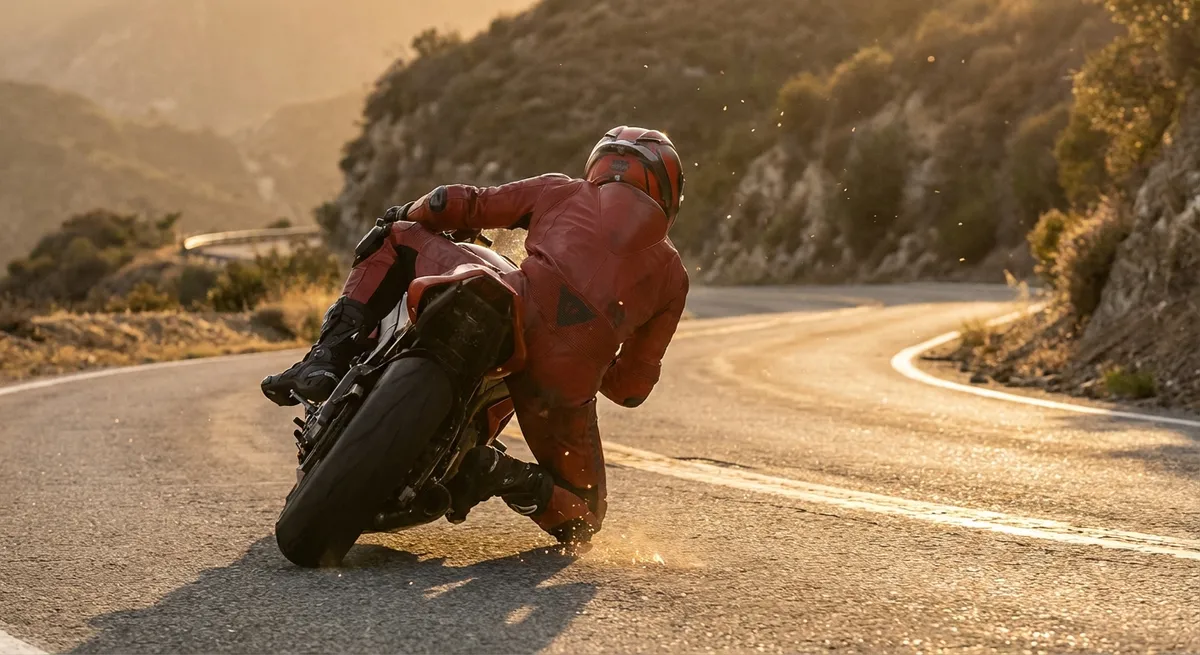
- Upper body low and slightly to the inside reduces the required bike lean angle for a given corner speed, giving you more tire margin.
- Neutral hips—aligned with the direction of travel, not twisted—let the bike move underneath you without arm tension.
- Light hands, anchored lower body: Grip the tank with your knees and keep your core engaged so your hands aren’t propping you up. This lets your steering inputs be precise rather than polluted by body weight.
Think of yourself as a movable mass that can help the chassis turn more easily. In a street context, you don’t need extreme hanging off; even a subtle 3–5 cm shift of your head and torso inside the turn, with your hips just slightly off center, meaningfully lowers required lean angle.
If you feel like you “run out of lean” often, it’s more likely you’re:
- Staying too upright on the bike.
- Being tense on the bars, which resists the chassis’s natural roll.
- Entering with poor throttle/brake transitions that overwhelm the front.
Drills that help:
- On a quiet road, ride a series of easy bends focusing only on light hands, firm knees. If you can momentarily open your fingers mid-corner without the bike wobbling, your lower body is doing its job.
- Practice small, deliberate countersteer inputs—press and release—just to feel how little effort is needed to change lean angle, then let the bike settle.
5. Surface Reading and Grip Budget: Treat Traction Like a Finite Currency
Every corner has a grip budget—a limited amount of friction you can “spend” on lean angle, braking, and acceleration. Overspend in any one category and you exceed available traction.
Technically, your tires obey something close to a friction circle model: the more lateral grip you’re using for cornering, the less you have left for braking or accelerating, and vice versa. On the street, where surfaces are inconsistent, your job is to:
- Estimate the size of the friction circle (how much grip) based on what you see.
- Decide how to allocate that grip between lean, brake, and throttle.
Surface cues that shrink your friction circle:
- Shiny patches = likely moisture, oil, or polished tar.
- Darker strips in the wheel tracks = possible oil accumulation.
- Gravel, leaves, sand, painted lines, steel plates, manhole covers = drastically reduced grip, especially when wet.
- Temperature extremes = cold tires/road reduce grip; very hot surfaces can also degrade it.
On a low-friction surface, you reduce lean angle or reduce braking/acceleration—or both. That may mean:
- Standing the bike up a bit and using more of the lane width.
- Releasing brake pressure earlier and being extremely gentle with roll-on.
- Accepting a slower corner to preserve a huge safety margin.
Train your eyes to treat every different texture as a data point. Instead of just “seeing the road,” interrogate it:
- “What does this dark patch mean?”
- “Is that shadow hiding a pothole or gravel?”
- “Are both wheel tracks clean, or is the center of the lane safer here?”
Over time, this becomes subconscious, and your speed naturally calibrates to actual grip instead of wishful thinking.
Conclusion
Fast riders can hustle a bike when everything is perfect. Skilled riders can maintain flow when the world is imperfect—which is every public road, every day. That skill is less about bravery and more about engineering your riding around a few technical foundations:
- Vision that programs your line, not just reacts.
- Throttle as a stability tool.
- Braking as a controlled ramp, not an on/off switch.
- Steering inputs and body position that free, not fight, the chassis.
- Grip treated as a finite budget, constantly re-evaluated.
Build these habits deliberately and your riding transforms. Corners stop being threats you survive and become problems you solve—smoothly, repeatably, and with a huge buffer of control.
Sources
- Motorcycle Safety Foundation – Basic RiderCourse Rider Handbook – Official MSF material covering visual strategies, basic braking, and cornering concepts.
- UK Government – Motorcycle Riding Skills (GOV.UK) – Outlines advanced on-road techniques and hazard perception for riders.
- California Superbike School – Articles on Throttle Control & Vision – Technical breakdowns of throttle, vision, and cornering dynamics from a respected training organization.
- BikeSafe London – Cornering and Positioning Guidance – Police-backed road-riding advice focusing on positioning, vision, and real-world corner strategy.
- NHTSA Motorcycle Safety Page – U.S. government data and guidance on motorcycle safety, emphasizing braking, visibility, and risk factors.
Key Takeaway
The most important thing to remember from this article is that this information can change how you think about Riding Tips.