Your motorcycle is not a collection of parts; it’s a coupled system of loads, temperatures, and tolerances that either works in harmony—or eats itself alive. Maintenance isn’t “changing oil on schedule.” It’s deliberately managing friction, flow, and feedback so the machine keeps performing exactly how you expect when conditions are worst, not when they’re easy.
This isn’t basic “check your chain” advice. This is about understanding what’s happening inside the metal and using that knowledge to maintain your bike like a development tech, not a distracted owner.
1. Oil as a Structural Component, Not Just a Fluid
Oil doesn’t just “lubricate.” In a modern engine, it is a load-bearing, heat-transporting, contaminant-suspending component that directly controls how your bearings, cam lobes, and piston rings survive.
From a technical standpoint, think in terms of:
- Viscosity under shear: That “10W-40” grade is a starting point, but in real use, the oil is being shredded by gears and high-RPM shear. Cheap or incorrect oil can lose viscosity under load, collapsing the hydrodynamic oil film on bearings long before the change interval.
- Boundary vs. hydrodynamic lubrication: At cruising RPM with proper oil film, your crank and cam journals are “riding” on a pressurized film of oil (hydrodynamic). On cold starts, at idle, or with degraded oil, you’re in boundary lubrication—metal asperities are actually touching, and anti-wear additives like ZDDP are doing the heavy lifting.
- Thermal stability: Repeated high-heat cycles (traffic jams, hot trackdays, desert rides) oxidize and thicken oil, forming varnish and sludge. That’s not cosmetic—it changes clearances when deposits build in ring lands and oil control passages.
- Detergent and dispersant packages: These don’t “clean your engine” in the way products are marketed; they keep contaminants suspended so the filter can trap them. Stretch intervals too far, and the additives are depleted while the base oil is still “looking fine.”
Technical takeaway for enthusiasts:
- Treat the shortest recommended interval in your manual as your baseline, then tighten it if:
- You ride short trips (oil never gets fully hot).
- You ride in high ambient temps or heavy traffic.
- You push high RPM regularly.
- On shared-sump bikes (engine and gearbox share oil), recognize that gear shear destroys oil viscosity faster than in automotive engines.
- Use oil analysis (Blackstone and similar labs) if you want quantitative data on wear metals, fuel dilution, and additive depletion. That’s engineer-level feedback, not guesswork.
2. Chain Load Path: Adjusting for Torque, Not Just Slack
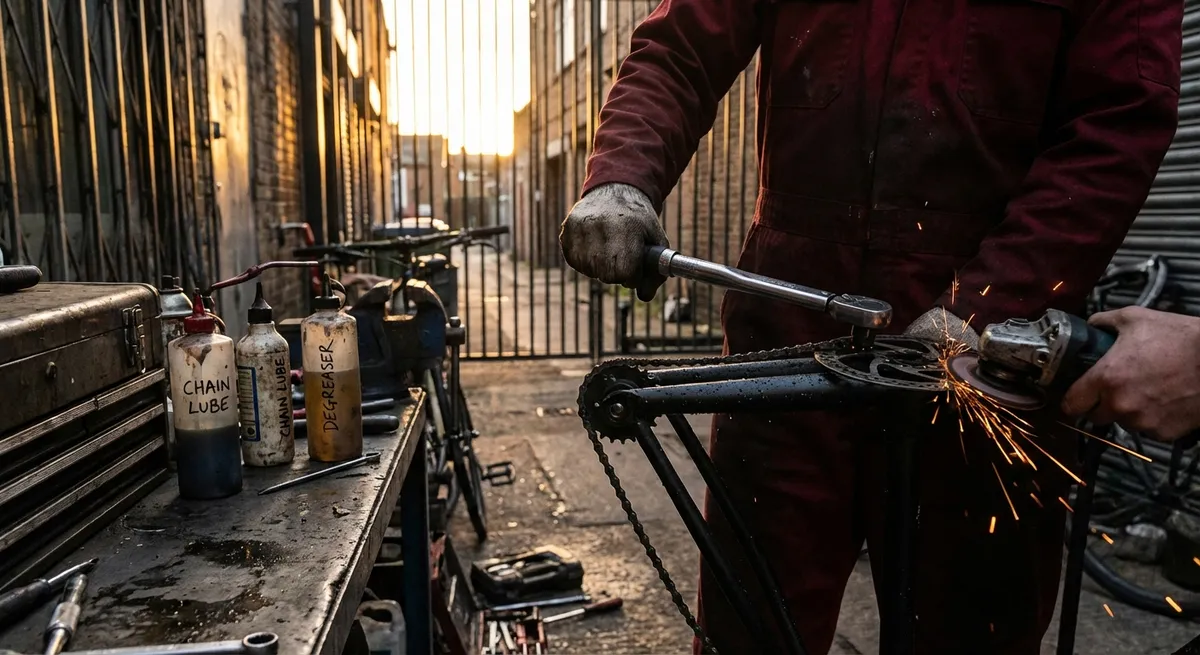
Chain maintenance is more than “clean, lube, check slack.” Your final drive is a load path transmitting torque impulses and shock loads from crank to contact patch. How you adjust and service it changes how those loads propagate through your swingarm, output shaft, and rear hub.
Key technical dimensions:
- Slack vs. dynamic tension: The spec in your manual is measured with the bike stationary. Under load, the swingarm arc and sprocket alignment change the effective chain length. Too tight and you’re side-loading countershaft bearings and stretching the chain under every suspension compression.
- Pitch wear and load concentration: Chains don’t “stretch” elastically—they wear at the pins and bushings, increasing pitch. When pitch is inconsistent along the chain, certain segments carry higher loads, accelerating wear and causing harsh driveline feel.
- Sprocket tooth geometry: Hooked, thinned, or shark-fin teeth don’t just mean “replace soon.” They change how smoothly the chain engages and disengages, creating impact loads that are transmitted directly into the gearbox and cush drive.
- Alignment error: Slight misalignment between front and rear sprockets causes the chain to scrub sideways across the teeth, multiplying wear and wasting power as friction and heat.
Technical actions that matter:
- Always check slack at multiple points in the chain. Adjust based on the tightest section.
- With the rear suspension compressed roughly to the point where the front sprocket, swingarm pivot, and rear axle are in line, verify that the chain is not going tight. If it is, your static slack setting is wrong for your real-world usage.
- When replacing, always do chain and sprockets as a set. Mixing new with worn just transfers wear instantly to the fresh part.
- For high-torque or track use, consider a high-quality X-ring or O-ring chain with correct tensile rating; it’s a structural element, not an accessory.
3. Brake System as a Thermal Management Problem
Brakes are not simply “pads and rotors that stop you.” They’re energy conversion devices turning forward kinetic energy into heat, which must be managed through fluid, pads, rotors, and airflow. Maintenance choices here directly shape your stopping power under repeated heavy use.
Technically important aspects:
- Boiling point and fluid age: Brake fluid is hygroscopic—it absorbs moisture over time. Water-laden fluid boils at much lower temperatures, forming gas bubbles under hard braking. Gas is compressible; that’s what gives you a spongy lever or sudden fade.
- Pad material and transfer films: Modern pads create a friction layer (transfer film) on the rotor. Consistent performance depends on a stable, even layer. Mixing incompatible pad types or running pads to the backing plate can strip or damage this film, causing pulsing, noise, or inconsistent bite.
- Rotor thickness and thermal mass: Thinner rotors have less thermal capacity. As they approach minimum thickness, they are more prone to warping under heat cycles and extreme use, even if they look visually fine.
- Caliper piston movement: Brake dust and dried fluid buildup can affect piston rollback and seal behavior, leading to dragging pads, uneven pad wear, and excess heat retention.
Maintenance that upgrades your real-world braking:
- Replace brake fluid on time, not just mileage—typically every 1–2 years, even on low-mileage bikes, because moisture ingress is a function of time, not distance.
- When you feel pulsing under gentle braking, don’t assume “warped rotors” immediately. It may be uneven pad deposits. Lightly re-bedding with appropriate pads or having the rotors professionally measured can prevent unnecessary replacement.
- Periodically inspect pad wear side-to-side. Uneven wear can indicate sticking pistons or sliders. Service calipers: clean pistons with appropriate cleaner (not aggressive solvents), check seals, and ensure free movement.
- For aggressive riders or mountain/track use, choose a pad compound with known high-temperature behavior and understand that some will trade initial cold bite for thermal stability.
4. Cooling System: Controlling Expansion, Not Just Temperature
Engine heat management isn’t only about the gauge staying out of the red. It’s about controlling expansion and contraction so clearances and seals live a long, stable life.
Key technical considerations:
- Pressure cap function: The radiator cap is a calibrated pressure device. Raising system pressure increases coolant’s boiling point, allowing more heat to be carried without phase change. A tired cap that can’t hold pressure leads to localized boiling and hotspots long before you see obvious “overheat” signs.
- Coolant chemistry: Modern coolant is not just anti-freeze; it’s a corrosion inhibitor and cavitation suppressant. Depleted additives allow micro-cavitation at water pump impellers and corrosion in narrow passages, which gradually reduce flow and heat transfer.
- Thermostat behavior: A sticky thermostat can cause oscillating temperatures. The engine goes hot, thermostat kicks open late, then overcools, then repeats. That cycling stresses metals and affects fuel mapping and lubrication conditions.
- Airflow path integrity: Bent radiator fins, missing shrouds, or misaligned bodywork alter how air actually moves through the core under way. The bike may seem fine at speed in cool weather but run dangerously close to limits in slow, hot conditions.
Maintenance tactics that respect the thermal reality:
- Replace coolant at the manufacturer’s time interval, not when it “looks okay.” The color doesn’t tell you whether the inhibitor package is still effective.
- Periodically inspect and gently straighten bent fins with a small tool; don’t blast radiators with high-pressure washers that fold fins and reduce effective area.
- Replace questionable radiator caps—they’re cheap and critical. If you’re chasing creeping temps and the cap is old, it’s a high-value first move.
- When flushing, always bleed air pockets per the service manual procedure. Trapped air at high points in the head or thermostat housing reduces local heat transfer and can cause warped components or hot spots.
5. Fasteners, Torque, and the “Memory” of Your Chassis
Most riders think of maintenance as fluids and wear items. But the mechanical integrity of your fasteners is what keeps clearances, alignments, and preload where the designers intended. Over-tighten or under-tighten, and you’re changing how loads travel through the frame, fork, and engine mounts.
Important technical aspects:
- Torque as clamp load, not “tightness”: Torque specs are designed to produce a specific clamping force. Too little, and things move under load; too much, and threads yield, parts distort, or bearings are preloaded beyond spec.
- Friction variability: The torque-to-clamp relationship assumes a known friction coefficient—clean threads, maybe a specific lubricant or dry condition. Dirty, corroded, or oily threads radically change the final clamp load for the same torque.
- Engine and chassis mounting: Many modern bikes use the engine as a stressed member. Engine mount torque affects frame stiffness distribution and can even subtly change handling feel and feedback. Randomly loosening/tightening mounts without following the specified sequence and values can upset that balance.
- Axle and pinch bolt interaction: The procedure for tightening axles and pinch bolts is engineered to align fork legs and wheel spacers without inducing twist. If you ignore the procedure, you can preload fork bushings and slider alignment, increasing stiction and degrading suspension sensitivity.
Maintenance behavior that respects engineering intent:
- Use a calibrated torque wrench for critical fasteners: axles, pinch bolts, calipers, engine mounts, triple clamps. This isn’t about being fussy—it’s about controlling clamp load.
- Follow the sequence in the service manual (e.g., engine mounting bolts, triple clamp bolts), not just the values. Load paths depend on order.
- Clean threads with a nylon brush or appropriate tap/die when required; use the specified threadlocker or lubricant. Don’t improvise with “whatever was on the shelf.”
- When reassembling front ends, follow the correct approach: tighten axle nut with pinch bolts loose, bounce the fork to self-align, then torque pinch bolts in the specified order. That’s how you keep fork action glass-smooth rather than sticky.
Conclusion
Maintenance isn’t a checklist—it’s systems engineering in your own garage. Oil is a structural fluid. Chains are dynamic load paths. Brakes are energy management systems. Cooling is controlled thermal expansion. Fasteners are calibrated clamps shaping how your bike flexes, steers, and stops.
When you see your motorcycle as a set of interacting subsystems instead of isolated parts, your maintenance transforms from reactive “fixing things when they break” to proactive controlling how your machine lives under real-world stress.
Do the basics, but do them with an engineer’s mindset. The payoff isn’t just reliability; it’s repeatable feel, predictable behavior, and a machine that responds exactly the way you built it to—mile after hard mile.
Sources
- [Motorcycle Maintenance – U.S. National Highway Traffic Safety Administration (NHTSA)](https://www.nhtsa.gov/road-safety/motorcycles) – Federal safety guidance on motorcycle components and upkeep relevance
- [Motorcycle Oils and Lubrication – American Petroleum Institute](https://www.api.org/products-and-services/engine-oil/motorcycle-oil) – Technical background on motorcycle-specific lubricants and performance standards
- [Motorcycle Chain Maintenance – DID Chain (Official)](https://www.didchain.com/maintenance/) – Manufacturer’s technical recommendations on chain wear, inspection, and service
- [Motorcycle Braking and Brake Fluid – Brembo Technical Insights](https://www.brembo.com/en/company/news/motorcycle-brake-fluid-what-it-is-and-when-to-change-it) – Detailed discussion of brake fluid behavior, boiling points, and service intervals
- [Cooling Systems in Internal Combustion Engines – SAE International](https://www.sae.org/publications/books/content/r-342/) – Engineering-level reference on engine thermal management and coolant system design
Key Takeaway
The most important thing to remember from this article is that this information can change how you think about Maintenance.