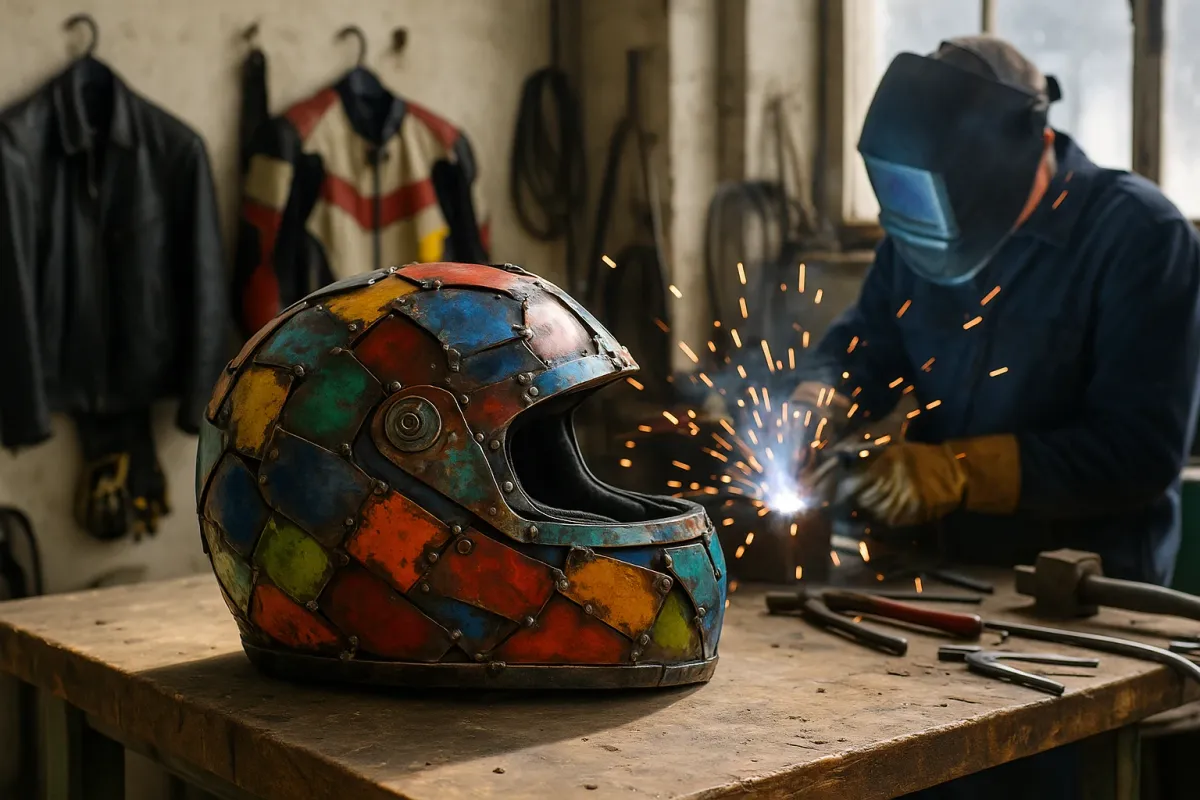
There’s a viral story today about American artist Brian Mock, a “metal revolutionist” who turns discarded car parts, forks, screws, and scrap into jaw‑dropping sculptures. It’s making the rounds because his work proves something riders already know in their bones: metal has a memory, and design is never an accident. On Moto Ready, that translates to one big question—if sculptors can turn junk into functional‑looking art, why are we still tolerating lazy engineering in some of our motorcycle gear?
Right now, manufacturers are racing to cut weight, reduce waste, and add features. But looking at Mock’s reclaimed-metal creations, you can spot the same design principles that separate serious motorcycle equipment from catalog cosplay. Let’s break down how the mindset behind high-end metal sculpture should reshape the way you choose your next jacket, helmet, or armor—today, not “someday when you upgrade.”
1. Structural Honesty: If You Can’t See The Load Path, Don’t Trust It
One thing that makes Brian Mock’s sculptures so compelling is structural honesty—you can literally trace how the load would travel through those welded components. Good moto gear should feel the same: you should be able to “read” how it will handle impact, abrasion, and flex just by looking and feeling.
Technically, this means seeking gear where the protection system has a clear load path. On a jacket, that’s CE‑rated armor positioned directly over key impact zones (shoulders, elbows, back) with minimal slop and no flimsy “bridge” of fabric between you and the pad. The shell should show reinforcement at seams, double or triple stitching, and ideally external or internal overlays at high‑risk zones (outer shoulders, hips, knees). On boots, the structure needs visible bracing at the ankle, shin, and heel, forming a mechanical “cage” that makes sense the way a roll cage does in a car. If a glove looks sleek but you can’t figure out how it spreads impact away from your knuckles or palm, it’s ornament, not protection. Borrow the sculptor’s eye: trace the forces in your head. If the design story doesn’t add up, walk away.
2. Material Pedigree: Not All “Metal” (Or Textile) Is Created Equal
Mock’s sculptures work because he knows exactly what he’s welding—different steels, alloys, and thicknesses all behave differently under stress and heat. Your gear is no different. Marketing loves buzzwords, but riders need pedigrees.
On textiles, demand specific fiber names and denier ratings. “600D polyester” is entry-level; for serious abrasion, you want high‑tenacity nylon (e.g., Cordura 1000D), UHMWPE blends (Dyneema, Spectra), or aramid fibers (Kevlar, Twaron) in the slide zones. The gold standard in impact‑plus‑slide areas is still leather: 1.2–1.4 mm cowhide or kangaroo on race and aggressive street gear. Anything thinner is comfort‑first, protection‑second. On armor, know the difference between hard-shell + foam sandwiches and modern viscoelastic materials like D3O, SAS‑TEC, Seesoft, or proprietary impact gels. Check for CE EN 1621‑1 (limbs) or EN 1621‑2 (back) with Level 2 ratings where possible. For boots and helmets, pay attention to shell materials and construction: multi‑density EPS in helmets, composite or fiberglass shells versus single‑density polycarbonate, and, in boots, real thermoplastic or metal reinforcements, not just “styled” panels. The more specific the spec sheet, the more likely the gear was engineered instead of decorated.
3. Layered Architecture: Build Gear Like A Sculpture, Not A Sticker Sheet
Brian Mock doesn’t just bolt parts together; he layers components so the shapes lock, brace, and complement each other. High-end moto gear does the same with protective layers that work as a system, not random add‑ons.
Think of your setup in three stacked layers: impact, abrasion, and environment. Impact is your armor: CE‑rated pads positioned correctly, held in place, and sized to cover the joint both flexed and extended. Abrasion is your outer shell: leather thickness, textile denier, and reinforcement panels all tuned to the riding you actually do (urban, touring, track). Environment covers weather and comfort: membranes (Gore‑Tex, eVent, D‑Dry, Hydratex), thermal liners, and venting. The technical sweet spot is gear where these layers don’t fight each other. Perforated leather that lines up with vented armor, so airflow is real, not theoretical. Waterproof gear that uses a laminated membrane (2L or 3L) so water beads off the outer shell instead of soaking it and chilling you by evaporation. Removable liners that don’t distort the fit of armor when you zip them out. When you’re shopping, physically peel through the layers. Check that vents bypass liners, that armor pockets don’t sag when liners are removed, and that the shell can hold its shape without internal padding. Integrated architecture beats bolt‑on complexity every time.
4. Ergonomics As Engineering: Articulated Fit, Not Just “Comfort”
Look at photos of Mock’s sculptures and you see implied motion—the way joints are built suggests how they’d move if brought to life. That’s exactly what you want in motorcycle gear: articulations designed from a riding position first, standing position second.
Technically, this comes down to pre‑curved patterning and panel orientation. On jackets and suits, you want rotated sleeves, stretch zones above the knees and lower back, and accordion panels on shoulders and elbows that are neutral when you’re on the bike, not when you’re standing in a mirror. For street boots, check the range of motion: front flex to operate brake/shifter, but firm resistance against excessive backward or lateral flex. TPU or internal bracing at the ankle should allow controlled motion in the plane of shift/brake action but lock against twisting—exactly how hinge‑style race boots work. Gloves should curve naturally around a ghost handlebar, with external seams on track gloves for reduced pressure points, and proper bridge or reinforcement on the ring finger to prevent “finger roll” in a crash. Try everything on in a riding stance: crouch, tuck, reach for imaginary clip‑ons or wide bars. If the armor shifts, if the back protector rises and jabs your helmet, or if the boot’s shin plate gaps when you bend, the ergonomics weren’t engineered for real riding.
5. Repairability & Longevity: The Reclaimed-Metal Mindset For Modern Gear
The whole point of reclaimed-metal art is giving materials a second, more meaningful life. In an era where sustainability is finally hitting power sports, riders should demand the same from their equipment. Disposable jackets and helmets might be cheap, but long term they’re a tax on both your wallet and the planet.
Look for gear designed to be serviced and partially rebuilt. Replaceable armor is a baseline; you should be able to upgrade stock Level 1 pads to Level 2 without buying a new jacket. On boots, prioritize replaceable toe sliders, heel plates, and, ideally, soles—you can see this thinking in premium brands where sole replacement is a standard service. Race suits and serious road gear should use stitching patterns and panel layouts that a competent leather or textile repair shop can replicate after a slide. For textiles, check if the manufacturer offers factory repair programs or partners (some Gore‑Tex-licensed brands do), and whether crash-repair is a marketing bullet point or an actual documented service. Even helmets—though never to be reused after a significant impact—can be extended via replaceable interiors, visors, and hardware to maintain fit and hygiene over years of use. The reclaimed‑metal mindset means you buy gear with a clear path for maintenance, repair, and, when its time comes, responsible replacement—not just fast fashion in ballistic nylon.
Conclusion
Today’s buzz around Brian Mock’s reclaimed-metal sculptures is a reminder that metal, shape, and structure tell the truth if you know how to read them. As riders, we don’t hang our parts on gallery walls—we drag them across asphalt at 60 mph and expect them to hold. That’s precisely why adopting a sculptor’s eye for structure, material, layering, ergonomics, and longevity isn’t artsy—it’s brutally practical.
Next time you’re tempted by another “tactical” jacket or flashy boot on your feed, ignore the surface. Trace the load paths. Decode the material choices. Inspect the architecture. Test the ergonomics in a real riding stance. Ask how it can be repaired, not just replaced. The gear that survives all those questions is the gear that deserves a place in your rotation—and maybe, one day, in someone else’s reclaimed‑metal masterpiece after it’s finally done its job.
Key Takeaway
The most important thing to remember from this article is that this information can change how you think about Gear & Equipment.