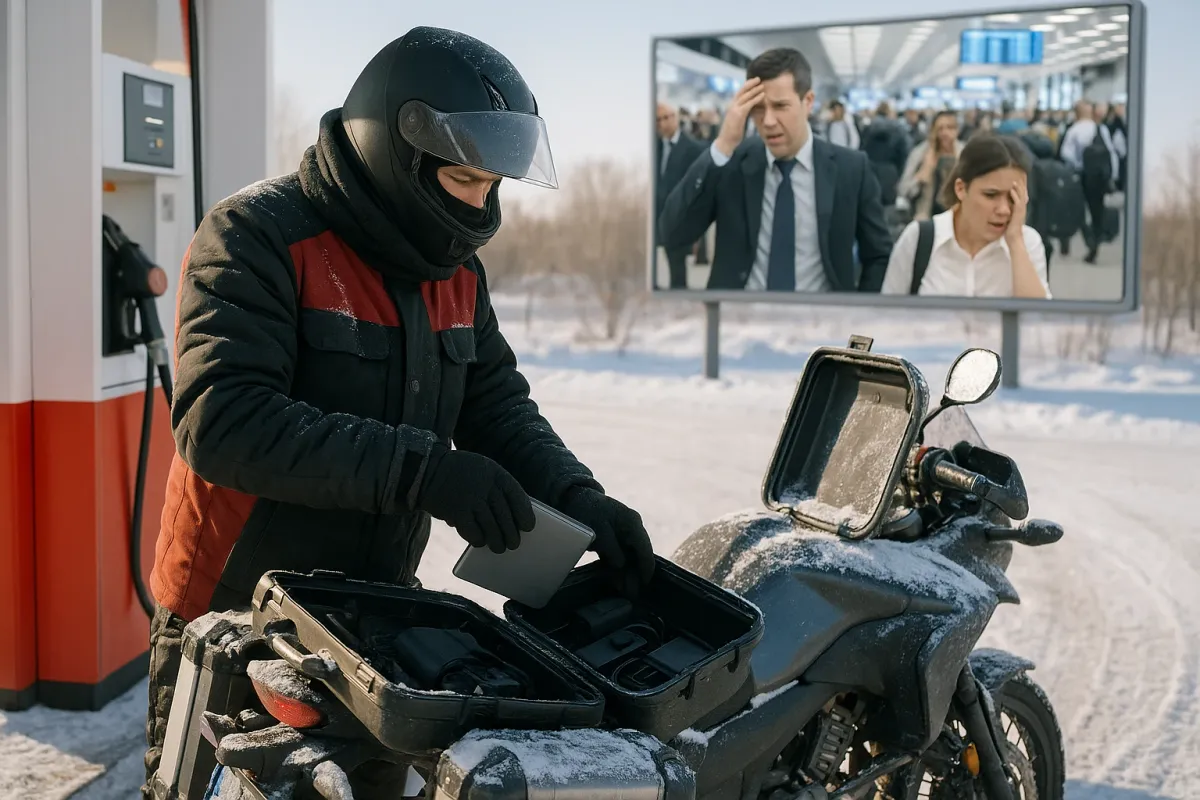
Airports are melting down again this season—lost luggage, dead phones, oversized carry-ons getting gate-checked into oblivion. Travel sites are pushing “must‑have gadgets” to survive holiday chaos, and there’s a BoredPanda piece right now rounding up the latest gear flyers are using to stay sane in the security line. While non‑riders are panic‑buying packing cubes and noise‑canceling headphones, riders should be looking at this exact trend and thinking: that’s our playbook for winter road trips.
Because under the marketing gloss, a lot of the tech designed for stressed travelers is brutally useful on a bike. Compact power management, space‑efficient packing, cable discipline, smart tracking—this is the exact same problem set we face when we’re strapping our life onto a sub‑40‑liter load and riding into cold, wet, dark conditions.
Below are five technical gear concepts, inspired by the current wave of holiday travel gadgets, re‑engineered for people who live on two wheels instead of in TSA lines.
1. Power Management Blocks: Turning “Airport Tech” Into a Moto Electrical System
Air travelers are snatching up high‑capacity power banks right now so their phones don’t die between delayed flights. Riders have an even harsher version of that problem: cold weather, constant GPS use, and sometimes a charging system that was never designed for LED light bars, heated gear, and a phone running nav at 100% brightness.
For a modern touring setup, think of your electrical system like a distributed power hub, not just a 12V socket. Start with the bike: know your stator output (often 350–550 W on middleweights, 700+ W on big tourers), then subtract baseline draw (EFI, lights, ABS, ECU—usually 180–250 W on a modern bike). The leftover wattage is all you safely own for accessories. If you buy a 90 W jacket, 35 W gloves, 30 W auxiliary lights, and run a 20 W phone charger, you can quickly flirt with overloading a smaller alternator, especially at idle.
Here’s where “traveler tech” thinking helps: use DC‑DC converters and staged outputs instead of daisy‑chaining off a single cigarette plug. A good motorcycle power distribution module (Hex ezCAN, Denali CANsmart, or simpler fused blocks like Eastern Beaver) does what a smart multi‑port wall charger does at an airport: it organizes and protects multiple loads, prevents overcurrent to any single circuit, and gives you clean 5 V / 9 V USB-C for your electronics. Combine that with a compact, PD‑capable power bank in your tank bag, and you decouple your phone and action cam from your heated gear load. Charge the bank while you ride on a low‑amp circuit, then run high‑draw fast charging off the bank at stops.
The goal is simple and technical: keep your bike’s stator from living at redline, keep wiring temperatures low, and maintain clean voltage to safety‑critical systems. It’s the same problem airport travelers are solving with “smart” chargers—just with more risk and more cold wind involved.
2. Compression Packing and MOLLE Discipline: How Luggage Nerds Beat Tail‑Bag Chaos
Travel articles right now are obsessed with packing cubes and compression sacks to survive cramped overhead bins. Riders should absolutely steal this concept—just make it tougher, lighter, and bike‑aware.
On a motorcycle, volume is the enemy. A 40 L tail bag looks big until you try to stuff winter layers, rain gear, tools, and a laptop into it. The travel‑world trick is segmentation and compression, but moto‑specific:
- Use medium‑size compression dry bags (5–10 L) for bulk items like thermal layers and midlayers. Roll, compress, and strap. A 10 L bag properly compressed can reclaim 30–40% volume.
- Keep tools and spares in a rigid or semi‑rigid roll low and central—under‑seat or at the bottom of panniers—to protect the contents and your spine.
- Treat your outer luggage (panniers, tail bag, tank bag) as a MOLLE platform: strap or clip pouches, not loose items. This prevents “yard sales” when a strap loosens at highway speed.
Most viral travel gadgets right now are about organization at speed—finding your cable, passport, or toiletries without detonating your entire bag. Riders benefit even more. Put ride‑critical items in consistent, muscle‑memory locations: earplugs in the same pocket every time, visor cloth in a dedicated sleeve, emergency tire kit in the left pannier lid, etc. When your hands are cold and light is fading, not having to rummage saves real time and real body heat.
The technical angle: every unnecessary stop and repack on a winter ride is extra cooling of your core temp and extra battery spent restarting. Smart, structured packing is a thermodynamic advantage, not just a convenience.
3. Cable Chaos vs. Aerodynamics: Using Travel Organizer Logic For Clean Cockpits
Holiday flyers are buying “tech organizers” and cable rolls to keep their gadget cords from turning their backpack into a rat’s nest. On a motorcycle, loose cables aren’t just annoying—they’re a mechanical and aerodynamic liability.
Your cockpit wiring should be treated like aircraft harnessing, not like a phone charging station. Start by mapping every line: USB leads to phone mount, GPS power, heated grip loom, aux light harness, communicator charge cable. Then:
- Bundle by function and motion. Anything moving with the bars should be loomed together and given a clean, unbound arc through full lock‑to‑lock movement. Use fabric‑style zip ties or reusable cinch straps to avoid brittle plastic in cold temps.
- Decouple vibration‑sensitive electronics (phones, cameras) from hard mounting points that see big amplitude vibrations—especially on thumpers and ADV singles. Anti‑vibration mounts, rubber grommets, and short, strain‑relieved cables reduce internal connector fatigue.
- Route cables in shadow zones behind the screen or fairing to keep airflow laminar off your chest—stray wires can cause miniature wake turbulence that increases helmet buffeting at speed.
This is where the travel‑gadget world and moto world collide perfectly: those flat, multi‑pocket cable organizers work exceptionally well in tank bags. Mount a single, coiled USB‑C or Lightning lead through a grommet to the cockpit; keep backup cables and adapters stored, labeled, and secured. No flapping leads, no half‑charged comms unit because you couldn’t find the right plug.
On a technical level, a clean harness reduces the chance of insulation wear, intermittent shorts, and mystery faults. It also cuts micro‑drag and noise in the airflow around your helmet, which at 70 mph and 8 hours into a cold day is more than just “comfort.”
4. Smart Tracking and Redundancy: AirTags Aren’t Just For Lost Suitcases
With luggage getting misrouted worldwide during the holidays, travelers are tucking AirTags, Tiles, and other trackers into their bags. That trend is spilling over into moto culture for a reason: location redundancy is a powerful safety tool when your life is strapped to a machine that can end up in a ditch where nobody sees it.
For gear, dropping a tracker into each pannier and your tank bag lets you quickly verify at a fuel stop if something got “forgotten” in the parking lot or light‑fingered at a motel—long before you’re 200 miles away. More importantly, a tracker in your jacket or inside the bike’s tail section gives a second, independent data point from your phone’s GPS when cell coverage is patchy.
Technical considerations for riders:
- Choose trackers with good cold‑weather battery performance. Coin cells lose efficiency in sub‑freezing temps. Consider insulating pouches or interior pockets vs. direct exposure in external bags.
- Understand the network model: Apple’s Find My vs. Tile’s crowd network vs. cellular GPS trackers. For remote ADV, a true satellite communicator (Garmin inReach, ZOLEO) beats all of them for SOS and breadcrumb tracking, but low‑cost tags are still worthwhile for your actual luggage.
- Mount or stash the critical tracker where it will likely survive a crash or theft attempt—inside the seat foam, tool tray, or a stitched‑in jacket pocket is better than a visible keychain.
Air travelers are using trackers for peace of mind while their gear disappears behind curtains; riders get the same peace of mind when their bike is parked overnight, chained in a sketchy hotel lot, or if they fail to make a planned check‑in. Share your location with a trusted contact on long winter rides, and make the tech earn its keep.
5. Micro‑Comfort Hardware: Borrowing “Long‑Haul Survival” From Airline Seats
That BoredPanda travel‑gadget roundup leans heavily into small things that make long‑haul flights tolerable: inflatable footrests, neck pillows, seat extenders, tiny fans. On a bike, this translates to micro‑ergonomic upgrades that turn a miserable, frozen slog into a focused, sustainable ride.
Instead of neck pillows, riders have:
- Neck gaiters and balaclavas with mapped fabric weights—windproof panels at the front, high‑loft fleece at the back, and moisture‑managing fabric where your helmet pads contact skin. Look for snug fits that seal your collarbone gap without restricting head rotation.
- Seat toppers (3D mesh, air‑cell cushions, or narrow gel inserts) that manage pressure distribution and airflow. A 10–15 mm 3D mesh layer can significantly reduce conductive heat loss through your core on cold seats while also reducing hotspot formation over 400+ km days.
- Helmets with independently closable chin, brow, and crown vents let you tune airflow to just clear fog without freezing your forehead.
- Pinlock or similar double‑pane visor inserts are the moto equivalent of anti‑fog plane window tech: they create a stable air layer that stops condensation at the surface. Combined with a properly fitted nose deflector, you keep CO₂ levels lower in the helmet while maintaining optical clarity.
Instead of tiny USB fans, winter riders rely on precise vent management:
This is the same engineering mentality behind long‑haul travel gadgets: handle tiny irritations (numb fingers, a cold line across your back, a pressure hotspot) before they cascade into fatigue and bad decisions. Small add‑ons—ergonomic lever blades, grip puppies or foam sleeves for thicker winter‑gloved hands, custom‑angle bar risers—are biomechanical upgrades, not “comfort toys.” Every percent of comfort you add is a percent of cognitive bandwidth you get back for reading the road.
Conclusion
Right now, non‑riders are doomscrolling lists of holiday travel gadgets to make airports less hellish. For us, that same movement is a reminder: the problems they’re solving—limited space, power management, organization under stress, body comfort over long hours—are the daily reality of riding in winter.
The difference is that on a bike, these aren’t lifestyle purchases; they’re performance upgrades. Think like a power‑user traveler, then build it tougher, cleaner, and more weatherproof. Turn your wiring into a smart hub, your luggage into a modular system, your cockpit into an organized workspace, your gear into a trackable network, and your contact points into a biomechanical advantage.
Share this with the friend who’s still bungee‑cording a duffel to a naked bike and charging their phone off a $5 Amazon socket. Airports are optional. Gear discipline on two wheels is not.
Key Takeaway
The most important thing to remember from this article is that this information can change how you think about Gear & Equipment.