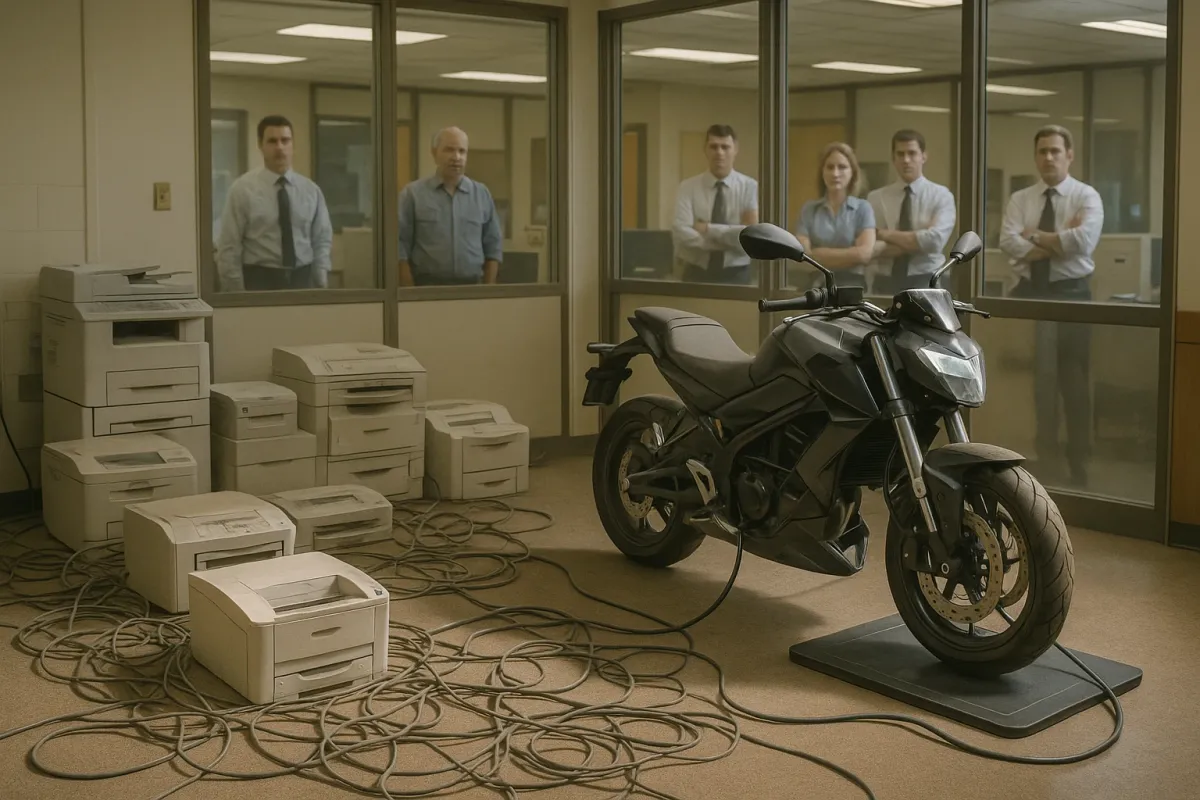
The internet is buzzing today over a viral article about “obsolete things” that prove how fast the world has changed. Floppy disks, VHS tapes, wired phones, even MP3 players—tech that felt untouchable a decade or two ago now looks like museum bait. That same energy is quietly ripping through the motorcycle world in 2025, and if you’re shopping for a new bike—or reviewing your current one—you need to know which “must‑have” features are about to age like dial‑up.
Motorcycle reviews used to focus on displacement, horsepower, and maybe ABS. Now, just like the gadgets in that trending “obsolete things” list, entire categories of moto tech are on the edge of irrelevance: analog dashes, cable throttles, non‑IMU ABS, even certain frame geometries. This isn’t futurist fluff; it’s happening right now on showroom floors and in spec sheets from Honda, Yamaha, KTM, BMW, and Triumph.
Below, we break down five technical points that every serious rider should use to judge modern bikes in 2025—through the lens of what’s about to become the two‑wheeled equivalent of the floppy disk.
1. Dash Tech: LCDs Are the New VHS
Those old “obsolete gadgets” posts always show CRT TVs and chunky remotes. In the moto world, the equivalent is the basic segmented LCD dash. If you’re reviewing or buying a 2025 bike and it doesn’t at least have a color TFT, you’re stepping into an era that’s already closing.
What’s happening right now:
- Mid‑range bikes are going fully connected.
Machines like the 2025 Yamaha MT‑09, Ducati Monster, Triumph Trident 660, and even budget‑friendly models from CFMOTO and Royal Enfield now offer full‑color TFTs, Bluetooth integration, and turn‑by‑turn nav via apps. What was “premium” in 2018 is expected baseline in 2025.
- Layout matters more than color.
- Refresh rate (does the tach sweep smoothly or stutter?)
- Legibility in direct sun (backlight power, contrast, anti‑glare coating)
- Data density (can you see gear, speed, mode, fuel, and nav without eye gymnastics?)
- Indicator logic is becoming a safety feature.
A good review in 2025 doesn’t stop at “nice TFT.” Look at:
High‑end bikes from BMW, KTM, and Aprilia are using color and layout to make warnings unmistakable. A clustered or tiny ABS/TC icon is a design fail in 2025; a modern safety‑focused dash surfaces critical info with priority and color hierarchy.
What to watch for in reviews:
If a current‑year bike shows up with a small monochrome LCD and no connectivity, that’s more than an aesthetics issue—resale and long‑term satisfaction will feel as dated as carrying a separate GPS unit in 2–3 years.
2. Rider Aids: Non‑IMU ABS Is the Flip Phone of Braking
The “obsolete things” article hammers home how quickly we abandoned basic cell phones once smartphones arrived. Rider aids are undergoing the same shift. Non‑IMU ABS and simple “on/off” traction control still show up in spec sheets, but they’re already functionally obsolete compared to full six‑axis IMU systems.
Why the IMU is the smartphone of your bike:
- *It knows how you’re moving, not just that you’re moving.
- Pitch (stoppies, hard braking)
- Roll (lean angle)
- Yaw (changing direction mid‑corner)
- Linear acceleration in three axes
- This unlocks “cornering” everything.
- Cornering ABS (modulates pressure based on lean angle)
- Cornering traction control and slide control
- Wheelie control that doesn’t kill drive
- Cornering lights that follow lean
- Why non‑IMU is becoming obsolete:
A six‑axis IMU (Bosch, Continental, or proprietary systems) measures:
Modern bikes like the latest Yamaha R7 HO, Ducati Panigale V2, KTM 890 Duke R, and BMW S 1000 RR use IMUs to deliver:
Straight‑line ABS assumes the tire’s grip is constant and the bike is upright. In the real world, we brake leaned, on imperfect surfaces, with varying tire temperatures. Non‑IMU systems are 90s thinking in a 2025 context.
What to demand from a serious 2025 review:
- Does it have cornering ABS or just “ABS”?
- Are TC modes lean‑sensitive or just RPM/gear‑based?
- How smoothly do interventions happen—abrupt, or almost transparent?
Any review praising “has ABS and TC” without noting IMU presence or behavior is as shallow as calling a flip phone “advanced” because it has a camera.
3. Power Delivery: Peak Horsepower Specs Are the MP3 Player of Performance
Just like MP3 players died the moment phones integrated better audio, peak horsepower specs are losing meaning now that ride modes, torque curves, and throttling strategies matter far more to real riders.
What’s changing across 2024–2025 model years:
- Ride‑by‑wire is now the norm, not the luxury.
Bikes from the Honda CB750 Hornet to the Suzuki GSX‑8S, Yamaha MT‑07 (update cycles), and KTM 790/890 line have embraced ride‑by‑wire. Most reviews still talk about “snatchy throttle” or “smooth response,” but few break down how maps are built.
- Torque curves beat spec‑sheet bragging.
A 100 hp twin with a fat midrange and smooth mapping (think modern parallel twins like Yamaha’s CP2/CP3, Suzuki’s 270° twins, or Ducati’s V2) will annihilate a peaky inline‑four in real‑world riding if the four’s mapping is old‑school on/off.
- Modes are more than just A/B/C.
- Power modes change throttle‑to‑butterfly ratio and sometimes torque limits.
- Rain modes often cap torque and soften engine braking.
- Sport modes can sharpen fueling but risk jitter if not mapped carefully.
On current bikes:
How to read (or write) a modern performance review:
Look for these details instead of a simple horsepower total:
- Is the bike “ridable” at 20–40% throttle? That’s where most road life happens.
- Does the throttle offer linear, predictable response at small openings?
- How does engine braking feel across modes? Is it tunable?
- What RPM band delivers the strongest usable drive?
Reviewers who obsess over peak numbers without dyno‑verified curves or ride impressions at partial throttle are doing the equivalent of reviewing a music device solely by storage size—ignoring sound quality and UI.
4. Chassis & Geometry: Old‑School Stability Setups Are Becoming Landlines
The “obsolete things” list includes wired phones—reliable, solid, but chained to one spot. Traditional, ultra‑stable chassis setups are like that: great in a straight line, but less relevant in a world where nimble, multi‑role performance is expected, even from “boring” naked and sport‑touring bikes.
How manufacturers are evolving the feel of modern machines:
- Shorter wheelbases, steeper rake.
Middleweights like the KTM 790/890 Duke, 2025 Yamaha MT‑09, and Triumph Street Triple variants show aggressive steering geometry that favors direction changes and front feel over dead‑straight Autobahn stability.
- Suspension adjustability is moving down‑market.
It’s no longer just superbikes getting adjustable forks and shocks. Honda’s CB650R, various Aprilia 660s, and even some Chinese and Indian brands now offer preload/rebound at least at the rear—sometimes both ends. Fixed‑rate suspension on a “premium” 2025 bike is getting harder to justify.
- Electronics meet suspension.
BMW’s Dynamic ESA, Ducati’s Skyhook, and Aprilia’s semi‑active systems are cascading down into more accessible trims. These read sensor data (including IMU where fitted) dozens of times per second and adjust damping on the fly.
What serious reviewers should be calling out:
- Turn‑in behavior: Does it flop, fall, or roll progressively?
- Mid‑corner support: Does the fork hold the line under trail braking, or dive and stand the bike up?
- Feedback vs. comfort: Is the suspension providing surface info without beating you up?
- Adjustability range: Do changes in preload and damping produce noticeable, testable* differences?
The landline approach—long wheelbase, conservative rake, basic non‑adjustable suspenders—still has a place for cruisers and entry bikes, but on anything marketed as “sport,” “streetfighter,” or “sport‑tourer,” it’s starting to look as dated as a rotary dial.
5. Braking & Heat Management: Non‑Radial, Non‑Floating Setups Are Cassette Tape Tech
Just as the “obsolete things” article shows cassettes and early CD players being left behind by streaming, basic braking hardware is being outpaced by modern riding expectations. Power is up, curb weights are steady or rising due to emissions and safety gear, and riders are staying in the throttle longer thanks to better electronics. Your brakes are now a primary performance spec, not an afterthought.
Key 2025 trends in braking tech:
- Radial calipers are the new baseline for anything sporty.
Bikes in the middleweight class and up (Kawasaki ZX‑4RR, Yamaha R7 HO where available, KTM RC 390 GP edition, Ducati Supersport, etc.) are using radial‑mount calipers even in non‑flagship trims. Axial calipers on a “sport” bike are becoming a red flag in reviews unless the price is bargain‑basement.
- Bigger discs, better materials.
- 300–320 mm front rotors are common; high‑end bikes push 330 mm+.
- Floating discs reduce warping and improve feel at the lever.
- Multi‑pad designs offer more consistent contact and heat distribution.
- Line quality & master cylinder design matter more than ever.
Braided lines—standard or as a dealer option—are moving mainstream, and master cylinders with better leverage ratios and radial designs are showing up outside the pure race replica segment.
- Heat management is tied to real‑world safety.
On big ADV and sport‑tourers (think BMW GS line, Yamaha Tracer 9 GT, Ducati Multistrada V4, KTM 1290 Super Adventure), long downhill runs with luggage and a passenger are the torture test. Modern reviews should be doing repeated high‑speed stops or long descents to probe fade resistance.
What to look for in technical reviews:
- Initial bite vs. modulation: Can you trail brake precisely, or is it grabby?
- Fade behavior: Do brakes go longer‑travel and vague after repeated hard use?
- ABS tuning: Does it pulse the lever violently, or intervene smoothly and late?
- Thermal recovery: Once hot, do they come back quickly or stay spongy?
Bikes that still rely on small, solid rotors with basic axial calipers and rubber lines may hit a price point, but in real‑world aggressive riding they feel as behind the curve as shuffling CDs in the age of playlists.
Conclusion
That trending article about “obsolete things” isn’t just nostalgia bait—it’s a warning. Tech doesn’t fade gradually; it falls off a cliff. Motorcycles are in the middle of that same transition in 2025. Analog dashes, non‑IMU ABS, peak‑hp‑only bragging rights, conservative chassis setups, and old‑school braking hardware are all on the wrong side of history for anyone who rides hard, rides far, or simply wants their next bike to feel current five years from now.
When you read—or write—motorcycle reviews this year, treat spec sheets like those photos of floppy disks and dial‑up modems. Ask the harder questions: Is the dash readable and connected? Are rider aids lean‑aware and intelligent? Does the torque curve match how humans actually ride? Is the chassis tuned for feedback as much as stability? Do the brakes feel 2025 or 2005?
Answer those honestly, and you’ll future‑proof your next purchase—and avoid waking up one morning to realize your “brand‑new” machine rides like a relic from a world that’s already moved on.
Key Takeaway
The most important thing to remember from this article is that this information can change how you think about Motorcycle Reviews.