Every rider you know is scrolling Cyber Monday deals right now. Gear, gadgets, “smart” helmets, Bluetooth intercoms, tire-pressure sensors, action cams—the internet is throwing tech at you faster than you can scroll. Headlines like “Cyber Monday Weekend Deals That Will Make You Forget Black Friday Even Happened” aren’t exaggerating; 2025’s sales push from Amazon, RevZilla, FC‑Moto, even OEMs like Yamaha and Kawasaki is massive.
But here’s the part nobody puts in the product description: the way you use that new tech can either sharpen your skills—or quietly dull them. The rush to “upgrade” is real, but if you bolt everything on the bike and on your body without a plan, you can end up slower, sloppier, and more distracted on the road. This piece isn’t about which deals to click; it’s about how to integrate all that Cyber Monday hardware into your riding technique like a pro.
Below are five technical, rider-focused tactics to turn today’s gear binge into real-world performance gains—without letting the sales season ride the bike for you.
Use Electronics As Data, Not Crutches: Building a Feedback Loop Instead of a Safety Net
Cyber Monday 2025 is awash with electronics: lean-sensitive ABS, cornering traction control, tire pressure monitoring systems (TPMS), and even budget data loggers are being discounted hard. Manufacturers are leaning into Bosch IMU packages, ride modes, and quickshifters across mid-range models. That’s fantastic—if you treat them as instruments, not autopilot.
Start with this mindset: every electronic aid is a sensor telling you how close you are to the edge. If traction control (TC) is lighting up frequently on corner exit, that’s not “cool tech saving you”; it’s a training note: your throttle application is too abrupt for the current grip level. Same with ABS—if the pump is chattering often under normal road braking, your braking phase is too binary: on/off, instead of a controlled pressure ramp.
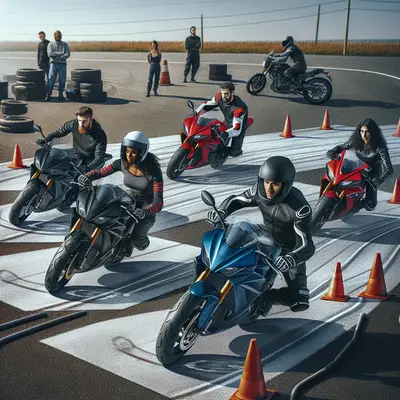
Practical drill: on a quiet, straight road or an empty lot, perform a series of controlled stops where you deliberately approach ABS activation without fully engaging it. Feel the tire load up, the fork dive, and how the braking force builds right before the system intervenes. Your goal: use the electronics as a hard ceiling you rarely touch, not as a daily riding surface. Over time, you’ll trust your own feel more than the dash lights, while still having that electronic safety net for unexpected situations.
When you bolt on that discounted TPMS kit, don’t just treat it as a warning light. Log what tire pressures correlate with best feel, warm-up time, and wear pattern for your specific tires, load, and routes. Over winter, you can refine a “cold pressure to set” for 0–5°C vs 15–25°C, using live readings as confirmation instead of guesswork. That’s how racers use telemetry; you can do a garage-version of the same with Cyber Monday tech.
Turn Helmet Tech Into a Vision Upgrade, Not a Distraction Device
Helmet deals are everywhere right now—integrated Bluetooth, HUD-style visors, built-in cameras. Companies from Sena to Cardo to budget brands on Amazon are pushing connectivity as the must-have “upgrade.” But your helmet’s primary job is to manage information density, not just add more of it.
On a technical level, your riding brain is already processing a huge visual stream: vanishing points, surface changes, brake lights, side mirrors, peripheral motion. When you add intercom chatter, GPS prompts, and music, you’re stacking cognitive load on top of a system that’s already maxed at 100 km/h. Studies on distracted driving and rider behavior consistently show that voice tasks and music change reaction time and hazard perception—even if your eyes are still on the road.
Turn that tech around: configure your setup as a filter, not a feed. For example:
- GPS: switch to audio-only prompts with minimal verbosity and no on-screen map in your direct field of view. Your route is mentally built from events (“next right in 300m”) instead of constant map monitoring.
- Intercom: limit group comms to short, pre-agreed callouts (e.g., “gravel left,” “stop in 500m,” “fuel next exit”) rather than general chatter. Treat it like rally pace notes, not a podcast.
- Music: if you insist on music, use it only in low-complexity environments (highway cruising, stable traffic) and kill it for twisties or urban density. Make that an iron rule.
Drill for visual discipline: on your next ride with a smart helmet or HUD, consciously delay any interaction (button press, voice command, mode change) until you are upright, with a known escape route, and both tires fully loaded in a straight line. If a setting can’t wait for that condition, it’s the wrong setting for riding. Cyber Monday helmets can be a vision upgrade—anti-fog coatings, better optics, wider FOV—if you configure the electronics to enhance clarity, not chatter.
Match Smart Gear to Smart Body Mechanics: Ergonomics as Performance Tech
This Cyber Monday weekend, ergonomic add-ons are everywhere: adjustable levers, bar risers, rearsets, touring seats, heated grips. The temptation is to treat these as comfort mods only, but for precise control, ergonomics is performance tech.
Levers first: a good short-travel, adjustable lever isn’t just about “feel good in the hand.” It directly sets your usable pressure range on both brake and clutch. A lever that’s too far from the bar forces you into a low-strength position, which increases fatigue and reduces fine modulation. Set your front brake lever so that under hard braking, your fingers are in a near-90° bend, with the ball of your fingers making contact at about the point where your index finger’s first joint meets the lever. Then, repeatedly practice controlled stops from 50–60 km/h, focusing on the linearity of your squeeze.
Bar risers and different bends: there’s a myth that “taller bars = more comfort” and that’s it. The real metric is torso angle vs. hip hinge. If you sit too upright, your ability to load the front tire under braking and corner entry is reduced because you can’t shift your mass forward efficiently. When you install taller bars, re-check body position at your typical cruising speed: you want a slight forward lean that allows your core—not your wrists—to hold you against the wind. That position dramatically improves mid-corner stability and reduces steering input wobble.
Heated grips and winter gloves, now heavily discounted, also change your input profile. Thick gloves reduce tactile sensitivity—especially at the lever bite point and throttle off-on transition. Your drill: with winter gear on, practice micro-throttle rolls in neutral and low-gear, low-speed maneuvers in a parking lot. Aim to make your roll-on so smooth that chain lash is almost entirely eliminated. Cyber Monday ergos should be tuned after you’re in full winter kit, not before.
Use Cameras and Apps as Training Tools, Not Just Content Machines
Action cams, 360 cameras, phone mounts, and tracking apps are getting huge price cuts this weekend because everyone wants POV footage for social. Fine—but if you’re serious about riding, that camera is more valuable pointed at you than at the scenery.
If you grab a GoPro, Insta360, or even a budget clone, mount it once facing forward for a baseline run, then spend the rest of your time mounting it backward, watching your inputs: body position, head orientation, throttle hand motion, and brake lever use. The goal is not cinematic footage; it’s diagnostic clarity.
Here’s how to turn Cyber Monday cameras into a coaching tool:
- Head position: on replay, can you see your helmet clearly turning and leading the bike into the corner, or are you staring at the dash or the patch of road right in front of the wheel? Late or minimal head turn correlates with rushed, choppy lines.
- Upper body: in mid-corner, is your torso rigid and vertical while the bike leans, or are you slightly to the inside with elbows relaxed? A stiff, straight-up upper body often causes mid-corner corrections and unstable lines.
- Controls: zoom in on your right hand. Is your throttle motion jerky, especially at initial roll-on? Are you covering the front brake in traffic? Can you see the brake light flickering unnecessarily mid-corner?
Pair the footage with a tracking app (Rever, Calimoto, or even Google Maps timeline) and overlay speed and corner radius. The objective isn’t top speed, it’s consistency: similar lines, similar apex points, smooth speed profiles. Turn one Sunday ride into a full debrief session, and you’ve extracted more value from a $199 camera than from a year of random YouTube tutorials.
Social bonus: share split-screen clips—forward view + rear-facing rider view—with analysis captions. That’s the kind of content riders actually learn from and share, not just another “here’s my road” repost.
Build a Seasonal Setup Protocol: Don’t Let Winter Gear Ruin Summer Skills
The reality behind those massive Cyber Monday weekend sales is simple: brands are clearing shelves for next season, pushing winter gear into your cart right as temperatures drop. Heated vests, thicker textiles, bulkier armor, and winter touring boots all change how you interface with the bike. If you just bolt it all on and go, your technique gets quietly re-written.
Extra bulk means:
- Reduced range of motion at hips and knees (affects weight transfer and hanging off)
- Stiffer ankle articulation (affects rear brake and gear shifts)
- Altered seat height due to thicker padding and layers
- Different wind load on chest and helmet (affects stability at speed)
Before you treat winter as “just riding but colder,” run a deliberate seasonal setup protocol after you unpack those discounts:
- Static check: fully kitted in new winter gear, sit on the bike on level ground. Check if you can still comfortably get the balls of both feet down. If not, adjust preload or consider a lower seat to restore your “emergency dab” capability.
- Control reach: with thick gloves on, ensure no accidental horn/indicator activation during full-lock turns or heavy braking. If it happens, rotate or reposition switchgear slightly.
- Dynamic low-speed drills: in an empty lot, do figure-eights, full-lock turns, and tight U-turns in both directions. Pay attention to whether the jacket restricts upper-body rotation; if it does, consciously exaggerate your head turn and shoulder rotation.
- Braking recalibration: perform a series of emergency stops with winter gear. New boot soles can change pedal feel and braking pressure. Recalibrate your muscle memory now—not when a car pulls out on a wet December morning.
Think of this like changing setup between dry and wet sessions at a trackday. Conditions, tires, and gear all change; so must your calibration. The Cyber Monday gear you score this weekend is only an upgrade if you adapt your technique to it.
Conclusion
Cyber Monday 2025 isn’t just a shopping event—it’s a massive, global experiment in how much technology riders can strap to their bikes and bodies in one weekend. The headlines about “weekend-long victory laps” for online deals are right; brands are rewriting how we buy gear. But what matters on the road isn’t what’s in your cart—it’s what you do with it when the visor clicks down.
Treat every new gadget, camera, helmet, and ergonomic upgrade as a tool in a deliberate training plan: electronics as feedback, not crutches; helmet tech as a clarity filter, not noise; ergos tuned for control, not just comfort; cameras pointed at your technique, not just the scenery; and winter gear integrated through a structured re-calibration, not guesswork.
Do that, and Cyber Monday doesn’t just change your kit—it changes your riding. And that’s the only upgrade that really matters.
Key Takeaway
The most important thing to remember from this article is that following these steps can lead to great results.