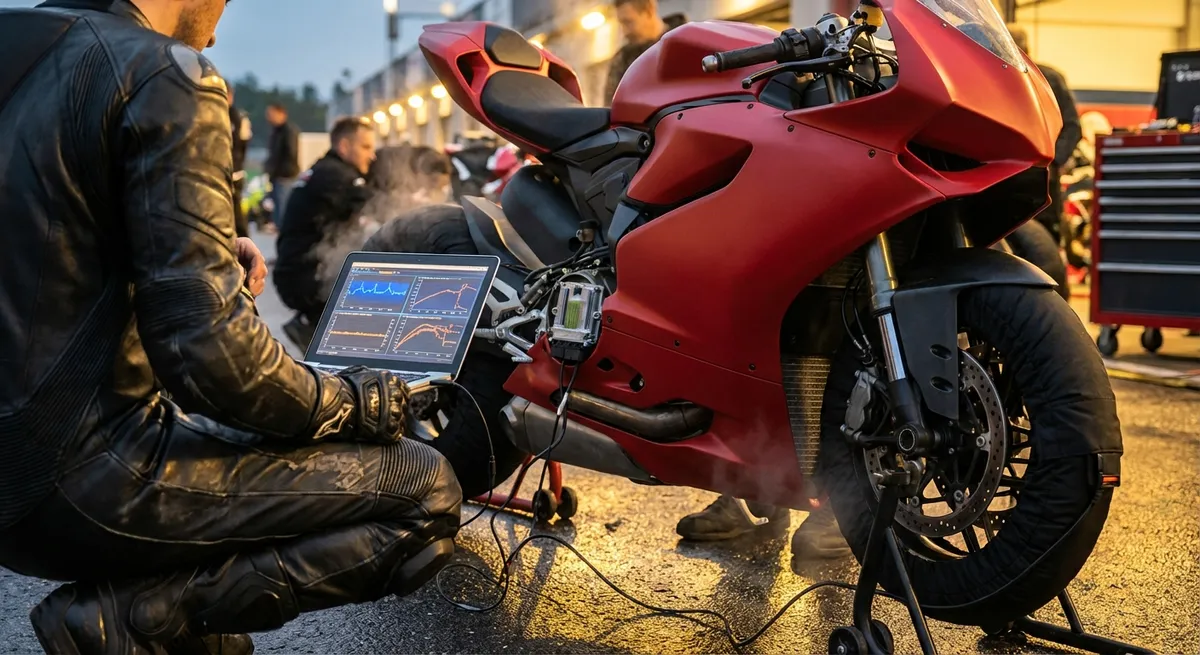
Motorcycle reviews are supposed to help you decide what to buy, but most of them barely scratch the surface. “It feels fast,” “the brakes are strong,” “the suspension is plush” — none of that means anything until you translate it into hard, mechanical reality. If you understand what reviewers should be measuring and how that maps to real-world riding, you can cut through the fluff and pick a machine that actually fits your riding style, roads, and skill level.
This isn’t about spec-sheet worship. It’s about using a technical lens to decode what a bike will do at 30 mph in traffic, 70 mph on the highway, and 120+ mph on track — before you ever throw a leg over it.
1. Engine Character: Beyond Horsepower and Torque Peaks
Most reviews lead with “X horsepower at Y rpm, Z Nm of torque.” On their own, those numbers are almost useless. What matters is how the engine makes that power and where in the rev range it’s actually accessible.
Key things to look for — or demand from a review:
- Torque curve shape, not just peak
A flat, broad torque curve between ~3,000–8,000 rpm usually means the bike pulls cleanly in real-world speeds without constant downshifting. A peaky curve that surges at the top suggests a bike that wakes up only near redline — fun on track, annoying in the city.
- Engine configuration and firing order
- Parallel twins (270° crank) often feel V-twin-like: strong midrange, characterful pulses.
- Inline-fours are usually smoother, rev higher, and build power more progressively.
- Big singles hit hard down low but sign off early and vibrate more.
- Compression ratio and tuning intent
Parallel twin, V-twin, inline-four, triple, single — each layout has distinct torque delivery, vibration profiles, and throttle response.
Higher compression (e.g., 13:1) typically points to a more aggressive, rev-happy engine that may demand premium fuel and careful tuning. Mid-range street bikes often sit in the 10–12:1 zone, prioritizing flexibility and fuel efficiency over razor’s-edge performance.
- Throttle response and fueling
When a reviewer talks about “snatchy,” “abrupt,” or “buttery smooth” throttle, translate that as fueling quality and ride-by-wire calibration. On/off transitions around small throttle openings (like in a corner or in traffic) separate a nervous bike from one that feels surgically precise.
- Gearing and real-world rpm
Reviews that mention what rpm you’re turning at 70 mph in top gear are gold. A bike spinning 6,500 rpm at highway speeds will feel busier and may use more fuel than one turning 4,000 rpm — even with similar peak power. Tall gearing can also dull acceleration if the engine lacks low-end torque.
When you read “strong midrange,” ask: At what rpm? In what gear? Under what load? Technical reviews should map that to actual speeds and typical riding scenarios — highway passing, corner exits, city roll-ons.
2. Chassis Geometry: Why the Numbers Decide If a Bike Talks or Fights You
Every review should at least hint at the chassis geometry, because rake, trail, and wheelbase determine how the bike feels underneath you even more than the engine does.
Core metrics and what they signal:
- Rake (head angle)
- Steeper rake (around 23–24°) → quicker steering, more responsive but potentially twitchier at high speed.
- Relaxed rake (around 26–28°) → calmer, more stable but slower to turn in.
- Trail (distance the contact patch “trails” behind the steering axis)
- Less trail → light, nimble steering, but can feel nervous on rough or fast roads.
- More trail → rock-solid stability, but more effort at the bars.
- Wheelbase
Typical sportbike: ~95–105 mm. Sport-touring and ADV: often 105–120+ mm.
Short (1400–1440 mm) generally means a bike that wants to change direction quickly but may wheelie more and be more sensitive to weight transfer. Long (1500+ mm) means better straight-line stability and composure under acceleration, but slower transitions.
- Weight bias and rider triangle
- More weight over the front = sharper turn-in, more front-end feel, but possibly quicker fatigue on longer rides.
- Neutral or rearward bias = comfort and stability, at the expense of razor sharp steering.
- Flex vs. stiffness
When reviewers mention feeling “over the front” or “sitting in the bike,” they’re really describing weight distribution and the rider triangle (relationship between bars, seat, and pegs).
A good review should distinguish between a frame that’s too stiff (“harsh over bumps, transmits every ripple”) and one that talks to you without shaking you apart (“communicative, compliant, holds a line over imperfections”). Ultimate torsional rigidity isn’t always better — some controlled flex helps grip on real roads.
Whenever you see comments like “falls into corners” or “needs a firm hand,” think geometry and weight bias. Those aren’t feelings; they’re the mechanical consequences of how the bike is laid out.
3. Suspension: Reading Past ‘Plush’ and ‘Firm’ Into Real Damping Behavior
Suspension is rarely explained well, yet it’s the system that decides whether a bike is a scalpel or a bar fight at speed.
Here’s what a technical review should tell you:
- Spring rate vs. damping
- If the bike blows through travel and wallows, it’s either under-sprung, under-damped, or both.
- If every small bump feels like a punch, it might be over-sprung, over-damped, or both.
Good reviewers will mention if the suspension uses too much travel under braking or if it “pogo-sticks” on rebound over successive bumps.
- Compression vs. rebound behavior
- Poor compression damping → front dives too fast, rear squats excessively, bike feels unsettled mid-corner when you hit bumps.
- Poor rebound damping → bike “packs down” over repeated bumps or “kicks back” after a bump instead of settling once.
- Adjustment range and usability
- Whether stock settings are in the middle of the usable range (ideal — headroom both ways), or nearly maxed out.
- If a couple of clicks make a noticeable difference or if you need big changes to feel anything.
- Static and rider sag (even if not numerically stated)
- “Rear sits too low, vague front end” → too much rider sag in the rear.
- “Nervous front, light feeling under braking” → front sag may be too little, rear too high.
- Use-case clarity
- Smooth tarmac vs. broken pavement.
- Single rider vs. two-up touring.
- Street sport vs. track readiness.
Compression, rebound, and preload adjusters are only useful if they have a logical and effective range. Reviews should indicate:
You almost never see sag numbers in mainstream reviews, but you’ll often see impressions that are really about sag:
A good review calls out what the suspension is tuned for:
Terms like “track-ready” or “comfort-biased” need translation: track-ready means firmer springs, more damping, and more composure at speed — but potentially harsh commuting. Comfort-biased means better compliance at legal speeds, but more movement and less precision on the limit.
4. Brakes and Electronics: From Feel at the Lever to the Algorithms Behind It
When someone says “brakes are strong,” that’s barely a headline. You care about:
- Brake hardware
- Caliper type (radial-mount vs. axial, number of pistons)
- Rotor diameter and thickness
- Master cylinder feel (spongy vs. firm, progressive vs. on/off)
Strong components don’t guarantee good braking, but they set the ceiling for what the system could do with proper tuning.
- Initial bite vs. progression
- Strong initial bite + good progression = confidence, especially on track.
- Soft bite but progressive = more beginner-friendly and better for low-speed control.
Reviews should note whether modulation is easy — can you precisely add or bleed off braking, or is it binary?
- ABS performance, not just presence
- Does it trigger too early on rough roads?
- Can you feel the pulsing, or is intervention smooth?
- Is there independent mode control (e.g., less intrusive rear ABS in “Sport” or “Track” modes)?
- Traction control and throttle modes
- Whether TC cuts power abruptly or trims it smoothly.
- If the modes (Rain, Road, Sport, Track) actually change throttle maps and intervention levels in a meaningful way.
- Whether wheelie control is separate (if present) and how predictable it feels.
- Integration, not gimmicks
Modern cornering ABS uses IMUs (inertial measurement units) to account for lean angle and pitch. What matters is:
A simple on/off TC is not the same as a multi-level, lean-sensitive system with good algorithms. A solid review will describe:
Electronic aids are valuable only when they’re consistent and transparent. If a review says, “I forgot the TC was there until I hit gravel on corner exit,” that’s praise. If they say, “The bike keeps cutting power just when I want to drive hard,” that’s a calibration problem.
For real riders, especially those pushing harder on mountain roads or track days, you’re not just buying hardware — you’re buying software logic. A technically strong review will talk about that logic as clearly as the calipers and rotors.
5. Thermal Management, Ergonomics, and Real-World Range: The Long-Game Metrics
A bike can be intoxicating for 10 minutes and a punishment device after two hours. Technical reviews that understand systems will address the long-game details riders feel every single ride.
Important long-term factors:
- Heat management
- Does the review mention engine heat on the inner thighs, right calf, or under the seat in slow traffic?
- Does the fan cycle frequently and loud, or rarely and quietly?
- Are there heat shields and ducting that actually work, or just cosmetic covers?
- Fuel range and consumption in context
- 40 mpg with a 15 L tank ≈ 158–200 km (100–125 mi) realistic range before reserve.
- 50+ mpg with a 20 L tank can make a genuine 300+ km (190+ mi) day easy.
Don’t just look at mpg/L/100 km numbers — combine them with tank size and typical use:
Good reviews will note both “spirited riding” and “steady highway” figures.
- Ergonomic triangle and weight distribution on the body
- Knee angle (tight and sporty vs. relaxed and open).
- Reach to bars (supporting an athletic, forward stance vs. upright and neutral).
- Seat shape and density — does it lock you in place or allow fore-aft movement?
Reviews should break down:
This isn’t “comfort” fluff; it’s about how your body interfaces with the bike’s control axes over time.
- Wind protection and aero
- Where the wind hits (chest, helmet, shoulders).
- Whether the flow is clean or buffety.
- Adjustability and real effect of screens or winglets.
- Serviceability and ownership engineering
- Valve check intervals and access (does half the bike need to come apart?).
- Oil and filter accessibility, chain adjusters, panel fasteners.
- Electronics access for diagnostics (OBD ports, dealer-only tools, etc.).
At 50–70 mph (80–110 km/h), aerodynamics define fatigue. Look for:
Technically aware reviews may note:
A bike that’s thermally miserable, cramped, and awkward to maintain might still review “well” after a 30-minute press ride — but you’re the one living with it. Look for reviewers who ride a full tank, in varied conditions, and talk like they’ve actually tried to live with the machine.
Conclusion
Motorcycle reviews are valuable only when you know how to read between the lines and translate impressions into engineering realities. Engine character isn’t about a single horsepower number; it’s about curves, gearing, and fueling. Handling isn’t “good” or “bad” — it’s geometry, weight bias, and suspension behavior. Brakes and electronics aren’t just spec-sheet checkboxes — they’re feel, calibration, and predictability at the edge of grip. And the real-world experience hinges on heat, ergonomics, range, and serviceability, not just how a bike felt in one perfect canyon run.
When you approach reviews with a technical mindset, you stop being sold to and start evaluating. You can match a machine’s mechanical personality to your roads, your pace, and your ambitions. That’s the difference between buying the hype and buying the right bike — not just for the next ride, but for the next 50,000 miles.
Sources
- [SAE International – Motorcycle Dynamics Overview](https://www.sae.org/publications/technical-papers/content/2005-32-0003/) - Technical paper diving into motorcycle dynamics, including effects of geometry and mass distribution
- [Kawasaki Motors – Understanding Motorcycle Specifications](https://www.kawasaki.com/en-us/racing/team-green/tech-tips/how-to-read-motorcycle-specs) - OEM-level explanation of common spec sheet terms and what they mean in practice
- [Honda Powersports – Technology and Features](https://powersports.honda.com/discover/technology) - Descriptions of modern engine, braking, and electronic systems from a major manufacturer
- [Yamaha Motor – IMU and Rider Aid Technology](https://global.yamaha-motor.com/business/mc/technologies/imu/) - Detailed look at how IMUs and electronic rider aids function in real time
- [U.S. Department of Energy – Fuel Economy Basics](https://www.fueleconomy.gov/feg/feg2023.shtml) - Background on fuel consumption and range considerations relevant to real-world riding
Key Takeaway
The most important thing to remember from this article is that following these steps can lead to great results.