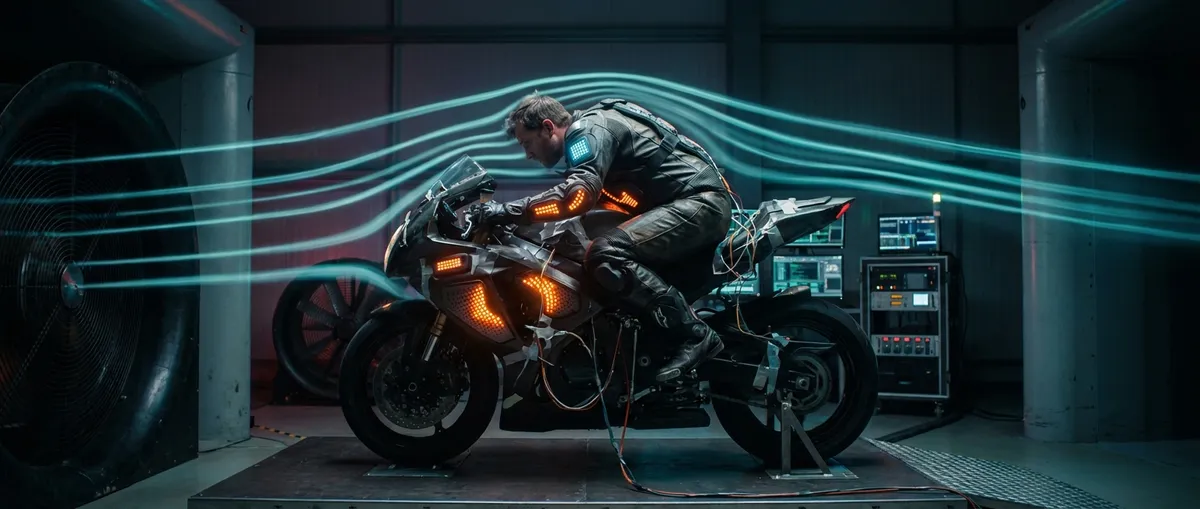
Motorcycle gear isn’t a costume, and it’s not just “better than jeans.” It’s a distributed crash system: energy management, friction control, and bio-mechanical protection all layered around your skeleton. When you start looking at jackets, gloves, boots, and suits like engineering components in a safety stack, your buying decisions change—fast.
This isn’t a “buy leather vs. textile” explainer. This is about understanding the physics and standards behind modern gear so you can assemble a system that behaves predictably when everything goes violently wrong.
Gear as an Energy Management System
Every impact or slide is just energy looking for a place to go. Your job is to route that energy into materials, not anatomy.
There are three core engineering tasks your gear has to perform:
- Distribute force – Spread a sharp, localized hit over a wider area so bone doesn’t see the full spike load. That’s the job of armor shells and stiff reinforcement panels.
- Delay force – Slow the time over which force is applied using crushable or viscoelastic material, reducing peak g-loads on joints and organs. That’s what modern impact foams do.
- Control friction – Manage how quickly you decelerate during a slide. Too little friction and you slide into the next hazard; too much and your limbs dig in and twist.
When you evaluate gear, stop asking, “Is this comfortable?” and start asking, “Where does the kinetic energy go?” A textile jacket with downgraded armor might feel great in the showroom, but if the foam pancakes on impact, your shoulder takes the load. Likewise, an abrasion-resistant suit with no proper armor might keep your skin intact while your hip fractures underneath.
Think in systems:
- Helmet = impact + penetration + rotational energy control
- Jacket/pants/suit = abrasion + impact + seam integrity
- Gloves/boots = localized impact + torsion + crush resistance
If one part of the system is weak, the failure mode usually jumps to your bones and ligaments.
Technical Point 1: Decoding Impact Armor (CE Levels, Materials, and Coverage)
Most riders know the phrases “CE Level 1” and “CE Level 2,” but few understand what those numbers represent under a test rig.
Under EN 1621-1 (limbs) and EN 1621-2 (back):
- A test anvil drops onto the armor multiple times.
- Sensors measure how much force gets through.
- Level 1: max transmitted force ≤ 35 kN, average ≤ 30 kN
- Level 2: max transmitted force ≤ 20 kN, average ≤ 18 kN
That difference is not academic. Lower transmitted force means less risk of fracture or severe soft tissue damage, especially in high-mass impacts like hips, shoulders, and spine.
Material science matters:
- PU foam / basic hard armor – Affordable, decent for low-energy hits, but often bulkier and can degrade over time.
- Viscoelastic / “smart” armor (D3O, Sas-Tec, Alpinestars Nucleon, etc.) – Soft and flexible until impact, then stiffens momentarily to spread and absorb energy. High-end versions can pass Level 2 at reduced thickness, improving comfort and mobility.
- Articulated back and chest protectors – Segmenting the armor with overlapping plates preserves energy distribution while allowing spinal flexion and rotation.
Technical priorities for riders:
- Target Level 2 armor at shoulders, elbows, hips, knees, and back; consider chest protection if you ride aggressively or in dense traffic.
- Check coverage area, not just the label. Some cheap pads barely cover the joint centerline. You want armor that extends well beyond the main load paths of the joint.
- Confirm retention: Does the armor stay in place when you mimic a crash (tuck, twist, reach)? If it rotates off your elbow when you extend your arms, the rating is meaningless.
When you upgrade armor, you’re not just buying “safety”—you’re tuning the force curve your body sees in a crash.
Technical Point 2: Abrasion & Tear Resistance – Why Fabric Specs Actually Matter
Skin is an awful abrasion material. It heats, tears, and contaminates instantly. Your outer shell’s job is to keep your dermal layer out of the equation as long as possible.
The older CE jacket standard, EN 13595, and the newer garment standard, EN 17092, approximate real-road sliding using abrasive belts and concrete analogs. While test setups vary, there’s a consistent engineering truth: surface durability is time.
Under EN 17092:
- Class AAA – Highest protection, typically full suits or robust jackets/pants for higher risk speeds
- Class AA – Balanced road gear, decent for spirited street riding
- Class A and below – Prioritizes comfort; lower abrasion resilience
Technical considerations:
- Leather (1.2–1.4 mm track-grade cowhide or kangaroo)
- Excellent abrasion time; high heat tolerance.
- Naturally high tear resistance; seams still critical failure point.
- Good for track and aggressive street, but can be hot and heavy.
- Textiles (e.g., Cordura, Armacor, SuperFabric, Dyneema blends)
- Wide performance range. A basic 600D polyester is not in the same universe as a high-denier Cordura or UHMWPE blend.
- Look for specified fabrics (e.g., “Cordura 1000D,” “Armacor,” “SuperFabric,” “Dyneema reinforced”) and impact zone reinforcement at shoulders, elbows, hips, knees, and seat.
- Pay attention to tear and burst strength; abrasion is useless if the fabric rips open at the first tumble.
- Seams and construction
- The seam is often the weakest link. CE garments are tested at critical seams for burst strength.
- Triple-stitched or hidden safety seams (external cosmetic seam + internal structural seam) drastically reduce blowout risk.
For high-speed or high-consequence riding, prioritize:
- AAA-rated one- or two-piece suit (leather or top-tier textile) for track or mountain work.
- At minimum AA-rated gear for serious street mileage.
- Reinforced double layers in high-risk zones: butt, outer thighs, shoulders, elbows, outer forearms, knees.
You’re buying slide time: more seconds between your body and the road.
Technical Point 3: Boot and Glove Engineering – Controlling Torsion, Crush, and Degloving
Hands and feet are mechanically complex, fragile, and hard to fix. They also take the brunt of instinctive crash reactions—reaching out, bracing, or getting trapped under the bike.
Boots: what really matters
A proper motorcycle boot is a structural component, not just leather above the ankle.
Key engineering features:
- Torsion control – Internal bracing or hinge systems that allow flex in the intended plane (forward/back) but resist side flex and twisting. This reduces the risk of spiral fractures and ligament ruptures.
- Shank and crush resistance – A stiff midsole (shank) spreads load if the bike lands on your foot or you hit a peg/rock edge. EN 13634 tests include transverse rigidity and impact.
- Ankle protection – Hard or semi-rigid cups on both medial and lateral sides, anchored to the boot’s chassis, not just floating in soft material.
- Closure integrity – Buckles, robust Velcro, or ratchet systems that won’t blow open under load. Laces alone are a snag hazard unless fully covered.
For any ride beyond casual urban crawling, you want a boot that passes EN 13634 with impact and crush protection—not just “reinforced moto sneaker.”
Gloves: small surface, high engineering demand
Hands instinctively touch down first. Your glove has to deal with abrasion, impact, and rotational forces with very little real estate.
Important design elements:
- Palm sliders – Hard or semi-hard inserts on the palm/heel area that encourage sliding rather than grabbing. Without these, high-friction palms can “stick,” causing wrist hyperextension or scaphoid fractures.
- Knuckle and finger armor – Not just hard shells, but ideally hybrid systems with underlying impact-absorbing foam. EN 13594 measures both impact and abrasion.
- Seam placement – External seams improve feel but can be a failure point if done poorly. Critical abrasion zones should avoid seam lines directly on the impact path.
- Cuff length and closure – Gauntlet-style cuffs that overlap your jacket and can be cinched tightly prevent gloves from being stripped off during a slide or tumble.
A visually “aggressive” glove with perf leather and carbon bits is meaningless if the palm stitching lets go at the first real slide. Pull and twist the glove aggressively when trying it on; if seams or closures feel fragile, they’ll fail under crash loads.
Technical Point 4: Weather Control as a Safety System (Not a Comfort Feature)
Weather management is often dismissed as a comfort issue, but temperature and moisture directly affect reaction time, focus, and muscle performance. Gear that controls microclimate keeps your brain and body in the performance window longer.
Heat management
- High core temperatures degrade cognitive performance and increase fatigue.
- Ventilation panels, mesh zones, and perforations must be strategically placed to flow air through the gear, not just flap at the surface.
- Look for large exit vents (back, rear thighs) paired with intake vents; airflow without an exit is just pressure.
- In very hot climates, some riders benefit from evaporative cooling layers worn under highly ventilated textile suits.
Cold management
- Cold reduces nerve conduction velocity and muscle responsiveness, especially in hands.
- Insulation isn’t just thickness; it’s about trapping air without inducing sweat. Removable thermal liners are beneficial for tuning your system.
- Heated grips and heated gloves aren’t luxury items in sustained cold—they’re neural protection for your response time and fine control.
Waterproofing and breathability
- Membranes (Gore-Tex, eVent, proprietary laminates) are engineered to allow water vapor out while blocking liquid water in.
- Drop-liner designs (floating membrane inside) are cheaper but can soak the outer shell, increasing weight and evaporative cooling after the rain.
- Laminated shells (membrane bonded to outer fabric) shed water more effectively, dry faster, and maintain consistent weight and thermal performance.
Wet, cold, or overheated riders make worse decisions and have degraded fine motor control. Weather-tuned gear is a rider performance amplifier, not just comfort fluff.
Technical Point 5: Fit, Kinematics, and the Dynamics of Staying Armored
The best armor in the world does nothing if it migrates away from the impact zone when you need it. Fit is not fashion—it’s kinematics: how the gear moves relative to your skeleton under real dynamic loads.
Engineering your fit:
- Pre-curved patterns – High-quality jackets, pants, and suits are cut in the riding position, not for standing in a store. If it feels slightly “aggressive” off the bike, that’s normal. On the bike, the armor should sit flush on shoulders, elbows, hips, and knees without gaps.
- Tension mapping – Use adjusters (straps at biceps, forearms, waist, calves) to pre-load the garment so armor is lightly tensioned against the joint. You want controlled compression, not loose drift.
- Layering allowance – If you ride in different seasons, ensure your shell size accounts for base and mid-layers without destabilizing armor placement. Too much empty volume means armor will rotate on impact.
- Mobility under lock-up – Sit on your bike in full gear, lock the bars left/right, tuck into a braking posture, hang off the side. At every extreme position, armor should still cover the joint centerline. If it pulls away or floats, that’s a failure mode.
Pay close attention to:
- Crotch and knee geometry on pants: if the knee armor rides too low while walking, it may align correctly in the seated position—but verify both.
- Boot-jacket-pants interface: Overlap between gloves–jacket sleeves and boots–pant legs should remain intact in crouched or extended positions to avoid skin exposure in a slide.
- Chest protector integration: If you add aftermarket chest armor or an airbag vest, ensure the jacket’s pattern accommodates it without stressing seams or pushing other armor out of place.
A well-fitted gear system is like a race harness in a car: it should keep your protective components where they need to be while still allowing you to operate the machine without restriction.
Conclusion
When you reframe motorcycle gear as a crash-engineered system, the shopping checklist changes. You stop chasing brand logos and colorways and start hunting for impact curves, abrasion times, seam strength, torsion control, and kinematics.
This isn’t about riding scared—it’s about riding with mechanical honesty. If you’re willing to lean a motorcycle into a decreasing-radius corner at real speed, you should be just as willing to engineer the armor that backs up that decision. Build your kit like you’d spec a braking system or tire package: identify the load cases, understand the materials, choose components that perform under real-world failure modes.
Your bike is a machine built for velocity. Your gear should be a machine built for survival when velocity suddenly stops.
Sources
- European Commission – Protective Equipment for Motorcyclists - Technical overview of motorcycle PPE performance, standards, and effectiveness
- Gore-Tex Professional – Motorcycle Garment Technology - Engineering details on waterproof/breathable laminates and garment construction for riders
- D3O – Impact Protection Technology - Technical descriptions of viscoelastic armor behavior, testing, and CE certification levels
- Transport for NSW (Australia) – Motorcycle Clothing Assessment Program - Independent testing data for abrasion, impact, and burst strength in real garments
- Cambridge University / EN 13595 Background via Cambridge Engineer Paul Varnsverry Interview (MCN) - Historical and technical context for CE protective clothing standards and test methods
Key Takeaway
The most important thing to remember from this article is that this information can change how you think about Gear & Equipment.