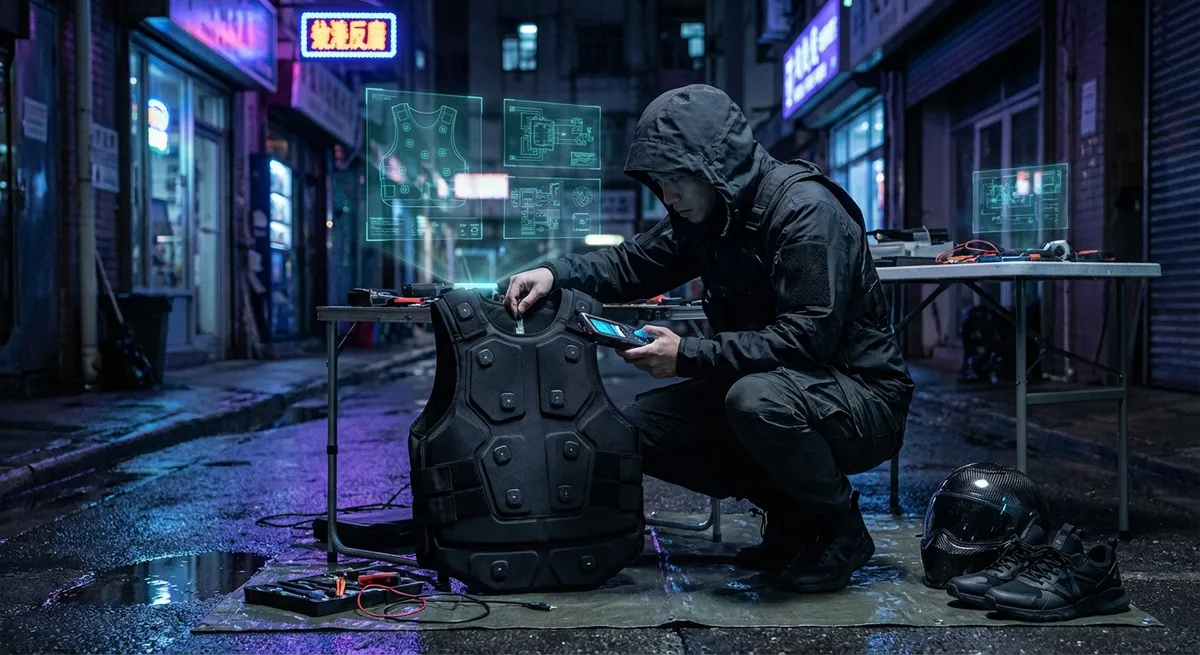
Motorcycle gear isn’t just “protection” anymore—it’s a wearable engineering system. Materials, impact curves, slide dynamics, sensor integration, and thermal management all converge in the jacket, pants, boots, and gloves you zip up before every ride. If you’re still thinking in terms of “leather vs textile” or “cheap vs expensive,” you’re leaving performance on the table. This is about building an integrated, technically coherent gear system that actually works at speed, in weather, and under real crash loads—not just on a spec sheet.
Below are five technical pillars that serious riders should understand before buying their next piece of kit.
1. Impact Energy Management: Not All Armor is Doing the Same Job
Most riders see a “CE” label and assume done deal. But impact protection is about energy curves—not just checkboxes.
Modern motorcycle armor is typically tested under the EN 1621 standard. A guided striker hits the armor with a defined joule load, and sensors measure how much force reaches the “body” underneath. What matters is not just whether it passes, but how it passes.
Key technical points:
- CE Level 1 vs Level 2 is a real, measurable difference.
- EN 1621-1 (limbs) sets an average transmitted force max of:
- Level 1: ≤ 35 kN
- Level 2: ≤ 20 kN
That’s up to roughly a 40–45% reduction in allowed transmitted force from Level 1 to Level 2.
- Coverage area is as critical as the rating.
- Long, anatomically curved shapes that wrap around joints
- Dedicated pockets with minimal free play
- External stitching or panel shaping that “locks” armor over the impact zones
- Armor material behavior under real-world temperatures.
- In cold weather, too-stiff armor may transmit more force because it doesn’t deform effectively.
- In high heat, it can bottom out more easily.
A Level 2 elbow pad that floats out of position in a tumble is functionally worse than a perfectly anchored Level 1 piece. Look for:
Many viscoelastic foams stiffen drastically when cold and soften excessively in high heat:
If you ride in wide temp ranges, look for published test data or manufacturer claims about performance from ~0–40°C (32–104°F), and prioritize materials explicitly tested across that spread.
- Back protectors: shape and architecture matter.
- EN 1621-2 governs back protectors and has similar Level 1/Level 2 thresholds.
- Large, articulated, multi-plate or “cell” designs follow spine curvature better and keep contact under movement.
- Standalone back protectors often outperform thin inserts that ship with jackets—treat OEM foam pads as placeholders, not final gear.
Practical takeaway: When evaluating armor, think in terms of energy management over your actual riding temperature range, not just a logo. Prioritize Level 2 where possible for high-risk zones (back, shoulders, elbows, hips, knees) and ensure the chassis keeps that armor locked over bone, not muscle.
2. Abrasion Dynamics: Slide Time, Not Just “Leather vs Textile”
In a real slide, the question is simple: how long until a hole appears and your skin is on the asphalt? That’s abrasion time—measured in seconds under standardized testing—and it should drive your outer shell choices.
Technically, abrasion resistance is mostly governed by:
- Fiber type and denier (or weight).
- High-density polyamide (e.g., Cordura) and aramid blends (e.g., Kevlar, Twaron) dramatically outperform generic polyester in abrasion and heat tolerance.
- For textiles, look for high-denier (500D, 600D, 1000D) polyamide in high-risk zones (shoulders, elbows, hips, knees, seat).
- For leather, 1.2–1.4 mm cowhide or kangaroo used in single, continuous panels over slide zones is ideal.
- Standardized abrasion testing: EN 17092 classes.
- Class AAA: highest protection (track-capable, more rigid, heavier)
- Class AA: balanced street protection and comfort
- Class A: lighter urban gear, reduced abrasion performance
For road gear:
These classes are tested on the Darmstadt or Cambridge-type machines, which approximate slide resistance over coarse abrasive surfaces. While not perfect replicas of every crash, they are a repeatable, comparative measure. For spirited road riding, target AA or AAA wherever comfort allows.
- Seams are the failure frontier.
- Safety seams use multiple rows of stitching, often with concealed or protected seams in high-risk zones.
- External decorative seams are not structural; prioritize garments where critical joins are double- or triple-stitched and not sitting directly on likely impact points.
- Zippers, closures, and panels in slide paths.
- Abrasion-heavy fabrics and clean panels on outer contact zones
- Vents and zips positioned in lower-risk areas (chest centerline, inner arms, upper back—away from common slide vectors)
Many garments fail not by grinding through fabric, but by seam burst or tearing:
A jacket with a zipper or vent panel running directly across a known slide path (outer shoulders, outer hips) may create early-failure points. Look for:
Practical takeaway: Don’t just ask “leather or textile?” Ask: What EN 17092 class? What is the fabric type and weight in slide zones? How are the seams built, and where are they located relative to likely impact paths?
3. Thermal and Moisture Management: Keeping the Rider in the Operating Window
Gear that protects you but cooks your brain or chills your core is functionally unsafe. Human performance falls off rapidly when core temperature drifts too high or too low, or when dehydration and sweat saturation kick in.
From a technical standpoint, your gear system should manage:
- Convective cooling (airflow)
- Direct venting (mesh panels, large zip vents) is incredibly effective at lower speeds but can overshoot and cause dehydration at highway speeds in hot, dry climates.
- Laminated waterproof shells with direct vents that pass through the membrane (not just into a liner) offer higher control: closed in cold/rain, open in heat without full compromise.
- Evaporative regulation
- Sweat must be transported away from skin to avoid clammy discomfort and rapid chilling when the sun drops.
- A proper base layer (synthetic or merino) under your jacket and pants is a functional tech component, not an afterthought. Cotton traps moisture; it has no place as a base layer for serious riding.
- Membrane technologies and their limits
- Waterproof-breathable membranes (e.g., Gore-Tex, D-Dry, Drystar, etc.) rely on a vapor diffusion gradient, not magic airflow. Breathability plummets in high humidity or when the outer fabric gets saturated (“wet-out”).
- Look for garments with:
- DWR (durable water repellent) treatments on the outer shell
- Vents that bypass or at least effectively couple with the membrane
- Separate thermal liners that can be removed without affecting weatherproofing
- Local microclimate zones
- Your core, hands, and feet have distinct thermal requirements:
- Core needs stable temperature to keep cognitive load and reaction time optimal.
- Hands need both warmth and precision feel—too thick a glove can degrade lever feedback and delay braking response.
- Feet need to stay dry to avoid blistering and loss of tactile peg feel.
- Match insulation to riding conditions rather than just buying the “warmest” thing you can find. Over-insulation in active riding can induce sweat, which then kills insulation performance when you stop.
Practical takeaway: Build your gear system in layers: base for moisture management, mid for thermal modulation, shell for impact/abrasion and weather. Choose ventilation and membrane strategies based on your climate and speed envelope, not just brand marketing.
4. Biomechanics and Fit: Turning Gear Into a Performance Interface
Protection that fights your body is protection you eventually stop wearing—or subconsciously work around with poorer control inputs. Gear must be designed around riding posture, not store-mirror posture.
Key biomechanical considerations:
- Pre-curved patterning and articulation
- High-performance jackets and pants are cut with bent elbows, knees, and a rotated hip angle, so the garment “settles” when you’re on the bike, not standing straight.
- Look for stretch panels (accordion leather or woven stretch) above knees, at shoulders, and across the lower back; these absorb the flex motion so armor doesn’t shift.
- Armor anchoring under movement
- When you move from upright to tucked, your armor should track with joints:
- Shoulder cups should still be centered over the joint, not sliding to the back.
- Knee armor should still sit over the patella when your knees are bent.
- When trying gear on, simulate real riding posture: sit, crouch, move your arms like you’re countersteering and covering the brakes. Feel where armor migrates.
- Boot and glove biomechanics
- Boots need torsional (twisting) and lateral rigidity in the ankle while preserving enough dorsiflexion/plantarflexion (toe up/down) to allow fine brake and shift inputs.
- Gloves need a pre-curved finger profile, minimized internal seam bulk at the fingertips, and wrist closure that sits below the wrist crease so it doesn’t fight your range of motion on the controls.
- Neck, helmet, and jacket integration
- A high collar plus a tall-chinned helmet can create binding when you shoulder check or look through corners.
- Check for:
- Collar shape and adjustability
- How the back protector and helmet base interact when you’re in your usual riding stance
If you feel “helmets jam into the back protector” on bigger head turns, you’ll unconsciously reduce head checks over time.
Practical takeaway: Treat fit as dynamic, not static. Fit gear in the posture and range of motion you actually ride in. Properly designed, biomechanically smart gear will disappear from your awareness at speed—and that’s the goal.
5. Integrated Systems: Electronics, Visibility, and Future-Proofing
We’re well past the era of “jacket, gloves, boots” as isolated items. Your gear is increasingly a connected system: sensors, power distribution, visibility layers, and communication all blend into what you wear.
Core technical elements:
- Airbag integration
- Two main architectures:
- Standalone vests (electronic or tethered) worn under or over jackets.
- Integrated airbags built into the jacket itself.
- Electronic systems rely on accelerometers, gyros, sometimes GPS, and algorithms trained on ride/crash data. Critical factors:
- Detection latency (how quickly it recognizes a crash scenario)
- Inflation time (often ~40–80 ms)
- Coverage vectors: chest, ribs, collarbone, neck, back
- Ensure your jacket has:
- Adequate expansion volume—airbags need room to inflate
- Interior space or dedicated channels for the bladder if using an under-jacket vest
- Power management for heated gear and electronics
- Modern riders often run: heated jacket/vest, heated gloves, GPS, comms, sometimes auxiliary lighting.
- Check your bike’s stator and charging system output vs baseline draw. Heated gear can pull 35–100 watts per garment at full power; it’s easy to overload small charging systems if you don’t account for it.
- Smart move: build a power budget on paper and use fused distribution blocks or controllers rather than daisy-chaining random leads off the battery.
- Retroreflective and active visibility layers
- Retroreflective materials (3M Scotchlite and equivalents) return light to its source; the placement matters more than sheer area.
- Prioritize:
- Moving parts (wrists, ankles, shoulders) where retroreflective hits generate biological motion cues for drivers
- 360° visibility: front, sides, and rear all get at least some reflective patches
- Active LEDs or fiber-optic panels integrated into backpacks or jackets can meaningfully increase conspicuity in low-light conditions but must be weatherproof and snag-resistant.
- Modularity and future-proofing
- Choose garments with:
- Removable armor cavities (so you can upgrade armor as new tech appears)
- Zipper or loop integration for future airbag vests
- Sufficient internal routing options for heated gear cables or battery packs
- Avoid over-specialized, non-modular systems that lock you into a single proprietary ecosystem if long-term flexibility matters to you.
Practical takeaway: Think of your gear as a platform you will iterate on. Airbags, heated layers, sensor-based systems, and emerging tech will plug into whatever you buy now. Give yourself routing options, volume, and compatibility.
Conclusion
Every ride is a live engineering test. The question is whether your gear is designed as a true system—balancing impact management, abrasion resistance, thermal control, biomechanics, and integrated technology—or just a random pile of products.
When you understand why certain materials, patterns, and systems work, you stop buying for fashion and start building for function. That’s where confidence comes from: not hope, but engineering. The right gear doesn’t just save your skin in a crash; it sharpens your control, widens your safe operating window, and frees up mental bandwidth to focus on the ride itself.
Treat your gear like you treat your bike: spec it, tune it, and evolve it. Your future self on a fast, complicated road will be very glad you did.
Sources
- European Commission – Protective Equipment for Motorcyclists – Overview of standards and regulatory framework for motorcycle PPE in the EU, including EN 1621 and EN 17092 references
- Gore-Tex Professional – How Waterproof Breathable Fabrics Work – Technical explanation of membrane behavior, waterproofing, and breathability relevant to riding gear shells
- 3M Scotchlite Reflective Material – Technical Information – Engineering data on retroreflective performance and design considerations for visibility in low light
- Alpinestars Tech-Air Airbag System – Example of modern motorcycle airbag technology, detection algorithms, and impact protection coverage
- Harvard T.H. Chan School of Public Health – Heat Stress and Performance – Evidence-based discussion of how heat stress affects human performance and cognition, relevant to thermal management in riding gear
Key Takeaway
The most important thing to remember from this article is that this information can change how you think about Gear & Equipment.