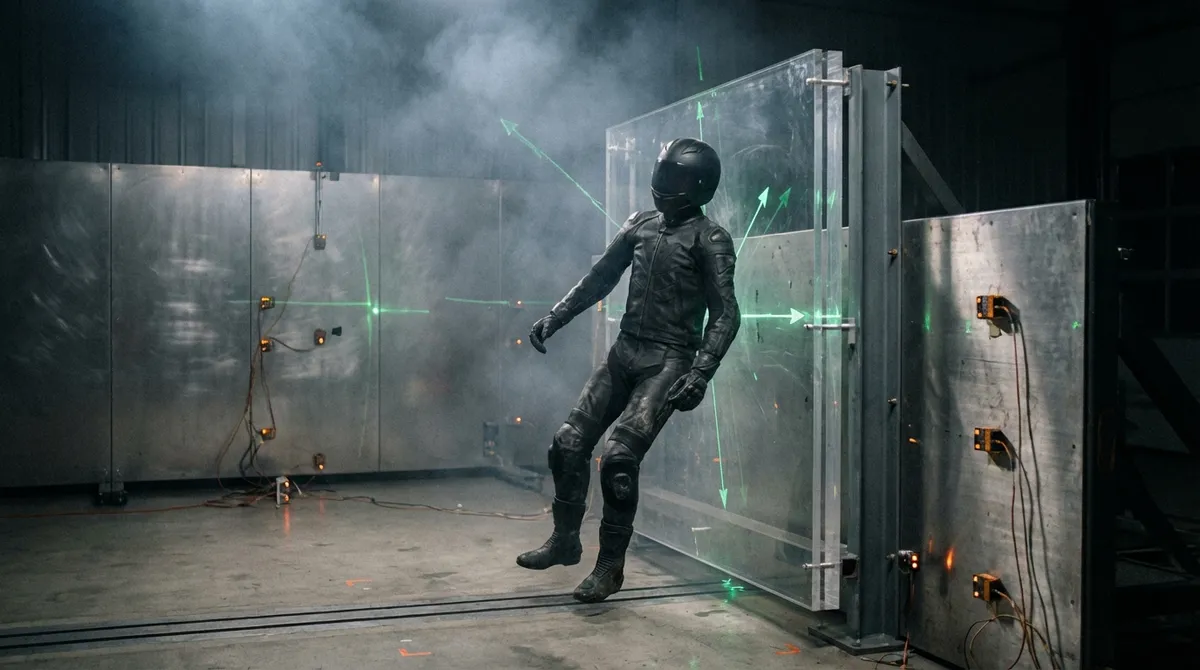
Motorcycle gear isn’t “clothing.” It’s a wearable energy-management system that has to deal with abrasion, impact, torsion, heat, and visibility—all while letting you actually ride the bike. When you stop thinking about jackets and gloves as fashion, and start thinking of them as mobile crash structures and signal amplifiers, your buying decisions change instantly. This isn’t about buying “more gear”; it’s about buying the right systems, built on physics, materials science, and proven certification data.
This breakdown goes past brochure buzzwords and straight into the technical variables that matter when the asphalt is measuring your slide distance in meters, not inches.
Impact Zoning and EN 17092: What the Labels Don’t Explain
Most riders see “CE-approved” and assume that means “good.” It doesn’t—not by itself. Modern apparel in Europe is tested under EN 17092, which classifies garments as AAA, AA, A, B, or C based on abrasion, seam strength, and tear resistance. But what the hang tag doesn’t explain is how your body is split into risk zones and how that should inform your buying choices.
EN 17092 divides the rider’s body into zones (1, 2, 3) with different required performance levels. Zone 1 (high risk: shoulders, elbows, knees, hips, seat, etc.) must withstand the most abrasion and tearing. Zone 2 is medium risk, and Zone 3 is lower risk. A jacket or pant that barely sneaks into an A rating may meet minimum requirements but can still be heavily compromised in Zone 1 materials to hit comfort or cost targets.
The technical move is this: look for AAA or solid AA gear where your personal crash exposure is highest (torso, limbs, seat) and accept lower ratings only where mobility and ventilation matter more. Commuters doing under-50 mph urban runs might rationally choose AA textiles with strong impact armor; high-speed highway and touring riders should seriously consider AAA-level shells or leather in critical zones.
Also, understand that EN 17092 tests single sliding impacts on standardized test rigs—reality includes multi-impacts, curbs, guardrail posts, and rotating limbs. You want margin. If a garment only carries EN 17092-A but has minimal documentation on reinforcement layers, seam construction, and armor coverage, you’re basically trusting marketing copy over measurable data.
Abrasion and Textile Physics: Beyond “Cordura vs Leather”
Abrasion protection is about time to failure under friction and pressure—how long the fabric can keep your skin off the road before it wears through. Leather (especially 1.2–1.4 mm full-grain cowhide or kangaroo) still offers exceptional performance, but modern technical textiles have closed some of the gap through engineered blends and layered construction.
The core variables:
- Denier (D): Higher denier generally means thicker, stronger threads. 500D Cordura is solid; 1000D in impact zones is better, especially when backed with reinforcement.
- Fiber type: Nylon 6,6 (e.g., Cordura), aramid fibers (Kevlar, Twaron), UHMWPE (Dyneema, Spectra), and advanced polyesters all have different melt points, stretch characteristics, and abrasion behavior.
- Coatings and weaves: Tight, high-density weaves and strategic PU coatings can prevent “bursting” and fiber melting during a slide, keeping the outer shell intact long enough for the underlying layers to share the load.
A highly technical approach is to think in terms of layered energy pathways. Ideal construction in high-risk zones might look like:
Tough outer shell (1000D Cordura or leather, or high-UHMWPE blend)
Backing layer (aramid or similar) to add abrasion depth and stop tearing once the outer shell is compromised
Mesh or liner that keeps armor correctly located relative to your joints and bones under torsion and impact
Textiles can match or exceed lower-grade leathers if the layering and materials are engineered properly. But single-layer fashion “moto” jeans with random Kevlar patches are not the same as purpose-built, fully lined, motorcycle-rated denim with UHMWPE/aramid blends rated under EN 17092 at AA or AAA. Look for lab-tested, documented performance—not just the word “Kevlar” thrown into the description.
Impact Armor as a System: CE Levels, Thickness, and Fitment
Armor is not a checkbox; it’s a mechanical interface between kinetic energy and your skeletal structure. CE armor is typically classified under EN 1621-1 (limbs) and EN 1621-2 (back), with Level 1 and Level 2 options. The numbers matter:
- Level 1: Max transmitted force up to 35 kN, with an average usually under 20–25 kN.
- Level 2: Max transmitted force up to 20 kN, with a lower overall average—meaning more impact energy is absorbed by the armor, not your bones.
Impact armor materials like viscoelastic foams (D3O, SAS-TEC, etc.) stiffen momentarily under high-speed load, spreading and attenuating energy before it reaches you. But three technical details decide whether that armor works when you actually hit something:
- Coverage geometry: Armor must actually cover the anatomical structures at risk—think the full length of the elbow joint and the ulnar bone, or hip cups that extend forward and slightly down, not just a tiny oval patch over the greater trochanter.
- Stability under rotation: A loose jacket or oversize pants will let pads rotate away during a slide or tumble. Adjusters, proper sizing, and internal pockets that “trap” armor in place matter as much as the armor rating itself.
- Back and chest as a pair: Many jackets include back protector pockets but no chest protection. Chest injuries (rib fractures, internal trauma) can be catastrophic even in relatively moderate-speed crashes. Using both a Level 2 back protector and proper chest armor dramatically improves your energy management in frontal impacts.
For riders who push hard or ride in high-risk environments (busy urban traffic, high-speed touring, canyon work), Level 2 armor with full coverage—and ideally some kind of rib or side protection—isn’t overkill. You’re building a human crash cage; partial coverage defeats the point.
Thermal and Moisture Management: The Hidden Safety Factor
Comfort isn’t just a luxury; it’s a cognitive performance variable. Overheated or soaked riders suffer from reduced reaction times, poor decision-making, and faster fatigue—direct pathways to mistakes. Your gear has to act as both insulation and a controlled exhaust system.
Technically, you’re managing:
- Convection: Moving air across your body to strip heat.
- Conduction: How quickly heat moves from skin through layers into the external environment.
- Evaporation: How efficiently sweat can phase-change from liquid to vapor and exit the system.
High-end motorcycle gear uses membrane technologies (GORE-TEX, eVent, proprietary PU membranes) and/or laminated shells to control water ingress while still allowing vapor to escape. The important distinction is:
- Drop-liner construction: Waterproof membrane hangs behind the outer shell. Cheaper and often more comfortable initially, but the outer shell can soak (“wet-out”), increasing weight, reducing breathability, and cooling you excessively at speed.
- Laminated construction: Membrane is bonded to the outer shell. Water beads off, the jacket doesn’t become a sponge, and drying times are significantly reduced. More expensive, but technically superior for extended wet or variable-weather riding.
Pair this with base layers engineered for wicking (synthetic or merino blends) rather than cotton. Cotton holds moisture against the skin, compromising evaporative cooling in heat and amplifying conductive heat loss in cold. In other words, the wrong T-shirt under a $1000 jacket can sabotage the entire system.
Hot-weather mesh gear should be scrutinized for its impact-zone materials. Full-mesh shells in Zone 1 with no reinforcement are thermally comfortable but mechanically fragile. A more technical solution is hybrid gear: high-flow mesh in low-risk zones, with robust textiles or leather overlays in elbows, shoulders, seat, and knees. Always ask: where will this gear fail first under friction and load?
Ergonomics, Biomechanics, and Active Control Interface
Your gear doesn’t just protect you when you crash; it alters how you ride before you ever go down. Ergonomics and biomechanics determine how easily you can control the motorcycle under load, at full lean, and during emergency inputs.
Critically, you want gear that:
- Preserves joint range of motion: Stretch panels, articulated knees and elbows, and accordion zones let you move without fighting the garment. If your jacket binds when you look over your shoulder or your pants pull when you stand on the pegs, you’re losing critical micro-movements.
- Maintains grip integrity: Gloves need high-friction yet tactile palms that still protect against abrasion and scaphoid injury. Look for palm sliders (hard or semi-hard inserts at the heel of the palm) that prevent your hand from digging in and twisting the wrist during a slide.
- Controls bulk at high speed: Excess fabric flapping at highway speeds isn’t just annoying; it can cause fatigue and subtly pull you out of position. Proper fit, volume adjusters, and cinch points at the arms, waist, and legs keep the garment stable in the airstream.
- Interfaces with boots and helmet cleanly: Pants should overlap boot tops without bunching or leaving exposed skin when seated. Jacket collars should seal without pressing the helmet uncomfortably forward or restricting head check rotation.
From a technical riding standpoint, compromised fit equals delayed inputs. If you hesitate because your glove fingers are too long, or your shoulders are fighting tight armor pockets when you countersteer, those milliseconds add up. The most “protective” gear on paper can become a liability if it degrades your control fidelity.
When possible, evaluate gear in a ride posture: on a bike, on the centerstand, or even sitting on a similar-height stool while mimicking full lock steering, hard braking, and shoulder checks. You’re not purchasing for the mirror; you’re purchasing for what happens at 60 mph on a decreasing-radius exit.
Conclusion
Motorcycle gear is applied engineering, not lifestyle decoration. You’re assembling a modular impact and abrasion mitigation system around your body—one that also has to keep you cognitively sharp, thermally stable, and fully in command of the motorcycle. Paying attention to standards like EN 17092 and EN 1621 is the starting point, not the finish line. The real power comes from understanding how textiles, armor, ergonomics, and thermal management interact as one kinetic armor package.
When you choose gear, think in terms of zones, layers, pathways, and interfaces: where the energy will go, how the materials will behave, how your body will move, and how long the system can hold together before failure. Build your kit like an engineer, not a catalog shopper—and then go ride hard, knowing the numbers are stacked more in your favor.
Sources
- European Committee for Standardization – EN 17092 Overview - Technical framework for protective garments for motorcycle riders, including zones and performance classes
- European Commission – Protective Equipment and CE Marking Guidance - Explains how PPE regulations and CE standards apply to motorcycle gear
- Gore-Tex Professional – Motorcycle Garments Technology - Detailed information on laminated vs. drop-liner waterproof/breathable constructions and their performance
- DuPont Kevlar – Applications in Protective Apparel - Technical background on aramid fibers used in abrasion- and cut-resistant motorcycle textiles
- National Highway Traffic Safety Administration (NHTSA) – Traffic Safety Facts: Motorcycles - Data and research on motorcycle crashes and injury mechanisms, relevant to understanding the role of protective gear
Key Takeaway
The most important thing to remember from this article is that this information can change how you think about Gear & Equipment.