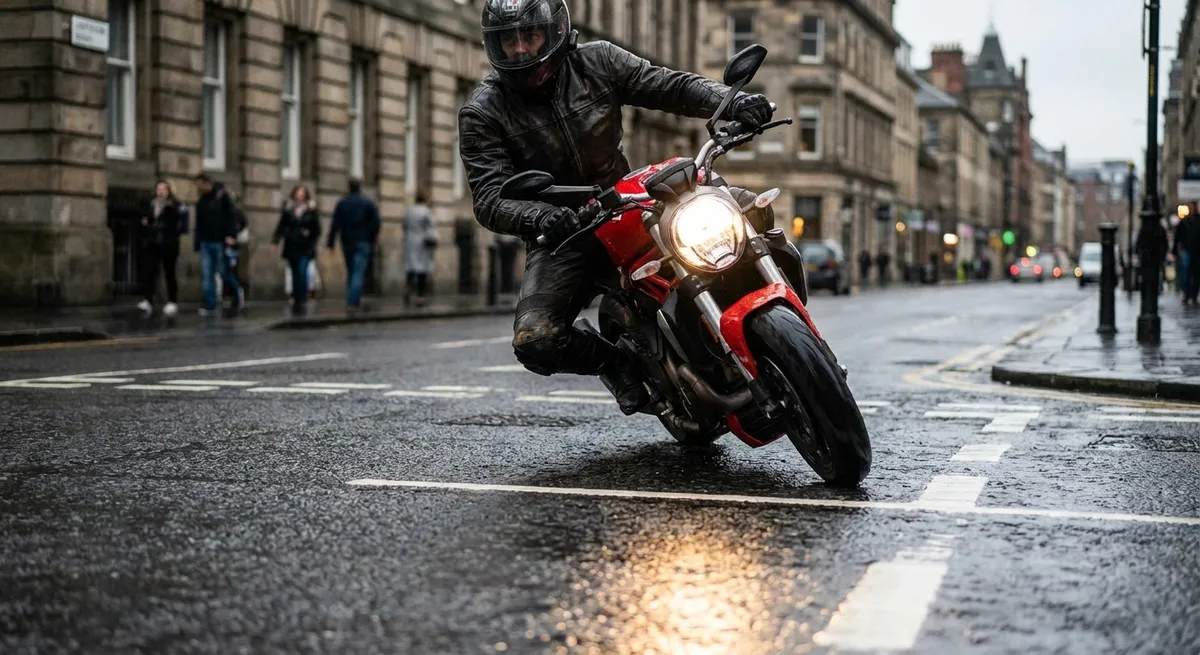
Most riders focus on speed, lean angle, or “confidence.” The riders who actually feel plugged into the bike and the road are obsessing over something else: line control. Not just which line you choose, but how precisely you build, hold, and correct that line with tiny, technical inputs. This is where street riding becomes engineering in motion—where every finger, toe, and muscle is doing data processing at 60 mph.
This isn’t about being the fastest. It’s about being the rider whose bike always seems stable, predictable, and unflustered—even when the road throws a surprise. That’s line control, and you can engineer it into your riding.
Below are five deeply technical points to tighten your street craft and make every corner feel deliberately constructed, not accidentally survived.
1. Engineering the “Setup Zone”: What You Do Before Turn-In
Most riders enter a corner still “busy”: rolling off the throttle, maybe still closing the brake, moving their eyes, shifting their body. The bike feels vague not because of speed, but because the chassis hasn’t been given time to stabilize. The pros obsess over the setup zone—the last 1–3 seconds before turn-in—because that’s where line quality is actually built.
Technically, you want the bike steady-state at turn-in:
- Speed fixed: You’ve finished your major braking before you ask the bike to lean.
- Gear selected: No surprise downshifts while already committed to lean.
- Contact patches settled: Your load transfer front-to-rear has slowed down, not spiking while you flick the bike.
Think in terms of states, not actions:
- Braking state: You’re upright, decelerating, vertical tire load high at the front.
- Transition state: You smoothly release brake pressure while beginning lean.
- Cornering state: Brake is off or feathered, throttle is neutral-to-slightly-open, and lean angle is increasing.
If you’re still hauling on the brakes at turn-in, your contact patch is overloaded and your margin for error shrinks. If you’re done with everything too early, you might spend too long coasting, which makes the bike vague and hard to place.
Train this deliberately:
- On a familiar corner, pick a visual “setup marker” (paint stripe, sign, patch).
- Aim to have speed, gear, and body position sorted by that marker.
- From that point to turn-in, you’re not “doing” much—you’re letting the chassis settle.
The feeling you’re after: when you tip the bike in, nothing feels rushed. You’re not reacting; you’re executing a preloaded plan.
2. Throttle as a Geometry Tool, Not a Speed Pedal
Throttle isn’t just about acceleration. On a motorcycle, it’s a geometry control—it changes how the chassis sits, how the suspension is loaded, and how much grip the tires can generate.
Technical breakdown:
- Roll-off / decel: Weight moves forward, front forks compress, reducing rake and trail. The bike turns more easily but the front tire is more heavily loaded.
- Neutral throttle: Weight distribution starts to even out; you’re not asking much acceleration or decel from the tire, which maximizes directional grip.
- Gentle roll-on: Rear suspension squats slightly, rake and trail increase, and the bike stabilizes. The front unloads a bit, which can make the steering lighter but more stable at a given lean.
In cornering, the “shape” of your line is massively influenced by these small shifts:
- If your line is running wide, riders often instinctively chop throttle, pitching weight forward. That can tighten the line, but it also destabilizes the chassis and may over-stress the front tire if done abruptly at lean.
- If you’re too tight or turning in too sharply, micro roll-on can let the bike track a slightly wider, more stable arc without adding much speed.
Technical drill:
- Find a long, open, constant-radius corner.
- Ride it several times focusing only on fine throttle changes:
- One lap with constant neutral throttle.
- One lap with a very gentle roll-on through the entire arc.
- One lap where you deliberately tighten and widen your line using only tiny roll-offs and roll-ons, avoiding any mid-corner steering corrections.
Pay attention to how 2–5% throttle changes affect line shape. You’re learning to “draw” your path with load transfer instead of violent steering inputs.
3. Vision Bandwidth: Running a Two-Layer Visual System
“Look where you want to go” is beginner-level advice. It’s not enough at speed. Advanced line control comes from managing two visual layers at once:
- Macro vision (far field): About 4–7 seconds ahead—where the road is going, where your exit is, what the radius is doing.
- Micro vision (near field): About 1–2 seconds ahead—surface quality, manhole covers, gravel dust, slick tar snakes.
Think of it as running two data streams:
- Macro tells you: “This is a tightening-radius right-hander that opens onto a short straight.”
- Micro tells you: “There’s a patched section mid-corner; grip will change just as I increase lean.”
Technically, your brain has limited bandwidth. If you lock onto the near field (right in front of the wheel), you ride reactively and late. If you stare too far ahead, you miss the texture cues that determine real grip.
To train the two-layer system:
- On a straight, soft-focus your eyes so you can see both the horizon and the pavement 15–20 meters ahead in peripheral vision.
- Enter a corner with deliberate “macro first”: identify the exit and general corner shape early.
- Then pulse your attention briefly to the near field: road texture, debris, cambers, shiny surfaces (often wet or polished), dark patches (possible oil or tar).
Over time, this becomes automatic: your eyes start scanning in a pattern like a radar sweep, not locked on one spot. The result is smoother line choice, earlier problem detection, and fewer mid-corner surprises.
4. Steering Inputs: Building Precision at the Bars and Pegs
Most riders steer harder than they need to and then fix the consequences mid-corner. Line control is about making the initial steering input clean, decisive, and appropriately sized, then letting the bike track.
Key technical elements:
- Countersteering magnitude: The bar force you apply dictates how quickly lean angle builds. Too abrupt and the chassis “snaps” to lean, unsettling suspension. Too gentle and you end up wide or rushed.
- Steering timing: Turn in too early and you fight the line mid-corner. Turn in too late and you’re forced into more lean than necessary to make the apex.
- Peg weighting: Pressure on the inside peg can help the bike lean and feel more “supported” underneath you; pressure on the outside peg improves feedback and stability. The goal isn’t to twist the chassis, but to help your body/bike system act as a single, stable mass.
Try this structured exercise:
- On a gentle, clear bend, focus on one clean steering input:
- Apply deliberate bar pressure to initiate lean.
- Once leaned, relax your arms slightly and let the bike track.
- Use only micro throttle and body pressure to refine the line.
- Next pass, experiment with slightly earlier turn-in with less steering force and then slightly later turn-in with more steering force.
- Feel how the combination of when and how hard you steer determines the entire arc of the line.
You’re building an internal “map” that says: for this corner speed and radius, this is how much and when I steer. That predictability is the heart of confident line control.
5. Body Position as a Stability System, Not a Style Choice
Hanging off, staying neutral, moving your upper body—these are not fashion decisions; they’re tools to manage lean angle, traction margin, and line stability.
Technical principles:
- Moving your torso to the inside of the corner reduces the lean angle required for a given speed and radius, all else equal. A few degrees less lean can mean a measurable increase in grip margin.
- If your body stays rigidly centered while the bike leans underneath, the combined center of mass is higher and more vertical over the tires, demanding more tire edge grip.
- Poorly executed body movement (jerky, late, or unsupported) destabilizes the bike right when you need stability the most.
For street riding, you don’t need full race-crouch body position, but you do benefit from:
- Sliding your upper body slightly inside and forward before turn-in.
- Keeping your outside knee anchored into the tank, creating a stable lower-body “hook.”
- Relaxing your inside arm so the bar isn’t being pulled or pushed unintentionally mid-corner.
Structure a simple progression:
- On a familiar sweeper, ride one lap completely neutral, minimal body shift.
- Next pass, before turn-in, move your chest slightly inside (toward the mirror) and keep your head roughly in line with the inside bar-end.
Notice:
- Does the bike need slightly less lean for the same speed and line? - Do your bars feel lighter and more precise mid-corner? - Does it feel easier to correct minor line deviations with small inputs, not big rescues?
You’re not trying to “look fast.” You’re trying to engineer margin: less lean for the same line, more grip in reserve for surprises.
Conclusion
Great street riding isn’t magic, and it isn’t bravery. It’s a technical discipline built from thousands of tiny decisions: when you stabilize the chassis, how you use throttle to sculpt geometry, how your eyes process the road, how cleanly you steer, and how your body position supports the tires.
Line control is where all of that converges.
When you start treating each corner as a design problem—not just “make it through,” but construct the cleanest, most stable line with the least drama—your riding changes. The bike stops feeling like something you’re surviving and starts feeling like a machine you’re co-engineering with the road itself.
Share this with the riders you actually trust to push themselves. Then go find a familiar loop and re-ride it with these five points in mind. You’ll feel the difference in the very first corner.
Sources
- MSF – Motorcycle Safety Foundation: Cornering - Official guidance on street riding techniques including cornering, visual strategies, and line choice.
- California Superbike School – The Art of Cornering - In-depth performance riding concepts on throttle control, steering, and body position.
- UK GOV – Enhanced Rider Scheme Overview - Government-backed advanced riding framework emphasizing planning, observation, and machine control.
- BMW Motorrad – Riding Tips: Cornering - Manufacturer perspective on safe, efficient cornering techniques and bike dynamics.
- Honda Powersports – Cornering Tips - Practical advice from a major OEM on vision, throttle use, and body position in turns.
Key Takeaway
The most important thing to remember from this article is that this information can change how you think about Riding Tips.