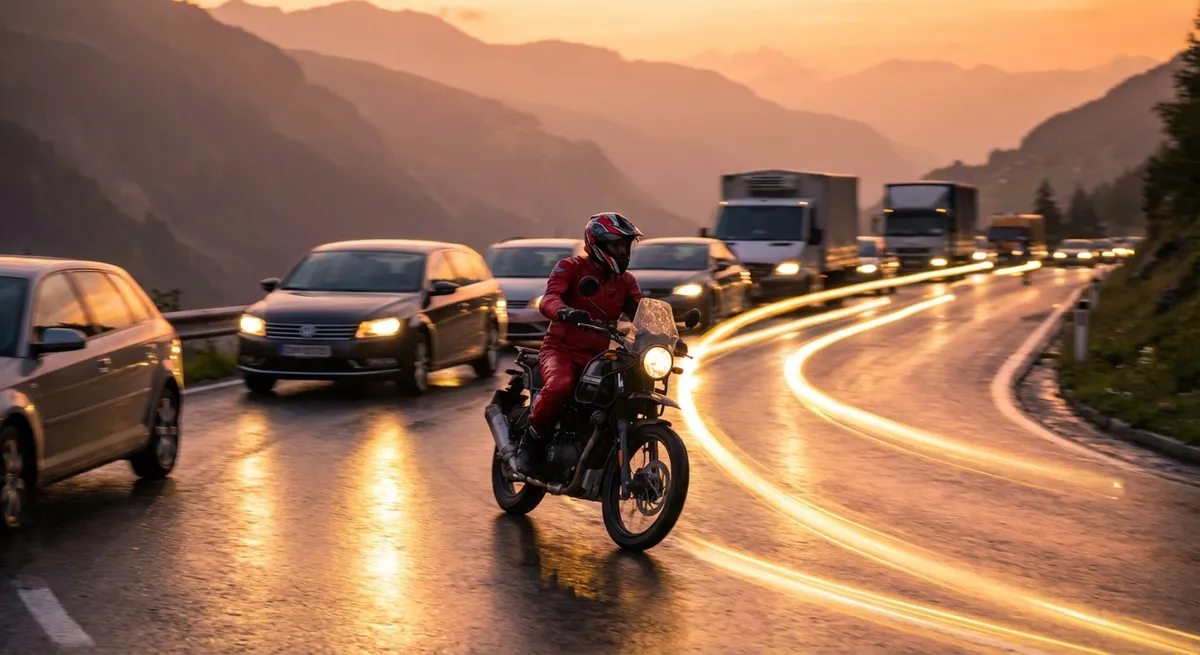
Riding in real traffic isn’t chaos—it’s a moving equation. Every lane, every gap, every brake light is a variable. Once you start treating line selection as an engineering problem instead of a vibe, your riding becomes smoother, safer, and a lot faster without feeling rushed. This is where technical riding lives: in the tiny decisions you make 300 times on a 20-minute ride.
Below are five technical, road-focused riding concepts that will immediately change how you process the street.
1. Visual Bandwidth: Training Your Eyes Like a Sensor Array
Most riders “look ahead.” Not enough riders manage what they’re looking at and how long they stare at it.
Think of your vision as a sensor array with limited bandwidth. Every extra second you stare at the car’s bumper ahead is bandwidth you’re not using to read threats 8–12 seconds down the road. On the street, you want layered vision:
- Far field (primary): 8–12 seconds ahead. This is where you read curve radius, traffic compression, brake light “waves,” merging patterns, and surface changes. Your line choice starts here, not at the apex.
- Mid field (secondary): 3–5 seconds ahead. This is where you refine speed, choose lane position, and track target vehicles.
- Near field (tertiary): 0–2 seconds ahead. This is for last-second surface checks, potholes, manhole covers, oil strips, and lane paint.
Technically, you’re managing scan frequency and dwell time. Don’t lock your gaze. Cycle your scan: far → mid → mirrors → instruments (briefly) → far again. Your head moves; your eyes lead. If you’re surprised by things “coming out of nowhere,” your visual loop is either too slow or too narrow.
You’re not just looking—you’re interrogating the environment:
- Do brake lights ahead pulse in sequence? That’s traffic compressing.
- Are shadows hiding surface defects under trees or trucks?
- Are drivers’ head/shoulder movements hinting at a lane change before they use indicators?
Line selection starts in this far visual band. If you’re reacting at the near band, your line is already compromised.
2. Lane Position as a Dynamic Variable, Not a Fixed Preference
Most riders have a “favorite” lane position: left track, right track, or center. That’s a bad habit. Lane position should be treated like a real-time variable you continuously tune based on three inputs:
Visibility (how well you see and are seen)
Surface integrity (how much grip and stability you have)
Escape routes (where you can go if the plan breaks)
Think of each lane as three tracks: left, center, right. You’re constantly solving a three-way tradeoff:
- Left track: Best for visibility past traffic in your lane and often for sight lines in left bends. Higher exposure to oncoming traffic and potential debris at the lane edge.
- Right track: Good for sight lines into right bends and away from oncoming vehicles. Higher exposure to cars merging or opening doors on multi-lane or urban roads.
- Center track: Often worst for traction (oil strip) at intersections, but sometimes best for symmetrical escape options and staying out of blind spots.
Technical riders map lane position to situations, not feelings:
- Approaching an intersection with an oncoming left-turn risk? Shift to a track that maximizes your optical footprint—usually left track in your lane, high-beam off, speed stable, not chopping the throttle. The goal is visual continuity, not drama.
- Overtaking a line of cars? Start slightly shifted in the lane to create a visual corridor past the lead car you’re evaluating. You want eyes on the gap before you commit, not once you’re already accelerating.
- Riding next to trucks or vans? Bias away from their blind spots and turbulent air, but always keep an escape “vector” in mind: shoulder, adjacent lane gap, or clear braking zone.
Lane position isn’t about where you like to ride; it’s about where the math adds up: maximum information, maximum options, acceptable risk.
3. Street Cornering: Building a Line Around Grip, Not Ego
Street cornering isn’t track cornering with speed limits; it’s a different problem. You’re dealing with unknown grip, hidden threats, and variable camber. The technical rider builds a line that protects grip margin first, speed second.
Use a simple but powerful sequence:
- Wide–Early–Smooth Entry: Stay slightly wider on approach to open the corner’s “visual aperture.” You’re not apex hunting—you’re information hunting. Delay your turn-in moment until you’ve seen at least halfway through the bend.
- Neutral Inputs at Max Lean: The more lean angle you’re using, the less throttle, brake, and steering correction you should be throwing in. A good street line aims to have the bike at its highest lean when demand on the tire is most predictable—not when you’re still guessing about the exit.
- Late Apex Bias: On the street, a later apex means you spend more time aligned with the exit, not drifting wide toward the opposite lane or shoulder. It’s margin, not slowness. As your vision confirms a clean exit, feed in throttle progressively to stand the bike up and return grip margin.
Technically, you’re managing the friction circle: your tire only has so much total grip for cornering, braking, and acceleration. Street cornering discipline is about reserving some of that grip for the unknown:
- Gravel in the exit?
- A car over the center line?
- Polished tar snakes mid-bend?
You can’t fully know, so you design a line that doesn’t consume 100% of your available traction. That’s what separates calculated speed from blind luck.
4. Braking as a Gradient, Not an On/Off Switch
Precision braking on the street is less about maximum deceleration numbers and more about controllability across a gradient. You want the ability to shape your deceleration curve, not just slam brakes and hope ABS saves you.
Key technical elements:
- Initial Bite (Set the Contact Patch): The first 10–20% of lever travel is where you seat the tire into the pavement—progressive, not abrupt. You’re loading the front suspension and expanding the tire’s contact patch. Done correctly, the bike feels like it “locks in” to the road rather than pitching.
- Build Phase: As weight transfers forward, available front grip increases. This is where you can apply more braking force without exceeding traction—if you’ve been smooth. You’re essentially “chasing” the growing friction circle as the tire loads.
- Taper Phase: As you approach the speed and location you want, you bleed off lever pressure so the fork can extend slightly before turn-in. You don’t want maximum brake force and maximum steering input to overlap.
On the street, trail braking isn’t about lap times; it’s a control tool:
- Maintaining light brake pressure into the early part of a corner lets you dynamically adjust if the radius tightens or if a car appears.
- The remaining brake pressure is a steering tool, subtly changing geometry (fork compression, rake, and trail) to help the bike turn in with more authority.
Your objective: build a habit where your default emergency response is progressive maximum braking, not panic grabbing. On a clean, straight road, practice staged stops: 60–0 km/h (or 40–0 mph) using varying initial bite and taper rates. You’re calibrating your fingers like a torque wrench.
5. Escape Geometry: Always Knowing Where “Out” Is
Fast riders often think about entry speed. Technical riders constantly think about exit vectors—even when they’re not cornering.
At any moment, you should be able to answer: If this goes bad in the next second, where am I going? That “where” is your escape geometry—a mental model of open space you can occupy quickly.
You build it by always tracking three things:
- Your Primary Path: Where you intend to be in the next 2–4 seconds.
- Your Immediate Lateral Escape: Shoulder, neighboring lane gap, or open space away from the threat.
- Your Longitudinal Escape: The braking distance you have behind the vehicle ahead versus the space behind you.
Examples:
- Following a car closely with another vehicle tailgating you? You’ve reduced longitudinal escape both front and rear. The technical move is to open a bigger gap ahead while simultaneously planning a lateral out—edge of lane, shoulder, or adjacent lane if legal and safe.
- Approaching a multi-lane intersection with cross-traffic risk? Choose a lane and lane position that give you both maximum forward visibility and at least one lateral path that isn’t blocked by curbs, parked cars, or concrete barriers.
- Riding in a group? Staggered formation increases escape geometry—each rider has a cleaner, separate path to brake or swerve without triggering a chain reaction.
Practically, this means you never mentally “commit” to a single line as your only outcome. You ride with a primary plan and a shadow plan: your current line and your instant bailout. That mindset drastically changes how you perceive closing speeds, following distances, and merge points.
Conclusion
Street riding done well feels smooth and almost effortless, but under the surface it’s intensely technical. You’re constantly solving for visibility, grip, and escape options while shaping your line through moving traffic and imperfect roads. When you start treating vision, lane position, braking, cornering, and escape geometry as deliberate variables—not habits—you turn every ride into a high-resolution, controllable system.
The bike is already capable. The real upgrade is in how you process the road.
Sources
- MSF – Basic and Advanced Riding Strategies – Rider training organization with foundational techniques on vision, lane positioning, and braking
- U.S. Department of Transportation – Motorcycle Safety – Data and guidelines on motorcycle risk factors, braking, and visibility in traffic
- UK Government – Motorcycle Riding Techniques (GOV.UK & THINK!) – Official safety campaigns and riding advice focused on real-world traffic scenarios
- Institute of Advanced Motorists – Advanced Riding Tips – Advanced roadcraft approach emphasizing observation, positioning, and planning
- BMW Motorrad Rider Training Concepts – Manufacturer-backed perspective on braking, cornering, and control techniques
Key Takeaway
The most important thing to remember from this article is that this information can change how you think about Riding Tips.