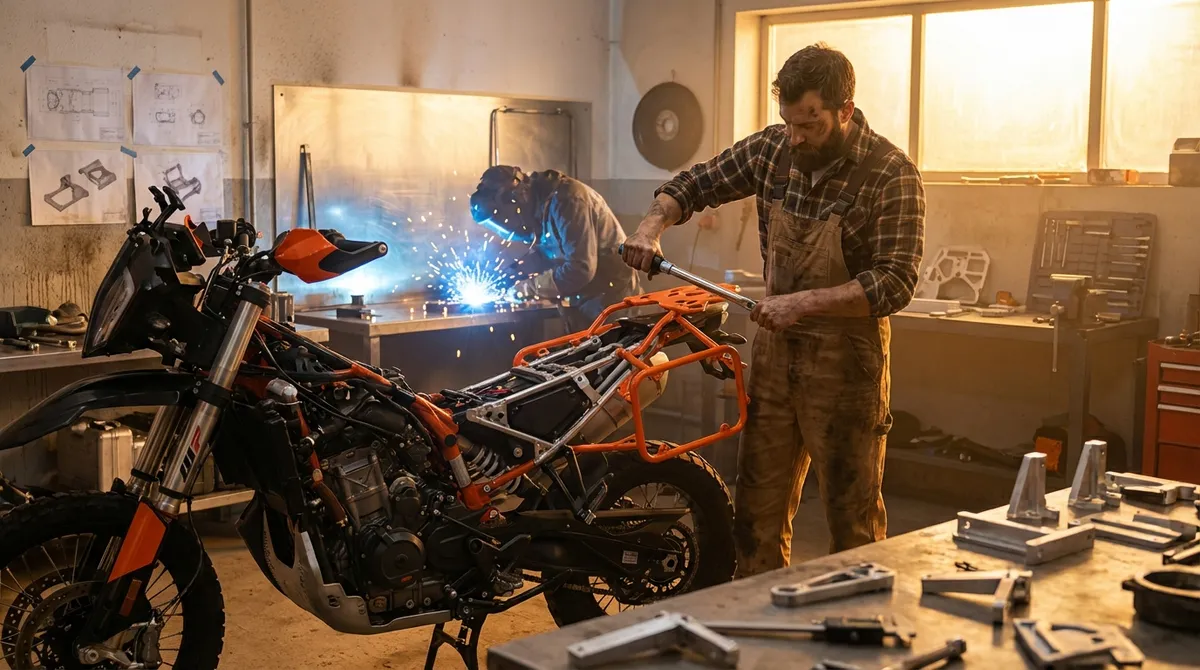
Every rider learns this the hard way: speed is easy, carrying speed with gear is hard. It’s one thing to ride fast and clean on an unladen bike; it’s something entirely different to do it with 40–80 lb of luggage strapped to a chassis never designed for chaos bungees and cheap racks. If your luggage setup is an afterthought, your suspension, aerodynamics, and braking system will all remind you—usually mid-corner, mid-brake, or mid-crosswind. This is where real engineering meets real riders: building a load-bearing system that preserves handling instead of destroying it.
This isn’t about which “adventure” bag looks best on Instagram. It’s about load paths, leverage, torsional stiffness, and how to turn your whole luggage ecosystem—racks, bags, straps, tools—into an integrated system that rides like it belongs on the bike at 30 mph and 130 mph.
Engineering the Load Path: Where Your Luggage Forces Actually Go
Every pound you bolt onto a motorcycle has to transmit its forces into the frame. The question is how and where. A well-engineered luggage system manages the load path—the route that weight and dynamic forces take through the racks, subframe, and main frame—so they don’t overload weak points.
From a technical standpoint, think in terms of:
- Static load: The raw mass of the luggage under gravity.
- Dynamic load: That same mass under acceleration, braking, bumps, and lean transitions.
- Moment arms: How far that mass is located from the bike’s center of gravity (CG) and the mounting points.
Mounting a 30 lb tail bag far behind the rear axle creates a large moment arm. Under acceleration or over bumps, the vertical and longitudinal forces are multiplied at the subframe mounts. Those tiny cast tabs and welds are suddenly dealing with forces they were never designed to handle.
Key technical principles when choosing and mounting luggage:
- Keep the heaviest weight as close to the bike’s CG as possible. This usually means:
- Heavier tools and spares in a low, forward-positioned bag or pannier.
- Lighter, bulky items (sleeping bag, clothing, rain gear) toward the rear and higher.
- Minimize overhang beyond the rear axle. The farther back you go, the more leverage:
- Hard top cases should be as compact as possible if used regularly at highway speeds.
- Tail racks should support weight over or just slightly behind the passenger seat, not hanging way off the tail.
- Respect subframe limitations. Many bikes, especially sport and naked models, have:
- Aluminum or thin steel tube subframes rated for minimal passenger/load.
- Manufacturer maximum load ratings for tail racks or pillion area—pay attention to these numbers.
- Use triangulated mounting points. High-quality rack systems:
- Tie into multiple frame locations to spread load.
- Use cross-bracing between left and right sides to reduce twisting.
If a rack uses one or two small tabs on each side with no cross-brace, it’s not just about luggage security; it’s about how much torsional stress that system is feeding into a concentrated area when you hit a pothole at 70 mph. A well-engineered system turns your luggage load into distributed force, not point loading.
Hard vs. Soft Luggage: Structural Behavior at Speed
The “hard vs. soft” luggage debate usually gets reduced to convenience and security. From an engineering perspective, there’s a deeper question: how does the luggage structure behave under impact, vibration, and aerodynamic load?
Hard Luggage: Structural Boxes on a Dynamic Frame
Hard cases (aluminum or plastic) are semi-rigid structures bolted to a flexible frame (the motorcycle):
- Pros (technical):
- Maintain shape under aerodynamic load, so they’re predictable at speed.
- Can be mounted to racks with precise, repeatable interfaces (less play, less wobble).
- Distribute local forces across the case wall instead of point-loading soft material.
- Cons (technical):
- Underside mounting points can become single-failure interfaces—snap a rack mount and the whole case is compromised.
- A rigid box in a crash transmits more impact force to the frame and rider.
- Large, squarish side cases increase frontal and side area, amplifying crosswind and turbulence-induced yaw moments.
On high-speed touring bikes, well-shaped hard luggage is engineered into the aero package (some OEM systems are tested in wind tunnels). On a smaller bike with aftermarket boxes, you are potentially bolting drag walls and side sails to a chassis never aerodynamically tuned for them.
Soft Luggage: Distributed Loads with Deformable Geometry
Soft bags are deformable bodies; they move with the bike and terrain:
- Pros (technical):
- Better at absorbing impact energy in a crash instead of transmitting it directly.
- Conform around irregular loads, spreading pressure more evenly if mounted correctly.
- Typically lighter, improving sprung mass distribution and reducing inertia around the roll axis.
- Cons (technical):
- If poorly strapped, they can shift the CG mid-corner or during braking.
- They can sag and contact the wheel, chain, or exhaust if you don’t manage clearance.
- Aerodynamically messy—not necessarily more drag than boxes, but more unpredictable shape under wind load.
For aggressive riding or mixed on/off-road travel, quality soft luggage with a semi-rigid backing or support frame is a strong hybrid: flexible in a crash, but stable under load and wind.
The decision isn’t just “hard or soft”—it’s how the bag integrates structurally and aerodynamically with your specific motorcycle and riding speed.
Aerodynamics and Stability: How Luggage Steals (or Saves) Your High-Speed Confidence
Add luggage, and you’re not just adding weight—you’re redesigning the bike’s aero profile. At speed, aerodynamic forces scale roughly with the square of velocity. Double your speed, and the aero load on those panniers is roughly four times higher.
Key technical points for high-speed stability with luggage:
Side Area and Yaw Sensitivity
Wide panniers and tall top cases increase side area, making the bike more sensitive to crosswinds and truck wake:
- A large side area behind the rear axle acts like a pendulum in yaw.
- When hit by a gust, the force tries to rotate the bike around its vertical axis.
- A shorter wheelbase and steeper rake/trail geometry can feel more nervous in these conditions with luggage.
Choosing narrower, more tapered cases and keeping heavy weight low can significantly reduce this effect.
Wake Interaction and Turbulence
Top cases stacked directly in the turbulence wake behind the rider can:
- Introduce buffeting and vibration to the case and rack.
- Load and unload the rack dynamically, fatiguing mounting hardware.
- Slightly lower or more forward-positioned tail packs.
- Panniers kept tight to the bike, allowing a smoother combined wake.
- Turbulent airflow can produce lift behind the rider.
- This shifts effective load off the rear tire at speed, potentially reducing traction margin under emergency braking.
- Do not oversize your top case “just because.”
- If you must run a tall box, keep its load extremely light—think soft goods, not dense tools.
Aerodynamically better:
Lift and Moment About the CG
Large top cases can act like a wing or spoiler in certain flow regimes:
Practical answer:
Speed-Dependent Packing Strategy
You can engineer your packing for the speeds you actually ride:
- Urban / low speed: Shape and aero are less critical; accessibility matters more.
- Highway touring: Aim for narrow, balanced, symmetric load with minimal rear overhang.
- Spirited twisties: Offload non-essential weight, keep only low, central mass, and avoid tall stacks that shift during rapid transitions.
A well-thought-out luggage setup should allow you to run at legal highway speeds in gusty conditions without a death grip on the bars. If you feel persistent weave or headshake only when loaded, your luggage aero and weight distribution need re-engineering, not just “getting used to.”
Load, Suspension, and Brakes: Tuning the Bike for a Fully Laden State
The bike that feels sharp solo can feel vague, wallowy, or harsh with luggage. That’s not “just how it is”; it’s a signal that your suspension and braking system aren’t tuned for your loaded condition.
Suspension: Sag and Damping for Loaded Riding
Every serious rider should know their sag numbers—both solo and loaded:
- Static sag (bike + luggage, no rider).
- Rider sag (bike + luggage + rider, in full gear).
When you add luggage:
- The rear sag increases, steepening rake and reducing trail at the front.
- The bike can become more nervous in a straight line yet sluggish in transitions because you’re using up travel and skewing the chassis geometry.
Technical action steps:
- Increase rear preload for luggage until your rider sag returns to near your solo baseline (typically ~30–35% of total travel for street).
- If available, add compression damping to control extra mass over bumps and rebound damping so the heavier rear does not pogo or wallow.
Don’t forget the front:
- Hard braking with added rear mass shifts more effective load forward. - If the fork is under-sprung or under-damped, it will dive excessively and kill mid-corner stability.
If you regularly ride loaded, you’re not overkilling it by installing heavier springs front and rear matched to your all-up weight (rider + gear + luggage).
Brakes: Stopping Distance and Thermal Load
Extra mass equals extra kinetic energy to shed under braking. The equation for kinetic energy is \(E_k = \frac{1}{2}mv^2\). Add 20–30% mass with luggage, and your brakes must turn that additional energy into heat.
Implications:
- Your stopping distance increases if you apply the same braking force.
- Brake fade risk increases on long descents or repeated hard stops.
Technical upgrades and practices:
- Use fresh, high-quality brake fluid with a high wet boiling point if you tour in mountains or hot climates.
- Run sintered pads appropriate for your rotor material for better high-temperature performance on most street and ADV setups.
- Inspect rotor thickness and condition more frequently if you’re doing repeated long, heavy, loaded trips.
Luggage isn’t just “stuff on a bike.” It becomes part of the mass and dynamic system that your suspension and brakes must control. If you tune only for your unloaded weekend blast, you’re ignoring the state you probably ride in most often.
Fast, Field-Serviceable Systems: Designing for Real-World Failure Modes
The true test of a luggage system is not how it looks in your garage; it’s how it behaves when a strap fails in the rain, a rack bolt backs out on a corrugated road, or you need something now in a storm. This is where field-serviceability becomes a technical requirement, not a luxury.
Mechanical Redundancy and Failure Planning
Think of every mounting interface as a potential single point of failure:
- Critical bolts should be:
- Of known grade and appropriate tensile strength.
- Installed with proper torque and, where appropriate, threadlocker.
- Periodically inspected or replaced, especially if aluminum subframes are involved.
- Redundancy by design:
- Use backup straps or safety tethers for tail bags and top cases on long trips.
- Treat any single clamp or hook as “primary retention,” but design in a secondary restraint that prevents catastrophic loss if the primary fails.
Quick Access vs. Structural Integrity
Don’t trade structural stability for convenience:
- Main load-bearing straps should be low, tight, and anchored to the frame or sturdy rack, not to cosmetic plastics or flimsy grab handles.
- Quick-access points (clips, roll-tops, zippers) are for contents, not for structural retention of the entire bag.
For soft luggage, look for:
- Multiple attachment points to control fore-aft and vertical movement.
- A rigid backing or harness that spreads loads across the bag body and rack rather than point loading a single seam.
Tooling and Standardization
From a technical logistics standpoint, your luggage hardware should be:
- Fastened with standardized fasteners that match the bike’s existing hardware as much as possible (e.g., mostly 4, 5, 6 mm hex).
- Serviceable with the on-bike toolkit, without special tools.
This is how you design for real-world issues:
- A loosened pannier mount on the side of the road is a 10-minute fix with a multi-tool, not a multi-hour breakdown.
- A broken strap in the rain is managed with a spare Voile strap or cam buckle because you planned for that failure mode.
If you think about your luggage setup like an engineer—identifying critical points, planning for failure, and validating your design on real roads—you end up with a system that survives not just miles, but abuse.
Conclusion
Most riders treat luggage as an accessory. The reality is harsher and more interesting: luggage is a structural and aerodynamic modification to your motorcycle. Every bag, rack, and strap alters weight distribution, load paths, aerodynamics, suspension behavior, and braking performance. When you start thinking in terms of mass placement, moment arms, triangulated mounts, aero side area, and field-serviceable interfaces, you stop “adding bags” and start engineering a load-bearing system.
The reward is huge: a bike that feels composed and predictable at full load, a chassis that keeps its feedback and precision, and a setup that can be inspected, understood, and repaired with the same confidence you bring to your line choice. That’s the difference between simply carrying gear and being truly Moto Ready—at speed, in weather, and far from home.
Sources
- NHTSA Motorcycle Safety – Motorcycle Components – U.S. government guidance on motorcycle components, loading, and safety considerations
- BMW Motorrad – Luggage Systems – OEM perspective on integrated luggage design, load distribution, and touring setup
- GIVI Tech – Load and Mounting Guidelines – Technical notes on proper mounting, maximum loads, and rack engineering from a major luggage manufacturer
- Adventure Rider – Engineering Discussion on Motorcycle Load and Handling – Community-sourced, experience-backed discussion of how luggage affects handling and stability
- Motorcycle Consumer News (Archived via Rider Magazine) – Suspension Setup for Touring – Detailed explanation of suspension tuning for loaded touring motorcycles
Key Takeaway
The most important thing to remember from this article is that this information can change how you think about Gear & Equipment.