Most riders obsess over power, exhaust sound, and paint. Very few obsess over symmetry—whether the bike is literally wearing out evenly side to side and front to back. But that symmetry is the quiet line between a motorcycle that feels surgically precise at 100 km/h and one that slowly turns vague, vague, vague… until it suddenly bites.
Mechanical symmetry is not sexy. It’s alignment numbers, torque values, sag measurements, and pad thickness. But if you want a motorcycle that tracks like it’s on rails, steers the same left and right, and still feels “tight” at 40,000+ km, this is the discipline that changes everything.
Below are five technical maintenance levers that directly control how evenly your motorcycle wears—and how surgically it responds.
1. Steering Geometry Preservation: Fork Alignment and Triple Clamp Discipline
Steering geometry isn’t just “rake and trail” in the spec sheet; it’s a living system that can drift out of tolerance as soon as the front end is disturbed. Misaligned forks, twisted bars, or uneven triple clamp clamping can give you asymmetric steering, weird turn‑in, and uneven tire wear—long before anything looks obviously “bent.”
Key practices:
- Torque sequence on triple clamps matters. When reinstalling forks, set fork height (exposed tube above top clamp) with a caliper or depth gauge, then torque the triple clamp pinch bolts in sequence and to spec using a calibrated torque wrench. Uneven clamping can bind the fork tubes and change steering feel.
- Check for “self-centering” of the bars. With the front wheel off the ground and steering damper (if any) disconnected or set to minimum, turn the bars 45° left and right and gently release. The bars should rotate smoothly and symmetrically with no notchiness or bias. Any “preferred” direction, stick-slip, or mid-point notch is a problem (head bearings or fork bind).
- Float the axle correctly. On many modern forks, one fork leg locates the axle, and the other is allowed to “float” on the axle before its pinch bolts are tightened. The correct process usually is:
- Install axle and tighten main axle nut to spec.
- Leave one side’s axle pinch bolts loose.
- Compress the forks several times (front brake applied) to let the loose leg self-align.
- Only then torque the pinch bolts to spec.
This reduces stiction and prevents the fork legs from being “forced” into a misaligned stance.
- Measure fork tube parallelism. With the wheel off and the bike supported, you can use a straightedge or precision bar across the fork tubes and feeler gauges to check for parallelism. Anything visibly twisted is unacceptable on a performance-focused bike.
The reward: a front end that glides through its stroke without side-load, steers the same left and right, and doesn’t chew one side of the front tire into a weird scallop.
2. Chain Line Integrity: Sprocket Alignment, Axle Squareness, and Tension Gradient
Enthusiasts talk endlessly about chain lube and cleaning but rarely about geometry—how accurately the sprockets are aligned and how evenly tension is distributed across chain travel. Misalignment is a slow killer: it loads the countershaft bearings, wears the chain unevenly, and can pull the rear wheel out of true tracking.
Technical checks and habits:
- Ignore the stamped swingarm marks. Those little notches on the swingarm are crude references. Use a more precise method:
- Measure from the swingarm pivot to the rear axle on both sides with a tape or, ideally, a laser alignment tool.
- Alternatively, use a straightedge or long alignment tool from rear sprocket to front sprocket and visually inspect chain line.
- Check tension at multiple wheel positions. Rotate the rear wheel and measure chain slack at several points. A “tight spot” indicates uneven chain wear or a slightly eccentric sprocket or hub mounting. Adjust tension to avoid over-tightening at the tightest point, not the average.
- Track sprocket wear patterns. Normal, healthy wear should be symmetric on both sides of each tooth. A hooked pattern on one side or visibly tapered teeth suggest misalignment or chronic over-tightening.
- Verify wheel tracking after tire changes. Whenever a tire is replaced or the rear wheel is removed, re-confirm chain line and axle squareness. Don’t assume the shop nailed it; most are working to speed, not perfection.
Result: a drive system that runs cooler, lasts longer, and avoids that annoying “drivetrain lash + chatter” when you’re picking up the throttle mid-corner.
3. Suspension Balance: Sag, Damping, and Thermal Consistency
A lot of riders fiddle with clickers, but fewer understand that maintenance—oil condition, bushing wear, seal friction—controls whether your suspension actually behaves like the designer intended. If front and rear are aging at different rates, you get dynamic imbalance: one end packs down under repeated hits, the other rebounds too fast, and the chassis pitch oscillates.
Critical maintenance focus areas:
- Set static and rider sag, then lock it in. Suspension isn’t “set and forget.” Every few thousand kilometers, especially if you change luggage or riding style, re‑measure:
- Front and rear rider sag (you in full kit).
- Static sag (bike only).
Springs settling, preload collars loosening, or new gear weight can all throw off the balance.
- Refresh fork and shock oil on time, not when it’s “obviously bad.” Suspension oil degrades thermally and mechanically. As viscosity drops, damping curves shift—usually becoming underdamped and inconsistent with temperature. For spirited street riders:
- Fork oil: often 20,000–30,000 km or 2–3 years, depending on manufacturer guidance and conditions.
- Shock service: many OEM shocks are under-serviced; performance units may need 15,000–25,000 km intervals.
- Monitor clicker symmetry and drift. Count and log your rebound and compression settings in a notebook or app. If you find you’re frequently adding damping at one end to “calm it down,” that’s a flag that oil or internal components may be degrading unevenly.
- Use temperature touch checks after a hard ride. Carefully (and briefly) touch the fork lowers, shock body, and reservoir after a sustained aggressive ride.
- Significantly hotter at one end may suggest that end is doing more work (or working inefficiently).
- Gross temperature disparity, combined with poor feel, can indicate a fading shock or fork oil foaming.
A well-balanced suspension system is what makes your bike feel “light” at speed—stable on the brakes, poised in transition, and predictable when the road gets violent.
4. Brake System Precision: Pad Taper, Rotor Runout, and Hydraulic Consistency
Modern ABS and radial calipers are only as good as the mechanical and hydraulic systems feeding them. The average rider waits until brakes feel “spongy” or squeal loudly; the enthusiast tracks pad symmetry, piston travel, and rotor behavior long before that.
What to monitor:
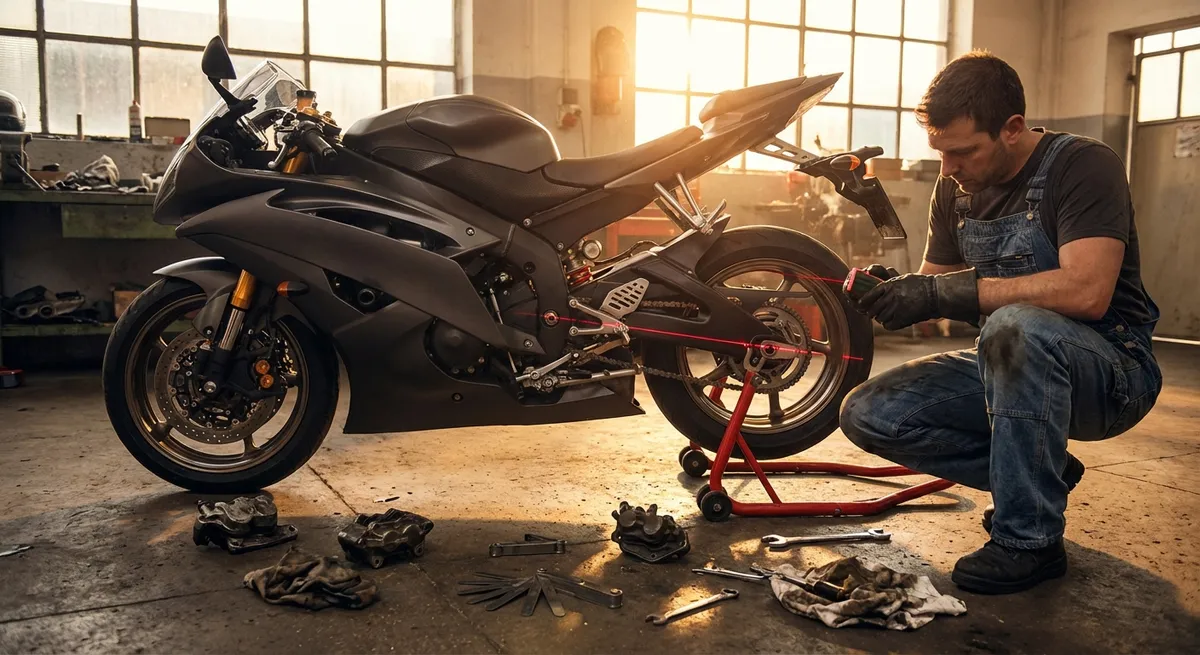
- Pad thickness and taper. Pull the calipers (or at least inspect carefully) and measure pad thickness on inboard and outboard pads, as well as top vs bottom. Significant taper means:
- Caliper misalignment or flex.
- Sticking pistons.
- Caliper not sliding correctly on pins (for sliding calipers).
Tapered pads reduce effective contact patch, create weird bite characteristics, and can accelerate rotor wear on one side.
- Rotor runout and thickness variation (TV). Use a dial indicator to measure:
- Lateral runout: rotor side-to-side wobble as it spins.
- Thickness: check several points around the rotor.
Excessive runout can cause pulsing at the lever and ABS false triggers. Thickness variation usually produces a rhythmic pulsation under braking.
- Regular fluid cycling, not just “flushing.” Brake fluid is hygroscopic; water content lowers boiling point and promotes corrosion. Instead of waiting for a “big flush,” adopt a micro-maintenance mindset:
- Every season or 12–24 months (check manufacturer): full fluid replacement.
- If you ride aggressively in mountains or on track: more frequent intervals.
- Use fresh, sealed containers; never reuse an opened bottle that’s been sitting for months.
- Piston movement symmetry. With pads removed and a block or old pad protecting the pistons, gently pump the brake lever and watch all pistons extend. Stuck or slow pistons cause uneven pad pressure and can create pull or noise. Clean and service as needed (using appropriate brake cleaners and, if required, seal replacement).
Endgame: brakes that are linear, repeatable, and identical in feel from first stop to last, even after descending a mountain pass with luggage.
5. Rotational Balance: Wheels, Bearings, and Dynamic Imbalance Under Load
Many riders think wheel balancing ends when the new tire leaves the machine with a couple of stick-on weights. But real-world rotational balance is a triangle: wheel/tire, bearings, and mounting. Any weakness distorts the feedback you get from the chassis.
Core technical checks:
- Dynamic wheel balancing over static when possible. Static balancing is better than nothing, but dynamic balancing (especially at a shop with a quality machine) accounts for both planes of imbalance. This becomes more critical as speeds rise or if you’re using heavier adventure rubber or luggage.
- Bearing play and smoothness. With the wheel off the bike:
- Spin by hand and feel for roughness or noise.
- Rock the wheel side to side and feel for play.
Even small bearing defects show up as vague steering, wandering lines, and low-speed instability.
- Match-mounting tire to wheel. Most tires have a dot (often yellow or red) indicating light or heavy spots. Proper mounting aligns that mark to the wheel’s valve stem or marked heavy spot. If your shop ignores this, you’re asking the balancer to fight the assembly instead of starting from a better baseline.
- Check balance with real-world accessories. If you run heavy inner tubes, bead locks (off-road), TPMS sensors, or wheel weights, ensure their effect is accounted for in balancing. Don’t assume the added hardware is “negligible” at speed—it isn’t.
- Monitor cupping and scalloping. Uneven tire wear (cupping on front, stepped wear on rear) is diagnostic:
- Cupping often ties back to suspension setup, damping, or underinflation.
- One-sided wear can indicate misalignment or chronic cornering bias.
Treat the tire surface as a plotted graph of your chassis health.
Balanced rotating assemblies reward you with less rider fatigue, clearer suspension feedback, and a front end that communicates grip cleanly instead of buzzing and shimmying.
Conclusion
Maintenance isn’t just changing oil and ticking off service intervals—it’s the continuous pursuit of mechanical symmetry. When your chassis, drivetrain, suspension, brakes, and rotating assemblies are all aligned, balanced, and wearing evenly, the motorcycle crosses a threshold: it stops feeling like a machine you’re managing and starts feeling like an extension of your intent.
You don’t need exotic parts to get there. You need measurements, discipline, and the willingness to go past “good enough” into the millimeter and Newton‑meter details most riders ignore.
Build a habit of inspecting symmetry: left vs right, front vs rear, static vs dynamic. Log your findings. Adjust in small, documented steps. Over time, you’ll feel it—lines that hold with less input, braking that’s glass-smooth, and a bike that, even with real mileage, still feels tight, neutral, and ready.
That’s mechanical symmetry—and it’s one of the purest forms of performance you can buy with time and attention instead of money.
Sources
- [Motorcycle Chassis Design – Motorcycle Safety Foundation](https://www.msf-usa.org/downloads/Motorcycle_Operator_Manual_English.pdf) – Official MSF materials covering basic chassis dynamics and control
- [Kawasaki Service Manual Library](https://www.kawasaki.com/en-us/owner-center/service-manuals) – OEM service procedures, torque specs, and alignment/maintenance practices for Kawasaki motorcycles
- [Yamaha Motors – Owner’s Manuals and Service Information](https://www.yamahamotorsports.com/motorsports/pages/owner-s-manuals) – Factory guidance on suspension service intervals, brake fluid replacement, and chassis checks
- [US National Highway Traffic Safety Administration (NHTSA) – Motorcycle Safety](https://www.nhtsa.gov/road-safety/motorcycles) – Safety-focused information on motorcycle maintenance and performance-critical systems
- [Motorcycle Mechanics – MIT Vehicle Engineering Lecture Notes](https://ocw.mit.edu/courses/2-972-motorcycle-mechanics-fall-2004/) – Educational material on motorcycle dynamics, suspension, and mechanical systems from MIT OpenCourseWare
Key Takeaway
The most important thing to remember from this article is that this information can change how you think about Maintenance.