Every ride is a live-fire experiment in physics, traction, and human bandwidth. The road doesn’t care how many YouTube tutorials you’ve watched—it cares how precisely you can place your mass, your contact patches, and your attention in space and time. This isn’t about “riding smooth” as a vibe; it’s about understanding the mechanics behind control so your bike does what you ask when everything gets noisy: crosswinds, blind crests, surprise gravel, and distracted drivers.
This guide breaks down five technical riding concepts that pay off immediately on the street. No buzzwords, no fluff—just hard leverage points you can apply the next time you thumb the starter.
1. Steering Torque and the “Latency Window” in Your Inputs
Countersteering isn’t just “push right, go right.” It’s about how much torque, for how long, and with how much delay you build between your intention and the bike’s reaction.
Every steering input has a latency window:
- Time for your brain to decide
- Time for your muscles to apply torque
- Time for the front tire to develop a slip angle
- Time for the chassis to roll to a new lean angle
- You’re avoiding a pothole at 60 mph (you cover ~88 ft per second)
- You’re finishing a pass before an oncoming car
- You misjudge a decreasing-radius corner entry
On a modern street bike, from the moment you decisively push the bar to the point the bike is settled in a new lean can be around 0.3–0.6 seconds, depending on speed and how assertively you steer. That delay matters when:
To build precise steering torque control:
- Anchor your outside arm and torso.
Lock your outside elbow lightly into your side and keep your torso stable. You want the steering torque to be deliberate, not smeared by your body wobbling around.
- Use firm, short steering pulses.
Instead of a vague push, apply a clean, decisive bar input over about 0.2–0.4 seconds, then release. The goal is to “rotate” the bike to your desired lean and then let it run neutral.
- Feel for “zero-torque” steady state.
Once you’re in the turn, there should be minimal bar pressure. If you’re death-gripping the inside bar, you’re either:
- Fighting your own body weight on the bars, or
- Forcing the bike into a line the chassis/geometry doesn’t naturally want to hold
- Practice timing, not aggression.
At moderate speed in a safe, open area, pick a visual reference and practice initiating the turn earlier, not harder. Learn how 0.3 seconds of earlier input feels versus 0.3 seconds of delay. The road rewards timing more than brute force.
Mastering steering torque and latency transforms emergency maneuvers from panic-twitches into controlled, repeatable actions. You stop “reacting” to corners and start placing the bike where it needs to be—on your schedule.
2. Vertical Load Management: Braking and Throttle as Suspension Tools
Most riders think of brakes and throttle as “speed controls.” Technically, they’re vertical load controls first—tools that shape how much force your tires and suspension are handling at any instant.
Your bike has a limited grip budget. That budget is spent on:
- Longitudinal forces (braking/acceleration)
- Lateral forces (cornering)
- Small overhead for surface irregularities (bumps, ripples, gravel)
When you abruptly change throttle or brake pressure, you’re not just changing speed—you’re lifting or dropping vertical load on the contact patches and forcing the suspension to rapidly re-allocate work.
Key principles:
- Load transfer is not binary.
Under braking, you’re shifting weight forward, but not “onto the front tire only.” You’re biasing the vertical load toward the front, which:
- Compresses the fork
- Shortens wheelbase
- Steepens rake/trail
- Increases front-tire grip and sharpens turn-in… until you overload it
- Entry braking sets cornering posture.
- Keeps the fork slightly compressed for sharper steering
- Gives predictable geometry as you initiate the turn
- Smooths the transition of vertical load to the front tire
- Throttle as a “load stabilizer.”
- Slight roll-on reduces fork dive
- Shifts a bit of load back to the rear
- Lets both tires share the grip budget more evenly
- Avoid “vertical jolts.”
Instead of finishing all braking upright, use a controlled, tapering brake release into the early part of the lean (“trail braking”). This:
Once leaned, your initial throttle isn’t about acceleration; it’s about stabilizing vertical load:
Abrupt roll-off mid-corner unloads the rear and spikes front load—exactly when the front is already busy handling lateral forces. That’s how front washouts start on imperfect surfaces.
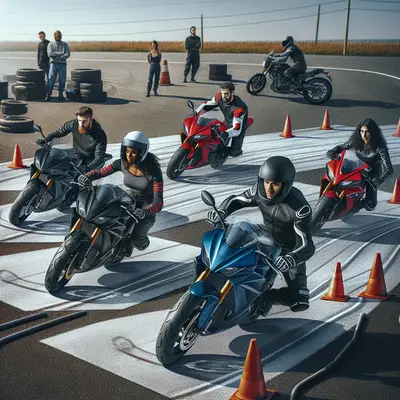
Practice in a safe environment:
- Brake progressively harder in a straight line and feel how the fork compresses
- Then, repeat while gradually releasing the brake into a shallow turn
- Finally, add a micro-throttle roll-on mid-corner and feel the bike settle
When you treat brakes and throttle as vertical-load sculpting tools, the bike stops feeling twitchy and starts feeling planted—even when the pavement isn’t.
3. Line Adaptation: Building “Plan B” Geometry for Unknown Corners
On real roads, you rarely get a textbook view through the entire corner. Trees, guardrails, elevation changes, and oncoming traffic clip your sight lines. Riding fast safely is not about picking one “perfect line”—it’s about choosing a line that preserves options when the unknown shows up.
Think of your corner approach as designing Plan A, with built-in Plan B:
- Entry position: bias for sight line, not just radius.
Conventional advice says “wide–apex–wide,” but on the street, the priority is seeing further:
- Move laterally in the lane to maximize your view past the corner’s inside obstruction
- On a right-hand corner (LHD traffic), avoid hugging the center line if sight lines are poor; that’s where opposing vehicles drift wide
- On a left-hand corner, you may run slightly more “inside” initially if it opens your view earlier
- Speed by sight distance.
- If you can’t stop before the edge of what you can see, you’re trusting luck, not geometry
- This is especially critical over crests and around blind hairpins
- Plan B line: extra lean and radius margin.
- Lean angle margin: don’t run at your personal limit; hold 10–20 degrees in reserve
- Line margin: position so you can tighten your line if:
- The corner tightens unexpectedly
- There’s gravel, water, or a stopped vehicle near the exit
- If you’re already near the road edge with lots of lean, your Plan B is gone
- Commitment point awareness.
- You’ve seen at least the corner apex
- You’ve validated there’s no blocking hazard mid-corner
- You know whether the turn opens, closes, or stacks into another
- On a familiar twisty road at conservative speeds, ride a section focusing only on:
Your corner speed should always be less than what you can safely abort within your visible, guaranteed clear distance:
As you turn in, leave yourself:
Every corner has a moment where changing your plan becomes expensive or impossible. On the street, you want that commitment point to be as late as possible, after:
Training drill:
“Where is my true Plan B right now?”
If the answer is “I don’t have one,” adjust your entry position and speed next time through.
This mindset shifts you from “can I make this?” to “how many safe options do I have if it’s worse than it looks?”
4. Crosswind and Turbulence Control Through Mass Distribution
At highway speeds, wind isn’t a background annoyance—it’s a serious lateral and yaw input to the chassis. Trucks, open plains, bridges, and coastal roads can all suddenly re-write your effective steering environment.
Instead of fighting the bars, manage your mass and the bike’s profile:
- Reduce your aerodynamic steering moment.
Strong crosswinds apply force mostly above the bike’s center of mass:
- Tuck your shoulders and elbows
- Keep your knees tight to the tank
- Avoid sitting bolt upright like a sail
- If you have soft luggage, pack it as compact and low as possible
- Widen your stance, narrow your grip.
- Your legs stabilize the bike’s main mass
- Your arms act as dampers, not struts
- A slightly narrower grip angle can reduce your tendency to over-correct steering inputs from gusts
- Preload a mild countersteer in steady crosswinds.
- You’ll ride with the bike leaned slightly into the wind
- That’s normal; don’t try to “straighten” the bike if the setup is stable
- The mistake is over-correcting every micro-gust instead of allowing the chassis to self-stabilize
- Truck wake strategy.
- Expect buffeting and a brief suction effect toward/away from the truck
- Keep a neutral but ready bar grip; don’t lock your elbows
- Make the pass decisively: don’t linger alongside the vehicle where turbulence is worst
- Maintain a smooth, low-frequency correction—avoid choppy input that compounds the buffeting
- Avoid mixing panic braking with gust response.
- Load the front in a moment of lateral instability
- Make the chassis pitch forward while yaw is changing
- This combination feels far worse than either alone
Use a strong lower body clamp on the tank and pegs while relaxing your upper body:
In a constant side wind, allow a small, steady bar pressure:
When passing or being passed by large vehicles:
A sudden gust plus an abrupt brake grab can:
If you must slow, roll off gently first, then add progressive brake while stabilizing your line with small, deliberate countersteer.
Handled with intent, crosswinds become just another input channel to manage—not a reason to white-knuckle the bar at 70 mph.
5. Sensory Bandwidth: Prioritizing Inputs Under High Load
At speed, your brain is essentially a real-time data filter: visual input, engine sound, tire noise, bar feel, seat vibration, and traffic cues all compete for bandwidth. The question isn’t how much you can sense; it’s what you choose to prioritize when things get busy.
A technical rider is deliberate about sensory hierarchy:
- Primary channel: vision as trajectory control.
Your eyes are your line-planning tools:
- Use a far–mid–near scan:
- Far: where the road is going
- Mid: where your front wheel will be in ~2–3 seconds
- Near: surface detail only when needed (potholes, gravel, seams)
- Avoid getting trapped in “near-only” vision under stress; that’s how you ride into exactly what you’re trying to avoid.
- Secondary channel: contact patch feel via seat and pegs.
- Subtle rear-tire squirm on poor surfaces
- Front pushing slightly on dirty or cold pavement
- Chassis chatter or harshness when suspension is riding on the stops
Your most useful traction cues often come through your feet and seat, not your hands:
Keep your upper body loose enough that your fingers aren’t the only ones doing the sensing.
- Tertiary channel: engine and driveline sound.
A stable, predictable engine note:
- Confirms you’re not unintentionally rolling on/off mid-corner
- Acts as a “metronome” for smooth throttle
- Alerts you to wheelspin or abrupt load changes if the note rises or drops unnaturally fast
- Consciously de-prioritize non-critical noise.
- If it doesn’t change your next steering, braking, or line decision, it’s static
- This keeps your cognitive budget for meaningful events: brake lights ahead, animal movement at the roadside, flashing hazards, surface color change
- Bandwidth drilling: structured overload practice.
- Moderate-speed cornering while tracking mirrors and a fixed RPM
- Rolling through twisties while calling out (in your helmet) surface hazards as you see them
Wind roar, helmet hiss, and background vibration are always there. Under load, ignore what you can’t act on:
In a low-risk environment, intentionally layer tasks:
You’re training your brain to process multiple channels without panic, so when the real chaos shows up, you’re already used to handling load.
Riding fast is not about being fearless; it’s about being high-resolution in how you sense and prioritize the world at speed.
Conclusion
Real skill on a motorcycle doesn’t come from a single “advanced technique.” It comes from how you manage steering torque timing, vertical load, line options, wind inputs, and sensory bandwidth as one coherent system. When those five elements click, the bike stops feeling like something you’re surviving and starts feeling like a precision instrument you’re piloting—even when the road throws you uncertainty, turbulence, and imperfect surfaces.
Don’t try to upgrade everything at once. Pick one concept from this article—maybe your steering torque timing, or how you use throttle to stabilize vertical load—and dedicate a few rides to exploring it deliberately. The payoff isn’t just more pace; it’s more margin, more predictability, and more rides where the limiting factor is your fuel range, not your luck.
Sources
- [Motorcycle Safety Foundation (MSF) – Basic and Advanced Training Concepts](https://www.msf-usa.org) – Covers foundational braking, cornering, and risk management skills used in formal rider training.
- [U.S. Department of Transportation – Motorcycle Rider Education](https://www.nhtsa.gov/road-safety/motorcycles) – Data and recommendations on motorcycle operation, visibility, and crash factors.
- [Yamaha Champions Riding School – Riding Techniques and Articles](https://ridelikeachampion.com/ycrs-blog/) – In-depth discussions on trail braking, vision, and load management from professional instructors.
- [California Superbike School – Technical Riding Articles](https://superbikeschool.com/articles/) – Explores steering, throttle control, and traction from a performance-riding perspective.
- [Motorcycle.com – Technical Features and Handling Analysis](https://www.motorcycle.com/features) – Articles that break down chassis behavior, geometry, and real-world handling characteristics.
Key Takeaway
The most important thing to remember from this article is that this information can change how you think about Riding Tips.