Riding a motorcycle well isn’t just about guts and lean angle—it’s about precision. Small inputs multiplied by speed become huge outcomes, and the best riders are the ones who treat throttle, brakes, and body position like calibrated instruments, not blunt tools. This isn’t track-day theory for its own sake; these are technical riding concepts wired directly into real-world riding: wet commutes, mountain switchbacks, freeway merges, and surprise hazards. The goal is simple—turn your riding into a repeatable, predictable system you can trust at any speed.
1. Throttle as a Load Tool, Not Just a Speed Control
Most riders treat the throttle as a “go faster / go slower” lever. At higher levels, it’s a chassis load controller.
When you roll off suddenly, you unload the rear tire and transfer weight forward, increasing fork compression and front tire load. When you roll on smoothly, you reverse that load transfer. That shifting mass changes your available traction at each contact patch and alters your effective steering geometry in real time.
The technical sweet spot on corner entry is often a slight neutral or very mild positive throttle as you release the brakes. You’re not accelerating hard; you’re stabilizing the bike. This keeps some load on the rear, prevents the front from being overloaded, and helps maintain a settled chassis. On bumpy or low-grip roads, that stability is worth more than raw corner speed.
Treat the throttle like a dimmer switch, not an on/off button. If you imagine your right hand moving in “percentages” (e.g., 0–10–20–30%) instead of “off / on,” you’ll naturally smooth transitions. That smoothness keeps the suspension operating in its designed range, maintains contact patch integrity, and gives your tires a much better chance to deal with surprise mid-corner bumps or slick spots.
In the wet, this matters even more. A smooth roll-on from apex to exit keeps longitudinal load predictable; abrupt mid-corner chops or stabs spike forces and easily exceed available grip. The rule: every throttle change should be deliberate, progressive, and justifiable.
2. Braking in Phases: Building and Releasing Force Intelligently
Braking isn’t one action; it’s a sequence. Treating it as “grab brake, then let go” wastes grip and destabilizes the chassis. Break it into three phases: initial contact, build, and fine release.
Initial contact: This is your “preload” of the braking system. You take up slack in the lever, bring pads to the disc, and start compression of the fork gently. You’re not chasing max decel yet; you’re establishing a stable geometry transition. Done right, this is a fraction of a second but crucial on imperfect roads.
Build phase: Once the front tire is loaded and the fork is compressed into its working range, you can add braking force aggressively—but still progressively. This is where most of your speed reduction happens. Because the tire is already loaded, you’re not shocking it from unloaded to loaded in an instant; you’re increasing force on a contact patch that’s already prepared to accept it.
Fine release: The most underused skill. As you approach corner entry or your target speed, you bleed off brake pressure gradually, matching your decreasing speed. This tapering release maintains a controlled amount of load on the front, allowing the geometry to relax smoothly rather than springing back and unsettling the bike.
This phased approach also underpins trail braking in street riding. You’re not trying to drag maximum brake deep into corners on the road; instead, you carry light braking past initial turn-in to fine-tune speed, load the front contact patch, and help the bike turn predictably. Think 5–20% lever pressure, not panic-stop levels. The benefit is a more adaptable entry speed: if the corner tightens unexpectedly, you still have some braking headroom and weight on the front to work with.
Practicing this on an empty stretch—or better, a controlled course—will dramatically upgrade your emergency braking performance. The same habits that produce smooth, phased braking at medium speed are exactly what you need when everything goes wrong at high speed.
3. Body Position as a Steering Aid, Not a Style Choice
Body position is more than looking fast in photos; it changes the physics your tires must solve. Where you place your mass changes required lean angle, turn-in effort, and how the chassis reacts to disturbances.
For real-world riding, you don’t need full race-style hang-off, but you do benefit from:
- Slightly shifting your upper body toward the inside of the turn
- Rotating your hips so your torso lines up with the bike’s steering axis
- Keeping your head level with the horizon and eyes up through the exit
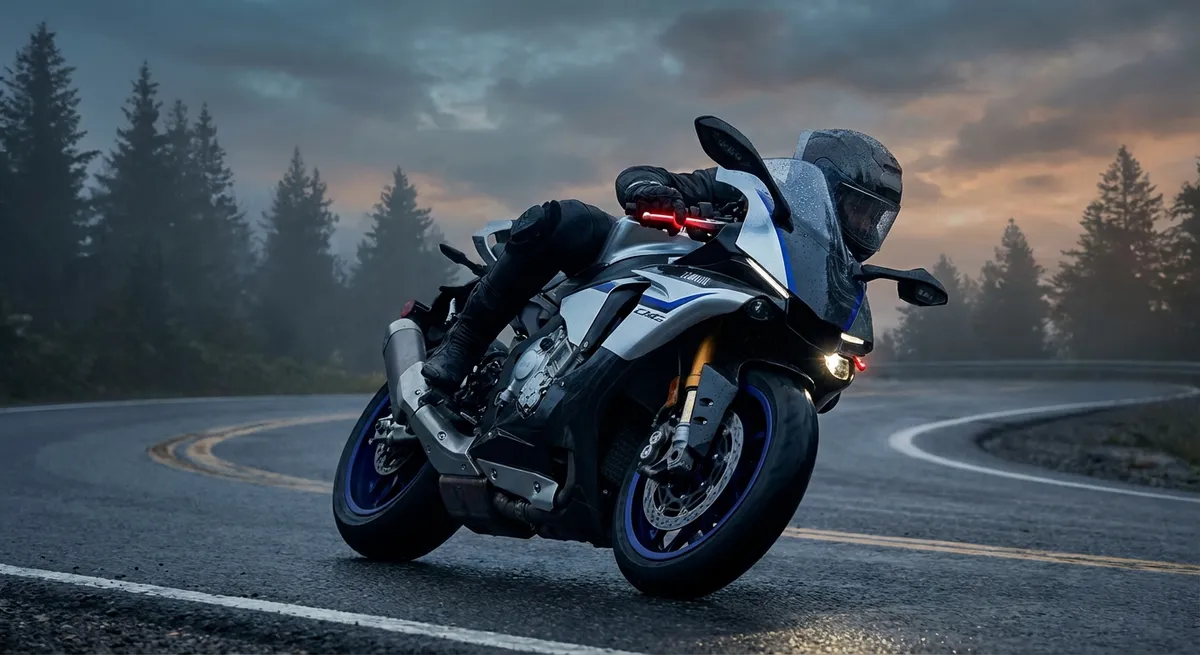
Moving even a bit of mass to the inside reduces the lean angle required for a given speed and radius. Less lean equals more grip margin, because the tire is running closer to its central, better-supported area. On unpredictable roads, that extra margin can absorb gravel, a painted line, or a mid-corner bump without demanding heroics.
Your lower body should lock lightly into the bike—knees and thighs stabilizing you against the tank—so your arms remain relaxed. If your arms are doing the job your legs should be doing, you introduce unwanted steering inputs. Loading the bars with body weight turns every bump, twitch, or head movement into steering noise.
Think of it this way: legs clamp and stabilize, core supports, arms communicate. Your job is to decouple body stability from steering inputs. That lets the front end track cleanly, especially over broken pavement or during braking while turning—two moments where bar tension from the rider is most likely to cause instability.
4. Reading and Using Road Surface Data in Real Time
The road is constantly broadcasting data. Most riders only “hear” the big messages—obvious gravel, shiny wet tarmac. Advanced riders use small visual and feedback cues to build a continuous mental model of grip.
Visually, scan for:
- Texture changes: A smoother, darker patch in an otherwise rough surface might be sealed or polished and likely lower-grip, especially when wet.
- Shine vs. matte: Shiny ≈ potentially slippery (wet paint, oil, polished tar). Matte, rough surfaces generally offer better mechanical keying for the tire.
- Camber and crown: Positive camber (banking into the turn) supports grip; off-camber (falling away from the turn) erodes it. The same speed and lean angle will feel very different on each.
- Contamination zones: Intersections (oil buildup), the center of lanes (drip patterns), and the outside of tight corners (gravel thrown out by cars) are classic traps.
From the bike, feel for:
- Subtle chatter or “buzz” from the tires as you begin to load them—this can be either normal feedback on rough pavement or a warning that you’re oscillating near the limit.
- Changes in steering effort mid-corner; a sudden lightening of the front or heavy, reluctant steering can signal a surface change or unexpected camber shift.
- Rear-end “float”—very slight lateral movement from the rear under throttle often means you’re at the beginning of traction loss. A tiny roll-off and smoother input usually resets stability.
Use this information not just reactively but proactively. If you see a questionable surface well in advance, pre-adjust your plan: reduce entry speed, raise your body slightly to maximize suspension travel, minimize lean, and aim to keep throttle and brake changes as gentle as possible across the compromised area.
On the street, “speed” is less about raw numbers and more about how far ahead you’re solving the surface puzzle.
5. Corner Setup as a Repeatable System, Not an Improvised Guess
Many riders “wing it” into corners—guess a speed, tip it in, hope it works. That’s not just inefficient; it’s unpredictable. You want a system for corner setup that you run every time, in compressed time at higher speeds.
A robust corner setup process looks like this:
- Information phase: Early vision. Identify the corner’s radius, camber, surface, and potential exit path. On the street, also identify threats: driveways, side roads, oncoming traffic, possible hidden washouts or debris.
- Positioning phase: Place the bike where it maximizes visibility and safety, not just line purity. For example, slightly away from the center line if you suspect oncoming vehicles cutting corners, or away from the outside where debris tends to collect.
- Speed and gear phase: You want speed and gear settled before significant lean. Choose a gear that places you in the mid-range of your torque band at expected apex/exit. This gives you controllable, linear throttle response instead of lag or sudden surges.
- Stability phase: As you release the brakes and initiate lean, blend into very light maintenance or gently increasing throttle. You are now in “stabilize and guide” mode, not “fix major errors” mode.
- Exit and adjust phase: As you see the exit open, smoothly roll on more throttle, stand the bike up progressively, and use the strongest part of the tire and chassis to accelerate. If you misjudged entry speed slightly, minor corrections in this phase are easy—major corrections mid-corner are not.
The key is repetition. Run this mental sequence on every curve, even at low speeds. You’re training your brain to follow a predictable decision chain under load. When something goes wrong—decreasing radius, surprise hazard, off-camber tightening—your brain isn’t starting from zero. You’re just adjusting parameters within a familiar framework.
That’s how real-world riding becomes less about “feeling brave today” and more about executing a proven process at varying speeds and conditions.
Conclusion
High-level motorcycle control isn’t mystical; it’s the sum of disciplined, repeatable technical habits. Using the throttle as a load tool, braking in structured phases, treating body position as a steering aid, reading the road like a live data feed, and running a consistent corner setup system—all of these give you something priceless: predictability. The bike starts behaving like a well-understood machine instead of a collection of surprises.
The more you refine these micro-inputs, the more your riding shifts from survival to deliberate performance. Not performance in the ego sense, but performance as in: the bike does exactly what you ask, when you ask, even when conditions are imperfect. That’s where real confidence comes from—and that’s the kind of riding that keeps you fast, smooth, and coming home in one piece.
Sources
- Motorcycle Safety Foundation (MSF) – Advanced Riding Tips - Official safety-focused guidance on advanced braking, cornering, and risk management
- UK Government – Motorcycle Riding Skills and Safety - Highway Code sections relevant to motorcycle positioning, observation, and control
- BMW Motorrad – Riding Safety and Technology Insights - Technical explanations of motorcycle dynamics, braking systems, and rider aids
- Ohlins – Suspension Basics and Chassis Dynamics - Detailed technical information on how suspension behavior affects traction, stability, and rider inputs
- California Superbike School – Cornering and Throttle Control Concepts - Articles explaining advanced concepts like throttle control, vision, and corner setup in practical terms
Key Takeaway
The most important thing to remember from this article is that this information can change how you think about Riding Tips.