Motorcycling isn’t about big, dramatic moves—it’s about tiny, precise inputs stacked over thousands of seconds. The riders who look “effortless” aren’t gifted; they’re running a tight control loop in their head and in their hands, constantly updating based on what the bike and road are telling them. This article dives into five technical riding concepts you can apply immediately—no track required, just you, your bike, and the roads you already ride.
1. Load Management: Controlling Weight Transfer, Not Just Speed
Speed is what you feel; load is what the tires feel. Your job as a rider is to manage how quickly and where that load moves.
When you brake, weight transfers forward, compressing the fork, increasing front tire load and grip, while unloading the rear. When you accelerate, the opposite happens. The key isn’t to avoid weight transfer; it’s to shape it. Smooth initial brake pressure ramps weight forward without shocking the tire. Think of it as building a “grip envelope” at the front before demanding real deceleration. Likewise, a progressive roll-on after the apex keeps the rear loaded without snapping the suspension open.
A useful mental model is rate of change:
- 0–10% of your brake or throttle input is where you “hook” the tire
- 10–80% is where you actually do the work (braking/accelerating)
- 80–100% is stabilization or fine-trim
Practice on an empty road: pick a marker, roll off, apply the brake gently until you feel the fork settle, then build pressure. Reverse the process on exit—smooth, progressive roll-on until you feel the rear sit down. You’re training your body to control suspension position, not just speed.
2. Vision as a Sensor Suite: Running a Continuous Scan Loop
Your eyes are your best onboard sensors, but most riders under-use them. The goal is a continuous scan loop that feeds your brain predictive data, not surprises.
Break your vision work into three layers:
Far field (3–10+ seconds ahead):
This is your strategy layer—corner radius, camber, road surface changes, intersections, traffic patterns. Your head should be turned early in corners, eyes leading the bike. You’re asking: Where will I be in a few seconds, and what will the road be doing?
Mid field (1–3 seconds ahead):
This is your tactics layer—cars creeping at junctions, cyclists, pedestrians, merging traffic, painted lines, manhole covers, gravel patches. You’re constantly running “if-then” scenarios: If that car moves, where’s my escape?
Near field (0–1 second ahead):
This is survival—potholes, debris, slick patches right in front of you. Glance here, don’t stare. Over-fixating near the wheel kills your ability to plan.
Overlay this with constant mirror checks and occasional shoulder checks where appropriate. The idea is to maintain a 360° mental map that’s updated every second. If you ever realize you’re “just looking ahead” without a structured scan, you’re riding under-sensored.
A simple drill: on your next ride, narrate in your helmet (even silently) what each layer shows you:
“Far: decreasing-radius left, slight downhill. Mid: car at side road, cyclist in shoulder. Near: patchy pavement.”
You’re training your brain to treat vision as structured input, not background scenery.
3. Brake Modulation: Turning ABS into a Safety Net, Not a Riding Style
Modern ABS is incredible, but using it as a primary control tool instead of a last line of defense is giving away performance and safety margin. Technical braking is about pressure modulation, timing, and chassis stability.
Key principles:
- Initial bite defines everything.
Smash the lever and you spike fork dive, destabilize the chassis, and risk overwhelming the front contact patch—especially on imperfect surfaces. A progressive squeeze (count “one-two” as you build pressure) lets the tire load up first.
- Hold, don’t saw.
Once you’ve reached your target deceleration, hold a steady pressure. Pumping the brake or hunting for pressure confuses the chassis and reduces grip.
- Trail braking is load control, not a style trick.
Carrying a tapering amount of brake pressure into the initial phase of the turn keeps the fork slightly compressed, steepens geometry, and sharpens turn-in. You’re using the brake not to slow down dramatically in the corner, but to sustain the right front load and rake angle as you tip in.
- Rear brake is a stability tool.
Light rear brake before full stop smooths low-speed control. At higher speeds, it can help settle the bike, but must be feathered—especially on bikes without advanced cornering ABS.
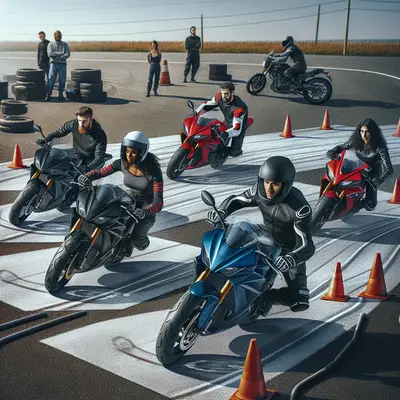
Practice: choose a straight stretch with a clear marker. Brake from the same speed to the same stopping point repeatedly, but focus only on:
1) smooth initial squeeze,
2) consistent decel feel,
3) zero ABS activation.
You’re calibrating your hands to the actual mechanical grip of your tires, not an electronic safety net.
4. Corner Setup: Building a Repeatable Entry Process
Most corner mistakes happen before the bike leans. A disciplined, repeatable entry sequence turns “hope” into a process.
For every significant corner, run this checklist:
Information phase:
- Identify the true entry point and likely exit line. - Read radius changes, camber, surface condition, oncoming traffic, and escape options. - Decide: Is this a committed corner or one I treat conservatively due to limited sight lines?
Position phase:
- Choose lane position to maximize vision and safety, not just apex speed. - On the street, this often means a more conservative line that keeps you away from the centerline in case of vehicles cutting the corner.
Speed + gear phase:
- Do your meaningful braking upright, before lean. - Choose a gear that gives you immediate throttle response at your planned minimum speed—don’t enter in a lazy overgear that forces you to wait for the engine.
Load + turn phase:
- Release the majority of brake as you initiate lean, possibly holding a trace of pressure (trail braking) to keep the front loaded. - Turn deliberately once—avoid mid-corner steering corrections; they’re usually the product of poor entry speed or late vision.
If you exit corners constantly needing mid-corner corrections, it’s rarely your “cornering skill.” It’s that your entry process is non-existent or inconsistent. Fix the stack before the lean, and 80% of your cornering smoothness appears almost magically.
5. Traction Intelligence: Reading Grip Beyond “Wet vs. Dry”
Grip isn’t binary. It’s a dynamic property influenced by surface texture, temperature, contamination, and your current load state. Technical riders read traction like telemetry.
Things to actively observe:
- Visual surface texture:
- Matte, coarse asphalt often offers better grip than shiny, polished surfaces.
- Tar snakes, painted lines, metal plates, and worn “glass-like” asphalt significantly reduce friction, especially when wet.
- Temperature and time-of-day effects:
- Cold tires on a cold road have significantly reduced grip. Early minutes of a ride should be explicitly “reduced-load” time—gentler lean, smaller brake/throttle demands.
- Bridges and elevated sections cool and freeze faster than surrounding pavement.
- Camber and runoff:
- Positive camber (banked into the turn) helps you; negative camber (road falls away) steals your margin.
- A decreasing-radius corner with negative camber and poor runoff is not where you “test” your lean angle; it’s where you bank margin.
- Feedback through the chassis:
- A light, slightly “grainy” feeling at the bars or pegs under increasing load can be early warning of approaching grip limits.
- Sudden, sharp movements (e.g., a slide that appears without warning) usually indicate a drastic surface change (oil, gravel, paint). Assume hidden contaminants where you can’t fully see the surface (blind crests, shaded corners).
A powerful habit: mentally tag surfaces as you ride. “High-grip, medium, low, unknown.” Then consciously scale your inputs based on that tag. Don’t use 80–90% of your braking and lean potential on an “unknown” or “low” surface. This is traction budgeting, and it’s what keeps high-skill riders intact on bad days.
Conclusion
Control on a motorcycle isn’t magic—it’s deliberate, technical input management. Load, vision, braking, corner setup, and traction aren’t separate topics; they’re one integrated system. Improve any one of these and your riding gets better. Improve all of them and your bike starts to feel like an extension of your nervous system, not a machine you’re merely sitting on.
On your next ride, don’t try to fix everything at once. Pick a single concept—load management on braking, or a structured vision scan, or a disciplined corner entry process—and ride with that as your sole technical focus. Layer these skills over time, and you’ll feel the transformation: more stability, more precision, more speed where it’s safe—and more margin everywhere else.
Sources
- [MSF – Basic RiderCourse Rider Handbook](https://www.msf-usa.org/downloads/BRCHandbook.pdf) – Official Motorcycle Safety Foundation handbook explaining braking, cornering, and basic control principles.
- [U.S. NHTSA Motorcycle Safety](https://www.nhtsa.gov/road-safety/motorcycles) – Government data and guidance on motorcycle dynamics, traction, and crash factors.
- [RoSPA – Motorcycle Riding Tips](https://www.rospa.com/leisure-safety/advice/motorcycling/advice-and-information) – Advanced roadcraft and defensive riding techniques from the UK’s Royal Society for the Prevention of Accidents.
- [IAM RoadSmart – Biker Roadcraft](https://www.iamroadsmart.com/campaign-pages/end-customer-campaigns/bikesmart) – Systematic approach to observation, positioning, speed, and gear selection for real-world roads.
- [BMW Motorrad – Riding Tips: Braking and Cornering](https://www.bmw-motorrad.com/en/experience/stories/safety/riding-tips.html) – Manufacturer-backed explanation of braking technique, cornering strategy, and electronic rider aids.
Key Takeaway
The most important thing to remember from this article is that this information can change how you think about Riding Tips.