Riders are roasting lazy workers online again. The trending Bored Panda piece “People Are Sharing Priceless ‘Not My Job’ Moments…” is full of photos where someone technically “did the job,” but obviously didn’t care about doing it right—crosswalks painted over trash, road signs installed backward, safety rails that don’t line up with the edge of the drop. Funny on the internet, terrifying when you’re on a motorcycle at 70 mph relying on those same systems to keep you alive.
Here’s the hard truth: a lot of what surrounds you on the road is “not my job” energy made concrete—faded markings, misaligned manhole covers, poorly placed gravel, weird patches from a rushed road crew. You can’t fix that. But you can absolutely stop riding with “not my job” habits yourself. On a bike, “I kind of did it” is how people end up in guardrails.
Let’s turn that viral theme into something useful: how to ride like the opposite of a “not my job” worker, with precision, intention, and zero excuses.
Stop “Paint-By-Numbers” Cornering: Build Real Entry Discipline
A lot of street riders corner like those lazy crosswalk jobs: more or less in the right area, wrong in the details. The line sort of works—until it doesn’t.
Here’s how to tighten up your corner entry so it’s deliberate, not accidental:
- Commit to a clear “entry point”: Pick a precise spot on the pavement where you begin your turn-in—not “somewhere near that pole.” On approach, say it in your helmet: “Turning in at that crack / patch / reflector.” This mental label keeps you from drifting into the corner too early.
- Delay turn-in until you see the exit: Especially on blind bends, adopt the “slow in, see out, roll on” rule. You wait to commit your lean until you can at least see some part of where you’ll exit. If you can’t, you carry more brake longer and keep the bike more upright.
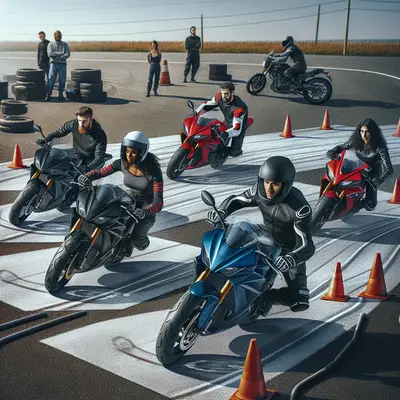
- Use progressive trail braking, not panic entries: Instead of finishing all your braking upright, bleed off speed as you tip in, releasing pressure gradually as lean angle builds. On a modern bike with ABS and decent tires, this keeps the front loaded and the chassis settled. Practice in an empty lot:
- 40 km/h → brake to 20 km/h while adding lean
- Focus on a smooth, linear lever release, not on an exact speed
- Separate “setup speed” from “ego speed”: Setup speed is the pace where your bike feels neutral and you’re not fighting line corrections. Ego speed is where you’re wide, tight, or mid-corner braking to save yourself. If you’re making more than one steering correction per corner, you’re riding ego speed.
- Use lane position as part of the system, not a style choice: Outside–inside–outside (within your lane) isn’t a club trick; it maximizes your vision and margin. On right-handers in right-hand traffic, stay wide left early, then gradually move to mid-lane at exit. On left-handers, avoid hugging the center line if it hides oncoming traffic—slightly delayed apex buys you information.
Clean entries feel boring at first. That’s good. Boring is where you have enough bandwidth left to notice the real threats: diesel patches, sloppy road repairs, and everyone else’s “not my job” nonsense.
Read The Road Like A QA Inspector, Not A Tourist
Those viral “who installed this?” photos are usually obvious because someone stepped back and looked at the whole picture. Do the same with the road. Don’t just see surface—see systems and failure points.
Train yourself to spot:
- Inconsistent color and texture:
- Dark, shiny = likely oil, diesel, or smooth tar snakes, especially in the center of the lane and on the outside of long sweepers where trucks lean and spill.
- Light, dusty or pale = fine gravel, salt, or worn aggregate. Treat it like ice. Adjust: more upright, gentler throttle/brake, no sudden lean changes.
- Linear defects (joint lines, trenches, paint ridges): Tires hate sharp longitudinal ridges. If you have to cross them:
- Straighten the bike as much as possible
- Unload the bars (relax grip) so the front can twitch without translating into a full bar input
- Cross at the largest angle you safely can (never follow a groove if you can avoid it)
- Utility covers and patchwork in the braking zone: Road crews love to put manholes exactly where you want to be on the brakes. If a heavy steel cover sits mid-lane before a corner:
- Set 80–90% of your braking before the cover
- Glide over it with neutral throttle and stable bars
- Resume any trail braking gently once you’re back on consistent tarmac
- Camber changes and hidden crowns: A road that looks flat might tilt off to the side, especially at driveways and intersections.
- Watch drainage patterns: where does water/wetness pool or streak after rain?
- On off-camber corners (road leans away from the turn), dial the speed down more than your eye tells you. Your available lean angle for the same grip is lower.
- Signs of lazy maintenance: Faded centerlines, half-erased arrows, damaged guardrails that never got fixed—all hint at a road authority that’s not on top of its game. On those stretches you assume worst case:
- Hidden potholes
- Debris not cleaned
- Temporary “fixes” like gravel dumps and cold patch
Your job as a rider is permanent, full-time quality control. If a section of road looks like a “not my job” meme, you ride it like it’s actively trying to surprise you.
Kill “Not My Job” Body Position: Make Every Input Intentional
A lot of riders sit on a motorcycle the way those bad workers paint lines over trash—whatever was there, they just go over it. No recalculation, no adaptation.
Your body is your primary control system. Sloppy posture is invisible until you’re trying to change direction hard or brake on imperfect pavement.
Dial it in:
- Anchor low, stay loose high:
- Grip lightly with the knees/inner thighs against the tank, especially during braking and over bumps.
- Let your arms be 20–30% engaged, not 80%. If your hands ache after 30 minutes, you’re carrying weight on the bars instead of the pegs and core.
- Neutral spine, pivot at the hips: Lean forward by hinging at the hips, not rounding your back. Your chest comes closer to the tank but your spine stays straight. This:
- Reduces fatigue
- Lets you slide side-to-side more easily for cornering
- Improves your feel for front-tire feedback
- Micro weight shifts, not Instagram hangs: On the street, you don’t need race-level hanging off, but you do need directional intent:
- Before a right-hander: slide your butt 2–3 cm to the right, drop a bit more weight on the right footpeg, and bring your chest toward the inside mirror
- This effectively reduces required lean angle for a given speed and radius, giving you a grip buffer when the surface isn’t perfect
- Use the “90% head / 10% bars” rule: Your eyes and head lead the bike. Turn your head so your nose points where you want to end up, not at the danger you’re trying to avoid. Bar input should feel like the consequence of where your head goes, not a separate action.
- Pre-load for transitions: When flicking through quick chicanes or S-bends:
- As you approach the change of direction, start unloading the current peg and pre-loading the next (shift weight before you push the bar)
- This reduces the force required at the bars and keeps the chassis stable across mid-corner bumps or bad patchwork
If a body position or input feels vague or “good enough,” assume it will become a problem the moment something unexpected happens. On two wheels, “not my job” posture is just a time-delayed crash.
Treat Every Car As A Potential “Not My Job” Driver
Those lazy-job memes are funny until you realize a frightening number of drivers bring that exact mindset to the road: turn signals optional, mirrors decorative, phones mandatory. Your safety depends on assuming they won’t do their job—and riding like the only professional in the room.
Make that assumption concrete with these habits:
- Build dynamic escape routes: At any moment, you should be able to answer: “If this car does something stupid, where do I go?” That answer changes every few seconds.
- On the highway, avoid being boxed in between two vehicles with no shoulder room
- When overtaking, plan not just how to pass, but where you’ll bail if they drift into you mid-pass
- Ride offset in lanes, never “perfectly centered” behind a car:
- In right-hand traffic, behind a car choose left or right tire track—not the middle.
- You gain:
- A view past the vehicle
- Space to dodge if they drop something or brake hard
- Room to move back to center if someone cuts in
- Brakelight discipline: Tap your brake lever lightly to flash your tail light when:
- You see a “maybe” behind you (head down, wandering lane position)
- You’re rolling off for a surprise hazard that they haven’t seen yet
- You’re at the front of a queue and expect to launch, but then notice cross-traffic blowing the red
- Assume every indicator is a question, not a promise: That car signaling right at a junction?
- Slow slightly, cover both brakes, and prepare for them to either:
- Turn slower than you expect
- Not turn at all
- The psychological shift from “they will” to “they might” removes the emotional sting when they fail you—and keeps your line conservative.
- Audit your own “not my job” moments in traffic:
- Lane change without double check over the shoulder?
- Rolling stop at a minor intersection because “nobody’s there”?
Each of those is you becoming the hazard you complain about. Set yourself a standard: zero lazy moves, especially around other riders.
You can’t fix other people’s standards, but you can refuse to ride at their level.
Never Outsource Your Safety To Gear And Electronics
In those viral photos, you constantly see safety systems installed wrong—railings that start after the drop, cones around a hole but no actual repair. That same mindset exists in riders who think ABS, traction control, and premium gear = invincibility.
Use tech as a multiplier of skill, not a replacement:
- Calibrate your right hand to your least capable bike: If you ride multiple machines (maybe an older carb bike and a new ride-by-wire with rider aids), base your throttle and brake discipline on the worst one. That way your skill ceiling is higher than any bike’s electronic support.
- Feel your ABS and TC deliberately—once, in a controlled way: On a clean, empty, straight road:
- Practice a few hard stops to the point of ABS activation so you recognize the pulsing and noise
- On a modern bike with multi-level TC, do a moderate roll-on in a low gear from low speed and check how intervention feels
That single calibration session helps you recognize those systems on the street, so you don’t panic when they step in on a bad surface.
- Gear = time, not immunity:
- A quality helmet, armor, and abrasion-resistant textiles or leather increase the time your body can slide or impact before catastrophic damage.
- They do nothing to help if you’re carrying way more speed than the situation can dissipate. Ride like you’re trying to preserve your gear, not test it.
- Set your own conditions, not the algorithm’s:
- Rain mode = good, but you still need longer following distances and earlier braking.
- Cornering ABS = good, but you still don’t want to be deep on the brakes while leaned over on a blind, dirty decreasing-radius turn.
- Pre-flight, don’t just faith-flight:
- Tire pressures checked cold at least weekly
- A visual look for cupping, sidewall damage, or plugged repairs before serious rides
- Chain slack and lube, lever free play, fastener glance (brake caliper bolts, axle nuts, bar clamps)
Skipping this is the literal mechanical version of “not my job”—and it absolutely can hurt you.
The bike is a brutally honest machine. It will do exactly what physics allows, not what marketing promised.
Conclusion
Those “Not My Job” memes are good for a laugh because the stakes are low: a crooked sign, a stupidly painted line, a misaligned railing in a photo you’ll scroll past in five seconds. On a motorcycle, the same mindset—“eh, close enough”—is the difference between an uneventful ride and a trip to the trauma ward.
Your job on two wheels is never optional, never half-done:
- Precise, disciplined corner entries
- Forensic-level reading of road surfaces
- Intentional, athletic body position
- Professional-grade traffic anticipation
- Skill-first, tech-second safety thinking
The world is full of people doing the minimum. Don’t ride like one of them. Every time you throw a leg over, make it your job to do everything right—even when nobody’s watching, and especially when the road clearly wasn’t built with you in mind.
Key Takeaway
The most important thing to remember from this article is that following these steps can lead to great results.