Most riders “do their oil” and call it good. But if you think of your motorcycle as a dynamic friction management system instead of just a machine with parts, maintenance stops being a chore and becomes an engineering project you get to ride.
This is your deep dive into lubrication as a performance tool—how oil, grease, and surface prep decide whether your bike feels tight, consistent, and trustworthy… or vague, notchy, and expensive to fix. We’ll break down the real mechanics behind it, and give you five technical focal points that serious riders should dial in.
Lubrication as a System, Not a Task
Every moving interface on your motorcycle lives in one of three lubrication regimes: boundary, mixed, or hydrodynamic. Understanding which is which is the difference between blindly following an owner’s manual and actually tuning your bike for feel and longevity.
Boundary lubrication is metal-on-metal with a thin chemical film—think chain rollers, cam lobes at low RPM, and clutch splines. Mixed lubrication is where the oil film carries part of the load but asperities (microscopic peaks) still touch—common in gear teeth, bearings at moderate speed, and cold engines. Hydrodynamic lubrication is the holy grail: a full oil wedge separating surfaces, like crankshaft journals at operating speed and temperature.
When you choose viscosity, service intervals, and lube types, you’re deciding which components can consistently live in hydrodynamic or mixed regimes and which are stuck surviving in boundary conditions. That’s maintenance as tribology—real-world friction science—not just “change it every 3,000 miles.”
1. Matching Oil Viscosity to Real Riding, Not Just the Label
Most riders read the manual, buy the recommended viscosity, and stop thinking. The technical reality is more nuanced: your oil has to maintain film strength across your actual thermal and load profile, not a lab cycle.
A multi-grade like 10W-40 describes two different behaviors: the “10W” represents cold crank viscosity, while “40” describes high-temperature viscosity at 100°C. If you ride aggressively, sit in urban heat, or run air/oil-cooled engines hard, your sump temperatures can spike beyond the assumptions baked into conservative factory charts. Too light at temperature, and your oil film thins out in critical hydrodynamic bearings—rod journals, mains—leading to micro-wear you won’t notice until it’s expensive.
On the other side, going “thicker is better” can be just as wrong. An overly viscous oil in a tight-clearance modern engine delays pressure buildup on cold starts and increases hydrodynamic drag at high RPM, stealing power and heat-soaking your oil faster. This is especially critical on shared-sump motorcycles where the engine, gearbox, and clutch all share the same oil and shearing forces are extreme.
Technical takeaway: choose viscosity based on the manual as your baseline, then factor in ambient climate, riding style, and engine design. Track-style riding in a hot climate on a high-compression engine may justify stepping one grade up on the hot side (e.g., 10W-40 to 10W-50), while a commuter in cooler temps is often better served staying exactly on spec to maintain cold-start flow and clutch behavior.
2. Shared-Sump Reality: How Gearboxes Destroy Weak Oils
Unlike most cars, many motorcycles run shared-sump lubrication: the engine, gearbox, and wet clutch live in the same oil. That gearbox is a brutal shear machine—gear meshing, sliding, and impact loading rapidly tear down viscosity modifiers in multi-grade oils.
When viscosity modifiers shear down, your 10W-40 may behave more like a tired 10W-30 under stress. That means thinner oil films on bearings, lower film strength in high-load contact areas, and higher operating temps. You might not see catastrophic failure right away, but you’ll feel it as a bike that slowly gets noisier, rougher, and more “gritty” with mileage.
This is where JASO MA/MA2 ratings actually matter. Passenger car engine oils (with “energy conserving” or “resource conserving” labels) are formulated with friction modifiers to reduce drag—great for fuel economy, terrible for wet clutches and some shared-sump gearboxes. MA/MA2 oils are designed to deliver predictable clutch friction behavior and better resistance to shearing in gear meshes.
Technical takeaway: for shared-sump motorcycles, prioritize:
- JASO MA or MA2 certification, not just API gasoline engine ratings
- Shear stability and base stock quality over “just synthetic vs. conventional” marketing
- Realistic oil-change intervals based on gear abuse (e.g., heavy commuting, track, loaded touring) rather than car-like mileage expectations
Think like a gearbox engineer, not just a rider.
3. Chain Lubrication as a Wear-Control Project, Not a Messy Habit
Chain maintenance isn’t about keeping it “shiny”—it’s about engineering a rolling, articulating contact system that survives thousands of heat cycles and shock loads without stretching into junk.
Modern O-ring/X-ring chains come pre-lubed between the pins and bushings; that sealed internal grease is what really determines chain life. Your chain lube doesn’t reach that cavity; instead, its job is to:
- Lubricate the roller-to-sprocket tooth contact
- Reduce external corrosion
- Protect the O-rings from drying, cracking, and tearing
- Cushion impact as the chain engages each sprocket tooth
The mistake is blasting the chain with heavy tacky lube until it drips. Excessive tackiness picks up abrasive road grit and turns your chain into a grinding paste belt that eats both sprockets and rollers.
From a technical standpoint, you want a lube that:
- Flows thin enough at application to penetrate roller interfaces
- Sets into a film that is resistant to fling but not so sticky it hoards debris
- Maintains behavior across your temperature range (think long summer rides vs. cold starts)
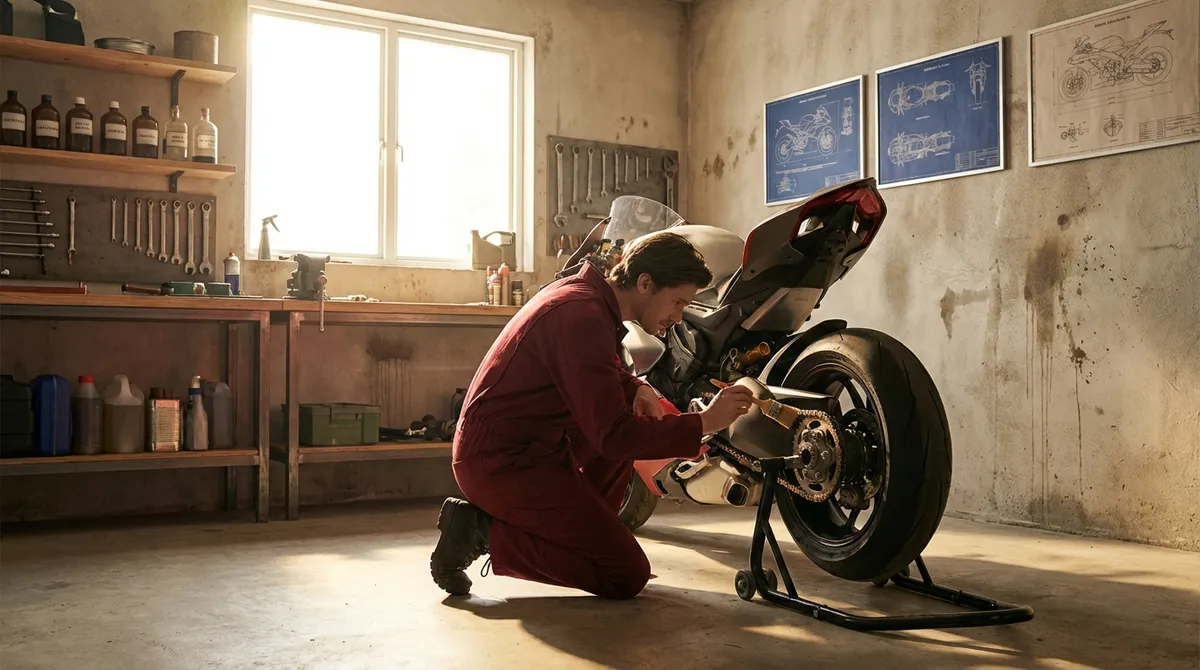
Application matters: lube the chain after riding, while it’s warm, so the carrier solvents flash off and the oil base flows and sets properly. Apply to the inside of the chain run, near the rear sprocket, so centrifugal force pulls the lube through the links rather than flinging it outward into your wheel and pads.
Technical takeaway: treat chain lube like fine-tuning a rolling contact experiment. The correct product, applied sparingly and consistently to a clean chain, preserves the engineered clearances and elasticity designed into that assembly.
4. Grease Selection: Bearings, Pivots, and the Hidden Friction Network
Grease is not “just grease.” Every pivot, bearing, or sliding joint is a carefully designed interface with expected loads, speeds, and motion ranges. Grease choice and application strategy directly shape steering feel, suspension precision, and long-term structural integrity.
Steering head bearings, for example, usually see low speed but high load and significant oscillation around center. That’s a perfect recipe for false brinelling: micro-indentations forming in the race where the rollers repeatedly vibrate under load without rotating fully. Using the wrong grease—or too little—accelerates notchiness and vague steering feedback.
Swingarm and linkage bearings operate in mixed environments: contamination from road spray, intermittent motion, and heavily leveraged loads through the suspension geometry. Here you want a water-resistant, EP (extreme pressure) capable grease with good mechanical stability, so it doesn’t thin out, leak, or harden into useless clay.
Wheel bearings live at higher RPM and generate shear heat; overpacking them or using excessively thick, high-drag grease increases rolling resistance and operating temperature. The goal is enough grease to form a continuous film through the rolling elements and races, not stuffing the cavity full “for good measure.”
Technical takeaway: select grease based on:
- NLGI grade (typically #2 for general motorcycle use)
- Thickener type (lithium complex, calcium sulfonate, etc.) and water resistance
- EP additives for high load points (linkages, steering head)
- Compatibility with OEM recommended types when topping up or re-greasing
When you grease thoughtfully, you’re tuning the feel of every movement—steering input, suspension response, even how the bike settles under load.
5. Thermal Management: Oil as a Structural Cooling Component
Oil is not just a lubricant—it’s a heat transfer medium, especially on air- and oil-cooled engines or high-performance liquid-cooled bikes pushed hard. Treating oil changes as simply “contaminant removal” ignores one of the most important functions: carrying heat away from critical components.
Under high load, film temperatures at bearing surfaces can far exceed bulk sump temperature. Dispersant and detergent additives help move micro-hotspots and contaminants away from surfaces toward the filter and sump. As oil oxidizes and shears down, its ability to stabilize temperatures and maintain film at elevated local temps degrades.
On some bikes, oil is routed through coolers, frame members, or even the swingarm—wherever the engineers can shed heat without compromising packaging. Dirty, degraded oil circulates less effectively under high shear, increases foaming risk, and compromises the consistency of the cooling loop.
Thermal stress is multiplicative: hotter oil oxidizes faster, which reduces viscosity and film strength, leading to more friction and heat generation, which accelerates breakdown further. That loop quietly eats service life from your engine, especially if you do lots of short, high-load, or hot-weather rides.
Technical takeaway:
- If your riding generates heat (track, heavy two-up touring, slow technical off-road), treat oil as a cooling system component and shorten intervals accordingly
- Monitor operating temperature trends where possible—some bikes allow real-time oil or coolant temp via dash or diagnostics
- Choose oils with robust high-temperature performance (look at HTHS viscosity and OEM approvals where available) if you routinely run the bike hard
You’re not just changing oil; you’re refreshing part of the engine’s thermal architecture.
Conclusion
Maintenance isn’t about obeying a schedule—it’s about actively managing friction, heat, and load so your motorcycle stays sharp, predictable, and mechanically honest with you.
When you choose oil viscosity based on your real riding, account for shared-sump shear, treat chain lube as a wear-control project, match grease to specific bearing physics, and respect oil’s role in thermal management, you’re doing more than “servicing” your bike. You’re tuning a complex mechanical ecosystem to respond cleanly and consistently every time you ask it to do something difficult.
That’s the Moto Ready mindset: don’t just keep the motorcycle alive—engineer the way it feels on the road.
Sources
- [JASO Engine Oil Standards – Japanese Automotive Standards Organization](https://www.jasoe.or.jp/en/tech/two_and_four_cycle_engines/) - Official overview of JASO MA/MA2 specifications and their relevance to motorcycle oils
- [Motorcycle Oil Explained – Mobil (ExxonMobil)](https://www.mobil.com/en/lubricants/for-personal-vehicles/automotive-lubricant-faqs/motorcycle-oil) - Technical discussion of viscosity, shared-sump requirements, and motorcycle-specific oil behavior
- [Understanding Engine Oil Viscosity – SAE International](https://www.sae.org/blog/engine-oil-viscosity) - Detailed breakdown of multi-grade viscosity ratings and how they relate to real operating conditions
- [Chain Wear and Lubrication – DID Chain](https://www.didchain.com/chain-basics/maintenance.html) - Manufacturer guidance on modern sealed chain lubrication and maintenance principles
- [Grease Selection and Bearing Lubrication – SKF](https://www.skf.com/group/services/engineering-consultancy-and-supervision/lubrication-management/grease-selection) - Engineering-level information on grease types, applications, and their impact on bearing life and performance
Key Takeaway
The most important thing to remember from this article is that this information can change how you think about Maintenance.