Every rider talks about “feel,” but the riders who are fast, smooth, and safe on any road are doing something much more precise: they’re managing load, traction, and timing with intent. This isn’t about memorizing “do this, don’t do that.” It’s about understanding what the motorcycle is actually doing under you, then giving it exactly the inputs it needs.
This guide dives into five technical riding concepts that translate directly to confidence and control on real roads, in real traffic, at real speeds.
1. Load Path Management: How Your Inputs Travel Through the Bike
Every control input you make—brake, throttle, steering, body position—sends a load path through the chassis, suspension, and tires. Skilled riders deliberately manage where and when that load shows up.
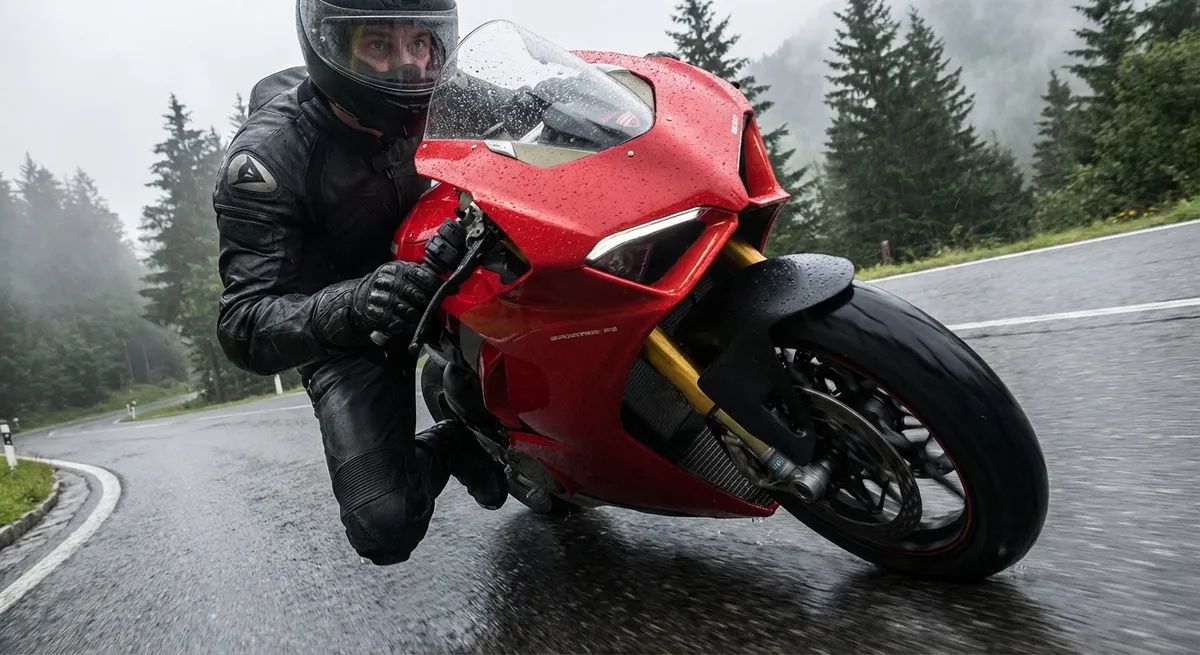
Under braking, weight transfers forward, increasing front tire load and compressing the fork. If you abruptly add lean angle while the fork is heavily compressed, you’re asking the front tire to handle high longitudinal load (braking) and high lateral load (cornering) simultaneously. That’s where “tuck” happens.
Instead, think of your inputs as a sequence:
- Brake straight up to build front load and compress the fork in a controlled way.
- Ease off the brake as you add lean, so total load remains within the tire’s grip envelope (often visualized as the “friction circle”).
- Transition to neutral or slight maintenance throttle at or near apex to stabilize chassis and shift some load rearward.
- Roll on throttle progressively as you lift the bike up on exit, transferring load smoothly to the rear tire.
This sequencing keeps the load path predictable and avoids shocking the chassis. The same logic applies on bumps, mid-corner corrections, and emergency maneuvers: don’t stack maximum brake, maximum lean, and maximum steering at the same time if you can help it. Spread them out by fractions of a second and the bike feels calmer, more “on rails,” and far more forgiving.
2. Front vs. Rear Brake: Division of Labor, Not a Yes/No Choice
Treating the rear brake as “for parking only” or the front brake as “only in emergencies” wastes a huge amount of control. Both ends have jobs, and those jobs change with speed, surface, and geometry.
At higher speeds on good tarmac, the front brake should do the majority of deceleration. Dynamic weight transfer loads the front tire, giving it the capacity to generate a large braking force. A strong, progressive initial squeeze builds that load; a smooth increase maximizes decel without overwhelming grip.
The rear brake becomes much more valuable in specific scenarios:
- Low-speed control (U-turns, tight traffic filtering): Light rear brake with a bit of throttle tension stabilizes the chassis, loads the rear tire, and smooths driveline lash. The bike feels “on a rail” at walking pace.
- Corner speed trimming: On some bikes, a very light rear brake mid-corner can settle the chassis without the geometry change you’d get from adding front brake. This must be subtle—too much rear can cause it to step out.
- Downhill riding: Blending in rear brake reduces the load spike on the front and keeps geometry more neutral, especially on steep grades.
- Wet or loose surfaces: Balanced front/rear braking spreads demand across both tires. The rear is easier to catch and correct if it locks briefly than a suddenly sliding front.
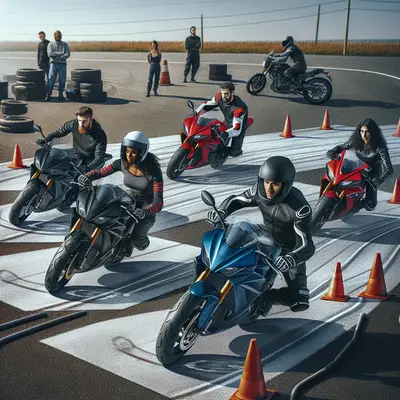
Practice progressive front brake application in a safe, straight-line environment: aim for firm lever pressure without ABS activation, then build up. Separately, practice ultra-light rear brake use at walking pace in a parking lot. Feel how tiny inputs stabilize or unsettle the bike. You’re training your foot to have the same finesse as your right hand.
3. Micro-Positioning: Using Your Body to Pre-Load the Bike
Body position isn’t just about hanging off in a photo. Even small shifts in weight dramatically affect how the bike initiates and holds a line, especially on imperfect roads.
Think in terms of micro-movements instead of exaggerated body English:
- Pre-load for turn-in: Before turning, move your upper body slightly to the inside and forward. This pre-biases the bike, so when you give a steering input, it falls into the corner more willingly and with less bar effort.
- Lower body stability: Lock your outside knee into the tank, and keep your inner thigh gently loaded on the seat edge. This removes unnecessary load and “death grip” from the bars, allowing the front to track freely over bumps.
- Head and eyes as the lead: Wherever your head goes, your torso wants to follow. Turning your head early toward the exit both improves vision and subtly cues the rest of your body to align the bike to that trajectory.
- Vertical control over bumps: On rough surfaces, slightly unweight your torso with your legs and core, allowing the bike to move under you rather than transferring every hit into the chassis. You’re effectively becoming a secondary suspension component.
Done right, your body becomes part of the bike’s dynamic system, not just extra mass on top. The payoff is reduced steering effort, more predictable grip, and a bike that feels lighter than its spec sheet suggests.
4. Throttle as a Geometry Tool, Not Just a Speed Control
The throttle doesn’t just change your speed; it changes your motorcycle’s geometry and attitude. Understanding this is critical for mid-corner stability.
On most modern bikes:
- Closed or chopping throttle mid-corner → weight shifts forward, fork compresses, rake and trail steepen slightly, making the bike more willing to turn but also putting more load on the front tire.
- Steady, slightly open throttle → chassis balances closer to neutral, distributing load more evenly front-to-rear and making the bike more stable and “planted.”
- Aggressive throttle opening while leaned → weight transfers rearward, fork extends, rake and trail increase slightly, making the bike stand up and widen its line.
This is why “maintenance throttle” through the mid-corner is such a powerful tool. It doesn’t need to be a big input—just enough to stop deceleration and hold a constant speed. You’re using the engine to help set a stable geometry rather than continuously pitching the chassis forward and back.
When you want to tighten your line, a tiny reduction in throttle (or slight increase in front brake at shallow lean, if you’re trained and conditions allow) increases front load and willingness to turn. When you want to open your line or stand the bike up for exit, a deliberate, progressive roll-on does the work. Think of it as drawing your trajectory with the right grip as much as with the bars.
Spend time in a safe environment riding a familiar corner and intentionally experimenting: same entry speed, but vary throttle: one run coasting, one with maintenance throttle, one with slightly earlier roll-on. Feel how the line changes. This builds an internal map of how your bike responds to just a few degrees of twist.
5. Real-World Vision Strategy: Beyond “Look Where You Want to Go”
“Look where you want to go” is incomplete advice. It’s a start, but higher-level riding demands a deliberate visual processing strategy that matches the speeds and scenarios you ride.
Break your visual field into three functional zones:
- Far field (3–7+ seconds ahead): This is where you read the story of the road—vanishing point movement, terrain, junctions, brake lights, and traffic flow. On twisty roads, watch how the vanishing point (where the road disappears from view) moves toward or away from you:
- Moving away = corner opening = safe to accelerate.
- Staying close = constant radius = maintain pace.
- Rushing toward you = tightening radius or blind hazard = prepare to slow.
- Mid field (1–3 seconds ahead): This is your working zone: identifying immediate lines, surface changes, and escape routes. You’re validating what you predicted from the far field and ready to adjust if needed.
- Near field (0–1 second ahead): This includes your instruments and the pavement immediately in front of the bike. You glance here, but you do not live here. Staring too close erodes reaction time and amplifies every small input into a correction spiral.
Train yourself to keep your primary focus in the far and mid fields, using short, intentional scans of the near field as needed. On straights, your eyes should be way out, building a buffer of information. On corner entry, snap your focus early to the corner’s far side or the current limit of your vision, not the patch of tarmac under your wheel.
Layer in hazard-specific vision habits:
- Scan road edges for driveways, intersections, and wheel movement from parked cars.
- Scan surface for color/texture changes indicating gravel, diesel, or wet patches.
- At night, read light behavior: oncoming vehicles over crests, reflections off signs, and headlight beams sweeping around unseen corners.
This structured visual strategy translates directly into smoother lines and earlier hazard detection. You stop reacting late and start riding ahead of the motorcycle.
Conclusion
Precise, technical riding isn’t about memorizing tricks—it’s about understanding the machine’s language and speaking it fluently with your hands, feet, eyes, and body. When you manage load paths, use both brakes intelligently, micro-position your body, treat the throttle as a geometry tool, and run a disciplined vision strategy, the bike stops feeling unpredictable. It starts feeling like an extension of your intent.
Take these concepts to a controlled environment first—empty parking lots, rider training courses, or low-traffic roads. Apply them one at a time, then blend them. The more you refine your inputs, the more your motorcycle will reward you with stability, feedback, and that rare feeling of being truly plugged in to the ride.
Sources
- Motorcycle Safety Foundation – Advanced Riding Tips - MSF provides research-backed guidance on braking, cornering, and visual strategies for street riders.
- U.S. NHTSA – Motorcycle Safety - Government data and recommendations on motorcycle control, crash factors, and rider behavior.
- California Superbike School – Technical Articles - In-depth discussions on throttle control, body position, and visual skills from a performance-riding perspective.
- BMW Motorrad – Riding Tips - OEM-level insights into braking, cornering, and body positioning across different riding scenarios.
- Institute of Advanced Motorists (IAM RoadSmart) – Advanced Riding - UK-based advanced riding techniques focused on observation, positioning, and real-world roadcraft.
Key Takeaway
The most important thing to remember from this article is that this information can change how you think about Riding Tips.