Motorcycles reward precision and punish noise. Every input you make—throttle, brake, bar, or peg—is a control signal passed through rubber, oil, and metal before it becomes grip or a slide. The riders who feel “smooth” aren’t magically talented; they’re just running cleaner signals into the system. This article is about tightening that signal: five technical riding concepts you can apply on the street or track to turn vague control into deliberate, repeatable performance.
1. Throttle as a Load Tool, Not an On/Off Switch
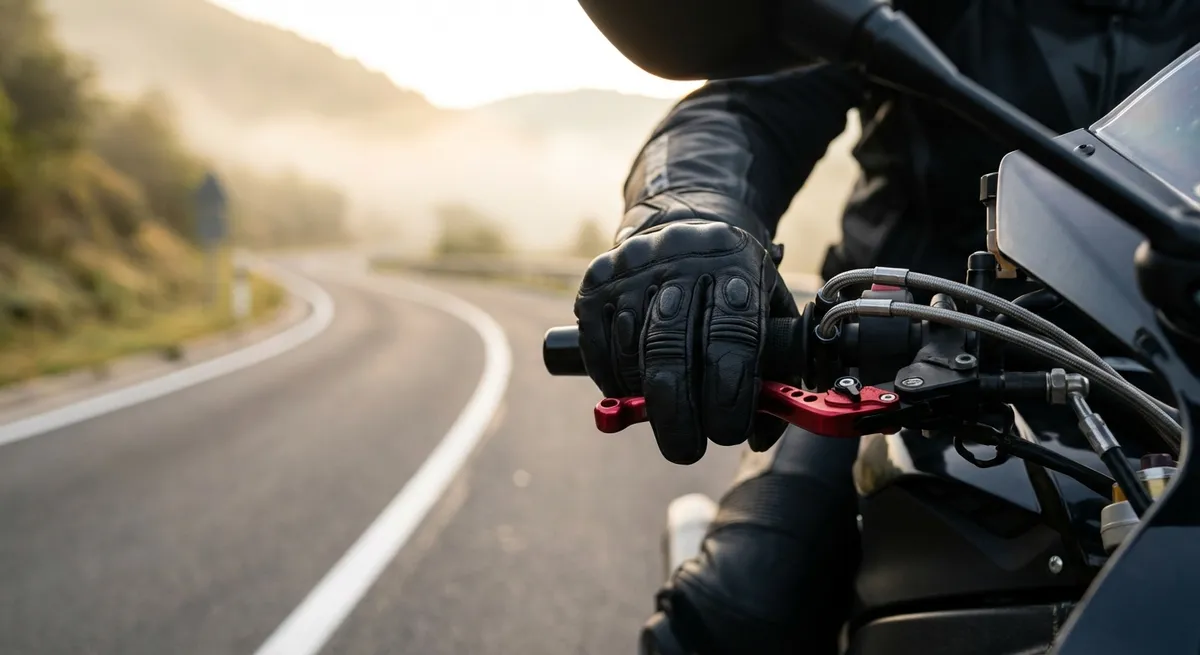
Think of your throttle hand as a load regulator, not a speed request.
When you roll on or off, you’re shifting how much of the tire’s available grip is devoted to acceleration versus cornering. A motorcycle in a corner is already eating up grip in the lateral (sideways) direction; when you snap on throttle, you ask the rear tire to handle both cornering and drive at once. If the combined demand exceeds the tire’s friction capacity, it spins or slides.
For corner exits, aim for a continuous, low-jerk throttle application:
- Start your roll-on the moment you can see your line will be held without adding lean.
- Increase throttle progressively, not in steps, so the suspension extends in a controlled way instead of unloading the tire abruptly.
- Prioritize “connect and maintain” over “hit and hope”: the tire should feel like it’s being loaded into grip, not snapped into it.
On modern ride-by-wire bikes, electronic smoothing can hide poor technique—until you ride in a lower intervention mode or on a more direct throttle map. Practice holding a constant throttle through long sweepers and making 1–2% adjustments rather than big swings. You’re aiming for low bandwidth in your right hand: minimal, intentional changes that the tire can translate cleanly into traction.
2. Braking That Talks to the Tire, Not Just the Lever
Strong braking isn’t about how hard you squeeze; it’s about how fast you build force and how well you support it with your body.
When you abruptly grab the lever, load transfer to the front tire happens faster than the suspension can manage, briefly overloading the available grip and inviting a slide or ABS intervention. Good braking starts with a micro-ramp:
- First, a very short initial squeeze (the “set”) to compress the fork and settle the tire into the pavement.
- Then, build pressure progressively to your desired deceleration level.
- Maintain that pressure with minimal modulation until you release for turn-in.
Watch your body position: if all your weight is hanging off locked arms, every bump and steering input feeds back into the brake lever. Anchor with your core and legs, not your wrists. Grip the tank with your knees, hinge slightly at the hips, and keep your elbows “alive” (slightly bent), so the front tire’s feedback doesn’t translate into involuntary lever inputs.
On the street, practice using a consistent deceleration rate—say, moderate braking from 60 mph to 30 mph—then gradually reduce your build-up time from lever-touch to full pressure while keeping it smooth. The technical goal: compress the fork quickly but not violently, trading chaotic spikes in front-tire demand for a predictable, controllable load curve.
3. Steering With the Chassis, Not Just the Bars
Turn-in is not only about pushing the inside bar; it’s about aligning the entire chassis so the bike wants to lean.
Countersteer is the entry command, but the bike’s response is filtered through tire profile, rake/trail geometry, suspension setup, and your body position. You can make the same bar input and get very different results depending on how you’re stacked on the bike.
To sharpen steering:
- Get your upper body slightly inside before the turn-in point. Even a small pre-position (head and shoulders toward the inside mirror) moves your center of mass, reducing how much lean angle is required for a given corner speed.
- Keep your inside arm relaxed and bent, outside arm more supportive. Your inside bar input should feel like a firm, brief steering pulse, not a continuous shove.
- Avoid loading the bars with body weight. Weight belongs on the pegs and tank, not through the grips.
Technically, this distributes load so the contact patch isn’t fighting against your own tension. When you release the initial countersteer input, let the bar “float” in your hands; the front end will naturally self-align to the lean and speed conditions if you’re not choking the signal with a death grip.
4. Peg Pressure as a Directional Signal
Most riders think of pegs as footrests; skilled riders use them as vector controls.
When you add pressure to the inside peg, you’re subtly shifting your effective center of mass lower and inward, and you’re changing how the suspension compresses front-to-rear and side-to-side. The result is a bike that feels more planted and willing to turn without needing excessive lean or bar torque.
Practical application:
- As you approach turn-in, transfer a bit more weight to both pegs by lifting slightly out of the seat. This pre-loads the suspension evenly and frees the chassis to rotate.
- At turn-in, add deliberate pressure to the inside peg, paired with the countersteer input. Think “stand on the inside peg” rather than “hang on the bar.”
- Through mid-corner, maintain a stable peg load; avoid sudden weight shifts that upset the suspension and tire contact patches.
Technically, this is using your lower body to manage moment distribution: instead of loading the steering head and forks with everything, you’re feeding control loads through the more structurally rigid path of the frame and swingarm. The bike tracks truer, and you retain more steering precision with less bar input.
5. Vision as a Timing System, Not Just Navigation
Your eyes aren’t just for seeing where you’re going; they’re the clock your riding runs on.
Every control input has a reaction time (your brain), a mechanical lag (cables, hydraulics, electronics), and a dynamic response (suspension and tire). If your eyes are late, every other system has to work harder and more abruptly to catch up. Technical riding starts with early, structured vision.
Build a three-layer vision habit:
- Far field (primary): Look through the corner to the exit or next decision point. This sets your timing for speed and line.
- Mid field (secondary): Use quick glances to confirm road surface, camber changes, and traffic dynamics. This refines your plan.
- Near field (peripheral): Let your lower vision and proprioception handle lane position and immediate placement; avoid staring at the patch of road 10 feet in front of you.
On the street, this means scanning for trajectory constraints: closing gaps, blind side roads, vehicles with misaligned wheels or subtle lane drift that signal a possible turn. Once you identify a constraint, adjust early—off-throttle or light brake—so you never have to make a high-amplitude correction late in the corner.
From a technical standpoint, good vision buys time, and time lets you keep all your control signals low frequency and low amplitude, which is exactly where the motorcycle’s physics and the tire’s grip curve are happiest.
Conclusion
Motorcycles are brutally honest systems. They don’t care how experienced you are; they care about signal quality—how clean, consistent, and coordinated your inputs are. When you treat throttle as a load tool, braking as a controlled ramp, steering as a chassis action, pegs as directional controls, and vision as your timing system, you stop “riding the bike” and start interfacing with a dynamic machine on its own terms.
These five technical points aren’t about going faster tomorrow; they’re about tightening the feedback loop between you, the chassis, and the tire. Speed, confidence, and flow are just the side effects of engineering your riding at the control-signal level.
Sources
- Motorcycle Safety Foundation – Basic and Advanced RiderCourses - Official training organization outlining fundamental and advanced control techniques for street riders
- Yamaha Champions Riding School – Technical Riding Concepts - In-depth discussions on modern motorcycle dynamics, braking, and cornering strategies
- California Superbike School – Cornering and Throttle Control Articles - Articles explaining throttle, line selection, and body position from a performance riding perspective
- Cycle World – Motorcycle Handling and Dynamics Features - Editorial and technical explorations of handling, suspension, and real-world riding behavior
- NHTSA Motorcycle Safety - U.S. government data and guidance on motorcycle crashes, risk factors, and safety considerations
Key Takeaway
The most important thing to remember from this article is that this information can change how you think about Riding Tips.