Motorcycles reward precision. Not just with speed, but with stability, confidence, and that addictive feeling of being fully “plugged in” to the machine. This isn’t about vague “ride smooth” advice—it’s about treat‑your‑bike‑like‑a‑system precision: how you load the chassis, how you use the tire, how you manage the bike’s pitch and yaw with deliberate inputs. The following five technical riding skills are the kind of refinements that separate “experienced” from “expert”—and they pay off in every environment, from canyon runs to long-distance touring.
1. Grip as a Finite Resource: Managing the Traction Circle, Not Just “Lean Angle”
Your tires don’t care about your confidence; they care about vectors. Each contact patch can only generate a finite amount of force before breaking loose. Think of that grip as a traction circle: braking, acceleration, and cornering all draw from the same limited “budget.”
At any instant, the tire’s total available friction is split between longitudinal (brake/drive) and lateral (cornering) forces. If you are hard on the brakes and already leaned over, you’re using a large chunk of the circle in both axes—and that’s when front-end washouts happen. The technical target is to phase loads in and out: brake hard while upright, then feather off the lever as you lean in so lateral load replaces longitudinal load, not stacks on top of it.
The same logic applies at the exit. If you start to roll on the throttle aggressively while still adding lean, you are asking the rear tire to do two jobs at once: hold the line and accelerate. Even modern sport tires and IMU‑based traction control have limits. The disciplined approach is “sequential loading”: finish most of your lean input, let the bike settle, then progressively add throttle as lean angle comes back toward center.
Practically, this means thinking in terms of grip allocation rather than “how far can I lean.” Let the front tire do mostly braking while upright. Let the mid-corner phase be mostly lateral. Let the exit gradually transition the load rearward into drive. That mindset shift alone dramatically lowers your risk envelope while actually making you faster and more consistent.
2. Chassis Pitch Control: Using Throttle and Brake as Geometry Tools
Your front fork and rear shock aren’t just comfort devices—they’re geometry controllers. Every time you touch the throttle or brakes, you’re changing rake, trail, and weight distribution. Precision riders treat those controls like geometry dials, not just speed controls.
On the brakes, weight transfers forward, compressing the fork. That steepens rake and reduces trail, making turn‑in sharper but also less forgiving. Too abrupt a squeeze and the fork can dive so quickly that you overload the front tire and lose feel. A better strategy is a rapid but progressive application: a firm initial squeeze to quickly load the front, followed by a controlled “build” as you sense how the tire and fork respond.
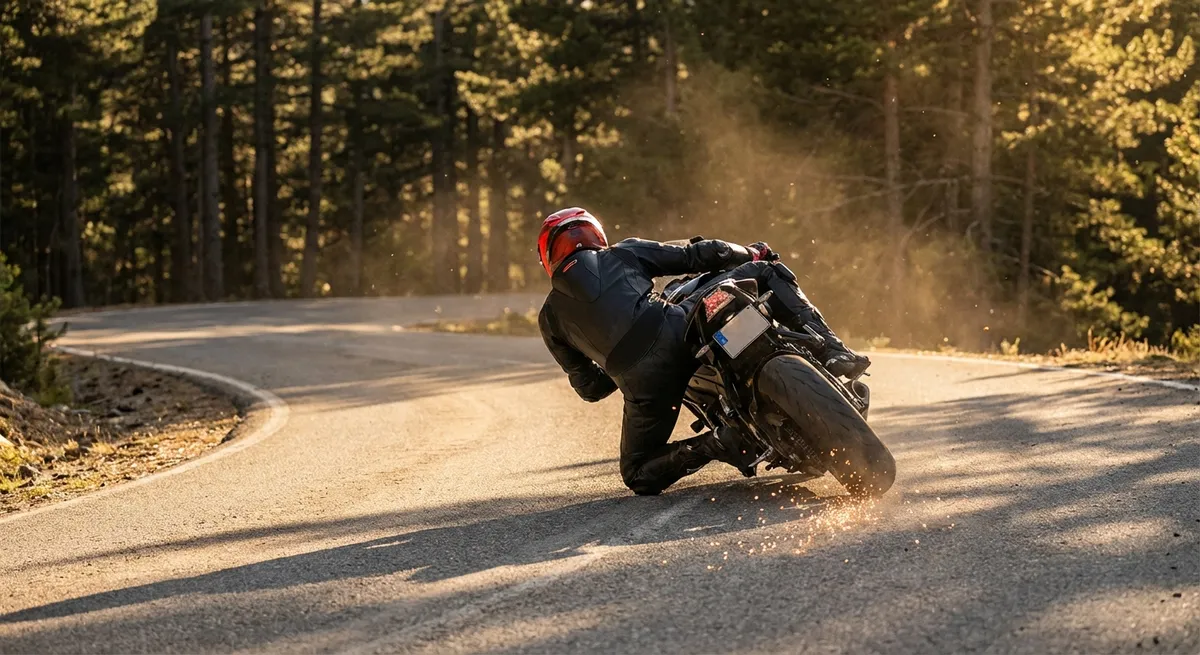
On corner exit, roll‑on throttle does more than accelerate; it unloads the front, extends the fork slightly, and transfers weight rearward. This relaxes the steering geometry and lengthens the wheelbase, making the bike more stable—but if you do it too abruptly while still leaned over, the chassis can stand up and run you wide. That’s why smooth, linear roll‑on is more than style; it directly shapes your line.
Advanced riders also exploit “maintenance throttle”—a tiny, steady opening mid‑corner that holds constant speed. This stabilizes the chassis: you keep the fork in a neutral, partially compressed zone where it can still absorb bumps and communicate grip. Creating that neutral pitch state—neither on the brakes nor accelerating hard—is a huge confidence multiplier on bumpy real‑world roads.
3. Line Crafting with Vision: Turning Sightlines into Real-Time Path Planning
“Look where you want to go” is beginner-level advice. Precision riding treats your eyes as high-bandwidth sensors feeding a real-time path‑planning algorithm. You’re not just looking through the corner; you’re continuously updating a dynamic line based on sightlines, surface, and traffic.
Start by lifting your visual horizon. Instead of staring at the patch of road just ahead of your front wheel, lock your primary focus as far down the road as conditions allow, especially at corner exit. This buys you processing time. Your peripheral vision will manage near-field corrections—road stripes, tar snakes, gravel—while your central vision shapes your macro line.
As you approach a blind corner, treat the limit of your vision as a hard constraint: your speed must be such that you can brake to zero within the distance you can clearly see and verify as clear. That’s not “riding slow”; it’s respecting the physics of stopping distance and surprise obstacles. As the corner opens and your sightline extends, you can extend throttle with it—your line literally “unfolds” as more road becomes visible.
Technically, your line should consider:
- Entry vector: Position the bike to maximize your corner radius within your lane, which reduces lean angle for a given speed.
- Apex timing: Aim for a slightly later apex on the street to preserve margin for unseen hazards and oncoming traffic.
- Exit trajectory: Keep a mental buffer zone from lane edges; don’t plan lines that only work if nothing goes wrong.
The more you treat vision as a structured input—horizon, apex, exit, mirrors, and threat scans—the more your riding feels like you’re “ahead of the bike” instead of constantly reacting.
4. Micro-Inputs at the Bars and Pegs: Steering With Load, Not Force
Modern motorcycles respond best to small but precise inputs. Big, abrupt bar movements are usually a symptom of poor preparation—wrong line, wrong speed, or delayed visual processing. Advanced riders use weight and pressure, not wrestling, to get the bike to do what they want.
Countersteering is the core: a brief, firm push on the inside bar initiates lean. But what matters at higher levels is how short, clean, and timed that input is. Apply the steering pressure decisively as you release the brakes and the front tire is loaded; that’s when the contact patch has the clearest “voice.” A vague or hesitant bar input often leads to over-correction and wobbly lines.
Your lower body is just as important. Lightly weighting the inside peg during turn initiation helps the bike fall into lean predictably, while a stable outside knee against the tank locks your torso to the chassis. This decouples your hands from your body weight so the bars only see intentional steering input, not every bump and muscle twitch.
Grip the bars lightly—just enough to control, not enough to clamp. Use your core and legs to ride out bumps and transitions, keeping your upper body relaxed. If your forearms are pumped after a spirited ride, that’s feedback that you’re using your arms as load paths instead of control surfaces.
The technical goal: a bike that can self-stabilize between your brief, deliberate inputs. You’re giving it corrections and commands, not constantly dragging it back on line.
5. Real-World Surface Reading: Calibrating for Grip on Imperfect Roads
Race tracks are curated: consistent asphalt, predictable camber, controlled run‑off. The street isn’t. Technical street riding is as much about reading the medium as it is about perfecting technique. Your ability to infer grip from limited information is a major performance and safety skill.
Start with macro indicators: pavement color, texture, and uniformity. Dark, shiny surfaces often signal polished asphalt or contamination (oil, coolant, diesel). Light, rough, or slightly noisy surfaces usually mean higher micro‑texture and better mechanical keying for the rubber. Edges where new asphalt meets old can create step changes in grip and camber—treat those transitions as potential instability zones.
Thermal conditions matter too. Cold tires and cold pavement have significantly less friction, especially on performance compounds designed for higher operating temperatures. On a chilly morning, build heat progressively with gentle acceleration, moderate braking, and avoiding hard lean angles for the first several miles. After rain, painted lines, metal covers, and smooth concrete can be treacherously slick even once the main asphalt has reasonable grip.
Use low-risk probes to “sample” traction. A slightly firmer brake squeeze in a straight line will tell you if ABS intervenes earlier than expected. A small, progressive roll‑on at modest lean informs you how quickly the rear starts to squirm. You’re essentially running micro-experiments, learning that particular road and condition before you commit to higher loads.
The disciplined mindset: assume grip is unknown until proven. Then increase loads gradually while continuously validating your assumptions with what the bike reports back through bars, pegs, and seat. Over time, this builds a deep internal library of “surface → feedback → traction” mappings that makes you both quicker and far harder to surprise.
Conclusion
Riding at a high level isn’t about being fearless; it’s about being exact. When you start treating grip as a managed resource, throttle and brake as geometry tools, vision as a planning system, controls as precision interfaces, and road surfaces as an engineering problem, the whole experience changes. Your riding becomes calmer, yet faster. More analytical, yet more immersive.
None of these five skills require a new bike, a closed course, or heroics. They require intention: specific things to practice on every ride, in every corner, under every condition. The payoff isn’t just cleaner lines and higher corner speeds—it’s the deep satisfaction of knowing you’re not just along for the ride. You’re running the system.
Sources
- [MSF – Motorcycle Safety Foundation: Street Strategies](https://www.msf-usa.org/street-strategies.aspx) – Practical guidance on vision, lane positioning, and risk management for street riders.
- [NHTSA – Motorcycle Safety](https://www.nhtsa.gov/road-safety/motorcycle-safety) – U.S. government data and recommendations on motorcycle crash factors and safe riding practices.
- [RideApart – The Traction Circle Explained](https://www.rideapart.com/news/254018/how-it-works-the-traction-circle/) – Clear explanation of the traction circle concept and how braking, turning, and acceleration share available grip.
- [Öhlins Motorcycle Suspension Basics](https://www.ohlins.com/products/motorcycle/) – Technical information on suspension behavior, weight transfer, and chassis dynamics from a major suspension manufacturer.
- [California Superbike School – Technical Articles](https://superbikeschool.com/articles/) – In-depth riding theory on throttle control, vision, and line selection derived from performance riding instruction.
Key Takeaway
The most important thing to remember from this article is that this information can change how you think about Riding Tips.